Fair Use Blog

“Sunday Schools That Teach Children Anarchy,” from the New York Times (May 8, 1910)

Here's some more on mass-media reception of Anarchism during the early 20th century: a strange little piece from the Sunday New York Times magazine from May 8, 1910, on Anarchist Sunday schools in New York, focusing on the Ferrer Sunday School taught by Alexander Berkman. The Sunday schools were part of the large network of schools, cultural spaces and other institutions organized by Anarchists in large cities like New York during the early 20th century. (Like most Anarchistic educational projects, the Sundays were closely associated with the Modern School Movement and the thought of Francisco Ferrer). Either of the writer of the article, or his editor, couldn't quite seem to decide whether they wanted this story to be a straight interview of Berkman and a description of how the Sunday Schools were operated, or whether they wanted another cookie-cutter Anarchist-menace scare story.
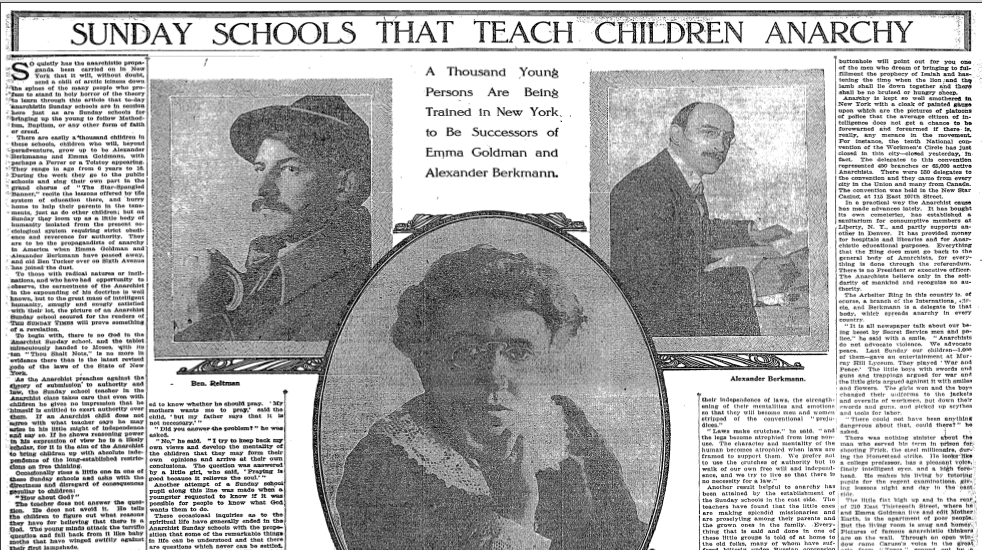
SUNDAY SCHOOLS THAT TEACH CHILDREN ANARCHY

A Thousand Young Persons Are Being Trained in New York to Be Successors of Emma Goldman and Alexander Berkman.

So quietly has the anarchistic propaganda been carried on in New York that it will, without doubt, send a chill of arctic iciness down the spines of the many people who profess to stand in holy horror of the theory to learn through this article that to-day anarchistic Sunday schools are in session here just as are Sunday schools for bringing up the young to follow Methodism, Baptism, or any other form of faith or creed.

>

There are easily a thousand children in these schools, children who will, beyond peradventure, grow up to be Alexander Berkmanns and Emma Goldmans, with perhaps a Ferrer or a Tolstoy appearing. They range in age from 6 years to 16. During the week they go to the public schools and sing their own part in the grand chorus of "The Star-Spangled Banner," recite the lessons offered by the system of education there, and hurry home to help their parents in the tenements, just as do other children; but on Sunday they loom up as a little body of humanity isolated from the present sociological system requiring strict obedience and reverence for authority. They are to be the propagandists of anarchy in America when Emma Goldman and Alexander Berkmann have passed away, and old Ben Tucker over on Sixth Avenue has joined the dust.

To those with radical natures or inclinations, and who have had opportunity to observe, the earnestness of the Anarchist in the expounding of his doctrine is well known, but to the great mass of intelligent humanity, smugly and snugly satisfied with their lot, the picture of an Anarchist Sunday school secured for readers of The Sunday Times will prove something of a revelation.

To begin with, there is no God in the Anarchist Sunday school, and the tablet miraculously handed to Moses, with its ten Thou Shalt Nots, is no more in evidence there than is the latest revised code of the laws of the State of New York.

As the Anarchist preaches against the theory of submission to authority and law, the Sunday school teacher in the Anarchist class takes care that even with children he gives no impression that he himself is entitled to exert authority over them. If an Anarchist child does not agree with what teacher says he may arise in his little might of independence and say so. If he shows reasoning power in his expression of view he is a likely scholar, for it is the aim of the Anarchist to bring children up with absolute independence of the long-established restrictions on free thinking.

Occasionally rises a little one in one of these Sunday schools and asks with the directness and disregard of consequences peculiar to children:

How about God?

The teacher does not answer the question. He does not avoid it. He tells the children to figure out what reasons they have for believing that there is a God. The young minds attack the terrific question and fall back from it like baby moths that have winged swiftly against their first lampshade.

The largest of the Sunday schools is in Avenue A. It is called the Ferrer Sunday School, and was, until the killing of the Spanish philosopher, known as the Radical Sunday School. How the name was changed will prove a story that may stand out with striking novelty in the child life of New York to-day. It shall be told a little later in this article.

The Ferrer Sunday School is conducted by Alexander Berkmann. It has about eighty members and is in two classes. It meets on Sunday between 10 in the morning and noon. The youngest child is 7.

Berkmann has no laid-out system of teaching, depending on his comprehension of the psychology of the group at the time of the gathering. There are no rules. A song may be sung in chorus, a song dealing with freedom of mankind and hate for oppression. Some of the children may have learned by heart a poem or a fragment of an anarchistic argument and these provide recitations. The training of the mind anarchistically is then begun.

Berkmann, in a talk with a Times writer, in the office of Mother Earth, the Anarchist magazine, gave a sample of this teaching.

This was his talk to his Sunday school on Sabbath after the execution of Ferrer.

Once a single human being was swept from the sea to the shore of an island where there lived no human beings. There he found a great flock of sheep. He studied them and noticed that some of them were very powerfully built and finely fed. Some had even attained the strength and ferocity of wolves. But there were a great many of the sheep that were lean and worn. They were hungry and had been trampled down and hurt.

The man thought that he could so arrange it that these sheep, with little to eat and with bruises from being trampled, could be taught to care for themselves better and realize what the power of the strong and wolflike sheep had brought them to. He went among the sheep that suffered and began to point out to them what was the matter. The wolfish and strong ones heard of this and they turned upon the man and killed him.

When Berkmann finished this parable one of the children, a boy 18 years old, arose and said:

Why Mr. Berkmann, this story is just like the story of Ferrer's death.

The children were so impressed with the parable and the discussion which followed that the name of the school was then changed from the Radical Sunday School to the Ferrer Sunday School.

In the classes, said Berkmann, we generally use current events as subjects for discussion and study. For instance, one of our lessons was produced by the Hudson-Fulton Celebration in New York. The children of the east side saw a great deal of the sailors from the many men-of-war in the harbor. They saw the sailors of different nationalities entering and leaving the cafés, the best of friends, their arms about each other and acting like human brothers. The question naturally followed. Why should they be thus fond of each other and thus brotherly on land, and on sea be commanded to kill each other? They are brothers, and love each other, and there can be no fair reason for their slaying each other.

A man who had been raised in one of the old credal beliefs with care but who had come to be an agnostic in middle life once told the writer than when he realized that his religion had gone from him he felt that what he called reason had stepped into a nursery, and, like a willful bully, had gathered up the toys of a child sitting there and had destroyed them because he considered them useless. He considered the change from belief to agnosticism the tragedy of his life. The figure may be applied to thinking grown-ups easily, but it is hard to think of applying it to a child. And yet in the Anarchist Sunday school the tragedy of the destroyed toys is not infrequently enacted.

The pupil of the Anarchist Sunday school is taught to reason. The teacher only serves to direct their attention to a problem.

One child, said Berkmann, wanted to know whether he should pray. My mothers wants me to pray, said this child, but my father says that it is not necessary.

Did you answer the problem? he was asked.

No, he said. I try to keep back my own views and develop the mentality of the children that they may form their own opinions and arrive at their own conclusions. The question was answered by a little girl, who said, Praying is good because it relieves the soul.

Another attempt of a Sunday school pupil along this line was made when a youngster requested to know if it was possible for people to know what God wants them to do.

These occasional inquiries as to the spiritual life have generally ended in the Anarchist Sunday schools with the proposition that some of the remarkable things in life can be understood and that there are questions which never can be settled. The mental attitude of the children might be put in this way: We are not certain whether there are grounds for the belief that we should pray.

That, of course, leaves the question well in the field of agnosticism. The teacher of anarchy does not, with the children, declare that there is no God. Nor does he say that there is a God. The Sunday school class goes frequently to the Museum of Natural History, to Central Park, to the Zoological Gardens, and other places where, with the teacher, nature is studied.

The Ferrer Sunday school is only one of about fifteen similar schools in the greater city. Wherever the local groups of Anarchists can handle their own Sunday schools, carrying on the propaganda with literature, letters, lectures, &c., they do so without asking aid of others. When they cannot the State group helps. There is no central or superior group. Each has its own autonomy, although they all work to develop their principles of solidarity and mutual aid.

There are frequently conventions of the Sunday school teachers. Those who have classes get together and exchange experiences and ideas. In this city the Anarchists know that the fulfillment of their vision is afar, and they are already sowing their seed in the young and new fields that a generation of their kind may take hold of the propaganda when the present generation has withered and fallen.

These little Anarchists are being trained to believe in no authority. As Mr. Berkmann put it, everything is being done for them to aid them in the development of their independence of laws, the strengthening of their mentalities and emotions so that they will become men and women stripped of the conventional prejudices.

Laws make crutches, he said, and the legs become atrophied from long non-use. The character and mentality of human becomes atrophied when laws are framed to support them. We prefer not to use the crutches of authority but to walk of our own free will and independence, and we try to live so that there is no necessity for a law.

Another result helpful to anarchy has been attained by the establishment of the Sunday schools in the east side. The teachers have found that the little ones are making splendid missionaries and are proselyting among their parents and the grown ones in the family. Everything that is said and done in one of these little groups is told of at home to the old folks, many of whom have suffered bitterly under Russian oppression and who have revolution deep in their hearts. They write letters to the Anarchist teachers and get replies. They discuss the views expounded at home by their children and many of them become radicals and join the Anarchist groups.

The Anarchists also spread their propaganda by establishing little libraries which they make easily accessible to all who want to study the theory.

In the spreading of the propaganda among the children the littlest are not overlooked. There are some as young as six years of age who are getting kindergarten lessons in anarchy. One of these lessons is the lesson which preaches to a boy of health and strength at the age of six that he should not strike or abuse a boy who is not as strong as he is but should help him because he needs help. That is the very heart of the kindergarten lesson.

All of this work is done in what is called the Workmen's Circle. The Circle is the general group and is known as the Arbeiter Ring. A little white enamel badge with the letters A. R. in the buttonhole will point out for you one of the men who dream of bringing to fulfillment the prophecy of Isaiah and hastening the time when the lion and the lamb shall lie down together and there shall be no bruised or hungry sheep.

Anarchy is kept so well smothered in New York with a cloak of painted gauze upon which are the pictures of platoons of police that the average citizen of intelligence does not get a chance to be forewarned and forearmed if there is, really, any menace in the movement. For instance, the tenth National convention of the Workmen's Circle has just closed in this city--closed yesterday, in fact. The delegates to this convention represented 450 branches or 65,000 active Anarchists. There were 550 delegates to the convention and they came from every city in the Union and many from Canada. The convention was held in the New Star Casino, at 115 East 107th Street.

In a practical way the Anarchist cause has made advances lately. It has bought its own cemetaries, has established a sanitarium for consumptive members at Liberty, N. Y., and partly supports another in Denver. It has provided money for hospitals and libraries for Anarchistic educational purposes. Everything that the Ring does must go back to the general body of Anarchists, for everything is done through the referendum. There is no President or executive officer. The Anarchists believe only in the solidarity of mankind and recognize no authority.

The Arbeiter Ring in this country is, of course, a branch of the International Circle, and Berkmann is a delegate to that body, which spreads anarchy in every country.

It is all newspaper talk about our being beset by Secret Service men and police, he said with a smile. Anarchists do not advocate violence. We advocate peace. Last Sunday our children--1,000 of them--gave an entertainment at Murray Hill Lyceum. They played War and Peace. The little boys with swords and guns and trappings argued for war and the little girls argued against it with smiles and flowers. The girls won and the boys changed their uniforms to the jackets and overalls of workmen, put down their swords and guns, and picked up scythes and tools for labor.

There could not have been anything dangerous about that, could there? he asked.

There was nothing sinister about the man who served his term in prison for shooting Frick, the steel millionaire, during the Homestead strike. He looks like a college professor, has a pleasant voice, finely intelligent eyes, and a high forehead. He makes his living by tutoring pupils for the regent examinations, giving lessons night and day in the east side.

The little flat high up and in the rear of 210 East Thirteenth Street, where he and Emma Goldman live and edit Mother Earth, is the apartment of poor people. But the living room is snug and homey. Pictures of famous anarchistic thinkers are on the wall. Through an open window came Caruso's voice in the great aria from Tosca, ground out by a phonograph, as Berkmann talked with the Times man. It was a warm combination, but the night was warm, and we were glad for the breeze that swept the little place however burdened it might be.

We teach no ism, he said, harking back to the Sunday schools. Our aim is to develop character and mentality in the child. We try to make them think, criticise, and feel.

We want their emotional and intellectual natures developed. We want to make them men and women absolutely free of the old restrictions. We hope that they will grow up with the spirit of solidarity and co-operation in them. We try to teach them that in and out of school.

We try to teach them ethical right and reason. Our Radical Boys' Literary Club, boys about 13 or 14 years old, hold meetings after school, and they run their organization just as the grown people do. They have advanced to where they need no help from their elders.

Among the grown Anarchists the cause is kept warm by fervid preachings in their publications. These are the weekly paper Frei Arbiter Stimme, with a circulation of 12,000; Mother Earth, with a circulation of 6,000; Freiheit, with 5,000 circulation, and Voine Listy, a Bohemian paper, with a circulation of 4,500.

There are nine large groups of the grown Anarchists in New York. These have regular meetings, and conduct the propaganda with lectures, debates, &c.

In the district from Fourteenth Street to the Battery east of Broadway are 850,000 people living. Here beats the heart of anarchy. Nearly all of these people are foreign born, the native born element being insignificant in its percentage.

Forsyth Street, Chrystie, Cannon, Pitt, Columbia, Second Streets all have buildings in which are tiny halls that may be rented for a dollar or two for a wedding, a banquet, a lodge meeting, or a group meeting of Anarchists.

The man who lives awhile in this teeming corner of Manhattan does not take long to find out where he can go and hear all the anarchy he wants expounded. The writer once met in one of these little halls S. Yanofsky, the editor of the Frei Arbiter Stimme. A man with dreamy eyes, pointed beard, and nervous energy, he seemed to be looked up to as little short of a god by a clump of young men and women who were wating for him.

Yanofsky and Berkmann were both rounded up by the police after the Silverstein bomb explosion in Union Square in 1908, and as there was nothing against either of them nothing came of the call to Police Headquarters. Yanofsky, when asked by the writer what he thought of Silverstein's act, replied:

The man who commits a violent deed, if he is not mad, is desperate. Violence never did any good for anarchy. All government is a form of violence. Suppose Silverstein had suffered personally--and his act was that of an impatient and ignorant man--what did he accomplish? He only made himself dead and gave the chance to the enemies of anarchy to spread their calumnies. He only helped them to kill of the chances of gaining liberty.

Berkmann was a little clearer on the matter of violence and anarchy.

If a Republican or Democrat should throw a bomb or kill another, he said, the Republican Party or the Democratic Party would not be blamed for it. When an Anarchist does a thing like that we frankly say that anarchy did not inspire it, but that conditions of inequality and injustice caused the crime. To stop the crime, stop the cause. Anarchy is for justice and freedom. It cannot be blamed for individual acts of violence.

Among the favorite east side speakers for anarchy, besides Yanofsky and Berkmann, is Dr. Ben Reitman, whose method is to stir up the hearers with fiery sentences depicting the wrongs resulting from the present order of things. He with the others believes that anarchy is gathering strength, and will continue to gather it and will prove a living force in the slow movement of society through the ages.

Max Nettlau, Anarchism: Communist or Individualist?—Both

Now available thanks to Shawn P. Wilbur at Two-Gun Mutualism & the Golden Rule:


ANARCHISM: COMMUNIST OR INDIVIDUALIST?—BOTH

By Max Nettlau.

ANARCHISM is no longer young, and it may be time to ask ourselves why, with all the energy devoted to its propaganda, it does not spread more rapidly. For even where local activity is strongest, the results are limited, whilst immense spheres are as yet hardly touched by any propaganda at all. In discussing this question, I will not deal with the problem of Syndicalism, which, by absorbing so much of Anarchist activity and sympathies, cannot by that very fact be considered to advance the cause of Anarchism proper, whatever its other merits may be. I will also try not to repeat what I put forward in other articles in years gone by as possible means of increasing the activity of Anarchists. As my advice was not heeded, it cannot, in any case, be considered to have hampered the progress of our ideas.

I will consider the theories of Anarchism only; and here I have been struck for a long time by the contrast between the largeness of the aims of Anarchism—the greatest possible realization of freedom and well-being for all—and the narrowness, so to speak, of the economic program of Anarchism, be it Individualist or Communist. I am inclined to think that the feeling of the inadequacy of this economic basis—exclusive Communism or exclusive Individualism, according to the school—hinders people from acquiring practical confidence in Anarchism, the general aims of which appeal as a beautiful ideal to many. I feel myself that neither Communism nor Individualism, if it became the sole economic form, would realize freedom, which always demands a choice of ways, a plurality of possibilities. I know that Communists, when asked pointedly, will say that they should have no objection to Individualists who wished to live in their own way without creating new monopolies or authority, and vice versa. But this is seldom said in a really open and friendly way; both sections are far too much convinced that freedom is only possible if their particular scheme is carried out. I quite admit that there are Communists and Individualists to whom their respective doctrines, and these alone, give complete satisfaction and leave no problem unsolved (in their opinion); these would not be interfered with, in any case, in their lifelong constancy to one economic ideal. But they must not imagine that all people are constituted after their model and likely to come round to their views or remain "unreclaimed" adversaries on whom no sympathy is to be wasted. Let them but look on real life, which is bearable at all only by being varied and differentiated, in spite of all official uniformity. We all see the survivals of earlier Communism, the manifold workings of present-day solidarity, from which new forms of future Communism may develop—all this in the teeth of the cut-throat capitalist Individualism which predominates. But this miserable bourgeois Individualism, if it created a desire for solidarity, leading to Communism, certainly also created a desire for a genuine, free, unselfish Individualism, where freedom of action would no longer be misused to crush the weaker and to form monopolies, as to-day.

Neither Communism nor Individualism will ever disappear; and if by some mass action the foundations of some rough form of Communism were laid, Individualism would grow stronger than ever in opposition to this. Whenever a uniform system prevails, Anarchists, if they have their ideas at heart, will go ahead of it and never permit themselves to become fossilised upholders of a given system, be it that of the purest Communism.

Will they, then, be always dissatisfied, always struggling, never enjoying rest? They might feel at ease in a state of society where all economic possibilities had full scope, and then their energy might be applied to peaceful emulation and no longer to continuous struggle and demolition. This desirable state of things could be prepared from now, if it were once for all frankly understood among Anarchists that both Communism and Individualism are equally important, equally permanent; and that the exclusive predominance of either of them would be the greatest misfortune that could befall mankind. From isolation we take refuge in solidarity, from too much society we seek relief in isolation: both solidarity and isolation are, each at the right moment, freedom and help to us. All human life vibrates between these two poles in endless varieties of oscillations.

Let me imagine myself for a moment living in a free society. I should certainly have different occupations, manual and mental, requiring strength or skill. It would be very monotonous if the three or four groups with whom I would work (for I hope there will be no Syndicates then!) would be organized on exactly the same lines; I rather think that different degrees or forms of Communism will prevail in them. But might I not become tired of this, and wish for a spell of relative isolation, of Individualism? So I might turn to one of the many possible forms of "equal exchange" Individualism. Perhaps people will do one thing when they are young and another thing when they grow older. Those who are but indifferent workers may continue with their groups; those who are efficient will lose patience at always working with beginners and will go ahead by themselves, unless a very altruist disposition makes it a pleasure to them to act as teachers or advisers to younger people. I also think that at the beginning I should adopt Communism with friends and Individualism with strangers, and shape my future life according to experience. Thus, a free and easy change from one variety of Communism to another, thence to any variety of Individualism, and so on, would be the most obvious and elementary thing in a really free society; and if any group of people tried to check this, to make one system predominant, they would be as bitterly fought as revolutionists fight the present system.

Why, then, was Anarchism cut up into the two hostile sections of Communists and Individualists? I believe the ordinary factor of human shortcomings, from which nobody is exempt, accounts for this. It is quite natural that Communism should appeal more to some, Individualism to others. So each section would work out their economic hypothesis with full ardour and conviction, and by-and-by, strengthened in their belief by opposition, consider it the only solution, and remain faithful to it in the face of all. Hence the Individualist theories for about a century, the Collectivist and Communist theories for about fifty years, acquired a degree of settledness, certitude, apparent permanency, which they never ought to have assumed, for stagnation—this is the word—is the death of progress. Hardly any effort was made in favor of dropping the differences of schools; thus both had full freedom to grow, to become generalized, if they could. With what result?

Neither of them could vanquish the other. Wherever Communists are, Individualists will originate from their very midst; whilst no Individualist wave can overthrow the Communist strongholds. Whilst here aversion or enmity exists between people who are so near each other, we see Communist Anarchism almost effacing itself before Syndicalism, no longer scorning compromise by accepting more or less the Syndicalist solution as an inevitable stepping-stone. On the other hand, we see Individualists almost relapse into bourgeois fallacies —all this at a time when the misdeeds of authority, the growth of State encroachments, present a better occasion and a wider field than ever for real and outspoken Anarchist propaganda.

It has come to this, that at the French Communist Anarchist Congress held in Paris last year Individualism was regularly stigmatised and placed outside the pale of Anarchism by a formal resolution. If ever an international Anarchist Congress was held on these lines, endorsing a similar attitude, I should say good-bye to all hopes placed in this kind of sectarian Anarchism.

By this I intend neither to defend nor to combat Communism or Individualism. Personally, I see much good in Communism; but the idea of seeing it generalized makes me protest. I should not like to pledge my own future beforehand, much less that of anybody else. The Question remains entirely open for me; experience will show which of the extreme and of the many intermediate possibilities will be the best on each occasion, at each time. Anarchism is too dear to me that I should care to see it tied to an economic hypothesis, however plausible it may look to-day. Unique solutions will never do, and whilst everybody is free to believe in and to propagate his own cherished ideas, he ought not to feel it right to spread them except in the form of the merest hypothesis, and every one knows that the literature of Communist and Individualist Anarchism is far from keeping within these limits; we have all sinned in this respect.

In the above I have used the terms "Communist" and "Individualist" in a general way, wishing to show the useless and disastrous character of sectional exclusiveness among Anarchists. If any Individualists have said or done absurd things (are Communists impeccable?), to show these up would not mean to refute me. All I want is to see all those who revolt against authority work on lines of general solidarity instead of being divided into little chapels because each one is convinced he possesses a correct economic solution of the social problem. To fight authority in the capitalist system and in the coming system of State Socialism, or Syndicalism, or of both, or all the three combined, an immense wave of real Anarchist feeling is wanted, before ever the question of economic remedies comes in. Only recognize this, and a large sphere of solidarity will be created, which will make Communist Anarchism stand stronger and shine brighter before the world than it does now.

* * *

P. S.—Since writing the above I have found an early French Anarchist pamphlet, from which I translate the following:

"Thus, those who feel so inclined will unite for common life, duties, and work, whilst those to whom the slightest act of submission would give umbrage will remain individually independent. The real principle [of Anarchism] is this far from demanding integral Communism. But it is evident that for the benefit of certain kinds of work many producers will unite, enjoying the advantages of co-operation. But I say once more, Communism will never be a fundamental [meaning unique and obligatory] principle, on account of the diversity of our intellectual faculties, of our needs, and of our will."

This quotation (the words in brackets are mine) is taken from p. 72 of what may be one of the scarcest Anarchist publications, on which my eye lit on a bookstall ten days after writing the above article: "Philosophie de l'lnsoumission ou Pardon a Cain," par Felix P. (New York, 1854, iv. 74 pp., 12mo)—that is, "Philosophy of Non-Submission," the author's term for Anarchy. I do not know who Felix P. was; apparently one of the few French Socialists, like Dejacque, Bellegarrigue, Coeurderoy, and Claude Pelletier, whom the lessons of 1848 and other experiences caused to make a bold step forward and arrive at Anarchism by various ways and independent of Proudhon. In the passage quoted he put things into a nutshell, leaving an even balance between the claims of Communism and Individualism. This is exactly what I feel in 1914, sixty years after. The personal predilections of everybody would remain unchanged and unhurt, but exclusivism would be banished, the two vital principles of life allied instead of looking askance at each other.

[Source: Mother Earth. 9, 5 (July 1914) 170-175.]

Read the whole thing at Two-Gun Mutualism & the Golden Rule.

Now online: Full text of two more issues of MOTHER EARTH — Vol. VI., No. 11 (January, 1912) and Vol. VII., No. 12 (February, 1913)

Three months ago, I happily announced that the complete text of the November 1914 issue of Mother Earth had been made available at the Fair Use Repository. To-day, I'm pleased to follow up that announcement -- with the announcement that the Fair Use Repository now features the complete text of three issues of Mother Earth. The two issues recently made available are:

Mother Earth, Vol. VI., No. 11 (January, 1912)

This issue is mainly occupied with the arts and revolution. It leads off with Blaming the Fester, a poem by Rebekah E. Raney. The New Year is a fundraising appeal on the occasion of Christmastime and the New Year, while Observation and Comments includes short reports on current events -- delays in the publication of Prison Memoirs of an Anarchist, the trial of the bosses who'd locked workers into the the Triangle Shirtwaist Factory, strikes and conspiracy trials around the country, Big Bill Haywood's feud with the Socialist Party of America, and more.

Paul Orleneff offers a celebratory review (unsigned, but probably written by Emma Goldman) of the actor's performances in New York. A Review of the Year, by Harry Kelly, and the continuation of a serialized article by Voltairine de Cleyre on The Mexican Revolution, discuss revolutions and uprisings flaring up throughout the world in 1911. In The Right to Live M. B. argues that political rights are empty without workers' material control over the means of their own survival (the organization of society in a manner to insure to each the material basis of life and make it as self-evident as breathing). Max Baginski reviews the Autobiography of Richard Wagner, taking it as evidence of the old commonplace that one can be a great artist and yet small as a man, and concluding that The suffocating dependence of artistic production upon wealth and patronage should cause the true artist--who is not content to produce mere market ware--to turn relentlessly rebel against the existing standards, to become a communist. ... The dream that Wagner once dreamed in Art and Revolution will some day be realized by the people,--nor will they need the aid of philosopher or king. The issue concludes with a continuation of the serialized article Economy as Viewed by An Anarchist by C. L. James, on the historical emergence of the bourgeois system and its connections with past forms of economic hierarchy, as well as with the subjection of women.

Mother Earth, Vol. VII., No. 12 (February, 1913)

The February 1913 issue has a few things to say about the State and a lot to say about the union struggle, Syndicalism, and government repression of striking workers. The issue leads off with To Our Friends, an appeal for readers to help widen the circulation of the journal, followed by another monthly instalment of short reports in Observations and Comments -- including remarks on the inauguration of Woodrow Wilson, the futility of appeals to the law, the advantages of direct action, new strike arbitration laws in New Zealand (among the first such labor laws in the world), the legal repression of Anarchists in the U.S., police scandals in Denver, and the incorporation of the Rockefeller fund.

James Montgomery's The Black Hundreds of Plutocracy and Government discusses the use of private security forces, with tacit or explicit government approval, to inflict large-scale violence on striking workers. The New Idol, a translation of an excerpt from Friedrich Nietzsche's Also Sprach Zarathustra, declares the State the coldest of all cold monsters. Theodor Johnson's Help Save These Comrades! reports on the case of a group of striking Swedish dock workers, who had been sentenced to life imprisonment for a bomb plot, and calls for international solidarity to get their sentences commuted. Making a Strike a Crime government's assault on the rights to picket and speak freely, with the imprisonment of dozens of peaceful picketers and speakers in Little Falls, New York during a textile mill strike. Intolerance in the Union comments on growing regimentation and bureaucratic control within conservative trade unions and reprints a letter from a comrade discussing his objections to a corrupt bargain made by his union's labor bosses, which resulted in his being persecuted by the labor bosses and expelled from the union. Syndicalism: Its Theory and Practice concludes a long article by Emma Goldman on state-free Syndicalist organizing, with a discussion of Syndicalism's characteristic methods -- Direct Action, Sabotage, and the General Strike. The issue concludes with Anarchist writer and teacher Bayard Boyesen's review of Alexander Berkman's Prison Memoirs of an Anarchist, and with an announcement of dates for Emma Goldman's lecture tour through the Midwest.

Onward

These issues complete a set of three reprinted issues of Mother Earth that I picked up from a table at the Bay Area Anarchist Bookfair. I'd very much like to make available more of Mother Earth's print run online. A number of partial and complete issues -- mostly earlier issues -- are currently available from The Anarchy Archives, and a fair amount is available for browsing in Google Books. But I'd like to liberate the latter from the Google Books's inaccurate automatic markup, often capricious behavior, and hypertext-unfriendly environment. And in any case, there are a lot of gaps to fill in. If you have any suggestions on issues to prioritize, or good lines on copies to be transcribed, please feel free to leave a comment here, or contact me with the details.

Read, cite, and enjoy!

Now online: Five articles from MOTHER EARTH Vol. VI., No. 11 (January, 1912)

I'm happy to announce that the Fair Use Repository now features five complete articles from the January, 1912 issue of Mother Earth:

  • Blaming the Fester, a poem by Rebekah E. Raney
  • Observations and Comments, a regular feature in many issues of Mother Earth; the format is much like Tucker's On Picket Duty -- a sort of ongoing polemical Anarchist three-dot column that ran near the beginning of each issue.

  • A Review of the Year by Harry Kelly -- an overview and review of the upsurge in popular uprisings, general strikes and Anarchist revolutionary activity that broke out throughout the world in 1911.

  • The Mexican Revolution (Continued), by Voltairine de Cleyre, previously published separately here in the Fair Use Blog -- part of a serialized discussion of the uprising against the Madero provisional government in Mexico, with discussions of the crimes of the Mexican government against the Yaquis, the revolution in the North (Baja California, Sinaloa, Chihuahua, and Sonora) and South (Morelos, Chiapas, Tabasco, San Luis Potosi, and Yucatan), the victories of Emiliano Zapata, and the extreme importance of the peasants' efforts to ignore the machinery of paper land-holding and reclaim the land they work.

  • The Right to Live by M. B., on the hollowness and sham of political rights and the pivotal importance of the natural right to possess the means of existence.

These are the first set of articles to be put online from Mother Earth Volume VI. Number 11; more will come soon. I believe that the complete issue should be available online by the end of the next week.

Read, cite, and enjoy!

Now online: full text of MOTHER EARTH IX.9 (November, 1914)

I'm happy to follow up our earlier announcement with an announcement that the Fair Use Repository now features the complete text of all the articles from the November 1914 issue of Mother Earth.

Most of the issue is occupied with Anarchist responses to, and debate over, the outbreak of World War I: Kropotkin on the Present War reprints Peter Kropotkin's letter to Gustav Steffen, supporting the French government's fighting in World War I; Alexander Berkman's In Reply to Kropotkin calls Kropotkin to task and argues that Anarchists should oppose all sides in all government wars. Goldman and Berkman followed this argument with a reprint of Chapter I of Kropotkin's own Wars and Capitalism, written in 1913, in which Kropotkin had skewered the French government's motives and argued that wars were the product of imperial capitalism and that the reason for modern war is always the competition for markets and the right to exploit nations backward in industry. In addition to the exchange over Kropotkin's letter, this issue also features That Economic Army, an article by Guy A. Aldred originally printed in the London Spur, which traces how the state and capital, during wartime, deformed the entire economy to draw not only men, but entire industries, into collaboration with the war machine, out of economic interest.

Alongside the discussion of the war, Vol. IX. No. 9 also features:

  • The Persecution of Margaret Sanger by Harry Breckenridge, a defense and a call for working-class solidarity with Margaret Sanger and the Woman Rebel, then facing Federal prosecution for obscenity (for distributing articles on birth control and scientific information about sexual health).

  • Black Friday of 1887 by M. B., a slashing review of the Socialist journalist Charles Edward Russell’s discussion of Haymarket in his memoirs, and a commemoration of the Haymarket martyrs hanged 11 November 1887.

  • My Lecture Tour by Alexander Berkman, an announcement of Berkman's upcoming lecture tour of the Midwest, with talks on War--At Home and Abroad, Unemployment and War, War and Culture, The War of the Classes, Is Labor Justified in Using Violence? Crime--In and Out of Prison, and The Psychology of Crime and Prisons.

  • Emma Goldman Dates by Emma Goldman, an announcement of Emma Goldman's upcoming lectures in Chicago on anti-militarism, Anarchism, and a lecture series on drama , as well as announcing dates for upcoming lecture series elsewhere in the Midwest.

I'm happy to have this issue of Mother Earth available in full. More issues should be coming soon.

Read, cite, and enjoy!

Now online: four articles from MOTHER EARTH (November, 1914): Anarchist responses to World War I and a commemoration of the Haymarket martyrs

I'm happy to announce that the Fair Use Repository now features four complete articles from the November, 1914 issue of Mother Earth:

  • Kropotkin on the Present War by Peter Kropotkin -- a reprint of Kropotkin's letter supporting the French government's fighting in World War I;

  • In Reply to Kropotkin by Alexander Berkman -- in which Berkman calls Kropotkin to task, argues that the international working class has no real stake in bosses' wars, and calls on Anarchists to oppose all sides in all government wars.

  • Wars and Capitalism (Chapter I) by Peter Kropotkin, a reprint of Kropotkin's earlier analysis of war, from 1913, in which he argued that the reason for modern war is always the competition for markets and the right to exploit nations backward in industry.

  • Black Friday of 1887, by M. B., a slashing review of the Socialist journalist Charles Edward Russell's discussion of Haymarket in his memoirs, and a commemoration of the Haymarket martyrs hanged 11 November 1887.

These are the first set of articles to be put online from Mother Earth Volume IX, Number 9; more will come soon. I believe that the complete issue should be available online by the end of the week.

Read, cite, and enjoy!

“The Mexican Revolution (Continuation),” by Voltairine de Cleyre (1912)

This article on the progress of the Mexican Revolution, by the American Anarchist writer and speaker Voltairine de Cleyre, appeared in Mother Earth, Vol. VI No. 11 (January, 1912).

This law of unappropriated lands, says Wm. Archer, has covered the country with Naboth's Vineyards. I think it would require a Biblical prophet to describe the abomination of desolation it has made.

It was to become lords of this desolution that the men who play the game,--landlords who are at the same time governors and magistrates, enterprising capitalists seeking investments--connived at the iniquities of the Diaz régime; I will go further and say devised them.

The Madero family alone owns some 8,000 square miles of territory; more than the entire state of New Jersey. The Terrazas family, in the state of Chihuahua, owns 25,000 square miles; rather more than the entire state of West Virginia, nearly one-half the size of Illinois. What was the plantation owning of our southern states in chattel slavery days compared with this? And the peon's share for his toil upon these great estates is hardly more than was the chattel slave's--wretched housing, wretched food, and wretched clothing.

It is to slaves like these that Madero appeals to be frugal.

It is of men who have thus been disinherited that our complacent fellow citizens of Anglo-Saxon origin say: Mexicans! What do you know about Mexicans? their whole idea of life is to lean up against a fence and smoke cigarettes. And pray what idea of life should a people have whose means of life in their own way have been taken from them? Should they be so mighty anxious to convert their strength into wealth for some other man to loll in?

It reminds me very much of the answer given by a negro employee on the works at Fortress Monroe to a companion of mine who questioned him good-humoredly on his easy idleness when the foreman's back was turned: Ah ain't goin' to do no white man's work, fo' Ah don' get no white man's pay.

But for the Yaquis, there was worse than this. Not only were their lands seized, but they were ordered, a few years since, to be deported to Yucatan. Now Sonora, as I said, is a northern state, and Yucatan one of the southernmost. Yucatan hemp is famous, and so is Yucatan fever, and Yucatan slavery on the hemp plantations. It was to that fever and that slavery that the Yaquis were deported, in droves of hundreds at a time, men, women and children--droves like cattle droves, driven and beaten like cattle. They died there, like flies, as it was meant they should. Sonora became desolated of her rebellious people, and the land became pacific in the hands of the new landowners. Too pacific in spots. They had not left people enough to reap the harvests.

Then the government suspended the deportation act, but with the provision that for every crime committed by a Yaqui, five hundred of his people be deported. This statement is made in Madero's own book.

Now what in all conscience would any one with decent human feeling expect a Yaqui to do? Fight? As long as there was powder and bullet to be begged, borrowed, or stolen; as long as there is a garden to plunder, or a hole in the hills to hide in!

When the revolution burst out, the Yaquis and other Indian people said to the revolutionists: Promise us our lands back, and we will fight with you. And they are keeping their word magnificently. All during the summer they have kept up the warfare. Early in September, the Chihuahua papers reported a band of 1,000 Yaquis in Sonora about to attack El Anil; a week later 500 Yaquis had seized the former quarters of the federal troops at Pitahaya. This week it is reported that federal troops are dispatched to Ponoitlan, a town in Jalisco, to quell the Indians who have risen in revolt again because their delusion that the Maderist government was to restore their land has been dispelled. Like reports from Sinaloa. In the terrible state of Yucatan, the Mayas are in active rebellion; the reports say that The authorities and leading citizens of various towns have been seized by the malcontents and put in prison. What is more interesting is, that the peons have seized not only the leading citizens, but still more to the purpose have seized the plantations parceled them, and are already gathering the crops for themselves.

Of course, it is not the pure Indians alone who form the peon class of Mexico. Rather more than double the number of Indians are mixed breeds; that is, about 8,000,000, leaving less than 3,000,000 of pure white stock. The mestiza, or mixed breed population, have followed the communistic instincts and customs of their Indian forbears; while from the Latin side of their make-up, they have certain tendencies which work well together with their Indian hatred of authority.

The mestiza, as well as the Indians, are mostly ignorant in book knowledge, only about sixteen per cent. of the whole population of Mexico being able to read and write. It was not within the program of the civilizing regime to spend money in putting the weapon of learning in the people's hands. But to conclude that people are necessarily unintelligent because they are illiterate, is in itself a rather unintelligent proceeding.

Moreover, a people habituated to the communal customs of an ancient agricultural life do not need books or papers to tell them that the soil is the source of wealth, and they must get back to the land!--even if their intelligence is limited.

Accordingly, they have got back to the land. In the state of Morelos, which is a small, south-central state, but a very important one,--being next to the Federal District, and by consequence to the City of Mexico,--there has been a remarkable land revolution. General Zapata, whose name has figured elusively in newspaper reports now as having made peace with Madero, then as breaking faith, next wounded and killed, and again resurrected and in hiding, then anew on the war path and proclaimed by the provisional government the arch-rebel who must surrender unconditionally and be tried by court martial; who has seized the strategic points on both the railroads running through Morelos, and who just a few days ago broke into the federal district, sacked a town, fought successfully at two or three points with the federals, blew out two railroad briadges and so frightened the deputies in Mexico City that they are all clamoring for all kinds of action; this Zapata, the fires of whose military camps are springing up now in Guerrero, Oaxaca and Pueblo as well, is an Indian with a long score to pay, and all an Indian's satisfaction in paying it. He appears to be a fighter of the style of our revolutionary Marion and Sumter; the country in which he is operating is mountainous and guerrilla bands are exceedingly difficult of capture; even when they are defeated, they have usually succeeded in inflicting more damage than they have received, and they always get away.

Zapata has divided up the great estates of Morelos from end to end, telling the peasants to take possession. They have done so. They are in possession, and have already harvested their crops. (Morelos has a population of some 212,000.)

In Pueblo reports in September told us that eighty leading citizens had waited on the governor to protest against the taking possession of the land by the peasantry. The troops were deserting, taking horses and arms with them.

It is they, no doubt, who are now fighting with Zapata. In Chihuahua, one of the largest states, prisons have been thrown open and the prisoners recruited as rebels; a great hacienda was attacked and the horses run off, whereupon the peons rose and joined the attacking party.

In Sinaloa, a rich northern state,--famous in the southwestern United States some years ago as the field of a great co-operative experiment in which Mr. C.B. Hoffman, one of the former editors of the Chicago Daily Socialist, was a leading spirit,--this week's paper reports that the former revolutionary general Juan Banderas is heading an insurrection second in importance only to that lead by Zapata.

In the southern border state of Chiapas, the taxes in many places could not be collected. Last week news items said that the present government had sent General Paz there, with federal troops, to remedy that state of affairs. In Tabasco, the peons refused to harvest the crops for their masters; let us hope they have imitated their brothers in Morelos and gathered them for themselves.

The Maderists have announced that a stiff repressive campaign will be inaugurated at once; if we are to believe the papers, we are to believe Madero guilty of the imbecility of saying, Five days after my inauguration the rebellion will be crushed. Just why the crushing has to wait till five days after the inauguration does not appear. I conceive there must have been some snickering among the reactionary deputies, if such an announcement was really made; and some astonished query among his followers.

What are we to conclude from all these reports? That the Mexican people are satisfied? That it's all good and settled? What should we think if we read that the people, not of Lower but of Upper, California had turned out the ranch owners, had started to gather in the field products for themselves, and that the Secretary of War had sent U.S. troops to attack some thousands of armed men (Zapata has had 3,000 under arms the whole summer and that force is now greatly increased) who were defending that expropriation? If we read that in the state of Illinois that farmers had driven off the tax-collector? that the coast states were talking of secession and forming an independent combination? that in Pennsylvania a division of the federal army was to be dispatched to overpower a rebel force of fifteen hundred armed men doing guerrilla work from the mountains? that the prison doors of Maryland, within hailing distance of Washington City, were being thrown open by armed revolutionaries?

Should we call it a condition of peace? regard it as proof that the people were appeased? We should not: we would say the revolution was in full swing. And the reason you have thought it was all over in Mexico, from last May till now, is that the Chicago press, like the eastern, northern, and central press in general, has said nothing about this steady march of revolt. Even The Socialist has been silent. Now that the flame has shot up more spectacularly for the moment, they call it a new revolution.

That the papers pursue this course is partly due to the generally acting causes that produce our northern indifference, which I shall presently try to explain, and partly to the settled policy of capitalized interest in controlling its mouthpieces in such a manner as to give their present henchmen, the Maderists, a chance to pull their chestnuts out of the fire. They invested some $10,000,000 in this bunch, in the hope that they may be able to accomplish the double feat of keeping capitalist possessions intact and at the same time pacifying the people with specious promises. They want to lend them all the countenance they can, till the experiment is well tried; so they deliberately suppress revolutionary news.

Among the later items of interest reported by the Los Angeles Times are those which announce an influx of ex-officials and many-millioned landlords of Mexico, who are hereafter to be residents of Los Angeles. What is the meaning of it? Simply that life in Mexico is not such a safe and comfortable proposition as it was, and that for the present they prefer to get such income as their agents can collect without themselves running the risk of actual residence.

Of course, it is understood that some of this notable efflux (the supporters of Reyes, for example, who have their own little rebellions in Tabasco and San Luis Potosi this week), are political reactionists, scheming to get back the political loaves and fishes into their own hands. But most are simply those who know that their property right is safe enough to be respected by the Maderist government, but that the said government is not strong enough to put down the innumerable manifestations of popular hatred which are likely to terminate fatally to themselves if they remain there.

Nor is all this fighting revolutionary; not by any means. Some is reactionary, some probably the satisfaction of personal grudge, much no doubt the expression of general turbulency of a very unconscious nature. But granting all that may be thrown in the balance, the main thing, the mighty thing, the regenerative revolution is the reappropriation of the land by the peasants. Thousands upon thousands of them are doing it.

Ignorant peasants: peasants who know nothing about the jargon of land reformers or of Socialists. Yes: that's just the glory of it! Just the fact that it is done by ignorant people; that is, people ignorant of book theories; but not ignorant, not so ignorant by half, of life on the land, as the theory-spinners of the cities. Their minds are simple and direct; they act accordingly. For them, there is one way to get back to the land; i.e., to ignore the machinery of paper land-holding (in many instances they have burned the records of the title-deeds) and proceed to plough the ground, to sow and plant and gather, and keep the product themselves.

Economists, of course, will say that these ignorant people, with their primitive institutions and methods, will not develop the agricultural resources of Mexico, and that they must give way before those who will so develop its resources; that such is the law of human development.

(To be Concluded)

Voltairine de Cleyre (1912)