Fair Use Blog

“Justus Schwab Mourned: Anarchists Forget Their Differences at His Funeral,” in the New York Times (December 21, 1900)

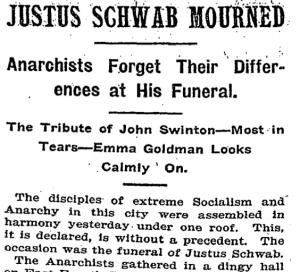
Yesterday's post mentioned Justus Schwab, a German-American radical and a fixture of the New York Anarchist milieu, who kept a radical "Beer-Hole" on First Street where Anarchists, socialists, writers, artists, and other radicals and misfits met to drink and talk into the night. Emma Goldman later described his saloon as "the most famous radical center in New York." Here is an item from the December 21, 1900 issue of the New York Times, on Schwab's death and his funeral, which brought together New York radicals across factional lines and putting aside schisms and personal breaks to celebrate his memory.

>

JUSTUS SCHWAB MOURNED

>

Anarchists Forget Their Differences at His Funeral.

>
The Tribute of John Swinton--Most in Tears--Emma Goldman Looks Calmly On.
>

>

The disciples of extreme Socialism and Anarchy in this city were assembled in harmony yesterday under one roof. This, it is declared, is without a precedent. The occasion was the funeral of Justus Schwab.

The Anarchists gathered in a dingy hall on East Fourth Street. All differences were forgotten, and there was not a single man or woman who gave evidence of any feeling other than sorrow at the loss of the dead disciple. At times during the speeches which were made over the body almost every one there broke down and wept. Dark, bearded faces that had worn a scowl of discontent for years were softened with grief, and men who had been bitter enemies of Justus Schwab while he was alive cried like children.

Emma Goldman, the woman Anarchist leader, who had been the dead man's closest friend, was the only one present who did not give some indication of emotion. She sat calmly throughout the ceremonies, although John Most, who had been opposed to Schwab for years, gave way completely to his grief several times.

The funeral services were held in the assembly room of the Labor Lyceum at 64 East Fourth Street. The body was taken from the room over the saloon at 50 First Street, where Schwab had lived, early in the day and placed on a bier in the middle of the assembly room. The coffin was open so that the face of the dead man could be seen, and coffin and bier were draped with flags. The emblem of Anarchy was wrapped around the coffin and thrown over the lower part of it, and flags from various labor unions hung below. There was a pile of flowers that brightened up the dark hall, arranged on a table at one end. There were wreaths from Cigar Makers' Union No. 90, from an Italian Anarchist society, and from the Social Science Club.

The funeral service was marked by the absolute absence of any religious ceremonial, and consisted of speeches by various friends of the dead man. The band of the Carl Sahm Club, which was stationed at one end of the hall, played a dirge that seemed to harmonize with the sombre surroundings, and the Lieber Tafel Singing Society, which the dead Anarchist had founded, sang Eventide. George Biederkapp, the author of a book of Socialist poems, recited an original poem eulogizing Schwab, entitled, The Storm Has Passed, and when he had taken his seat almost every one in the room was in tears. Alexander Jonas, a Socialist leader, made a short speech in German and was followed by John Swinton, who spoke in English.

I am entirely overcome, he said, when I attempt to speak of our dead brother. I have never known a man so self-sacrificing, so faithful, so noble.

John Most, who had been the leader of the Anarchist faction opposed to Schwab, was the next speaker. He spoke in German and in the most dramatic manner. When he had completed his speech he was evidently exhausted, and sank into a chair as the pall-bearers lifted the coffin and carried it out to the hearse, which was waiting for it.

As the hearse started slowly down Second Avenue, followed by a few carriages, nearly 2,000 people, many of them in tears, fell in line behind it. The procession passed by the little saloon where Schwab had lived and then proceeded slowly to the ferry at the foot of East Houston Street. All along the route the windows of the tenements were filled with people. At the ferry the carriages followed the hearse and the Anarchists on foot dispersed quietly. The body was taken to Fresh Pond, L. I., for cremation.

Source

“Sunday Schools That Teach Children Anarchy,” from the New York Times (May 8, 1910)

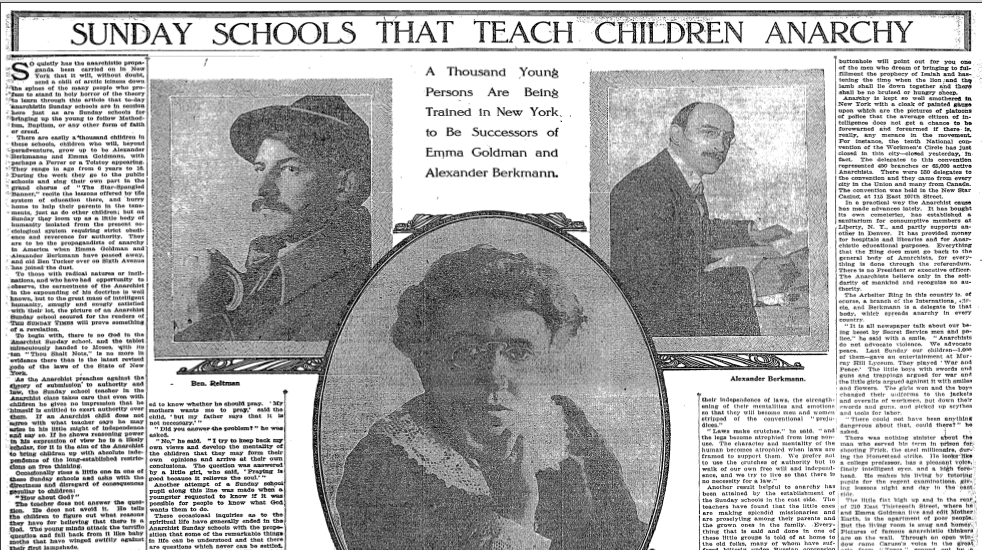
Here's some more on mass-media reception of Anarchism during the early 20th century: a strange little piece from the Sunday New York Times magazine from May 8, 1910, on Anarchist Sunday schools in New York, focusing on the Ferrer Sunday School taught by Alexander Berkman. The Sunday schools were part of the large network of schools, cultural spaces and other institutions organized by Anarchists in large cities like New York during the early 20th century. (Like most Anarchistic educational projects, the Sundays were closely associated with the Modern School Movement and the thought of Francisco Ferrer). Either of the writer of the article, or his editor, couldn't quite seem to decide whether they wanted this story to be a straight interview of Berkman and a description of how the Sunday Schools were operated, or whether they wanted another cookie-cutter Anarchist-menace scare story.

SUNDAY SCHOOLS THAT TEACH CHILDREN ANARCHY

A Thousand Young Persons Are Being Trained in New York to Be Successors of Emma Goldman and Alexander Berkman.

So quietly has the anarchistic propaganda been carried on in New York that it will, without doubt, send a chill of arctic iciness down the spines of the many people who profess to stand in holy horror of the theory to learn through this article that to-day anarchistic Sunday schools are in session here just as are Sunday schools for bringing up the young to follow Methodism, Baptism, or any other form of faith or creed.

>

There are easily a thousand children in these schools, children who will, beyond peradventure, grow up to be Alexander Berkmanns and Emma Goldmans, with perhaps a Ferrer or a Tolstoy appearing. They range in age from 6 years to 16. During the week they go to the public schools and sing their own part in the grand chorus of "The Star-Spangled Banner," recite the lessons offered by the system of education there, and hurry home to help their parents in the tenements, just as do other children; but on Sunday they loom up as a little body of humanity isolated from the present sociological system requiring strict obedience and reverence for authority. They are to be the propagandists of anarchy in America when Emma Goldman and Alexander Berkmann have passed away, and old Ben Tucker over on Sixth Avenue has joined the dust.

To those with radical natures or inclinations, and who have had opportunity to observe, the earnestness of the Anarchist in the expounding of his doctrine is well known, but to the great mass of intelligent humanity, smugly and snugly satisfied with their lot, the picture of an Anarchist Sunday school secured for readers of The Sunday Times will prove something of a revelation.

To begin with, there is no God in the Anarchist Sunday school, and the tablet miraculously handed to Moses, with its ten Thou Shalt Nots, is no more in evidence there than is the latest revised code of the laws of the State of New York.

As the Anarchist preaches against the theory of submission to authority and law, the Sunday school teacher in the Anarchist class takes care that even with children he gives no impression that he himself is entitled to exert authority over them. If an Anarchist child does not agree with what teacher says he may arise in his little might of independence and say so. If he shows reasoning power in his expression of view he is a likely scholar, for it is the aim of the Anarchist to bring children up with absolute independence of the long-established restrictions on free thinking.

Occasionally rises a little one in one of these Sunday schools and asks with the directness and disregard of consequences peculiar to children:

How about God?

The teacher does not answer the question. He does not avoid it. He tells the children to figure out what reasons they have for believing that there is a God. The young minds attack the terrific question and fall back from it like baby moths that have winged swiftly against their first lampshade.

The largest of the Sunday schools is in Avenue A. It is called the Ferrer Sunday School, and was, until the killing of the Spanish philosopher, known as the Radical Sunday School. How the name was changed will prove a story that may stand out with striking novelty in the child life of New York to-day. It shall be told a little later in this article.

The Ferrer Sunday School is conducted by Alexander Berkmann. It has about eighty members and is in two classes. It meets on Sunday between 10 in the morning and noon. The youngest child is 7.

Berkmann has no laid-out system of teaching, depending on his comprehension of the psychology of the group at the time of the gathering. There are no rules. A song may be sung in chorus, a song dealing with freedom of mankind and hate for oppression. Some of the children may have learned by heart a poem or a fragment of an anarchistic argument and these provide recitations. The training of the mind anarchistically is then begun.

Berkmann, in a talk with a Times writer, in the office of Mother Earth, the Anarchist magazine, gave a sample of this teaching.

This was his talk to his Sunday school on Sabbath after the execution of Ferrer.

Once a single human being was swept from the sea to the shore of an island where there lived no human beings. There he found a great flock of sheep. He studied them and noticed that some of them were very powerfully built and finely fed. Some had even attained the strength and ferocity of wolves. But there were a great many of the sheep that were lean and worn. They were hungry and had been trampled down and hurt.

The man thought that he could so arrange it that these sheep, with little to eat and with bruises from being trampled, could be taught to care for themselves better and realize what the power of the strong and wolflike sheep had brought them to. He went among the sheep that suffered and began to point out to them what was the matter. The wolfish and strong ones heard of this and they turned upon the man and killed him.

When Berkmann finished this parable one of the children, a boy 18 years old, arose and said:

Why Mr. Berkmann, this story is just like the story of Ferrer's death.

The children were so impressed with the parable and the discussion which followed that the name of the school was then changed from the Radical Sunday School to the Ferrer Sunday School.

In the classes, said Berkmann, we generally use current events as subjects for discussion and study. For instance, one of our lessons was produced by the Hudson-Fulton Celebration in New York. The children of the east side saw a great deal of the sailors from the many men-of-war in the harbor. They saw the sailors of different nationalities entering and leaving the cafés, the best of friends, their arms about each other and acting like human brothers. The question naturally followed. Why should they be thus fond of each other and thus brotherly on land, and on sea be commanded to kill each other? They are brothers, and love each other, and there can be no fair reason for their slaying each other.

A man who had been raised in one of the old credal beliefs with care but who had come to be an agnostic in middle life once told the writer than when he realized that his religion had gone from him he felt that what he called reason had stepped into a nursery, and, like a willful bully, had gathered up the toys of a child sitting there and had destroyed them because he considered them useless. He considered the change from belief to agnosticism the tragedy of his life. The figure may be applied to thinking grown-ups easily, but it is hard to think of applying it to a child. And yet in the Anarchist Sunday school the tragedy of the destroyed toys is not infrequently enacted.

The pupil of the Anarchist Sunday school is taught to reason. The teacher only serves to direct their attention to a problem.

One child, said Berkmann, wanted to know whether he should pray. My mothers wants me to pray, said this child, but my father says that it is not necessary.

Did you answer the problem? he was asked.

No, he said. I try to keep back my own views and develop the mentality of the children that they may form their own opinions and arrive at their own conclusions. The question was answered by a little girl, who said, Praying is good because it relieves the soul.

Another attempt of a Sunday school pupil along this line was made when a youngster requested to know if it was possible for people to know what God wants them to do.

These occasional inquiries as to the spiritual life have generally ended in the Anarchist Sunday schools with the proposition that some of the remarkable things in life can be understood and that there are questions which never can be settled. The mental attitude of the children might be put in this way: We are not certain whether there are grounds for the belief that we should pray.

That, of course, leaves the question well in the field of agnosticism. The teacher of anarchy does not, with the children, declare that there is no God. Nor does he say that there is a God. The Sunday school class goes frequently to the Museum of Natural History, to Central Park, to the Zoological Gardens, and other places where, with the teacher, nature is studied.

The Ferrer Sunday school is only one of about fifteen similar schools in the greater city. Wherever the local groups of Anarchists can handle their own Sunday schools, carrying on the propaganda with literature, letters, lectures, &c., they do so without asking aid of others. When they cannot the State group helps. There is no central or superior group. Each has its own autonomy, although they all work to develop their principles of solidarity and mutual aid.

There are frequently conventions of the Sunday school teachers. Those who have classes get together and exchange experiences and ideas. In this city the Anarchists know that the fulfillment of their vision is afar, and they are already sowing their seed in the young and new fields that a generation of their kind may take hold of the propaganda when the present generation has withered and fallen.

These little Anarchists are being trained to believe in no authority. As Mr. Berkmann put it, everything is being done for them to aid them in the development of their independence of laws, the strengthening of their mentalities and emotions so that they will become men and women stripped of the conventional prejudices.

Laws make crutches, he said, and the legs become atrophied from long non-use. The character and mentality of human becomes atrophied when laws are framed to support them. We prefer not to use the crutches of authority but to walk of our own free will and independence, and we try to live so that there is no necessity for a law.

Another result helpful to anarchy has been attained by the establishment of the Sunday schools in the east side. The teachers have found that the little ones are making splendid missionaries and are proselyting among their parents and the grown ones in the family. Everything that is said and done in one of these little groups is told of at home to the old folks, many of whom have suffered bitterly under Russian oppression and who have revolution deep in their hearts. They write letters to the Anarchist teachers and get replies. They discuss the views expounded at home by their children and many of them become radicals and join the Anarchist groups.

The Anarchists also spread their propaganda by establishing little libraries which they make easily accessible to all who want to study the theory.

In the spreading of the propaganda among the children the littlest are not overlooked. There are some as young as six years of age who are getting kindergarten lessons in anarchy. One of these lessons is the lesson which preaches to a boy of health and strength at the age of six that he should not strike or abuse a boy who is not as strong as he is but should help him because he needs help. That is the very heart of the kindergarten lesson.

All of this work is done in what is called the Workmen's Circle. The Circle is the general group and is known as the Arbeiter Ring. A little white enamel badge with the letters A. R. in the buttonhole will point out for you one of the men who dream of bringing to fulfillment the prophecy of Isaiah and hastening the time when the lion and the lamb shall lie down together and there shall be no bruised or hungry sheep.

Anarchy is kept so well smothered in New York with a cloak of painted gauze upon which are the pictures of platoons of police that the average citizen of intelligence does not get a chance to be forewarned and forearmed if there is, really, any menace in the movement. For instance, the tenth National convention of the Workmen's Circle has just closed in this city--closed yesterday, in fact. The delegates to this convention represented 450 branches or 65,000 active Anarchists. There were 550 delegates to the convention and they came from every city in the Union and many from Canada. The convention was held in the New Star Casino, at 115 East 107th Street.

In a practical way the Anarchist cause has made advances lately. It has bought its own cemetaries, has established a sanitarium for consumptive members at Liberty, N. Y., and partly supports another in Denver. It has provided money for hospitals and libraries for Anarchistic educational purposes. Everything that the Ring does must go back to the general body of Anarchists, for everything is done through the referendum. There is no President or executive officer. The Anarchists believe only in the solidarity of mankind and recognize no authority.

The Arbeiter Ring in this country is, of course, a branch of the International Circle, and Berkmann is a delegate to that body, which spreads anarchy in every country.

It is all newspaper talk about our being beset by Secret Service men and police, he said with a smile. Anarchists do not advocate violence. We advocate peace. Last Sunday our children--1,000 of them--gave an entertainment at Murray Hill Lyceum. They played War and Peace. The little boys with swords and guns and trappings argued for war and the little girls argued against it with smiles and flowers. The girls won and the boys changed their uniforms to the jackets and overalls of workmen, put down their swords and guns, and picked up scythes and tools for labor.

There could not have been anything dangerous about that, could there? he asked.

There was nothing sinister about the man who served his term in prison for shooting Frick, the steel millionaire, during the Homestead strike. He looks like a college professor, has a pleasant voice, finely intelligent eyes, and a high forehead. He makes his living by tutoring pupils for the regent examinations, giving lessons night and day in the east side.

The little flat high up and in the rear of 210 East Thirteenth Street, where he and Emma Goldman live and edit Mother Earth, is the apartment of poor people. But the living room is snug and homey. Pictures of famous anarchistic thinkers are on the wall. Through an open window came Caruso's voice in the great aria from Tosca, ground out by a phonograph, as Berkmann talked with the Times man. It was a warm combination, but the night was warm, and we were glad for the breeze that swept the little place however burdened it might be.

We teach no ism, he said, harking back to the Sunday schools. Our aim is to develop character and mentality in the child. We try to make them think, criticise, and feel.

We want their emotional and intellectual natures developed. We want to make them men and women absolutely free of the old restrictions. We hope that they will grow up with the spirit of solidarity and co-operation in them. We try to teach them that in and out of school.

We try to teach them ethical right and reason. Our Radical Boys' Literary Club, boys about 13 or 14 years old, hold meetings after school, and they run their organization just as the grown people do. They have advanced to where they need no help from their elders.

Among the grown Anarchists the cause is kept warm by fervid preachings in their publications. These are the weekly paper Frei Arbiter Stimme, with a circulation of 12,000; Mother Earth, with a circulation of 6,000; Freiheit, with 5,000 circulation, and Voine Listy, a Bohemian paper, with a circulation of 4,500.

There are nine large groups of the grown Anarchists in New York. These have regular meetings, and conduct the propaganda with lectures, debates, &c.

In the district from Fourteenth Street to the Battery east of Broadway are 850,000 people living. Here beats the heart of anarchy. Nearly all of these people are foreign born, the native born element being insignificant in its percentage.

Forsyth Street, Chrystie, Cannon, Pitt, Columbia, Second Streets all have buildings in which are tiny halls that may be rented for a dollar or two for a wedding, a banquet, a lodge meeting, or a group meeting of Anarchists.

The man who lives awhile in this teeming corner of Manhattan does not take long to find out where he can go and hear all the anarchy he wants expounded. The writer once met in one of these little halls S. Yanofsky, the editor of the Frei Arbiter Stimme. A man with dreamy eyes, pointed beard, and nervous energy, he seemed to be looked up to as little short of a god by a clump of young men and women who were wating for him.

Yanofsky and Berkmann were both rounded up by the police after the Silverstein bomb explosion in Union Square in 1908, and as there was nothing against either of them nothing came of the call to Police Headquarters. Yanofsky, when asked by the writer what he thought of Silverstein's act, replied:

The man who commits a violent deed, if he is not mad, is desperate. Violence never did any good for anarchy. All government is a form of violence. Suppose Silverstein had suffered personally--and his act was that of an impatient and ignorant man--what did he accomplish? He only made himself dead and gave the chance to the enemies of anarchy to spread their calumnies. He only helped them to kill of the chances of gaining liberty.

Berkmann was a little clearer on the matter of violence and anarchy.

If a Republican or Democrat should throw a bomb or kill another, he said, the Republican Party or the Democratic Party would not be blamed for it. When an Anarchist does a thing like that we frankly say that anarchy did not inspire it, but that conditions of inequality and injustice caused the crime. To stop the crime, stop the cause. Anarchy is for justice and freedom. It cannot be blamed for individual acts of violence.

Among the favorite east side speakers for anarchy, besides Yanofsky and Berkmann, is Dr. Ben Reitman, whose method is to stir up the hearers with fiery sentences depicting the wrongs resulting from the present order of things. He with the others believes that anarchy is gathering strength, and will continue to gather it and will prove a living force in the slow movement of society through the ages.
“To Drive Anarchists Out of the Country,” from the New York Times (March 4, 1908)

In line with some of our other recent material from the anti-immigrant and anti-Anarchist panic of the 19-aughts, here is a long front-page story from the New York Times in 1908, in which the Times declared that The United States has declared open war on Anarchists. The form that the war would take was a mass crackdown on immigrants -- one of the first major immigration enforcement actions in United States history -- in order to round up and deport Anarchists with radical political beliefs.

TO DRIVE ANARCHISTS OUT OF THE COUNTRY


Secretary Straus Orders Immigration Men to Co-operate with Police in Locating Criminals.


INDORSED BY ROOSEVELT


Added Precautions to be Taken in Excluding Aliens--Three Assassinations Were Plotted in Chicago.


Special to The New York Times.

WASHINGTON, March 3.--The United States has declared open war on Anarchists. As a result of the great increase in crime and the growing boldness of those who are enlisted under the red flag, Commissioners of Immigration and immigrant Inspectors have been instructed by Secretary Straus of the Department of Commerce and Labor to ally themselves with the police and detectives of the cities and aid in putting an end to terrorism. The order was issued to-day, and is said to have the hearty indorsement of President Roosevelt.

Secretary Straus orders that the immigration authorities shall take steps necessary to securing the co-operation of the police and detective forces in an effort to rid the country of alien Anarchists and criminals falling within the law relating to deportation.

Secretary Straus's Order.

The order of Secretary Straus follows:

To all Commissioners of Immigration and Immigrant Inspectors in charge: It is hereby directed that, with a view to promptly obtaining definite information with regard to alien Anarchists and criminals located in the Untied States, you shall confer fully with the Chief of Police or the Chief of the Secret Service of the city in which you are located, furnishing such official with detailed information with regard to the inhibition of that statute against aliens of the criminal classes, explaining the powers and limitations imposed by said statute upon the immigration officials with respect to such persons.

You should call to the attention of the Chief of Police or Chief of the Secret Service the definition of Anarchist contained in Sections 2 and 38 of the act of Feb. 20, 1907, and the provisions of Section 2 placing within the excluded classes persons who have been convicted of or admit having committed a felony or other crime or misdemeanor involving moral turpitude, pointing out that if any such person is found within the United States within three years after landing or entry therein he is amenable to deportation under the provisions of Section 21 of said act.

The co-operation of said officials should be requested, making it clear that in order that any particular Anarchist or criminal may be deported, evidence must be furnished showing (1) that the person in question is an alien subject to the immigration acts; (2) that he is an Anarchist or criminal as defined in the statute; (3) the date of his arrival in the United States, which must be within three years of the date of his arrest; (4) the name of the vessel or of the transportation line by which he came, if possible, and (5) the name of the country whence he came, the details with respect to the last three items being kept at the various ports of entry in such a manner as to be available if information is furnished with respect to the Anarchist's name, the date of his arrival, and the port of entry.

It is desired that the above indicated steps shall be taken at once and that no proper effort shall be spared to secure and retain the co-operation of the local police and detective forces in an effort to rid the country of alien Anarchists and criminals falling within the provisions of the statute relating to deportation.

Uneasy Over Anarchy's Spread.

The Administration has viewed with increasing uneasiness the spread of Anarchy and Socialistic teachings. The threats made against citizens of wealth and position are becoming more numerous with every month. The attempt to kill the Chief of Police of Chicago, the riot in Philadelphia following the dispersal of an Anarchistic meeting, and the threats made against clergymen have brought the Government to a realization that something must be done to make life and property more secure.

With the activity of the immigration authorities and the police in running down criminals in the United States, there will be taken added precautions against admitting to the country any more of the same class. The examination of the hordes of aliens that come yearly to these shores will be made so severe that it will in the future partake of the nature of an inquisition. The Government is beginning to realize that it has been employing too lax methods in the past.

A case in point, they say, is the presence in this country of Emma Goldman. This woman is declared to be a firebrand and an Anarchist of the most rabid type. She went abroad some months ago, and at that time it was openly stated that she would not be readmitted to the country. In spite of these declarations Miss Goldman is back again in the United States spreading the propaganda of revolutionary Socialism.

It is cases such as these, in the opinion of officials, that lend encouragement to the vicious element. The laws, in the first place, are held to be too lenient, and secondly, they are not administered with the severity the situation demands. More stringent laws, coupled with emphatic application of them, are said to be the crying need of the time.

As the law now stands, an Anarchist may go about unmolested by the police after he has spent three years in this country and has not been connected with the perpetration of a crime in that time. He is immune from deportation. It does not matter whether the criminal is a citizen or not, he can legally resist all efforts to return him to the country from whence he came.

Possible to Exclude Anarchists.

It is possible, however, under the existing law to exclude Anarchists. The law declares that, among others, there may be excluded from the country anarchists, or persons who believe in or advocate the overthrow by force or violence of the Government of the United States or of all government or of all forms of law, or the assassination of public officials.

Section 20 of the Immigration act, which covers the exclusion of aliens, provides: That any alien who shall enter the United States in violation of the law shall, upon the warrant of the Secretary of Commerce and Labor, be taken into custody and deported to the country whence he came at any time within three years after the date of his entry into the United States.

Section 21 provides that in case the Secretary of Commerce and Labor shall be satisfied that an alien has been found in the United States in violation of this act, or that an alien is subject to deportation under any law of the United States, he shall cause such alien within the period of three years after landing to be taken into custody and returned to the country whence he came.

This makes it mandatory upon the Secretary to deport any alien Anarchist whom he may discover who has not been in the country three years.

General Enemies of Society.

In addition to these provisions, which ordinarily would cover the case of an Anarchist, a separate section dealing with enemies of society generally was included in the act. Section 38 says:

That no person who believes in or who is opposed to all organized government, or who is a member of or affiliated with any organization entertaining and teaching such disbelief in or opposition to all organized government, or who advocates or teaches the duty, necessity, or propriety of the unlawful assaulting or killing of any officer or officers, whether of specific individuals or of officers generally, of the Government of the United States, or of any other organized government, because of his or their official character, shall be permitted to enter the United States or any territory or place subject to the jurisdiction thereof.

This section shall be enforced by the Secretary of Commerce and Labor under such rules and regulations as he shall prescribe. That any person who knowingly aids or assists any such person to enter the United States or any territory or place subject to the jurisdiction thereof, or who connives or conspires with any such person or persons to allow, procure, or permit any such person to enter therein, except pursuant to such rules and regulations made by the Secretary of Commerce and Labor shall be fined not more than $5,000, or imprisoned for not more than five years, or both.

--The New York Times, March 4, 1908, pp. 1-2.

Emma Goldman Now Alien (New York Times, April 9, 1909)

This is a side column from Page 2 of the New York Times on April 9, 1909, reporting the U.S. Attorney's success in convincing a federal court to strip Emma Goldman of her citizenship, which she had gained by marriage to a naturalized citizen in 1887.

EMMA GOLDMAN NOW ALIEN.

Deprived of Rights of Citizenship by Disenfranchisement of Her Husband.
Special to The New York Times.

Buffalo, N.Y., April 8.--Judge Hazel, in the United States Court this morning, granted an order canceling the citizenship papers of Jacob A. Kersner. Through this order all rights of citizenship also are taken from Kersner's wife, who is none other than Emma Goldman, the woman leader of the Anarchists in this country, whose fiery teachings, it was charged by many, incited Leon Czolgosz to the assassination of President McKinley.

The order was granted upon motion of Special United States Attorney P. S. Chambers of Pittsburg, and the evidence upon which it was based was presented principally by Kersner's own father, who was subpoenaed from his home at Rochester.

Kersner obtained his citizenship documents in 1884, when the statutes governing such procedure were quite lax compared with the present laws. He was two years under age at the time. Three years later he married Emma Goldman. She was a foreigner herself, but by virtue of her marriage to a citizen she was clothed with the rights of citizenship. Emma was only a girl, then, and had barely begun the career that later connected her so closely with the Reds in the public eye.

--The New York Times (April 9, 1909), Page 2.

Now online: Full text of two more issues of MOTHER EARTH — Vol. VI., No. 11 (January, 1912) and Vol. VII., No. 12 (February, 1913)

Three months ago, I happily announced that the complete text of the November 1914 issue of Mother Earth had been made available at the Fair Use Repository. To-day, I'm pleased to follow up that announcement -- with the announcement that the Fair Use Repository now features the complete text of three issues of Mother Earth. The two issues recently made available are:

Mother Earth, Vol. VI., No. 11 (January, 1912)

This issue is mainly occupied with the arts and revolution. It leads off with Blaming the Fester, a poem by Rebekah E. Raney. The New Year is a fundraising appeal on the occasion of Christmastime and the New Year, while Observation and Comments includes short reports on current events -- delays in the publication of Prison Memoirs of an Anarchist, the trial of the bosses who'd locked workers into the the Triangle Shirtwaist Factory, strikes and conspiracy trials around the country, Big Bill Haywood's feud with the Socialist Party of America, and more.

Paul Orleneff offers a celebratory review (unsigned, but probably written by Emma Goldman) of the actor's performances in New York. A Review of the Year, by Harry Kelly, and the continuation of a serialized article by Voltairine de Cleyre on The Mexican Revolution, discuss revolutions and uprisings flaring up throughout the world in 1911. In The Right to Live M. B. argues that political rights are empty without workers' material control over the means of their own survival (the organization of society in a manner to insure to each the material basis of life and make it as self-evident as breathing). Max Baginski reviews the Autobiography of Richard Wagner, taking it as evidence of the old commonplace that one can be a great artist and yet small as a man, and concluding that The suffocating dependence of artistic production upon wealth and patronage should cause the true artist--who is not content to produce mere market ware--to turn relentlessly rebel against the existing standards, to become a communist. ... The dream that Wagner once dreamed in Art and Revolution will some day be realized by the people,--nor will they need the aid of philosopher or king. The issue concludes with a continuation of the serialized article Economy as Viewed by An Anarchist by C. L. James, on the historical emergence of the bourgeois system and its connections with past forms of economic hierarchy, as well as with the subjection of women.

Mother Earth, Vol. VII., No. 12 (February, 1913)

The February 1913 issue has a few things to say about the State and a lot to say about the union struggle, Syndicalism, and government repression of striking workers. The issue leads off with To Our Friends, an appeal for readers to help widen the circulation of the journal, followed by another monthly instalment of short reports in Observations and Comments -- including remarks on the inauguration of Woodrow Wilson, the futility of appeals to the law, the advantages of direct action, new strike arbitration laws in New Zealand (among the first such labor laws in the world), the legal repression of Anarchists in the U.S., police scandals in Denver, and the incorporation of the Rockefeller fund.

James Montgomery's The Black Hundreds of Plutocracy and Government discusses the use of private security forces, with tacit or explicit government approval, to inflict large-scale violence on striking workers. The New Idol, a translation of an excerpt from Friedrich Nietzsche's Also Sprach Zarathustra, declares the State the coldest of all cold monsters. Theodor Johnson's Help Save These Comrades! reports on the case of a group of striking Swedish dock workers, who had been sentenced to life imprisonment for a bomb plot, and calls for international solidarity to get their sentences commuted. Making a Strike a Crime government's assault on the rights to picket and speak freely, with the imprisonment of dozens of peaceful picketers and speakers in Little Falls, New York during a textile mill strike. Intolerance in the Union comments on growing regimentation and bureaucratic control within conservative trade unions and reprints a letter from a comrade discussing his objections to a corrupt bargain made by his union's labor bosses, which resulted in his being persecuted by the labor bosses and expelled from the union. Syndicalism: Its Theory and Practice concludes a long article by Emma Goldman on state-free Syndicalist organizing, with a discussion of Syndicalism's characteristic methods -- Direct Action, Sabotage, and the General Strike. The issue concludes with Anarchist writer and teacher Bayard Boyesen's review of Alexander Berkman's Prison Memoirs of an Anarchist, and with an announcement of dates for Emma Goldman's lecture tour through the Midwest.

Onward

These issues complete a set of three reprinted issues of Mother Earth that I picked up from a table at the Bay Area Anarchist Bookfair. I'd very much like to make available more of Mother Earth's print run online. A number of partial and complete issues -- mostly earlier issues -- are currently available from The Anarchy Archives, and a fair amount is available for browsing in Google Books. But I'd like to liberate the latter from the Google Books's inaccurate automatic markup, often capricious behavior, and hypertext-unfriendly environment. And in any case, there are a lot of gaps to fill in. If you have any suggestions on issues to prioritize, or good lines on copies to be transcribed, please feel free to leave a comment here, or contact me with the details.

Read, cite, and enjoy!

Now online: Five articles from MOTHER EARTH Vol. VI., No. 11 (January, 1912)

I'm happy to announce that the Fair Use Repository now features five complete articles from the January, 1912 issue of Mother Earth:

  • Blaming the Fester, a poem by Rebekah E. Raney
  • Observations and Comments, a regular feature in many issues of Mother Earth; the format is much like Tucker's On Picket Duty -- a sort of ongoing polemical Anarchist three-dot column that ran near the beginning of each issue.

  • A Review of the Year by Harry Kelly -- an overview and review of the upsurge in popular uprisings, general strikes and Anarchist revolutionary activity that broke out throughout the world in 1911.

  • The Mexican Revolution (Continued), by Voltairine de Cleyre, previously published separately here in the Fair Use Blog -- part of a serialized discussion of the uprising against the Madero provisional government in Mexico, with discussions of the crimes of the Mexican government against the Yaquis, the revolution in the North (Baja California, Sinaloa, Chihuahua, and Sonora) and South (Morelos, Chiapas, Tabasco, San Luis Potosi, and Yucatan), the victories of Emiliano Zapata, and the extreme importance of the peasants' efforts to ignore the machinery of paper land-holding and reclaim the land they work.

  • The Right to Live by M. B., on the hollowness and sham of political rights and the pivotal importance of the natural right to possess the means of existence.

These are the first set of articles to be put online from Mother Earth Volume VI. Number 11; more will come soon. I believe that the complete issue should be available online by the end of the next week.

Read, cite, and enjoy!

Now online: full text of MOTHER EARTH IX.9 (November, 1914)

I'm happy to follow up our earlier announcement with an announcement that the Fair Use Repository now features the complete text of all the articles from the November 1914 issue of Mother Earth.

Most of the issue is occupied with Anarchist responses to, and debate over, the outbreak of World War I: Kropotkin on the Present War reprints Peter Kropotkin's letter to Gustav Steffen, supporting the French government's fighting in World War I; Alexander Berkman's In Reply to Kropotkin calls Kropotkin to task and argues that Anarchists should oppose all sides in all government wars. Goldman and Berkman followed this argument with a reprint of Chapter I of Kropotkin's own Wars and Capitalism, written in 1913, in which Kropotkin had skewered the French government's motives and argued that wars were the product of imperial capitalism and that the reason for modern war is always the competition for markets and the right to exploit nations backward in industry. In addition to the exchange over Kropotkin's letter, this issue also features That Economic Army, an article by Guy A. Aldred originally printed in the London Spur, which traces how the state and capital, during wartime, deformed the entire economy to draw not only men, but entire industries, into collaboration with the war machine, out of economic interest.

Alongside the discussion of the war, Vol. IX. No. 9 also features:

  • The Persecution of Margaret Sanger by Harry Breckenridge, a defense and a call for working-class solidarity with Margaret Sanger and the Woman Rebel, then facing Federal prosecution for obscenity (for distributing articles on birth control and scientific information about sexual health).

  • Black Friday of 1887 by M. B., a slashing review of the Socialist journalist Charles Edward Russell’s discussion of Haymarket in his memoirs, and a commemoration of the Haymarket martyrs hanged 11 November 1887.

  • My Lecture Tour by Alexander Berkman, an announcement of Berkman's upcoming lecture tour of the Midwest, with talks on War--At Home and Abroad, Unemployment and War, War and Culture, The War of the Classes, Is Labor Justified in Using Violence? Crime--In and Out of Prison, and The Psychology of Crime and Prisons.

  • Emma Goldman Dates by Emma Goldman, an announcement of Emma Goldman's upcoming lectures in Chicago on anti-militarism, Anarchism, and a lecture series on drama , as well as announcing dates for upcoming lecture series elsewhere in the Midwest.

I'm happy to have this issue of Mother Earth available in full. More issues should be coming soon.

Read, cite, and enjoy!

Now online: four articles from MOTHER EARTH (November, 1914): Anarchist responses to World War I and a commemoration of the Haymarket martyrs

I'm happy to announce that the Fair Use Repository now features four complete articles from the November, 1914 issue of Mother Earth:

  • Kropotkin on the Present War by Peter Kropotkin -- a reprint of Kropotkin's letter supporting the French government's fighting in World War I;

  • In Reply to Kropotkin by Alexander Berkman -- in which Berkman calls Kropotkin to task, argues that the international working class has no real stake in bosses' wars, and calls on Anarchists to oppose all sides in all government wars.

  • Wars and Capitalism (Chapter I) by Peter Kropotkin, a reprint of Kropotkin's earlier analysis of war, from 1913, in which he argued that the reason for modern war is always the competition for markets and the right to exploit nations backward in industry.

  • Black Friday of 1887, by M. B., a slashing review of the Socialist journalist Charles Edward Russell's discussion of Haymarket in his memoirs, and a commemoration of the Haymarket martyrs hanged 11 November 1887.

These are the first set of articles to be put online from Mother Earth Volume IX, Number 9; more will come soon. I believe that the complete issue should be available online by the end of the week.

Read, cite, and enjoy!