Fair Use Blog

Max Eastman Is ‘Sorry’ For Today’s Rebels (Alden Whitman, New York Times, Jan. 9, 1969)

Here is an article on Max Eastman and his reflections on the New Left in his old age. This article appeared in The New York Times of January 9, 1969 (p. 33).

Max Eastman Is 'Sorry' For Today's Rebels

By ALDEN WHITMAN.

One of the country's reigning radical writers and agitators of a half-century ago looked this week at today's young militants and found more to pity than to praise.

He is Max Eastman, editor of the Socialist periodical, The Masses, and its successor, The Liberator, in the years before and during World War I. Widely influential in left-wing and labor circles, these magazines printed articles by Mr. Eastman and by, among others, John Reed and Floyd Dell. Art Young and Robert Minor were among the cartoonists.

Twice Faced Trial

Because of antiwar articles in The Masses, Mr. Eastman was twice brought to trial amid nationwide publicity, charged with conspiracy to obstruct the draft. The charge was dropped after two Federal juries were unable to agree on a verdict.

I feel kind of sorry for these young rebels of today, he said in an interview last Saturday at his West 13th Street apartment that marked his 86th birthday. He was on his way from Martha's Vineyard, where he and his wife spend their summers, to a winter home in Barbados.

They have an emotion not unlike ours, he continued, running his fingers through a shock of fine, snow-white hair. They want to make a revolution but they have no ultimate purpose.

I have a certain emotional sympathy for them, but they are rather pathetic because they have no plan. They just seek a revolution for its ow sake.

By contrast, said Mr. Eastman, glancing from his padded chair around a room festooned with Christmas and birthday cards, We had a program and a purpose, which was to make over capitalism into Socialism, and it was based on an ideal and on an ideal and on an ideology.

With a vigor that belied his years, the ruddy-faced Mr. Eastman categorized the radicals of the New Left as the bohemian wing of the bourgeoisie, sons and daughters of the well-to-do, who have no real class affiliation and no alliances with the working class.

It is not possible, he said in slow, measured tones, to bring about a revolution--except on a class basis--unless by some sort of fluke.

Asked why today's rebels appeared to lack an ideology, he declared:

Socialism was once a plausible plan, but when Socialism failed completely and produced a totalitarian tyranny [in the Soviet Union under Stalin], it left social ideas without a theoretical basis.

Mr. Eastman stressed, though, that there were some similarities between rebels in 1969 and those of his era.

Mood Called the Same

The mood of militance is the same, he asserted, and so is the general rejection of convention. But many of today's restive youth are caught up in trivialities. Obscenity, for example.

Having broken with the Socialist movement (but I never considered myself a Marxist, not even in The Masses days in 1913) when his friend Leon Trotsky was read out of the Communist party by Stalin in 1926-27, Mr. Eastman made his own transition from radicalism to the Reader's Digest. He has been a roving editor for that publication since 1941.

The author and poet indicated hat his outlook for social change in the United States and the world was gloomy. He doubted, he said, that this country needs a revolution, or that one was possible either from the New Left or the Negro community. Negro militants, he said, are bound to raise hell, but they can't make a revolution.

We have to patch up the world as it is and accept it, although I don't feel very happy about it, Mr. Eastman said.

Like many writers, he has given no thought to retirement. Doubleday is to publish this spring a translation he made many years ago of Trotsky's account of Lenin's youth.

The manuscript, which Mr. Eastman had believed lost, turned up in the Harvard library a few years ago. It chronicles the Bolshevik leader's life up to when he joined the Russian revolutionary movement after becoming a lawyer in St. Petersburg, now Leningrad.

In addition, Mr. Eastman is collecting a number of essays and portraits of his contemporaries for publication soon. These, he remarked with a twinkle in his bluish eyes, are to be entitled Bull in the Afternoon and Other Essays.

The lead essay, a criticism of Ernest Hemingway's Death in the Afternoon, precipitated the famous set-to between the two authors.

Fresh in His Mind

That encounter, which took place in 1937 in the office of Max Perkins, an editor at Scribner's, was still fresh in Mr. Eastman's mind.

Hemingway shoved an open book against my nose, he recalled, and accused me of saying that he lacked virility. I grabbed him by the throat and threw him--or backed him up--over Perkins's desk and onto his back on the floor.

The two men's friendship, never thereafter the epitome of cordiality, is now largely a mellow memory for Mr. Eastman. In addition to the piece on Hemingway, Mr. Eastman plans to include his new book essays on H. L. Mencken, Bernard Berenson and Sherwood Anderson.

At 86, an author is still an author.

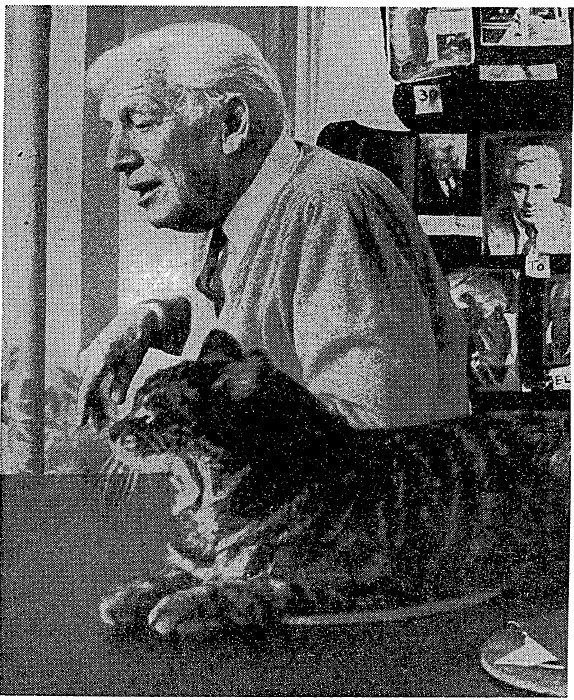
The article closes with a photo from
The New York Times (by Michael Evans)
Max Eastman, with his tabby Twiggy, during the interview at his home on West 13th Street.
>

“The Success of an Efficient Printer,” from The American Printer (June 20, 1916)

This is an item from a 1916 issue of The American Printer (Vol. 62.12), printed at New York. I noticed it and clipped it out because it's about the career of Horace E. Carr, a Cleveland-area printer (active in the Cleveland arts scene, influenced by the work of William Morris, and also a friend of the individualist anarchist Fred Schulder, whose pamphlet he printed). Here:

The Success of an Efficient Printer

SOME one sent us a copy of a house-organ that was several years old, and in it we found a marked article by David Gibson, in which he tells in his interesting style the story of Horace Carr, the Cleveland printer. It is worth reading:

Back in 1893, when we all had fresh bank failures every morning for breakfast, a printer in the old Herald job office in Cleveland, O., bought an old treadle press and a few fonts of type from a man who conducted a combination printing shop and candy store out in his neighborhood, which equipment he stored away in a room in his house.

A few weeks later when bank failures were about all anybody had for breakfast, this printer found himself out of a job.

He tried to find another, but the thought came to him very soon that it would be easier to find a few jobs of printing at which both he and the little outfit he had stored away could work.

This theory proved to be correct, and its occurring to him after he had been thrown out of employment is a very good illustration of why throwing out a man very frequently gives him a boost.

His first job was 20,000 counter slips for a neighboring grocery, and for which he agreed to accept provisions as payment.

Now, anybody who has ever been anywhere near a treadle press knows that 20,000 impressions, one at a time, is a whole lot. He didn't have enough rules to set the job three times--the capacity of his press--and he didn't feel justified in adding any more to his investment; but--

Where there is want there is a will.

He set the job once, made a mold by beating wet tissue backed with blotting paper down into the type with a hairbrush, held the mold tight to the type between a couple of scrap-steel plates by means of a couple of glue clamps, and baked the impression dry in the kitchen-stove oven.

Then he melted the contents of the hellbox in a soup ladle, cast three stereotype plates, and thus by a little headwork he cut his footwork in three.

The work following this consisted of billheads for job carpenters, business cards for clothes-wringer peddlers, and tickets for milkmen.

He was alive to the value of advertising as appealing to the habits and tendencies of the human mind; when he went out soliciting work he needed something to leave with those on whom he called--something to serve as a reminder.

So he set a line on a card:

Perfect Printing Punctually Performed Pleases Particular People!

He didn't have enough Ps: there were only six in the font in which he was compelled to set it for display, so he cut the seventh out of a block of maple wood.

Even with all his disadvantages, his work was good enough to impress the city librarian, and he was asked to figure on an annual report.

He got the job even though he was the third highest bidder, by agreeing to set in hand composition what the others proposed to do with a machine. Linotype composition in those days was not up to its present high state of perfection.

The job was too big for his imposing stone, to say nothing of his press, so he made it up on the kitchen table and farmed out the presswork.

With the profit on this job he bought more equipment, and a little later he moved downtown.

This man was Horace Carr.

He is today, perhaps, the foremost strictly type printer in America, and has done as much as any one man to revive this simple, beautiful art and commercially apply it to what would otherwise be the commonplace.

His influence has been felt not only directly through his own work, but by the published examples and exhibitions he has educated the younger printers to his tradition.

It was a big jump from being thrown out of a newspaper job office to his present position, but--

Many a man loses his opportunity by not losing his job.

An examination of some samples of his very early work, which includes some milk tickets, very clearly indicates the reason for his present position.

These early efforts indicate a simplicity, care and cleanliness beyond the same class of work at that time.

He took pains and at the expense of untold labor by reason of lack of common facilities. He used one job to study the next, and doubtless put more pride in his work than he got out in price.

His price may have been market, yet his quality was more than market.

While Horace Carr's plant is not large today, and his business is not large as compared with that of many printers, yet it is more than complete, and his patronage is unique.

It is not always well to measure a success with a tapeline; more frequently a micrometer will do.

His product is mostly small-edition work involving strictly type design.

He gets better than market prices for his work even though he may not get all that he thinks it is worth.

Few of us ever get what we think we are worth.

Horace Carr can actually express a personality or a business in type.

For instance, a letterhead for a millinery store would express the feminine in type selection and color scheme, in direct contrast to the boldness expressed in a letterhead for a machine shop.

The writer once saw a letterhead that he designed [p. 20] for a fashionable undertaker. You would have known that it was for one of that profession without reading it. The type selection had a suggestion of early religious printing, and the whole was done in purple and black to suggest mourning.

While Horace Carr's work has all been performed in Cleveland, yet his first real recognition came from abroad. Some samples of his work fell into the hands of the British Printer, one of the leading typographical journals of England.

And there is a good example in this for any man in any field of endeavor: A man may do good work in some place and get recognition for it another; a mechanic may do good work in one shop and get recognition for it in another; a man may do good work on one farm and get his reward on another.

A man should be efficient for his own sake, in his own selfish interest, rather than out of consideration for the man for whom he may be immediately working.

The efficient man can get a job anywhere; it becomes a selection of jobs rather than just a job.

An efficient man doesn't have to work under unjust conditions; he can go where the conditions are just.

The efficient man can be absolutely certain of the money return if he makes efficiency the first consideration.

--From The Success of an Efficient Printer, in The American Printer: A Semi-Monthly News, Business and Technical Journal 62.12 (June 20, 1916). 19-20.

Source

The death of Alexander Agassiz, from The Dial (April 16, 1910)

Here's a passage from The Dial: A Semi-Monthly Journal of Literary Criticism, Discussion, and Information. The passage is from the regular Casual Comment feature; this one taking notice of the death of the American scientist and industrialist Alexander Emanuel Agassiz (d. March 27, 1910).

The passing of a noted naturalist and a distinguished contributor to the literature of natural science is noted with regret in the sudden death, March 28, of Professor Alexander Agassiz, at the age of seventy-five. Gifted son of a gifted father, he shone not only as an original investigator in that father's domain of science, but also as a mining engineer and a remarkably able man of business. His work at Harvard, where he stepped into Louis Agassiz's shoes without getting lost in them, and where he built up a great museum of comparative zoölogy and made the university his pecuniary debtor to the extent of a half a million dollars, is well known. His success as superintendent and then president of the Calumet and Hecla mines is to be read in the astonishing rise of Calumet and Hecla stock from next to nothing until it is now quoted at six hundred dollars a share. The elder Agassiz used to declare, when invited to turn his scientific knowledge to his own and others' pecuniary account, that he had no time to waste in money-making. The son found time to make moeny and to spend it beneficently, besides continuing his special researches in his favorite branches of science. His original and unostentatious ways of giving were in marked contrast with the methods pursued by some other public benefactors. When, six years ago, he was offered $75,000 for conducting some deep-sea soundings in the Pacific, on condition that the enterprise should be known as the Carnegie-Agassiz Expedition, he promptly declined the offer and found money elsewhere -- chiefly in his own pocket. The life of such a man is full of inspiration to others; and it is to be hoped that a worthy biography of Alexander Agassiz may in due time be forthcoming.

--From Casual Comment, The Dial, April 16, 1910, p. 264

Now online: Full text of two more issues of MOTHER EARTH — Vol. VI., No. 11 (January, 1912) and Vol. VII., No. 12 (February, 1913)

Three months ago, I happily announced that the complete text of the November 1914 issue of Mother Earth had been made available at the Fair Use Repository. To-day, I'm pleased to follow up that announcement -- with the announcement that the Fair Use Repository now features the complete text of three issues of Mother Earth. The two issues recently made available are:

Mother Earth, Vol. VI., No. 11 (January, 1912)

This issue is mainly occupied with the arts and revolution. It leads off with Blaming the Fester, a poem by Rebekah E. Raney. The New Year is a fundraising appeal on the occasion of Christmastime and the New Year, while Observation and Comments includes short reports on current events -- delays in the publication of Prison Memoirs of an Anarchist, the trial of the bosses who'd locked workers into the the Triangle Shirtwaist Factory, strikes and conspiracy trials around the country, Big Bill Haywood's feud with the Socialist Party of America, and more.

Paul Orleneff offers a celebratory review (unsigned, but probably written by Emma Goldman) of the actor's performances in New York. A Review of the Year, by Harry Kelly, and the continuation of a serialized article by Voltairine de Cleyre on The Mexican Revolution, discuss revolutions and uprisings flaring up throughout the world in 1911. In The Right to Live M. B. argues that political rights are empty without workers' material control over the means of their own survival (the organization of society in a manner to insure to each the material basis of life and make it as self-evident as breathing). Max Baginski reviews the Autobiography of Richard Wagner, taking it as evidence of the old commonplace that one can be a great artist and yet small as a man, and concluding that The suffocating dependence of artistic production upon wealth and patronage should cause the true artist--who is not content to produce mere market ware--to turn relentlessly rebel against the existing standards, to become a communist. ... The dream that Wagner once dreamed in Art and Revolution will some day be realized by the people,--nor will they need the aid of philosopher or king. The issue concludes with a continuation of the serialized article Economy as Viewed by An Anarchist by C. L. James, on the historical emergence of the bourgeois system and its connections with past forms of economic hierarchy, as well as with the subjection of women.

Mother Earth, Vol. VII., No. 12 (February, 1913)

The February 1913 issue has a few things to say about the State and a lot to say about the union struggle, Syndicalism, and government repression of striking workers. The issue leads off with To Our Friends, an appeal for readers to help widen the circulation of the journal, followed by another monthly instalment of short reports in Observations and Comments -- including remarks on the inauguration of Woodrow Wilson, the futility of appeals to the law, the advantages of direct action, new strike arbitration laws in New Zealand (among the first such labor laws in the world), the legal repression of Anarchists in the U.S., police scandals in Denver, and the incorporation of the Rockefeller fund.

James Montgomery's The Black Hundreds of Plutocracy and Government discusses the use of private security forces, with tacit or explicit government approval, to inflict large-scale violence on striking workers. The New Idol, a translation of an excerpt from Friedrich Nietzsche's Also Sprach Zarathustra, declares the State the coldest of all cold monsters. Theodor Johnson's Help Save These Comrades! reports on the case of a group of striking Swedish dock workers, who had been sentenced to life imprisonment for a bomb plot, and calls for international solidarity to get their sentences commuted. Making a Strike a Crime government's assault on the rights to picket and speak freely, with the imprisonment of dozens of peaceful picketers and speakers in Little Falls, New York during a textile mill strike. Intolerance in the Union comments on growing regimentation and bureaucratic control within conservative trade unions and reprints a letter from a comrade discussing his objections to a corrupt bargain made by his union's labor bosses, which resulted in his being persecuted by the labor bosses and expelled from the union. Syndicalism: Its Theory and Practice concludes a long article by Emma Goldman on state-free Syndicalist organizing, with a discussion of Syndicalism's characteristic methods -- Direct Action, Sabotage, and the General Strike. The issue concludes with Anarchist writer and teacher Bayard Boyesen's review of Alexander Berkman's Prison Memoirs of an Anarchist, and with an announcement of dates for Emma Goldman's lecture tour through the Midwest.

Onward

These issues complete a set of three reprinted issues of Mother Earth that I picked up from a table at the Bay Area Anarchist Bookfair. I'd very much like to make available more of Mother Earth's print run online. A number of partial and complete issues -- mostly earlier issues -- are currently available from The Anarchy Archives, and a fair amount is available for browsing in Google Books. But I'd like to liberate the latter from the Google Books's inaccurate automatic markup, often capricious behavior, and hypertext-unfriendly environment. And in any case, there are a lot of gaps to fill in. If you have any suggestions on issues to prioritize, or good lines on copies to be transcribed, please feel free to leave a comment here, or contact me with the details.

Read, cite, and enjoy!

Now online: two British labor manifestos on World War I

Continuing our collection of historical sources and political documents from the 1910s, especially those related to World War I, I'm happy to announce that the Fair Use Repository now features the complete text of two manifestos from British labor organizations taking on the outbreak of World War I.

  • On August 1, 1914, the British Section of the International Socialist Bureau published the Manifesto to the British People, written by J. Keir Hardie and Arthur Henderson, arguing that Whatever may be the rights and wrongs of the sudden, crushing attack made by the militarist Empire of Austria upon Servia, it is certain that the workers of all countries likely to be drawn into the conflict must strain every nerve to prevent their Governments from committing them to war.

  • In September 1914, the Parliamentary Committee of the Trades Union Congress issued a Manifesto to the Trade Unionists of the Country, supporting the war, praising the Labour Party's role in the government's military enlistment campaign, urging working-class men to enlist voluntarily in order to demonstrate to the world that a free people can rise to the supreme heights of a great sacrifice without the whip of conscription, and calling on the government to ensure that enlisted men receive at the hands of the State a reasonable and assured recompense, not so much for themselves as for those who are dependent upon them, and to take a liberal and even a generous view of its responsibilities toward those citizens who come forward to assist in the defence of their country.

The manifestos are taken from versions reprinted in the wartime anthology, Labour in war time (1915), by George Douglas Howard Cole; I initially put them up in order to fill out the references made to each of the two manifesto's in Guy Aldred's That Economic Army, which refers to each of them in the course of Aldred's analysis of economic conscription, and how it had turned virtually all of English politics and civil society towards support of the war machine.

Now online: full text of MOTHER EARTH IX.9 (November, 1914)

I'm happy to follow up our earlier announcement with an announcement that the Fair Use Repository now features the complete text of all the articles from the November 1914 issue of Mother Earth.

Most of the issue is occupied with Anarchist responses to, and debate over, the outbreak of World War I: Kropotkin on the Present War reprints Peter Kropotkin's letter to Gustav Steffen, supporting the French government's fighting in World War I; Alexander Berkman's In Reply to Kropotkin calls Kropotkin to task and argues that Anarchists should oppose all sides in all government wars. Goldman and Berkman followed this argument with a reprint of Chapter I of Kropotkin's own Wars and Capitalism, written in 1913, in which Kropotkin had skewered the French government's motives and argued that wars were the product of imperial capitalism and that the reason for modern war is always the competition for markets and the right to exploit nations backward in industry. In addition to the exchange over Kropotkin's letter, this issue also features That Economic Army, an article by Guy A. Aldred originally printed in the London Spur, which traces how the state and capital, during wartime, deformed the entire economy to draw not only men, but entire industries, into collaboration with the war machine, out of economic interest.

Alongside the discussion of the war, Vol. IX. No. 9 also features:

  • The Persecution of Margaret Sanger by Harry Breckenridge, a defense and a call for working-class solidarity with Margaret Sanger and the Woman Rebel, then facing Federal prosecution for obscenity (for distributing articles on birth control and scientific information about sexual health).

  • Black Friday of 1887 by M. B., a slashing review of the Socialist journalist Charles Edward Russell’s discussion of Haymarket in his memoirs, and a commemoration of the Haymarket martyrs hanged 11 November 1887.

  • My Lecture Tour by Alexander Berkman, an announcement of Berkman's upcoming lecture tour of the Midwest, with talks on War--At Home and Abroad, Unemployment and War, War and Culture, The War of the Classes, Is Labor Justified in Using Violence? Crime--In and Out of Prison, and The Psychology of Crime and Prisons.

  • Emma Goldman Dates by Emma Goldman, an announcement of Emma Goldman's upcoming lectures in Chicago on anti-militarism, Anarchism, and a lecture series on drama , as well as announcing dates for upcoming lecture series elsewhere in the Midwest.

I'm happy to have this issue of Mother Earth available in full. More issues should be coming soon.

Read, cite, and enjoy!

Now online: four articles from MOTHER EARTH (November, 1914): Anarchist responses to World War I and a commemoration of the Haymarket martyrs

I'm happy to announce that the Fair Use Repository now features four complete articles from the November, 1914 issue of Mother Earth:

  • Kropotkin on the Present War by Peter Kropotkin -- a reprint of Kropotkin's letter supporting the French government's fighting in World War I;

  • In Reply to Kropotkin by Alexander Berkman -- in which Berkman calls Kropotkin to task, argues that the international working class has no real stake in bosses' wars, and calls on Anarchists to oppose all sides in all government wars.

  • Wars and Capitalism (Chapter I) by Peter Kropotkin, a reprint of Kropotkin's earlier analysis of war, from 1913, in which he argued that the reason for modern war is always the competition for markets and the right to exploit nations backward in industry.

  • Black Friday of 1887, by M. B., a slashing review of the Socialist journalist Charles Edward Russell's discussion of Haymarket in his memoirs, and a commemoration of the Haymarket martyrs hanged 11 November 1887.

These are the first set of articles to be put online from Mother Earth Volume IX, Number 9; more will come soon. I believe that the complete issue should be available online by the end of the week.

Read, cite, and enjoy!

“The Mexican Revolution (Continuation),” by Voltairine de Cleyre (1912)

This article on the progress of the Mexican Revolution, by the American Anarchist writer and speaker Voltairine de Cleyre, appeared in Mother Earth, Vol. VI No. 11 (January, 1912).

This law of unappropriated lands, says Wm. Archer, has covered the country with Naboth's Vineyards. I think it would require a Biblical prophet to describe the abomination of desolation it has made.

It was to become lords of this desolution that the men who play the game,--landlords who are at the same time governors and magistrates, enterprising capitalists seeking investments--connived at the iniquities of the Diaz régime; I will go further and say devised them.

The Madero family alone owns some 8,000 square miles of territory; more than the entire state of New Jersey. The Terrazas family, in the state of Chihuahua, owns 25,000 square miles; rather more than the entire state of West Virginia, nearly one-half the size of Illinois. What was the plantation owning of our southern states in chattel slavery days compared with this? And the peon's share for his toil upon these great estates is hardly more than was the chattel slave's--wretched housing, wretched food, and wretched clothing.

It is to slaves like these that Madero appeals to be frugal.

It is of men who have thus been disinherited that our complacent fellow citizens of Anglo-Saxon origin say: Mexicans! What do you know about Mexicans? their whole idea of life is to lean up against a fence and smoke cigarettes. And pray what idea of life should a people have whose means of life in their own way have been taken from them? Should they be so mighty anxious to convert their strength into wealth for some other man to loll in?

It reminds me very much of the answer given by a negro employee on the works at Fortress Monroe to a companion of mine who questioned him good-humoredly on his easy idleness when the foreman's back was turned: Ah ain't goin' to do no white man's work, fo' Ah don' get no white man's pay.

But for the Yaquis, there was worse than this. Not only were their lands seized, but they were ordered, a few years since, to be deported to Yucatan. Now Sonora, as I said, is a northern state, and Yucatan one of the southernmost. Yucatan hemp is famous, and so is Yucatan fever, and Yucatan slavery on the hemp plantations. It was to that fever and that slavery that the Yaquis were deported, in droves of hundreds at a time, men, women and children--droves like cattle droves, driven and beaten like cattle. They died there, like flies, as it was meant they should. Sonora became desolated of her rebellious people, and the land became pacific in the hands of the new landowners. Too pacific in spots. They had not left people enough to reap the harvests.

Then the government suspended the deportation act, but with the provision that for every crime committed by a Yaqui, five hundred of his people be deported. This statement is made in Madero's own book.

Now what in all conscience would any one with decent human feeling expect a Yaqui to do? Fight? As long as there was powder and bullet to be begged, borrowed, or stolen; as long as there is a garden to plunder, or a hole in the hills to hide in!

When the revolution burst out, the Yaquis and other Indian people said to the revolutionists: Promise us our lands back, and we will fight with you. And they are keeping their word magnificently. All during the summer they have kept up the warfare. Early in September, the Chihuahua papers reported a band of 1,000 Yaquis in Sonora about to attack El Anil; a week later 500 Yaquis had seized the former quarters of the federal troops at Pitahaya. This week it is reported that federal troops are dispatched to Ponoitlan, a town in Jalisco, to quell the Indians who have risen in revolt again because their delusion that the Maderist government was to restore their land has been dispelled. Like reports from Sinaloa. In the terrible state of Yucatan, the Mayas are in active rebellion; the reports say that The authorities and leading citizens of various towns have been seized by the malcontents and put in prison. What is more interesting is, that the peons have seized not only the leading citizens, but still more to the purpose have seized the plantations parceled them, and are already gathering the crops for themselves.

Of course, it is not the pure Indians alone who form the peon class of Mexico. Rather more than double the number of Indians are mixed breeds; that is, about 8,000,000, leaving less than 3,000,000 of pure white stock. The mestiza, or mixed breed population, have followed the communistic instincts and customs of their Indian forbears; while from the Latin side of their make-up, they have certain tendencies which work well together with their Indian hatred of authority.

The mestiza, as well as the Indians, are mostly ignorant in book knowledge, only about sixteen per cent. of the whole population of Mexico being able to read and write. It was not within the program of the civilizing regime to spend money in putting the weapon of learning in the people's hands. But to conclude that people are necessarily unintelligent because they are illiterate, is in itself a rather unintelligent proceeding.

Moreover, a people habituated to the communal customs of an ancient agricultural life do not need books or papers to tell them that the soil is the source of wealth, and they must get back to the land!--even if their intelligence is limited.

Accordingly, they have got back to the land. In the state of Morelos, which is a small, south-central state, but a very important one,--being next to the Federal District, and by consequence to the City of Mexico,--there has been a remarkable land revolution. General Zapata, whose name has figured elusively in newspaper reports now as having made peace with Madero, then as breaking faith, next wounded and killed, and again resurrected and in hiding, then anew on the war path and proclaimed by the provisional government the arch-rebel who must surrender unconditionally and be tried by court martial; who has seized the strategic points on both the railroads running through Morelos, and who just a few days ago broke into the federal district, sacked a town, fought successfully at two or three points with the federals, blew out two railroad briadges and so frightened the deputies in Mexico City that they are all clamoring for all kinds of action; this Zapata, the fires of whose military camps are springing up now in Guerrero, Oaxaca and Pueblo as well, is an Indian with a long score to pay, and all an Indian's satisfaction in paying it. He appears to be a fighter of the style of our revolutionary Marion and Sumter; the country in which he is operating is mountainous and guerrilla bands are exceedingly difficult of capture; even when they are defeated, they have usually succeeded in inflicting more damage than they have received, and they always get away.

Zapata has divided up the great estates of Morelos from end to end, telling the peasants to take possession. They have done so. They are in possession, and have already harvested their crops. (Morelos has a population of some 212,000.)

In Pueblo reports in September told us that eighty leading citizens had waited on the governor to protest against the taking possession of the land by the peasantry. The troops were deserting, taking horses and arms with them.

It is they, no doubt, who are now fighting with Zapata. In Chihuahua, one of the largest states, prisons have been thrown open and the prisoners recruited as rebels; a great hacienda was attacked and the horses run off, whereupon the peons rose and joined the attacking party.

In Sinaloa, a rich northern state,--famous in the southwestern United States some years ago as the field of a great co-operative experiment in which Mr. C.B. Hoffman, one of the former editors of the Chicago Daily Socialist, was a leading spirit,--this week's paper reports that the former revolutionary general Juan Banderas is heading an insurrection second in importance only to that lead by Zapata.

In the southern border state of Chiapas, the taxes in many places could not be collected. Last week news items said that the present government had sent General Paz there, with federal troops, to remedy that state of affairs. In Tabasco, the peons refused to harvest the crops for their masters; let us hope they have imitated their brothers in Morelos and gathered them for themselves.

The Maderists have announced that a stiff repressive campaign will be inaugurated at once; if we are to believe the papers, we are to believe Madero guilty of the imbecility of saying, Five days after my inauguration the rebellion will be crushed. Just why the crushing has to wait till five days after the inauguration does not appear. I conceive there must have been some snickering among the reactionary deputies, if such an announcement was really made; and some astonished query among his followers.

What are we to conclude from all these reports? That the Mexican people are satisfied? That it's all good and settled? What should we think if we read that the people, not of Lower but of Upper, California had turned out the ranch owners, had started to gather in the field products for themselves, and that the Secretary of War had sent U.S. troops to attack some thousands of armed men (Zapata has had 3,000 under arms the whole summer and that force is now greatly increased) who were defending that expropriation? If we read that in the state of Illinois that farmers had driven off the tax-collector? that the coast states were talking of secession and forming an independent combination? that in Pennsylvania a division of the federal army was to be dispatched to overpower a rebel force of fifteen hundred armed men doing guerrilla work from the mountains? that the prison doors of Maryland, within hailing distance of Washington City, were being thrown open by armed revolutionaries?

Should we call it a condition of peace? regard it as proof that the people were appeased? We should not: we would say the revolution was in full swing. And the reason you have thought it was all over in Mexico, from last May till now, is that the Chicago press, like the eastern, northern, and central press in general, has said nothing about this steady march of revolt. Even The Socialist has been silent. Now that the flame has shot up more spectacularly for the moment, they call it a new revolution.

That the papers pursue this course is partly due to the generally acting causes that produce our northern indifference, which I shall presently try to explain, and partly to the settled policy of capitalized interest in controlling its mouthpieces in such a manner as to give their present henchmen, the Maderists, a chance to pull their chestnuts out of the fire. They invested some $10,000,000 in this bunch, in the hope that they may be able to accomplish the double feat of keeping capitalist possessions intact and at the same time pacifying the people with specious promises. They want to lend them all the countenance they can, till the experiment is well tried; so they deliberately suppress revolutionary news.

Among the later items of interest reported by the Los Angeles Times are those which announce an influx of ex-officials and many-millioned landlords of Mexico, who are hereafter to be residents of Los Angeles. What is the meaning of it? Simply that life in Mexico is not such a safe and comfortable proposition as it was, and that for the present they prefer to get such income as their agents can collect without themselves running the risk of actual residence.

Of course, it is understood that some of this notable efflux (the supporters of Reyes, for example, who have their own little rebellions in Tabasco and San Luis Potosi this week), are political reactionists, scheming to get back the political loaves and fishes into their own hands. But most are simply those who know that their property right is safe enough to be respected by the Maderist government, but that the said government is not strong enough to put down the innumerable manifestations of popular hatred which are likely to terminate fatally to themselves if they remain there.

Nor is all this fighting revolutionary; not by any means. Some is reactionary, some probably the satisfaction of personal grudge, much no doubt the expression of general turbulency of a very unconscious nature. But granting all that may be thrown in the balance, the main thing, the mighty thing, the regenerative revolution is the reappropriation of the land by the peasants. Thousands upon thousands of them are doing it.

Ignorant peasants: peasants who know nothing about the jargon of land reformers or of Socialists. Yes: that's just the glory of it! Just the fact that it is done by ignorant people; that is, people ignorant of book theories; but not ignorant, not so ignorant by half, of life on the land, as the theory-spinners of the cities. Their minds are simple and direct; they act accordingly. For them, there is one way to get back to the land; i.e., to ignore the machinery of paper land-holding (in many instances they have burned the records of the title-deeds) and proceed to plough the ground, to sow and plant and gather, and keep the product themselves.

Economists, of course, will say that these ignorant people, with their primitive institutions and methods, will not develop the agricultural resources of Mexico, and that they must give way before those who will so develop its resources; that such is the law of human development.

(To be Concluded)
Voltairine de Cleyre (1912)