Fair Use Blog

Max Eastman Is ‘Sorry’ For Today’s Rebels (Alden Whitman, New York Times, Jan. 9, 1969)

Here is an article on Max Eastman and his reflections on the New Left in his old age. This article appeared in The New York Times of January 9, 1969 (p. 33).

Max Eastman Is 'Sorry' For Today's Rebels

By ALDEN WHITMAN.

One of the country's reigning radical writers and agitators of a half-century ago looked this week at today's young militants and found more to pity than to praise.

He is Max Eastman, editor of the Socialist periodical, The Masses, and its successor, The Liberator, in the years before and during World War I. Widely influential in left-wing and labor circles, these magazines printed articles by Mr. Eastman and by, among others, John Reed and Floyd Dell. Art Young and Robert Minor were among the cartoonists.

Twice Faced Trial

Because of antiwar articles in The Masses, Mr. Eastman was twice brought to trial amid nationwide publicity, charged with conspiracy to obstruct the draft. The charge was dropped after two Federal juries were unable to agree on a verdict.

I feel kind of sorry for these young rebels of today, he said in an interview last Saturday at his West 13th Street apartment that marked his 86th birthday. He was on his way from Martha's Vineyard, where he and his wife spend their summers, to a winter home in Barbados.

They have an emotion not unlike ours, he continued, running his fingers through a shock of fine, snow-white hair. They want to make a revolution but they have no ultimate purpose.

I have a certain emotional sympathy for them, but they are rather pathetic because they have no plan. They just seek a revolution for its ow sake.

By contrast, said Mr. Eastman, glancing from his padded chair around a room festooned with Christmas and birthday cards, We had a program and a purpose, which was to make over capitalism into Socialism, and it was based on an ideal and on an ideal and on an ideology.

With a vigor that belied his years, the ruddy-faced Mr. Eastman categorized the radicals of the New Left as the bohemian wing of the bourgeoisie, sons and daughters of the well-to-do, who have no real class affiliation and no alliances with the working class.

It is not possible, he said in slow, measured tones, to bring about a revolution--except on a class basis--unless by some sort of fluke.

Asked why today's rebels appeared to lack an ideology, he declared:

Socialism was once a plausible plan, but when Socialism failed completely and produced a totalitarian tyranny [in the Soviet Union under Stalin], it left social ideas without a theoretical basis.

Mr. Eastman stressed, though, that there were some similarities between rebels in 1969 and those of his era.

Mood Called the Same

The mood of militance is the same, he asserted, and so is the general rejection of convention. But many of today's restive youth are caught up in trivialities. Obscenity, for example.

Having broken with the Socialist movement (but I never considered myself a Marxist, not even in The Masses days in 1913) when his friend Leon Trotsky was read out of the Communist party by Stalin in 1926-27, Mr. Eastman made his own transition from radicalism to the Reader's Digest. He has been a roving editor for that publication since 1941.

The author and poet indicated hat his outlook for social change in the United States and the world was gloomy. He doubted, he said, that this country needs a revolution, or that one was possible either from the New Left or the Negro community. Negro militants, he said, are bound to raise hell, but they can't make a revolution.

We have to patch up the world as it is and accept it, although I don't feel very happy about it, Mr. Eastman said.

Like many writers, he has given no thought to retirement. Doubleday is to publish this spring a translation he made many years ago of Trotsky's account of Lenin's youth.

The manuscript, which Mr. Eastman had believed lost, turned up in the Harvard library a few years ago. It chronicles the Bolshevik leader's life up to when he joined the Russian revolutionary movement after becoming a lawyer in St. Petersburg, now Leningrad.

In addition, Mr. Eastman is collecting a number of essays and portraits of his contemporaries for publication soon. These, he remarked with a twinkle in his bluish eyes, are to be entitled Bull in the Afternoon and Other Essays.

The lead essay, a criticism of Ernest Hemingway's Death in the Afternoon, precipitated the famous set-to between the two authors.

Fresh in His Mind

That encounter, which took place in 1937 in the office of Max Perkins, an editor at Scribner's, was still fresh in Mr. Eastman's mind.

Hemingway shoved an open book against my nose, he recalled, and accused me of saying that he lacked virility. I grabbed him by the throat and threw him--or backed him up--over Perkins's desk and onto his back on the floor.

The two men's friendship, never thereafter the epitome of cordiality, is now largely a mellow memory for Mr. Eastman. In addition to the piece on Hemingway, Mr. Eastman plans to include his new book essays on H. L. Mencken, Bernard Berenson and Sherwood Anderson.

At 86, an author is still an author.
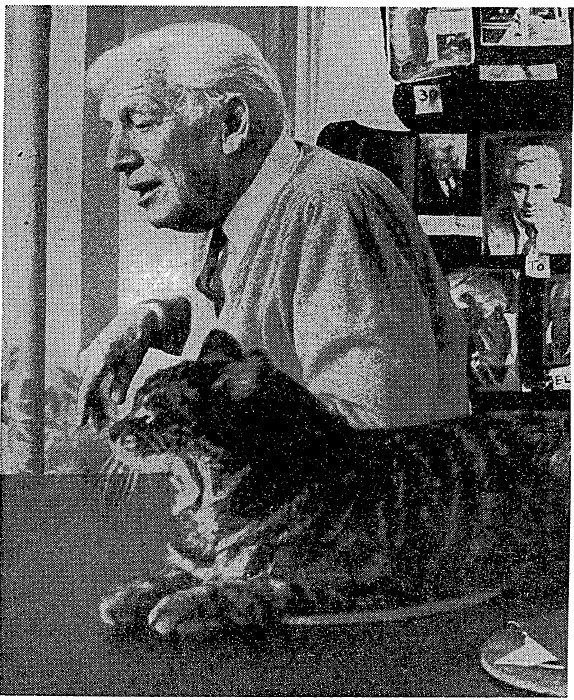
The article closes with a photo from
The New York Times (by Michael Evans)
Max Eastman, with his tabby Twiggy, during the interview at his home on West 13th Street.
>

Have You A Country? (Revolt, January 15, 1916)

This is a letter published in Vol. I, No. 2 of Revolt (dated January 15th, 1916), an Anarchist newspaper edited by Hippolyte Havel and published by the Revolt Publishing Association, 63 East 107th Street, New York, N. Y. The copy came to us by way of a facsimile edition published by The Match!, a journal of Ethical Anarchism, published from Tucson, Arizona. The letter was contributed by Robert Minor, and appears on pp. 6-7 of the issue.

British Labor shows fight. The army poison hasnt twisted their brains as much as their bosses had hoped for. It gives a fellow's heart a quicker throb to know that even in the mob-crazy war country, Labor can hold up its head and be Labor still. In times of peace, workers know that capitalists are their enemies; in time of war they are often fools enough to go fight their friend workers of another country for the sake of the capitalist enemies that they have been fighting at all other times. They've got to learn better, and it looks as though the English are learning. Hurrah for the English! (That means English Labor, not the Greedy British Empire, their greatest enemy.)

They are not perfect by a long sight, but neither are we, nor any other labor. They are improving, that's the point. They have got their bosses so badly worried as to be afraid to make a daring stand for their crooked privileges. It is really amusing. Go to it, friends; you may weaken and be fooled later on, but even then, the little start you have made in defying conscription will not be forgotten, and the world will profit by the example.

May we do as well here in America. It's our turn now. Conscription is at the door, the back door, trying to sneak in. Stand up, American Labor! You ought to do even better, without the disadvantage of actual war upon you. You haven't any country. No labor, anywhere, has any country. So don't be patriotic. Be Labor. And fight to GET your country, not to help your bosses hold it.

HAVE you a country? Then, why do you pay rent?

Robert Minor.

Now online: two British labor manifestos on World War I

Continuing our collection of historical sources and political documents from the 1910s, especially those related to World War I, I'm happy to announce that the Fair Use Repository now features the complete text of two manifestos from British labor organizations taking on the outbreak of World War I.

  • On August 1, 1914, the British Section of the International Socialist Bureau published the Manifesto to the British People, written by J. Keir Hardie and Arthur Henderson, arguing that Whatever may be the rights and wrongs of the sudden, crushing attack made by the militarist Empire of Austria upon Servia, it is certain that the workers of all countries likely to be drawn into the conflict must strain every nerve to prevent their Governments from committing them to war.

  • In September 1914, the Parliamentary Committee of the Trades Union Congress issued a Manifesto to the Trade Unionists of the Country, supporting the war, praising the Labour Party's role in the government's military enlistment campaign, urging working-class men to enlist voluntarily in order to demonstrate to the world that a free people can rise to the supreme heights of a great sacrifice without the whip of conscription, and calling on the government to ensure that enlisted men receive at the hands of the State a reasonable and assured recompense, not so much for themselves as for those who are dependent upon them, and to take a liberal and even a generous view of its responsibilities toward those citizens who come forward to assist in the defence of their country.

The manifestos are taken from versions reprinted in the wartime anthology, Labour in war time (1915), by George Douglas Howard Cole; I initially put them up in order to fill out the references made to each of the two manifesto's in Guy Aldred's That Economic Army, which refers to each of them in the course of Aldred's analysis of economic conscription, and how it had turned virtually all of English politics and civil society towards support of the war machine.

Now online: full text of MOTHER EARTH IX.9 (November, 1914)

I'm happy to follow up our earlier announcement with an announcement that the Fair Use Repository now features the complete text of all the articles from the November 1914 issue of Mother Earth.

Most of the issue is occupied with Anarchist responses to, and debate over, the outbreak of World War I: Kropotkin on the Present War reprints Peter Kropotkin's letter to Gustav Steffen, supporting the French government's fighting in World War I; Alexander Berkman's In Reply to Kropotkin calls Kropotkin to task and argues that Anarchists should oppose all sides in all government wars. Goldman and Berkman followed this argument with a reprint of Chapter I of Kropotkin's own Wars and Capitalism, written in 1913, in which Kropotkin had skewered the French government's motives and argued that wars were the product of imperial capitalism and that the reason for modern war is always the competition for markets and the right to exploit nations backward in industry. In addition to the exchange over Kropotkin's letter, this issue also features That Economic Army, an article by Guy A. Aldred originally printed in the London Spur, which traces how the state and capital, during wartime, deformed the entire economy to draw not only men, but entire industries, into collaboration with the war machine, out of economic interest.

Alongside the discussion of the war, Vol. IX. No. 9 also features:

  • The Persecution of Margaret Sanger by Harry Breckenridge, a defense and a call for working-class solidarity with Margaret Sanger and the Woman Rebel, then facing Federal prosecution for obscenity (for distributing articles on birth control and scientific information about sexual health).

  • Black Friday of 1887 by M. B., a slashing review of the Socialist journalist Charles Edward Russell’s discussion of Haymarket in his memoirs, and a commemoration of the Haymarket martyrs hanged 11 November 1887.

  • My Lecture Tour by Alexander Berkman, an announcement of Berkman's upcoming lecture tour of the Midwest, with talks on War--At Home and Abroad, Unemployment and War, War and Culture, The War of the Classes, Is Labor Justified in Using Violence? Crime--In and Out of Prison, and The Psychology of Crime and Prisons.

  • Emma Goldman Dates by Emma Goldman, an announcement of Emma Goldman's upcoming lectures in Chicago on anti-militarism, Anarchism, and a lecture series on drama , as well as announcing dates for upcoming lecture series elsewhere in the Midwest.

I'm happy to have this issue of Mother Earth available in full. More issues should be coming soon.

Read, cite, and enjoy!

Now online: four articles from MOTHER EARTH (November, 1914): Anarchist responses to World War I and a commemoration of the Haymarket martyrs

I'm happy to announce that the Fair Use Repository now features four complete articles from the November, 1914 issue of Mother Earth:

  • Kropotkin on the Present War by Peter Kropotkin -- a reprint of Kropotkin's letter supporting the French government's fighting in World War I;

  • In Reply to Kropotkin by Alexander Berkman -- in which Berkman calls Kropotkin to task, argues that the international working class has no real stake in bosses' wars, and calls on Anarchists to oppose all sides in all government wars.

  • Wars and Capitalism (Chapter I) by Peter Kropotkin, a reprint of Kropotkin's earlier analysis of war, from 1913, in which he argued that the reason for modern war is always the competition for markets and the right to exploit nations backward in industry.

  • Black Friday of 1887, by M. B., a slashing review of the Socialist journalist Charles Edward Russell's discussion of Haymarket in his memoirs, and a commemoration of the Haymarket martyrs hanged 11 November 1887.

These are the first set of articles to be put online from Mother Earth Volume IX, Number 9; more will come soon. I believe that the complete issue should be available online by the end of the week.

Read, cite, and enjoy!