Fair Use Blog

Countereconomics on the shopfloor

So lately I’ve been reading through a cache of syndicalist and autonomist booklets that I picked up a couple years ago from a NEFACker friend of mine who was soon to move out of Vegas. Partly for my own edutainment, but also because I am doing some prep work for possibly introducing a sort of Little Libertarian Labor Library to the ALL Distro.[1] Anyway, here’s a really interest passage I ran across in a booklet edition of Shopfloor Struggles of American Workers — a talk by the Detroit auto-worker and autonomist Marxist Martin Glaberman — on the difference between asking workers to vote on an issue and asking them to strike over it, taking as an example the internal conflicts over the union bosses’ no-strike pledge during World War II.

One of the things I want to start with, because it does provide a framework, and is not simply an event from the past, is something I did some work on a number of years ago about auto workers in the United States during World War II, the kinds of struggles that went on on the shop floor, within the union, between the workers and the government, a complex reality. What it revolved around was the struggle against the no-strike pledge in the UAW When the United States entered World War II, virtually all of America’s labor leaders graciously granted in the name of their members a pledge not to strike at all during the war.

In the first months of the war, the first year, there was an actual drop off in strikes. The end of 1941 through 1942 was a period that put a finish to the late thirties, the massive organizational drives, the sit-down strikes, the violence, all the things that created the big industrial unions. The job hadn’t been entirely done. Ford wasn’t organized until early 1941. Little Steel wasn’t organized, unionized, until the war was well under way, and so on.

Gradually, however, as the war went on, the number of strikes, (by definition all of them were wildcats, all of them were illegal under union contracts and under union constitutions) began to escalate until by the end of the war, the number of workers on strike exceeded anything in past American labor history. What was distinct about the UAW wasn’t just that the wildcat strikes were larger in number and more militant, but the fact that something took place which made it possible to make a certain kind of record. It was the only union in which, because there were still two competing caucuses, leaving rank and file workers a certain amount of democratic leeway to press for their point of view, an actual formal debate and vote took place on the question of the no-strike pledge.

A small, so-called rank and file, caucus was organized late in 1943 and early 1944, to begin a campaign around a number of issues, but the central issue was the repeal of the no-strike pledge. … So[2] they proceeded to have a referendum. This referendum was in some respects the classic sociological survey. Everyone got a postcard ballot. Errors, cheating, etc. were really kept to a minimum. Everyone on the commission thought that it was as fair as you get in an organization of a million or more members. It took several months to do. When the vote was finally in, the membership of the UAW had voted about two to one to reaffirm the no-strike pledge.

The conclusion any decent sociologist would draw is that autoworkers on the whole thought that patriotism was a little bit more important than class interests, that they supported the war rather than class struggle and strikes, etc. There was a little problem, however, and this is why this is such a fascinating historical experience. The problem was that at the very same time that the vote was going on, in which workers voted two to one to reaffirm the no-strike pledge, a majority of autoworkers struck ….

To visualize it is fairly simple: you’re not voting on the shop floor; you get this postcard, you’re sitting at the kitchen table, you’re listening to the radio news with the casualty reports from Europe and the Pacific and you think, yes, we really should have a no-strike pledge, we’ve got to support our boys. Then you go to work the next day and your machine breaks down and the foreman says, Don’t stand around, grab a broom and sweep up, and you tell him to go to hell because it’s not your job and the foreman says he’s going to give you time off and the next thing you know, the department walks out. … The reality is that in a war which was probably the most popular war that America took part in, workers in fact, if not in their minds or in theory, said that given the choice between supporting the war or supporting our interests and class struggle, we take class struggle.

— Martin Glaberman, Shopfloor Struggles of American Workers (1993?)

Glaberman puts this out as a distinction between what workers say in their minds or in theory and what they say or do in fact. I’m not sure that’s right — doesn’t the story about the foreman involve the workers’ mind and beliefs just as much as the story about the kitchen table? — but I think the most important thing here is Glaberman’s attention to the context at the point of decision, and how that shapes what kind of decision a worker thinks of herself as making. Not just the outcome of the choice, but really the topic, whether the worker is asked to make some kind of political choice about what she ought, in some general and detached sense, she ought to value (isn’t Patriotism important?), or she finds herself making an engaged, personal choice about what’s happening — what’s being done — to her and her fellow workers right now, on the margin. There is a lesson here for counter-economists.

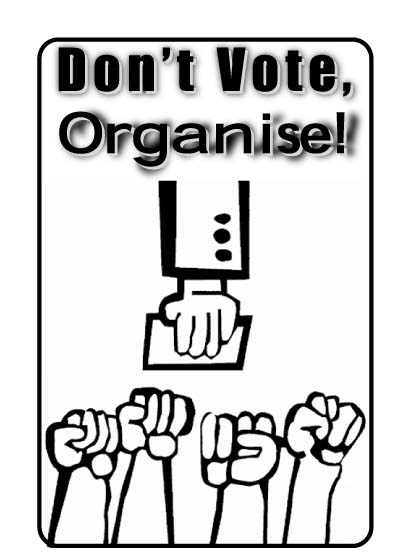
Freedom is not something you vote on. It’s something you struggle for. And what’s far more important than trying to figure out how to get people to endorse the right ideology, or, worse, the least-bad set of policies and candidates to each other across the kitchen table, is figuring out how you and your neighbors can best cooperate with each other, practice solidarity and withdraw from maintaining and collaborating with the state. People who would never respond to a smaller-government candidate or a libertarian ideological pitch often will act very differently when you open up opportunities to support grassroots alternatives and withdraw from the day-to-day inhumanities of war taxes, regulations, police, prisons, borders, and the state-supported and state-supporting corporate capitalist economy. Meanwhile, those who talk all day about changing votes, and building parties to more effectively capture a few more votes here and there, and have nothing else to offer, are wasting time, resources, and organizing energy on efforts that are not merely futile, but in fact actively lethal to any hope of motivating and coordinating effective practical action.

See also:

  1. [1] The basic idea: L4 would encompass some of the material we already have (Chaplin’s General Strike, Carson’s Ethics of Labor Struggle) and a lot of new and classic material, with new titles published at regular intervals, all with the basic underlying goal of (1) providing some decent labor-oriented materials for ALL locals, and (2) providing a decent source (mostly, currently, lacking) for IWW local organizing committees and other radical labor efforts to find some decently produced, low-cost booklet-style materials for lit drops and outreach tables, beyond just the IW, Anarcho-Syndicalist Review, and the relatively expensive books you can purchase through GHQ. ↩
  2. [2] [After an inconclusive floor debate in convention. —RG] ↩

Now online: Full text of two more issues of MOTHER EARTH — Vol. VI., No. 11 (January, 1912) and Vol. VII., No. 12 (February, 1913)

Three months ago, I happily announced that the complete text of the November 1914 issue of Mother Earth had been made available at the Fair Use Repository. To-day, I'm pleased to follow up that announcement -- with the announcement that the Fair Use Repository now features the complete text of three issues of Mother Earth. The two issues recently made available are:

Mother Earth, Vol. VI., No. 11 (January, 1912)

This issue is mainly occupied with the arts and revolution. It leads off with Blaming the Fester, a poem by Rebekah E. Raney. The New Year is a fundraising appeal on the occasion of Christmastime and the New Year, while Observation and Comments includes short reports on current events -- delays in the publication of Prison Memoirs of an Anarchist, the trial of the bosses who'd locked workers into the the Triangle Shirtwaist Factory, strikes and conspiracy trials around the country, Big Bill Haywood's feud with the Socialist Party of America, and more.

Paul Orleneff offers a celebratory review (unsigned, but probably written by Emma Goldman) of the actor's performances in New York. A Review of the Year, by Harry Kelly, and the continuation of a serialized article by Voltairine de Cleyre on The Mexican Revolution, discuss revolutions and uprisings flaring up throughout the world in 1911. In The Right to Live M. B. argues that political rights are empty without workers' material control over the means of their own survival (the organization of society in a manner to insure to each the material basis of life and make it as self-evident as breathing). Max Baginski reviews the Autobiography of Richard Wagner, taking it as evidence of the old commonplace that one can be a great artist and yet small as a man, and concluding that The suffocating dependence of artistic production upon wealth and patronage should cause the true artist--who is not content to produce mere market ware--to turn relentlessly rebel against the existing standards, to become a communist. ... The dream that Wagner once dreamed in Art and Revolution will some day be realized by the people,--nor will they need the aid of philosopher or king. The issue concludes with a continuation of the serialized article Economy as Viewed by An Anarchist by C. L. James, on the historical emergence of the bourgeois system and its connections with past forms of economic hierarchy, as well as with the subjection of women.

Mother Earth, Vol. VII., No. 12 (February, 1913)

The February 1913 issue has a few things to say about the State and a lot to say about the union struggle, Syndicalism, and government repression of striking workers. The issue leads off with To Our Friends, an appeal for readers to help widen the circulation of the journal, followed by another monthly instalment of short reports in Observations and Comments -- including remarks on the inauguration of Woodrow Wilson, the futility of appeals to the law, the advantages of direct action, new strike arbitration laws in New Zealand (among the first such labor laws in the world), the legal repression of Anarchists in the U.S., police scandals in Denver, and the incorporation of the Rockefeller fund.

James Montgomery's The Black Hundreds of Plutocracy and Government discusses the use of private security forces, with tacit or explicit government approval, to inflict large-scale violence on striking workers. The New Idol, a translation of an excerpt from Friedrich Nietzsche's Also Sprach Zarathustra, declares the State the coldest of all cold monsters. Theodor Johnson's Help Save These Comrades! reports on the case of a group of striking Swedish dock workers, who had been sentenced to life imprisonment for a bomb plot, and calls for international solidarity to get their sentences commuted. Making a Strike a Crime government's assault on the rights to picket and speak freely, with the imprisonment of dozens of peaceful picketers and speakers in Little Falls, New York during a textile mill strike. Intolerance in the Union comments on growing regimentation and bureaucratic control within conservative trade unions and reprints a letter from a comrade discussing his objections to a corrupt bargain made by his union's labor bosses, which resulted in his being persecuted by the labor bosses and expelled from the union. Syndicalism: Its Theory and Practice concludes a long article by Emma Goldman on state-free Syndicalist organizing, with a discussion of Syndicalism's characteristic methods -- Direct Action, Sabotage, and the General Strike. The issue concludes with Anarchist writer and teacher Bayard Boyesen's review of Alexander Berkman's Prison Memoirs of an Anarchist, and with an announcement of dates for Emma Goldman's lecture tour through the Midwest.

Onward

These issues complete a set of three reprinted issues of Mother Earth that I picked up from a table at the Bay Area Anarchist Bookfair. I'd very much like to make available more of Mother Earth's print run online. A number of partial and complete issues -- mostly earlier issues -- are currently available from The Anarchy Archives, and a fair amount is available for browsing in Google Books. But I'd like to liberate the latter from the Google Books's inaccurate automatic markup, often capricious behavior, and hypertext-unfriendly environment. And in any case, there are a lot of gaps to fill in. If you have any suggestions on issues to prioritize, or good lines on copies to be transcribed, please feel free to leave a comment here, or contact me with the details.

Read, cite, and enjoy!

Now online: two British labor manifestos on World War I

Continuing our collection of historical sources and political documents from the 1910s, especially those related to World War I, I'm happy to announce that the Fair Use Repository now features the complete text of two manifestos from British labor organizations taking on the outbreak of World War I.

  • On August 1, 1914, the British Section of the International Socialist Bureau published the Manifesto to the British People, written by J. Keir Hardie and Arthur Henderson, arguing that Whatever may be the rights and wrongs of the sudden, crushing attack made by the militarist Empire of Austria upon Servia, it is certain that the workers of all countries likely to be drawn into the conflict must strain every nerve to prevent their Governments from committing them to war.

  • In September 1914, the Parliamentary Committee of the Trades Union Congress issued a Manifesto to the Trade Unionists of the Country, supporting the war, praising the Labour Party's role in the government's military enlistment campaign, urging working-class men to enlist voluntarily in order to demonstrate to the world that a free people can rise to the supreme heights of a great sacrifice without the whip of conscription, and calling on the government to ensure that enlisted men receive at the hands of the State a reasonable and assured recompense, not so much for themselves as for those who are dependent upon them, and to take a liberal and even a generous view of its responsibilities toward those citizens who come forward to assist in the defence of their country.

The manifestos are taken from versions reprinted in the wartime anthology, Labour in war time (1915), by George Douglas Howard Cole; I initially put them up in order to fill out the references made to each of the two manifesto's in Guy Aldred's That Economic Army, which refers to each of them in the course of Aldred's analysis of economic conscription, and how it had turned virtually all of English politics and civil society towards support of the war machine.