Fair Use Blog

Max Eastman Is ‘Sorry’ For Today’s Rebels (Alden Whitman, New York Times, Jan. 9, 1969)

Here is an article on Max Eastman and his reflections on the New Left in his old age. This article appeared in The New York Times of January 9, 1969 (p. 33).

Max Eastman Is 'Sorry' For Today's Rebels

By ALDEN WHITMAN.

One of the country's reigning radical writers and agitators of a half-century ago looked this week at today's young militants and found more to pity than to praise.

He is Max Eastman, editor of the Socialist periodical, The Masses, and its successor, The Liberator, in the years before and during World War I. Widely influential in left-wing and labor circles, these magazines printed articles by Mr. Eastman and by, among others, John Reed and Floyd Dell. Art Young and Robert Minor were among the cartoonists.

Twice Faced Trial

Because of antiwar articles in The Masses, Mr. Eastman was twice brought to trial amid nationwide publicity, charged with conspiracy to obstruct the draft. The charge was dropped after two Federal juries were unable to agree on a verdict.

I feel kind of sorry for these young rebels of today, he said in an interview last Saturday at his West 13th Street apartment that marked his 86th birthday. He was on his way from Martha's Vineyard, where he and his wife spend their summers, to a winter home in Barbados.

They have an emotion not unlike ours, he continued, running his fingers through a shock of fine, snow-white hair. They want to make a revolution but they have no ultimate purpose.

I have a certain emotional sympathy for them, but they are rather pathetic because they have no plan. They just seek a revolution for its ow sake.

By contrast, said Mr. Eastman, glancing from his padded chair around a room festooned with Christmas and birthday cards, We had a program and a purpose, which was to make over capitalism into Socialism, and it was based on an ideal and on an ideal and on an ideology.

With a vigor that belied his years, the ruddy-faced Mr. Eastman categorized the radicals of the New Left as the bohemian wing of the bourgeoisie, sons and daughters of the well-to-do, who have no real class affiliation and no alliances with the working class.

It is not possible, he said in slow, measured tones, to bring about a revolution--except on a class basis--unless by some sort of fluke.

Asked why today's rebels appeared to lack an ideology, he declared:

Socialism was once a plausible plan, but when Socialism failed completely and produced a totalitarian tyranny [in the Soviet Union under Stalin], it left social ideas without a theoretical basis.

Mr. Eastman stressed, though, that there were some similarities between rebels in 1969 and those of his era.

Mood Called the Same

The mood of militance is the same, he asserted, and so is the general rejection of convention. But many of today's restive youth are caught up in trivialities. Obscenity, for example.

Having broken with the Socialist movement (but I never considered myself a Marxist, not even in The Masses days in 1913) when his friend Leon Trotsky was read out of the Communist party by Stalin in 1926-27, Mr. Eastman made his own transition from radicalism to the Reader's Digest. He has been a roving editor for that publication since 1941.

The author and poet indicated hat his outlook for social change in the United States and the world was gloomy. He doubted, he said, that this country needs a revolution, or that one was possible either from the New Left or the Negro community. Negro militants, he said, are bound to raise hell, but they can't make a revolution.

We have to patch up the world as it is and accept it, although I don't feel very happy about it, Mr. Eastman said.

Like many writers, he has given no thought to retirement. Doubleday is to publish this spring a translation he made many years ago of Trotsky's account of Lenin's youth.

The manuscript, which Mr. Eastman had believed lost, turned up in the Harvard library a few years ago. It chronicles the Bolshevik leader's life up to when he joined the Russian revolutionary movement after becoming a lawyer in St. Petersburg, now Leningrad.

In addition, Mr. Eastman is collecting a number of essays and portraits of his contemporaries for publication soon. These, he remarked with a twinkle in his bluish eyes, are to be entitled Bull in the Afternoon and Other Essays.

The lead essay, a criticism of Ernest Hemingway's Death in the Afternoon, precipitated the famous set-to between the two authors.

Fresh in His Mind

That encounter, which took place in 1937 in the office of Max Perkins, an editor at Scribner's, was still fresh in Mr. Eastman's mind.

Hemingway shoved an open book against my nose, he recalled, and accused me of saying that he lacked virility. I grabbed him by the throat and threw him--or backed him up--over Perkins's desk and onto his back on the floor.

The two men's friendship, never thereafter the epitome of cordiality, is now largely a mellow memory for Mr. Eastman. In addition to the piece on Hemingway, Mr. Eastman plans to include his new book essays on H. L. Mencken, Bernard Berenson and Sherwood Anderson.

At 86, an author is still an author.

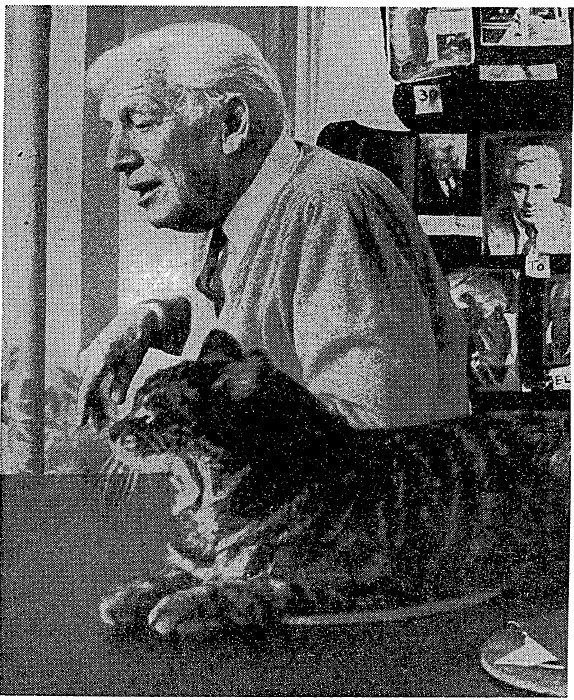
The article closes with a photo from
The New York Times (by Michael Evans)
Max Eastman, with his tabby Twiggy, during the interview at his home on West 13th Street.
>

“An Open Letter to Barry Goldwater,” by Karl Hess, in Ramparts (October 1969)

This is an article of Karl Hess's, which appeared in the October 1969 issue of the New Left magazine Ramparts, pp. 28-31. Hess had been a close friend of Barry Goldwater during the early 1960s and had worked as the chief speechwriter in his 1964 presidential campaign.

An Open Letter to Barry Goldwater

It probably isn’t the highest or hottest item on your agenda, but every now and then you might think about why we are now on opposite sides of the fence—or why the fence is growing more like a barricade every day. My side is what is loosely called the New Left, a position to which you will undoubtedly refer a thousand times in a thousand speeches but about which, if the present is an indication, you will know less and less the more often you mention it.

The thing that first attracted me to the New Left was the familiar ring of what was being said there. Decentralization. The return to the people of real political power—of all power. There was also something very attractive in the New Left’s analysis of the American corporate system and its use of political power to preserve and enlarge itself. The way the largest corporations had so strenuously opposed you and supported Johnson, for instance, certainly made it seem fruitful to ask why. Could it have been that you might not have played ball quite so well as he?

There was, of course, a seemingly dissonant sound in the New Left’s attitude toward American adventures abroad. You had championed, and I had fully seconded, the notion that, morally, American arms could and should be used anywhere to fend off incursions by THEM. The crucial question which I permitted, even forced, myself to ask—and which you must never face if you are to hold onto your position in regard to THEM—was simply Who are THEY? And, lo and behold, THEY turned out to be a lot of US.

Let’s face it, we were trying to have it both ways. On the one hand, we spoke of freedom and liberty; on the other, of arming, adventuring, seeking and grasping. We spoke of a world that could not be half slave and half free, but we worked for a world that would be all American. We spoke of the evils of federal power but clucked approval at the same evils on a local scale. We spoke of letting the blacks in on our shuck, but when it came to liberation, we spoke of law and order.

Contradictions like these inevitably tear apart any structure—even a friendship, even a world—once you see them. Because you are, so far as my experience has permitted me to judge, the most essentially honest and potentially radical major American political figure, I am still betting that they could tear apart your position and that some day you will find yourself on this side of the barricades. As a matter of fact, the last time we met you were edging in this direction anyway. You described it yourself one day during your successful 1968 campaign for reelection to the Senate. We were in your living room, just shooting the shit. When the histories are written, you said, I’ll bet that the old right and the New Left are put down as having a lot in common and that the people in the middle will be the enemy. That’s right. They do and they are.

That same week, as I recall, you spoke at the University of Arizona where you said that you had much in common with the anarchist wing of SDS. Anarchist! SDS! Remember? You said those words and you were not struck by lightning. And the point is that you have, or at least had, a lot in common with most of SDS. Now it’s probably their turn to snort in disbelief and even derision, and I do admit that I have passed over lightly such details as imperialism, but at least both of you—you then, SDS now—have sought to grasp certain political problems radically, by the roots.

Even before you made your speech about some commonality of interest with SDS, former SDS president Carl Oglesby knew that there was at least a historic echoing from the right of positions which have come to be regarded as New Leftist. Senator Taft, for instance, led the fight against NATO, making many of the same points that SDS makes on a broader scale about imperialism. I know that you departed long ago from a foreign policy position even roughly akin to Senator Taft’s, but perhaps knowing that the New Left’s position did not spring full-blown from the brow of Chairman Mao might at least let you examine, or re-examine, America’s role as the world’s policeman and protector of markets.

Why even bother with the suggestion? The answer is probably more romantic than reasonable. Common sense tells me that the rhetoric has ended and the revolution has begun. But nostalgia keeps suggesting that maybe we could speak for a minute and even agree that it would be far better, and so very much more decent, to give up power rather than having to go through, once again, the agony of having it taken away. I know you at least sensed this once as you contemplated the many changes you felt were inevitable and not very far off.

You caused virtual apoplexy among conservatives when you spoke, as you did in 1964, of the inevitability of world government, which you saw as developing through the political enlargement of such military arrangements as NATO. Your perception of change was right on. Your notion of how it would be accomplished, if you think about it (which I must admit too few of us did during the hectic days of the campaign), was a flat contradiction of your other principles—those regarding the return of political power to individuals. For a man as suspicious of central government as you were, the idea of accepting even the possibility of one huge, overall, overpowering government was 180 degrees off. Clarence Streit and other liberals thought it a silver lining in your otherwise cloudy aspect, of course. And there again you were quite correct in your perception: liberals are fatheads. The only thing worse than a big government is a bigger one!

It was the New Left that most sharply outlined the direction which was consistent with your root principles—decentralization. SDS’s early movement into neighborhood organizing was a manifestation of this. The current and, I think, monumentally significant work on neighborhood government by Milton Kotler—a colleague of mine at the Institute for Policy Studies—is more emphatically libertarian in nature than any single statement, action, stance or proposal of the entire Republican Party, with the Democrats thrown in to boot. And the present movement of SDS out into the neighborhoods, fields and factories, as well as into the schools, is deeply involved with putting power back where you, most emphatically of all working politicians, always said it belonged: in the hands of the people—not the people of some sociological abstraction, but the people in one-by-one, community-by-community reality.

In the long liberation of the blacks in this slave-haunted land, you also perceived a transfer of power as sharply as anyone—back then. You spoke of blacks having to have real political power before they could be free, and you risked and got a political mudbath by emphasizing that power far and beyond the then currently chic bullshit about bigger and better welfare checks, bigger and better federal fetters for a people already bloody from white, liberal legislation.

Today there are blacks who are putting into practice what you spoke about. They are struggling for real political power and they will get it even if they have to take it in combat. The Black Panthers are the vanguard of that struggle. Nineteen have died in it so far. They are in black reality the echo of a white past which you supposedly respect and even revere—the first American Revolution.

Senator, if you had been born black, and poor, you would now be a Panther or I seriously misjudge the strength of your character and convictions.

The Panthers are dying for the sort of liberty that you used to talk about. Dying, boss, not talking. Can’t you hear a brother’s voice even when it’s his last gasp? Extremism in the defense of liberty is no vice and moderation in the pursuit of justice is no virtue, and where in the name of Jefferson, Adams, and that grandfather of yours who said fuck foreign kings and wars and came to the U.S., where in all their names is there a more extreme grasp for liberty and justice than in this black colony now breaking away? Here are people who desperately needed some fellow extremist somewhere up there in hazy Washington to talk to, and all they heard was law and order, law and order, the clanking of cell doors, the thud of clubs and the crack of small arms fire.

There won’t be a chance to talk now because wars are much too loud. But while there was a chance, where were you? Where were we all—all of us who made our living talking about liberty, and then didn’t recognize it when it started flowering at our feet, because the petals were black and red and not red-white-and-blue.

I guess it would have been political suicide to talk to a Panther when you wanted to get back into the Senate. But you faced that once before and didn’t even flinch. Remember?

In 1964, it seemed as if there were a real possibility of racial trouble resulting from your campaign. I happen to think you are as color-blind as any man in American politics, but the image of your most red-necked followers blurred it all, and the race issue was a rising concern. To make matters worse, some of your most respected political advisors (real professionals) had talked long and loosely enough about the beneficial effects of racial disturbances on your candidacy to ring alarms for anyone. They claimed that one good race riot would put you in office. They knew, long before Spiro Agnew and probably as soon as George Wallace, that millions of white Americans were just bone scared of the black liberation movement and that it would take very little violence to shake out any government and put in any man with a tough reputation—and that’s just the kind you had.

I am convinced that, had it not been for one crucial action by you, efforts to incite racial trouble would have been inevitable. But you took the action, risking your entire candidacy as you did it. You called in some key reporters for an off-the-record briefing and made a single point: you said that if any racial trouble resulted from your candidacy, you would drop out of the race even if it were the day before the election. It was a flat unqualified pledge and I know you meant it. It not only stopped any insane incendiarism among your supporters, but it also put you on the line for killing your candidacy if there was trouble—whatever the cause.

You see, it’s things like that—the sort of gut courage and conviction that corporate liberals and the country club conservatives who so admire you couldn’t even imagine—that makes me miss you here on this side of the barricades.

But this side, you probably feel, is not anti-communist and you have spent an entire lifetime fighting Communism. Well, so had I. And because it was so easy just to fight, I had stopped thinking about what the hell it was we were fighting about in the first place. I would judge, by all I can read, that anti-communists today are operating almost exclusively from information, images and mind-sets formed in the Thirties and Forties.

Fresh from the horror of the purge trials, the slaughter in the Ukraine, the rise of Stalinism, it was easy to be anti-communist then. It was so easy, in fact, that it distorted the entire direction of the right in America. Its direction had been very individualistic, isolationist, decentralist—even anarchistic—and certainly radical compared to the corporate statism that had been rising ever since Herbert Hoover refined the process of federal rationalization of the economy.

Anti-communism twisted the direction of the right, which I feel, if left undisturbed, would today be near the New Left on most major issues. Unexamined anti-communism made possible these cop-outs: that the proper role of government could be the enhancement of industrial growth and corporate profit as a part of building a strong nation to beat back the Red peril; that citizenship training had to be intensified, education redirected, and certain liberties foresworn in order to—dig it—preserve liberty.

I will bet you an autographed picture of Jerry Rubin against a Readers Digest flag decal that not one of your friends who are so oburatelyobdurately anti-communist today can honestly fill you in on the essential differences between communism in North Korea, Viet-Nam, and Cuba—and Russia. Between China and Poland, between Rumania and Hungary and so forth. And I would double the whole bet that they wouldn’t even know where to look to find out what the Panthers, SDS, and the New Left in general have to say about Soviet Communism, about small c communism, about Marcuse, about anything.

Senator, the world has changed. The Provisional Revolutionary Government in South Viet-Nam (that’s our bunch, not yours) has issued a political platform which evidences much of the concern for individual liberty, freedom of trade and ownership of actually private property that Republicans used to rhapsodize about before they won political power. Have you read it? Or if you have read it but not believed it, have you actually tested your doubts?

I suppose that even mentioning Viet-Nam would cause you to stop reading this—if you’ve even begun. I know how deeply you feel about it, because once I did also and in just the same way. I’ll just sketch what happened and suggest that if you ever care to follow the same path, who knows, we might yet bump into each other again.

We thought that Viet-Nam was another case of international communism trying to bend the free world’s borderlines. Diem was reisting THEM—a story that was easy to buy and impossible to prove. But in truth, the NLF was local, and was bent on pursuing justice for the South Vietnamese who were being stripped of land and political power by Diemist politicians. From there on, the errors were compounded.

You once said that it wasn’t worth a single American life just to save face in Viet-Nam. But how many lives is it costing today to do just that? Today the face is Richard Nixon’s. Yesterday it was Lyndon Johnson’s. At least you took a crack or two at Lyndon. Is your friend Dick really any different? Or have you changed your mind about that fatal ratio between face and lives?

It occurs to me, Senator, that there is a document written by a fellow named Goldwater, an ex-Air Force general, that bears on this issue. It was a position paper you prepared for an Air Force project, as I recall. It discussed convergence between the communist and non-communist nations, but you didn’t see convergence as simply a matter of the two blocs coming together. You felt that perhaps as the communist bloc broke up and the demands of the people were felt, free institutions would develop strongly there, but that at the same time they might crumble in the other bloc. There could be a time, you felt, when Eastern Europe would be moving into freedom while America was sinking into tyranny.

Isn’t there something familiar going on today? Aren’t there in fact more difference between the communist parties of Eastern Europe than between, say, the Democrats and Republicans in this country? Aren’t we showing a tendency to side with the Soviets against dissident communist regimes—China being a foremost example? Isn’t there a revival among your very colleagues in the Senate and House of the security-law syndrome that did so little but hurt so much during the Fifties? Wasn’t there something more than just signpost sloganeering in the description of the Chicago police riot as Prague West? Isn’t Czechoslovakia just Russia’s Viet-Nam—not as brutal or bloody but just as politically obscene?

If you ever got a chance to read the New Left’s literature you might feel a jolt of recognition, page after page, as you found an analysis of the U.S.-U.S.S.R. detente that makes many of the points you once made. I can imagine that the word left would turn you off; yet, in an historical sense, you were a prominent leftist when you attacked established power, as you used to attack it. You even wrote several times of your position as being classically liberal—classically, that is, leftist. Is it socialism that still haunts the phrase for you? It shouldn’t. You are now supporting an administration which is practicing the sort of industrial-military socialism that Bismarck developed. Is the socialism of, for instance, neighborhood control of the community’s resources really more frightening than that?

Which reminds me of Ocean Hill-Brownville, or People’s Park. Senator, they were doing just what you used to talk about. You should have been there. Your old ideas were.

You used to make the liberals froth when you spoke against federal influence in the schools. Federal money, you used to say, inevitably leads to federal pupils, and the liberals turned pale, threw up their dickies, and said you were a heartless monster. Well, they treated McCoy the same way at Ocean Hill when he said that his folks should run their own school and not your folks.

And your old buddy Ronald Reagan! Now there’s a lesson in liberty for you. On one side of People’s Park there is the State of California with its right of eminent domain. It took the land. I would say it stole the land. How, I wonder, do you describe the right of eminent domain? On the other side are people who have an exotic notion about ownership. They don’t think it should be exercised at the point of a gun or a bayonet. They worked that land. They homesteaded it. They owned it in a sense far deeper than any government proclamation. Think of it that way: a scrap of government paper on one side; real people on the other, and your old friend Ronald Reagan, so help us, now supporting that scrap of paper against the people, with as much bloodcurdling diligence as any man you ever fought in the political arena. Senator, are you really sure you want to be a deputy sheriff for state power? That’s just what you are on the other side of the fence at the People’s Park!

Student dissent generally? Why did you have to come down so solidly on the side of the police? Don’t you remember that they are the employees of the state, not the people? Why couldn’t we have heard your rebel voice, instead of your company manners, when push came to shove at Berkeley and Columbia? Wasn’t that a time to re-examine the entire structure of the system? Was there any more appropriate man to do it, after the years you had spent talking about the dangers of a schooling that might force people to conform rather than encourage them to think? Why couldn’t you, of all men, see what was on the other side of those broken windows on the campus?

We had a discussion once about the campus scene, and it seemed clear to me that you would be in a far different position as a student than you are as a senator. Not long ago, you reminded me, marijuana was as common a smoke as burley in the Southwest. Nobody thought much about it, you said. I don’t really know what you thought about it then, but I can’t imagine anyone else in the Senate with your sort of good, bull-headed devotion to politically inadvisable principles, who could better take the lead in stopping the insane rampage against young people going on across the country in connection with a drug which, you freely admit, was as common as and much less troublesome than whiskey back where you came from.

The draft is another raid on young people that you did take the lead on—once. It was your very first presidential campaign pledge. You didn’t bullshit about it. You said that as president you would end the draft. Period. Just end it. You didn’t fuzz it up with after the emergency or after we study it, like your chum Dick. You may recall that the draft was the subject of our very last conversation. In preparation for your return to the Senate, I had worked up material for a flat-out repeal of the draft which, I felt, could appropriately be your first order of business when you were in the Senate and, hopefully, raising hell instead of brownie points.

I don’t cry about politics anymore, but if I did, I surely would have when you replied that in regard to anti-draft legislation you thought you should wait and see what Dick Nixon was going to do! You know what Dick Nixon always does! He shillies for a while. Then he shallies. Then he very carefully sets out in every direction at once, arriving exactly nowhere some time later, but promising that tomorrow he’ll begin again.

But, since you've returned to the Senate, it seems as if you are forever checking with someone to see if the coast is clear. You used to tell a joke about the little old lady you met in the hotel lobby who asked if you didn’t used to be Senator Goldwater. It’s getting less funny as time goes on. Something is happening out in the world, out on the streets. Much of it involves things you have said and thought throughout your life; much it involves things with which you profoundly disagree but which you should at least subject to a new dialogue. All of it involves a basic crisis, the sort of broken faith in state power that you have urged, the sharp awareness of the meaning of political power as the power of people against the power of overriding institutions. On the other hand (I mean the other side, your side now), there is ossification, resistance to radical change, support of vested power, liberal reformism, rule and repression by fiat and that most abhorrent of all organically collectivist notions—that the state really can and should claim the loyalty, blood and lives of all born to its borders and its bias.

Maybe that’s where you want to be after all. If I had only read about you, over the years, I would come to that conclusion and let the matter drop as being of little real importance. But instead, I have worked with you over the years. I think that even with the absolute disagreement I now have with you in regard to American imperialism, corporate-state capitalism, and anti-communism, there is such a crucial point of mutual interest on the New Left in regard to political power (it properly exists only in the people and in their communities) that you should be here and not over there. Because that’s where it’s at today, Senator. Here or there. The left of the individual people of this entire earth, taking back the power that the politicians and the exploiters stole from them, or the right of reaction, of established authority, of vested interests, of police, politics, and power.

There was a time when you used to drive the professional pols stark, staring mad because whenever you discovered that you had made a mistake on a position you would just come right out and say, Folks, I was wrong. Now here’s how it is.

Well, again, take a long, hard look at the contradictions between liberty at home, imperialism abroad; anti-colonialism abroad, black colonialism at home; free markets in the speeches, state-industrial-complex in the reality; local responsibility in the platforms, local suppression in the precinct houses; anti-communism for Castro, detente for Brezhnev; unshirted hell about welfare programs, unzippered lust for warfare programs.

I will have to admit that there is not exactly a long line queued up on the New Left waiting to hear from you. But there’s a hell of a lot more room for you over here, I would think, than in a Republican Party which regards Everett Dirksen as a hero and you as a maverick, respectable now only because you seem to have been broken to the bit.

In case you want to visit my side some time, there are a lot of pamphlets and things around that you might find interesting. And ideas. And, most of all, people. Good people. Love to see you over here. But if not, that’s okay. We’ll be up your way sooner or later anyway. See you. Right on.

Karl Hess is a former editor of Newsweek. He was the principal author of the 1960 Republican platform, a co-author of the 1964 platform, and Goldwater’s chief speech writer.

Joseph Déjacque on Revolution (from The Revolutionary Question)

Now available thanks to Shawn P. Wilbur at Contr'un:


Of the Revolution

Principles :

Liberty, equality, fraternity

Consequences:

Abolition of government in all its forms, monarchic or republican, the supremacy of one alone or of majorities;

But anarchy, individual sovereignty, complete, unlimited, absolute liberty of everyone to do everything which is in the nature of the human being.

Abolition of Religion, whether catholic or Israelite, protestant or any other sort. Abolition of the clergy and the altar, of the priest,–curate or pope, minister or rabbi;–of the Divinity, idol in one or three persons, universal autocracy or oligarchy;

But the human being,–at once creature and creator,–no longer having anything but nature for God, science for priest, and humanity for altar.

Abolition of private property, property in the soil, in buildings, in the workshop, in the shop, property in everything which is an instrument of labor, production or consumption;

But collective property, unified and indivisible, possession in common.

Abolition of the family, the family based on marriage, on paternal and marital authority, on heredity;

But the great human family, the family united and indivisible like property.

The enfranchisement of women, the emancipation of children.

Finally, the abolition authority, privilege, and antagonism;

But liberty, equality, fraternity incarnated in humanity;

But all the consequences of the triple formula, passed from theoretical abstraction into practical reality, into positivism.

That is to say Harmony, that oasis of our dreams, no longer fleeing like a mirage before the caravan of the generations and delivering to each and all, under the shade of fraternity and in universal unity, the sources of happiness, the fruits of liberty: a life of delights, finally, after an agony of more than eighteen centuries in the sandy desert of Civilization!

[From “The Revolutionary Question.” Working translation by Shawn P. Wilbur]

Read the whole thing at Contr'un.

“The Mexican Revolution (Continuation),” by Voltairine de Cleyre (1912)

This article on the progress of the Mexican Revolution, by the American Anarchist writer and speaker Voltairine de Cleyre, appeared in Mother Earth, Vol. VI No. 11 (January, 1912).

This law of unappropriated lands, says Wm. Archer, has covered the country with Naboth's Vineyards. I think it would require a Biblical prophet to describe the abomination of desolation it has made.

It was to become lords of this desolution that the men who play the game,--landlords who are at the same time governors and magistrates, enterprising capitalists seeking investments--connived at the iniquities of the Diaz régime; I will go further and say devised them.

The Madero family alone owns some 8,000 square miles of territory; more than the entire state of New Jersey. The Terrazas family, in the state of Chihuahua, owns 25,000 square miles; rather more than the entire state of West Virginia, nearly one-half the size of Illinois. What was the plantation owning of our southern states in chattel slavery days compared with this? And the peon's share for his toil upon these great estates is hardly more than was the chattel slave's--wretched housing, wretched food, and wretched clothing.

It is to slaves like these that Madero appeals to be frugal.

It is of men who have thus been disinherited that our complacent fellow citizens of Anglo-Saxon origin say: Mexicans! What do you know about Mexicans? their whole idea of life is to lean up against a fence and smoke cigarettes. And pray what idea of life should a people have whose means of life in their own way have been taken from them? Should they be so mighty anxious to convert their strength into wealth for some other man to loll in?

It reminds me very much of the answer given by a negro employee on the works at Fortress Monroe to a companion of mine who questioned him good-humoredly on his easy idleness when the foreman's back was turned: Ah ain't goin' to do no white man's work, fo' Ah don' get no white man's pay.

But for the Yaquis, there was worse than this. Not only were their lands seized, but they were ordered, a few years since, to be deported to Yucatan. Now Sonora, as I said, is a northern state, and Yucatan one of the southernmost. Yucatan hemp is famous, and so is Yucatan fever, and Yucatan slavery on the hemp plantations. It was to that fever and that slavery that the Yaquis were deported, in droves of hundreds at a time, men, women and children--droves like cattle droves, driven and beaten like cattle. They died there, like flies, as it was meant they should. Sonora became desolated of her rebellious people, and the land became pacific in the hands of the new landowners. Too pacific in spots. They had not left people enough to reap the harvests.

Then the government suspended the deportation act, but with the provision that for every crime committed by a Yaqui, five hundred of his people be deported. This statement is made in Madero's own book.

Now what in all conscience would any one with decent human feeling expect a Yaqui to do? Fight? As long as there was powder and bullet to be begged, borrowed, or stolen; as long as there is a garden to plunder, or a hole in the hills to hide in!

When the revolution burst out, the Yaquis and other Indian people said to the revolutionists: Promise us our lands back, and we will fight with you. And they are keeping their word magnificently. All during the summer they have kept up the warfare. Early in September, the Chihuahua papers reported a band of 1,000 Yaquis in Sonora about to attack El Anil; a week later 500 Yaquis had seized the former quarters of the federal troops at Pitahaya. This week it is reported that federal troops are dispatched to Ponoitlan, a town in Jalisco, to quell the Indians who have risen in revolt again because their delusion that the Maderist government was to restore their land has been dispelled. Like reports from Sinaloa. In the terrible state of Yucatan, the Mayas are in active rebellion; the reports say that The authorities and leading citizens of various towns have been seized by the malcontents and put in prison. What is more interesting is, that the peons have seized not only the leading citizens, but still more to the purpose have seized the plantations parceled them, and are already gathering the crops for themselves.

Of course, it is not the pure Indians alone who form the peon class of Mexico. Rather more than double the number of Indians are mixed breeds; that is, about 8,000,000, leaving less than 3,000,000 of pure white stock. The mestiza, or mixed breed population, have followed the communistic instincts and customs of their Indian forbears; while from the Latin side of their make-up, they have certain tendencies which work well together with their Indian hatred of authority.

The mestiza, as well as the Indians, are mostly ignorant in book knowledge, only about sixteen per cent. of the whole population of Mexico being able to read and write. It was not within the program of the civilizing regime to spend money in putting the weapon of learning in the people's hands. But to conclude that people are necessarily unintelligent because they are illiterate, is in itself a rather unintelligent proceeding.

Moreover, a people habituated to the communal customs of an ancient agricultural life do not need books or papers to tell them that the soil is the source of wealth, and they must get back to the land!--even if their intelligence is limited.

Accordingly, they have got back to the land. In the state of Morelos, which is a small, south-central state, but a very important one,--being next to the Federal District, and by consequence to the City of Mexico,--there has been a remarkable land revolution. General Zapata, whose name has figured elusively in newspaper reports now as having made peace with Madero, then as breaking faith, next wounded and killed, and again resurrected and in hiding, then anew on the war path and proclaimed by the provisional government the arch-rebel who must surrender unconditionally and be tried by court martial; who has seized the strategic points on both the railroads running through Morelos, and who just a few days ago broke into the federal district, sacked a town, fought successfully at two or three points with the federals, blew out two railroad briadges and so frightened the deputies in Mexico City that they are all clamoring for all kinds of action; this Zapata, the fires of whose military camps are springing up now in Guerrero, Oaxaca and Pueblo as well, is an Indian with a long score to pay, and all an Indian's satisfaction in paying it. He appears to be a fighter of the style of our revolutionary Marion and Sumter; the country in which he is operating is mountainous and guerrilla bands are exceedingly difficult of capture; even when they are defeated, they have usually succeeded in inflicting more damage than they have received, and they always get away.

Zapata has divided up the great estates of Morelos from end to end, telling the peasants to take possession. They have done so. They are in possession, and have already harvested their crops. (Morelos has a population of some 212,000.)

In Pueblo reports in September told us that eighty leading citizens had waited on the governor to protest against the taking possession of the land by the peasantry. The troops were deserting, taking horses and arms with them.

It is they, no doubt, who are now fighting with Zapata. In Chihuahua, one of the largest states, prisons have been thrown open and the prisoners recruited as rebels; a great hacienda was attacked and the horses run off, whereupon the peons rose and joined the attacking party.

In Sinaloa, a rich northern state,--famous in the southwestern United States some years ago as the field of a great co-operative experiment in which Mr. C.B. Hoffman, one of the former editors of the Chicago Daily Socialist, was a leading spirit,--this week's paper reports that the former revolutionary general Juan Banderas is heading an insurrection second in importance only to that lead by Zapata.

In the southern border state of Chiapas, the taxes in many places could not be collected. Last week news items said that the present government had sent General Paz there, with federal troops, to remedy that state of affairs. In Tabasco, the peons refused to harvest the crops for their masters; let us hope they have imitated their brothers in Morelos and gathered them for themselves.

The Maderists have announced that a stiff repressive campaign will be inaugurated at once; if we are to believe the papers, we are to believe Madero guilty of the imbecility of saying, Five days after my inauguration the rebellion will be crushed. Just why the crushing has to wait till five days after the inauguration does not appear. I conceive there must have been some snickering among the reactionary deputies, if such an announcement was really made; and some astonished query among his followers.

What are we to conclude from all these reports? That the Mexican people are satisfied? That it's all good and settled? What should we think if we read that the people, not of Lower but of Upper, California had turned out the ranch owners, had started to gather in the field products for themselves, and that the Secretary of War had sent U.S. troops to attack some thousands of armed men (Zapata has had 3,000 under arms the whole summer and that force is now greatly increased) who were defending that expropriation? If we read that in the state of Illinois that farmers had driven off the tax-collector? that the coast states were talking of secession and forming an independent combination? that in Pennsylvania a division of the federal army was to be dispatched to overpower a rebel force of fifteen hundred armed men doing guerrilla work from the mountains? that the prison doors of Maryland, within hailing distance of Washington City, were being thrown open by armed revolutionaries?

Should we call it a condition of peace? regard it as proof that the people were appeased? We should not: we would say the revolution was in full swing. And the reason you have thought it was all over in Mexico, from last May till now, is that the Chicago press, like the eastern, northern, and central press in general, has said nothing about this steady march of revolt. Even The Socialist has been silent. Now that the flame has shot up more spectacularly for the moment, they call it a new revolution.

That the papers pursue this course is partly due to the generally acting causes that produce our northern indifference, which I shall presently try to explain, and partly to the settled policy of capitalized interest in controlling its mouthpieces in such a manner as to give their present henchmen, the Maderists, a chance to pull their chestnuts out of the fire. They invested some $10,000,000 in this bunch, in the hope that they may be able to accomplish the double feat of keeping capitalist possessions intact and at the same time pacifying the people with specious promises. They want to lend them all the countenance they can, till the experiment is well tried; so they deliberately suppress revolutionary news.

Among the later items of interest reported by the Los Angeles Times are those which announce an influx of ex-officials and many-millioned landlords of Mexico, who are hereafter to be residents of Los Angeles. What is the meaning of it? Simply that life in Mexico is not such a safe and comfortable proposition as it was, and that for the present they prefer to get such income as their agents can collect without themselves running the risk of actual residence.

Of course, it is understood that some of this notable efflux (the supporters of Reyes, for example, who have their own little rebellions in Tabasco and San Luis Potosi this week), are political reactionists, scheming to get back the political loaves and fishes into their own hands. But most are simply those who know that their property right is safe enough to be respected by the Maderist government, but that the said government is not strong enough to put down the innumerable manifestations of popular hatred which are likely to terminate fatally to themselves if they remain there.

Nor is all this fighting revolutionary; not by any means. Some is reactionary, some probably the satisfaction of personal grudge, much no doubt the expression of general turbulency of a very unconscious nature. But granting all that may be thrown in the balance, the main thing, the mighty thing, the regenerative revolution is the reappropriation of the land by the peasants. Thousands upon thousands of them are doing it.

Ignorant peasants: peasants who know nothing about the jargon of land reformers or of Socialists. Yes: that's just the glory of it! Just the fact that it is done by ignorant people; that is, people ignorant of book theories; but not ignorant, not so ignorant by half, of life on the land, as the theory-spinners of the cities. Their minds are simple and direct; they act accordingly. For them, there is one way to get back to the land; i.e., to ignore the machinery of paper land-holding (in many instances they have burned the records of the title-deeds) and proceed to plough the ground, to sow and plant and gather, and keep the product themselves.

Economists, of course, will say that these ignorant people, with their primitive institutions and methods, will not develop the agricultural resources of Mexico, and that they must give way before those who will so develop its resources; that such is the law of human development.

(To be Concluded)
Voltairine de Cleyre (1912)