Fair Use Blog

“Peaceable Secession an Absurdity” (New York Evening Post, November 12, 1860)

52. Peaceable Secession an Absurdity

(New York Evening Post [Lincoln], November 12, 1860)

In behalf of the treachery and imbecility of the Administration at Washington the new doctrine is invoked that each state has a right peacefully to secede--that nullification of any particular law of Congress is to be resisted and punished by the government, but that secession, i.e., the absolute nullification and defiance of all such laws, and of the Constitution and of the Union, is perfectly right and within the power, at all times, of each and every state. The faithless members of the cabinet seek thus to shelter themselves and their partisans in disunion from resistance by the general government, while the imbeciles aim in the same way to find an excuse from [sic] shrinking from their duty of affirmative and energetic action for which they lack courage if not principle.

A more monstrous and absurd doctrine than that of the right of any state at its pleasure to secede from the Union has never been put forth. the government in such case would indeed be a mere rope of sand. According to this dogma, Cuba, after we shall have paid $200,000,000 for her purchase, as a state may at once secede, and leave the United States Treasury to place that small item to the account of "profit and loss." Texas, when she came into the Union after we had paid many millions to discharge her debts, and other millions to go into her coffers, was and is entirely at liberty to secede with the booty. Each and all the states carved out of the Louisiana purchase, for which we also paid such an immense sum, may do the like.

So, too, states in which the largest amounts of the public property may be situated may at any time secede with that property. When the Pacific Railroad shall be constructed, at an expense of countless millions, paid from the common treasure, the two or three states through which it will run may decamp with the plunder and plant a custom-house on the site of our storehouses. Vermont, New Hampshire, Indiana, Illinois, Ohio, Kentucky, Tennessee, and the other inland states, which will have contributed to these great disbursements, and in which states hardly a dollar of the public treasure is even [ever?] expended, are to look quietly and approvingly on the exodus of those which have been thus purchased and enriched at their expense, and to recognize the right of each of them to secede and take the property with them.

Again, if this right exists it exists at all times, until no two states remain united. What, then, would become of the national debt and the national credit? To whom would the creditors of the government look for payment? Should the government be, as it may at any time be, indebted on its stocks hundreds of millions of dollars, its creditors could look, in case of secession, only to the states which should remain united. Those which should have seceded and established independent governments could not be reached. The creditor could claim of them no percentage of liability. They would plead that they had never contracted, and that they had been only stockholders in a corporation in which there was no individual liability.

Nor could the continuing government of the United States compel the payment by the seceding state of a portion of the public debt. There would be no data from which a definite percentage could be assigned to it, nor would it have the ability to pay. If South Carolina finds it [161] necessary to repudiate at the outset by suspending specie payments, and (as already foreshadowed) by annulling even private debts due by its citizens to those of other states, it is plain that both ability and principle will be lacking for payment of her share (if it could be allotted) of the public debt. There is no court by which any fixed amount could be established as due from her on account of that debt, or which could issue execution for its payment. It results therefore that the seceding state could only be compelled to pay any share of the national debt (contracted on her account, as well as that of the other states) by war and reprisals by the general government. This puts an end to the idea of peaceable secession and the right of secession.

But can any of the democratic book-keepers tell us how (if payment could be compelled) they could make out the account current between the seceding state and the government, so as to strike a balance between the debit and the credit sides? Large amounts have been expended by the government on her account and within her borders. Forts for her harbors, light-houses, court-houses, coast-surveys, custom-houses, nonpaying postoffices and post routes, and salaries of the swarms of officers and leeches attendent upon all these, in addition to her undefinable share of the public debt, have all been paid. But then she has a credit side of the account also, which it will be impossible to adjust. How are we to ascertain the values and the proportions thereof to which she is entitled of the public arms and ammunitions of war, arsenals, ceded places, public edifices, ships of war, and of the public lands? Is there any court, or is there any form of action by which partition can be made of the territories? This last item is a very material one, for the only point of principle on which the secessionists take issue with the Republicans as to the platform of the latter (adopted at Chicago) is that of carrying slavery into the territories. What foothold or property in the territories will the seceders retain on leaving the Union? They will be foreign states, and we believe it has not yet been claimed, even by Judge Taney, that the laws of foreign states extend proprio vigore over the territories.

Another difficulty in making up the account with South Carolina would result from her claiming an almost incalculable credit for the disproportion of the public burdens which she fancies she has borne in the confederacy, by reason of what she considered the unequal operation of the various revenue laws.

Now, this right of secession, if it exist at all, is an absolute one, and a state has as much right to exercise it at one time as at another. If she may secede at will, she may do so in anticipation of war, or in time of [162] war. If she can secede when she chooses, she owes no allegiance to the government an hour after she decides to secede, but will then be just as independent of the government as she is of any other nation. In the midst of war, then, it will be the right of any state not only to desert our own government, but at the same time to ally herself with the enemy. The Hartford Convention complained that New England was heavily taxed, but not defended by the general government, and merely proposed to ask the consent of the government to expend in the defence of New England the taxes raised in New England. This was not claimed as a right, but the consent of the government was to be sought. This was hardly an approach to secession, but the democracy of that day did not tolerate even the proposition, and the Hartford Convention was execrated.

But the absurdity of this new doctrine of the right of secession is too palpable for serious argument. The government under such a principle could not have twenty-four hours of assured existence. Neither other nations, nor its own citizens, could have confidence in its permanence. It would lack the vital principle of existence, because it would wholly lack credit. Nobody would lend it a dollar, for nobody could be sure that it would hold together long enough to pay a six months' loan, to say nothing of loans for long terms of years. The public faith, on which alone all who deal with governments can repose, would be utterly lacking. Business could have no security or stability, for men would not embark either their industry or their capital, unless under the shelter of laws and institutions not liable to change.

No--if a state secedes it is revolution, and the seceders are traitors. Those who are charged with the executive branch of the government are recreant to their oaths if they fail to use all lawful means to put down such rebellion. The people of no party base any confidence either in the fidelity or nerve of the Administration in Washington, but fear they will prove, some of them from inclination and others from timidity, practical allies of the revolutionists. They and their partisans have done all in their power to inflame and mislead the South, by charging upon the northern states the design of interfering with the rights of the people of the South, and the mercenaries here have co-operated in this false clamor and deception. The Administration, in relinquishing the government will endeavor to leave all possible embarrassments in the way of its successors, but we much mistake if those of its partisans here who have been foremost in the false work, will not be the first with whom the consequent mischief will come home to roost.

Howard Cecil Perkins, ed. Northern Editorials on Secession, Volume I (Gloucester, Mass.: Peter Smith, 1964), 158-162.

“Our Foreign Relations” (New-York Daily Tribune, June 3, 1861)

423. Our Foreign Relations

(New-York Daily Tribune [Lincoln], June 3, 1861)

Whoever reads attentively the recent debate on American affairs in the House of Lords will find it difficult to detect therein any trace of that ill will toward our Government or disposition to aggravate our intestine troubles which is popularly supposed to animate the councils of the Western European Poewrs. That there are Britons high in rank and station who would see without profound regret the dismemberment and ruin of the Great Republic, we cannot doubt; that a kindred impulse is rife though latent among the dignitaries and courtiers of most monarchies, we believe; but that any of the Great Powers is disposed or likely to take any position or step calculated to disturb our international amity, we do not credit. On the contrary, the tone of the debate aforesaid, and of European official utterances generally, is marked by eminent dignity, moderation, and anxiety to give no just cause of offense to our Government or People.

Has this evident desire to maintain amicable relations with us been fairly met on this side of the water? We think not. In many quarters a disposition to take offense at trifles and aggravate slight differences into causes of serious quarrel has been manifested. Some of our valorous contemporaries have seemed to think that, since we are in for a fight anyhow, we might as well make a job of it, and polish off Great Britain, France, Spain, and perhaps two or three others, before we return to our plows, our anvils, and our ledgers. We dissent from this view altogether, insisting that we shall first finish up the little matter we have in hand, and then, if we have other accounts to settle, proceed with them seriatim, until the last shall have been fully adjusted.

A good deal of not unnatural feeling has been excited among us by the language of Lord John Russell importing thta our Government and that of Jeff. Davis are to be accorded respectively the rights of "belligerents." We do not consider his expression felicitous, and we are confident that, if the subject were now to come up originally, different language would be chosen. But consider well the circumstances under which that language was uttered.

The doctrine that a government in fact is to be regarded by foreign powers as a government of right is emphatically of American origin. Up to this year, we have steadfastly commended and adhered to it. By virtue of it, we were among the first to recognize the independence of the South American republics, of Mexico and of Texas. By virtue of it, [973] our Minister at the French Court was the first to recognize the Republic of 1848. Respect for it paralyzed the tongues which would have gladly pleaded for a manly American protest against the bloody and perfidious Napoleonic usurpation of December, 1851. In virtue of it, we gave an early and emphatic recognition to the new Kingdom of Italy, in contravention of the historical rights of the Pope, the Grand Duke of Tuscany, and a baker's dozen of sovereign princes. By virtue of it, should the People of Hungary or of Ireland at any time declare themselves independent and expel the officials and the troops of their hereditary rulers, we shall undoubtedly and promptly recognize their separate Nationality and sovereignty. The right and wrong of their quarrel with those rulers is a matter with which we profess to have absolutely nothing to do. We simply state the American doctrine on this point, without caring to argue it. Having bravely and determinedly upheld it in the face of the Holy Alliance and in contempt of all the time-honored canons of European diplomacy, we cannot creditably repudiate it at the very first instance in which it is brought to bear on ourselves, and when all the world seems to be coming round to the position on which we formerly stood alone.

Now look at the case in its main aspects, as it was known in Europe at the moment when Lord John made his demonstration, premising that a foreign minister is not at liberty to discriminate between the late and the present of our quadrennial Administrations. He must deal with our Government as a unit subsisting in perpetuity, and having the sole guardianship of its own consistency.

In December last, the little State of South Carolina professed to secede from, and sever all connection with, the American Union. She thereupon seized the Federal arms and munitions on deposit in the Arsenal at Charleston, the Federal custom-houses within her boundaries--whereof that at Charleston must alone have cost several hundred thousand dollars--the money in the Federal Sub-Treasury, &c., &c.--and went to collecting revenue from imports in those stolen custom-houses in her own name exclusively, and for her own benefit. Of the forts in Charleston harbor, she seized all but the strongest, and closely invested that, planting battery after battery in ever-narrowing circles around it, and repelling by force the only two attempts ever made to replenish its slender stock of provisions. She arrested the U.S. Collector at Georgetown for high treason in attempting to continue the collection of revenue for the Union. The Federal Judge, Collector, &c., at Charleston renounced the service of the Union and entered that of the State. All these doings went on openly, ostentatiously, within two days' [974] journey, by mail, of the Federal Metropolis, within three days' steam of New-York; yet not a precept was issued, not a musket leveled, in behalf of the repudiated authority and violated laws of the Nation. Georgia, Alabama, Mississippi, Louisiana, Florida, and Texas, rapidly following suit, stealing a million dollars from the Mint at New-Orleans, capturing all the forts and arsenals within their limits, save Fort Pickens and the inaccessible island strongholds within the geographical limits of Florida, seizing several Federal vessels and the Navy-Yard at Pensacola, while fully one-third of our little Army, hitherto employed in the defense of the inland frontiers of Texas, was first demoralized and then subjected to a capitulation by its traitorous commander, Twiggs, and even the stipulations made with him in its favor, were ultimately repudiated by his Confederate villains, who thus robbed the troops of their arms, and compelled them to surrender as prisoners of war.

This process went on unresisted, unobstructed, in the face and eyes of an Executive half of whose Ministers were deep in the councils of unequivocal traitors. But Congress also was in session throughout the three Winter months, and did nothing whatever to arrest it. Meantime, half of our Embassadors in Europe were helping on the treason, introducing the emissaries of Jeff. Davis furtively to the ministers of foreign affairs with whom they maintained official relations, and Mr. C. J. Faulkner volunteered a formal assurance to the French Government that no forcible resistance to the progress and triumph of Secession would be made by the Federal Government!

Now we state but the most obvious, undeniable truth when we say that if Austria, or Great Britain, or Russia, had suffered herself in like manner, and without a shadow of resistance, to be divested of Hungary, of Ireland, of Poland, respectively, the other Great Powers would have assumed that the separation was tacitly conceded and final. Authority which does not even try to enforce obedience, power which does not differ practically from impotence, is not understood in Europe--and can we wonder? Suppose Ireland, a single fortress excepted, were to-day free from the presence of a British official or soldier, and had so remained unmolested, unmenaced, for months, would not her independence be acknowledged outright by our Government? How could the natural and urgent demand for such recognition be plausibly resisted?

But a new Administration was installed at Washington three months ago. What then? Was Fort Sumter promptly reënforced and provisioned? Was it even given out that it would be so soon as the necessary force could be collected? Nay; was an expedition at once set on foot--no matter how secretly--to achieve that end? Were loyal collectors [975] appointed for Charleston, Savannah, Mobile, New-Orleans, and Galveston, to replace those who had forfeited if not formally abjured their offices by plunging into treason? Was any attempt promptly made, or even promised, to enforce the revenue laws of the Union in the ports of the disloyal States? The facts are on record. They speak for themselves.

But it is said that Lord John Russell and M. Thouvenel should not have received, even unofficially, the emissaries of our Sepoys. How so? did not Mr. Seward, our own Foreign Minister, hold conference after conference with their counterparts accredited to Washington? The propriety, the policy of so doing, is not now in question. For our own part, we cannot deem it unwise to hear what your adversary has to propose or suggest before proceeding to extremities with him. But it must not be forgotten that if Mr. Jeff. Davis's envoys were liable to the treatment of traitors anywhere, it was at Washington, not at London or Paris; and that it ill became M. Thouvenel to refuse to receive Americans whom any Plenipotentiary at his Court commended to his distinguished consideration. We strongly suspect, though we do not know, that Messrs. Yancey and Mann were equally favored by Mr. Dallas at London.

What the Unionists of America ask of Europe is simply and only fair play. If with this we cannot thrash the Secessionists into good behavior--promptly, and thereby, conclusively--then we will frankly and heartily acknowledge their independence. They pretend to be accredited and sustained by the Eight Millions of Whites in the seceded States, and thence argue that they cannot be beaten. Their conclusion would be safe is their promises [premises?] were true; but they are not. We feel sure that this War against the Union is the result of years of conspiracy and plotting--that it was fermented by systematic fraud and falsehood--that it has been swelled to its present formidable proportions by wholesale and persistent lying on the stump, lying through the newspapers, and lying by telegraph, until a great portion of the Southern People are utterly deluded and driven to frenzy by assertions that the North envies and hates them, is bent on their destruction by fire, famine, and slaughter, and is raising vast armies to steal their slaves, burn their houses, ravage their fields, and outrage their wives and daughters. Give us a fair chance to disabuse them, and then let them have a fair, peaceful election, and the South would give a Union majority to-morrow, as the election of last Winter clearly indicated. Deceived, maddened as they are, there is still a very large minority of the Southern PEople, and especially of the more intelligent and responsible classes, who still at heart "carry the flag and step to the music of the Union." Silenced by [976] terrorism, compelled to vote for Secession at the point of the bowie knife, to surrender their property to the horse-leech exactions of the traitors, and even to take up arms in support of treason, they yet sight for the halcyon days of peace and security so "vilely cast away," and hope for their return through the triumph of the armies now mustering for the defense of the integrity of the Nation. All we ask of Europe is to be well let alone until we shall have had a fair opportunity to demonstrate that inflexible purpose of the American People not to be split up into half a dozen miserable Venezuelas and Nicaraguas, but to maintain the Republic in its entirety and with its recognized geographical limits as they appear on any reputable Atlas or globe. Let the Old World remain strictly neutral, refusing to lend money to either party, or to harbor the priveteers [sic] of either, and if we do not vindicate our right to be a great nation, we will agree to be content with the secondary position to which dismemberment must temporarily consign us. We ask but a clear field and no favor, and may God defend the Right!

Northern Editorials on Secession Volume II, 972-976.

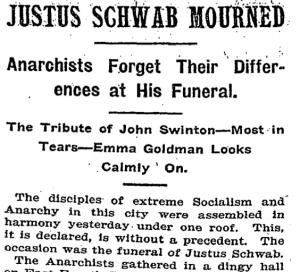
“Justus Schwab Mourned: Anarchists Forget Their Differences at His Funeral,” in the New York Times (December 21, 1900)

Yesterday's post mentioned Justus Schwab, a German-American radical and a fixture of the New York Anarchist milieu, who kept a radical "Beer-Hole" on First Street where Anarchists, socialists, writers, artists, and other radicals and misfits met to drink and talk into the night. Emma Goldman later described his saloon as "the most famous radical center in New York." Here is an item from the December 21, 1900 issue of the New York Times, on Schwab's death and his funeral, which brought together New York radicals across factional lines and putting aside schisms and personal breaks to celebrate his memory.

>

JUSTUS SCHWAB MOURNED

>

Anarchists Forget Their Differences at His Funeral.

>
The Tribute of John Swinton--Most in Tears--Emma Goldman Looks Calmly On.
>

>

The disciples of extreme Socialism and Anarchy in this city were assembled in harmony yesterday under one roof. This, it is declared, is without a precedent. The occasion was the funeral of Justus Schwab.

The Anarchists gathered in a dingy hall on East Fourth Street. All differences were forgotten, and there was not a single man or woman who gave evidence of any feeling other than sorrow at the loss of the dead disciple. At times during the speeches which were made over the body almost every one there broke down and wept. Dark, bearded faces that had worn a scowl of discontent for years were softened with grief, and men who had been bitter enemies of Justus Schwab while he was alive cried like children.

Emma Goldman, the woman Anarchist leader, who had been the dead man's closest friend, was the only one present who did not give some indication of emotion. She sat calmly throughout the ceremonies, although John Most, who had been opposed to Schwab for years, gave way completely to his grief several times.

The funeral services were held in the assembly room of the Labor Lyceum at 64 East Fourth Street. The body was taken from the room over the saloon at 50 First Street, where Schwab had lived, early in the day and placed on a bier in the middle of the assembly room. The coffin was open so that the face of the dead man could be seen, and coffin and bier were draped with flags. The emblem of Anarchy was wrapped around the coffin and thrown over the lower part of it, and flags from various labor unions hung below. There was a pile of flowers that brightened up the dark hall, arranged on a table at one end. There were wreaths from Cigar Makers' Union No. 90, from an Italian Anarchist society, and from the Social Science Club.

The funeral service was marked by the absolute absence of any religious ceremonial, and consisted of speeches by various friends of the dead man. The band of the Carl Sahm Club, which was stationed at one end of the hall, played a dirge that seemed to harmonize with the sombre surroundings, and the Lieber Tafel Singing Society, which the dead Anarchist had founded, sang Eventide. George Biederkapp, the author of a book of Socialist poems, recited an original poem eulogizing Schwab, entitled, The Storm Has Passed, and when he had taken his seat almost every one in the room was in tears. Alexander Jonas, a Socialist leader, made a short speech in German and was followed by John Swinton, who spoke in English.

I am entirely overcome, he said, when I attempt to speak of our dead brother. I have never known a man so self-sacrificing, so faithful, so noble.

John Most, who had been the leader of the Anarchist faction opposed to Schwab, was the next speaker. He spoke in German and in the most dramatic manner. When he had completed his speech he was evidently exhausted, and sank into a chair as the pall-bearers lifted the coffin and carried it out to the hearse, which was waiting for it.

As the hearse started slowly down Second Avenue, followed by a few carriages, nearly 2,000 people, many of them in tears, fell in line behind it. The procession passed by the little saloon where Schwab had lived and then proceeded slowly to the ferry at the foot of East Houston Street. All along the route the windows of the tenements were filled with people. At the ferry the carriages followed the hearse and the Anarchists on foot dispersed quietly. The body was taken to Fresh Pond, L. I., for cremation.

Source

“Defeat of the Communists,” in The New York Times (January 14, 1874)

Here's another account from the mainstream New York press -- this time, from the New York Times -- on the New York "Committee of Safety" and on the police attack on labor protesters in Tompkins Square. Like the previously posted stories from the Herald, the paper treated the protest as a project of "The Communists," in the midst of the United States' first great Red Scare. Also notable here is an early press appearance for Justus Schwab, here arrested with a red flag around his waist, later known and beloved by the Anarchist community in New York City as the owner of a "Beer-Hole" on First Street, which provided a meeting-place for radicals, political refugees, writers and artists that Emma Goldman remembered as "the most famous radical center in New York."

Here's the story, printed in the New York Times, on January 14, 1874.

>

DEFEAT OF THE COMMUNISTS

>

THE MASS-MEETING AND PARADE BROKEN UP.

>
ENCOUNTER BETWEEN THE MOB AND THE POLICE--ARREST OF RIOTERS.
>

>

The Police Commissioners wisely refused permission to the Communists to parade yesterday. There would have been no objection to an honest working men's parade, but the great majority of the working men, through their acknowledged representatives, disclaimed all connection with the projection display, and it was therefore considered unadvisable to permit a few malcontents to disturb the peace of the City. The events of yesterday sufficiently proved the wisdom of the prohibition, and the bad spirit that unfortunately is rife among the more worthless sections of the community. In spite of the refusal it was stated early in the day that the meeting would be held, and by 10 o'clock Tompkins square and vicinity were occupied by perhaps 3,000 persons of the lowest class, most of whom, however, were probably there out of idle curiosity. At 10:15 the Police, under Commissioner Duryee and Capts. Walsh, Murphy, Tynan, and Allaire, with platoons from their respective precincts, the Seventeenth, Eleveneth, Eighteenth, and Twenty-first, marched into and cleared the square, while a mounted squad scoured the streets in the vicinity. Capt. Walsh, with Sergts. Cass and Berghold and twenty-two men, made for the largest crowd, assembled round a banner inscribed The Tenth Ward Working Men's Organization, and here there was a fray, in which Sergt. Berghold had his head broken, and his assailants fared no better. They told their stories afterward at the Seventeenth Precinct Station-house, corner of Fifth street and Second avenue, where they were conveyed, and at which thenceforward the interest centered. Christian Meyer, who struck the Sergeant, confessed his misdeeds with much naivete, as he was sitting with head bandaged and a broken wrist in a sling in the officers' quarters. He said he was a painter by trade, belonging to an association with 3,000 members; that there were about 100 of them only present; that every one was armed in some way, his own weapon being a claw-hammer, with a thong to put his hand through; and that they had orders not to fight unless they were attacked. The Sergeant pushed him, so he obeyed orders and hit the Sergeant. Justus Schwab, another captive, who wore a red flag around his waist, said his father had served four years' imprisonment for riot at Frankfort, Germany: that he had been four years and eight months in the country, and fourteen weeks out of work. He thought every man should defend the State, and that the State should provide for every man. He thought the working men would triumph, and commenced to sing the Marseillaise, a performance which was checked. On Hofflicher, another leader, was found a somewhat elaborate Communistic badge. The vicinity of the station-house for several blocks was thronged until quite late in the afternoon, and in the Bowery as far down as Canal street, knots of men were gathered on the corners as late as 2 o'clock, waiting for the procession. In the vicinity of the Seventeenth Precinct Station-house the task of dispersing the multitude kept the officers well employed. There were incessant skirmishes in which clubs were judiciously applied with seasonable but not excessive severity, and prisoners were continually being brought in. The scrambles of the mob as the officers advanced were not unamusing; in fact, it seemed as if they rather enjoyed the exercise. The housetops and windows for blocks were crowded with patient spectators.

At 3:45 P. M. the prisoners were marched to Essex Market Police Court, and arraigned before Justice Flammer, who held them in default of $1,000 bail each. The schools soon after filled the streets with children and a more respectable class of citizens appeared. The trouble was evidently over. It was at no time beyond easy control. The forbearance and good humor of the Police were admirable. There were unpleasant incidents, however, which showed plainly that a neglected spark might have been fanned into a dangerous flame amid the unamiable passions abroad. Alderman Kehr, about noon, was passing through Fourth street, when he was recognized, and as the cry was raised, Here's an Alderman--go for him! he jumped on an Avenue A car, but was again recognized, the car boarded, and he had to jump off again and run for his life. Police Commissioners Charlick and Gardner visited the Seventeenth Precinct in a coupé at 4:30 P. M.

THE COMMITTEE OF SAFETY BEFORE THE MAYOR

>

The Mayor arrived at his office at noon. When he had taken his seat, his Secretary handed him a card containing the request, Mr. Leander Thompson would like to have an interview with his Honor. The Mayor recognized the name as that of a member of the Working Men's Committee of Safety, who had previously called upon him as a representative of the labor movement, and at whose request he had promised to address the laborers at Union square. The Mayor told his Secretary to admit Mr. Thompson, and the latter, accompanied by Messrs. John McMichael, George Buck, John Halbert, and Luceen Saniel, entered the office. Gen. Duryee, the Police Commissioner, was in an adjoining chamber, and, the moment Thompson entered, the Mayor called him to his side.

Well, gentlemen, said the Mayor, I am ready to hear what you have to say.

Mr. Thompson, in response, said the deputation represented the Committee of Safety, and they had called to escort his Honor to Tompkins square where, they hoped, he would address the people.

Mayor Havemeyer--I have heard what occurred this morning, and I do not desire to address crazy or excited people, who might be anxious to send brickbats flying.

Mr. Thompson--The people would like to hear your views. We will take you in a carriage. The working men are a peaceable and orderly class. They made an attempt to meet and express their views and were forcibly ejected by the Police, who clubbed and trampled upon them.

Mr. McMichael here stepped forward and said, Mr. Mayor, I hope you will come with us. We promised the people that you would speak to them, and they will be much disappointed if you do not. The meeting this morning was intended to be peaceable and orderly, but the Police interfered and clubbed every one they met. there were 20,000 persons in the square and its vicinity, and they were driven back without cause. I believe that it is absolutely necessary for you to come up and speak to the working men. They are very much excited about the treatment they have received from the Police, and consequences which we would wish to avert may follow if they are not spoken to.

Gen. Duryee interposed here. He said that all law-abiding citizens would act peaceably, and that he did not believe there would be any further trouble. But, resumed Mr. McMichael, the Police treated the meeting most mercilessly. Without a moment's warning they clubbed them off the ground.

Gen. [sic]Duryea[/sic], (warmly)--No, Sir; the Police did not act until a man came forward and struck a Sergeant on the head with a heavy hammer, which he had rigged so completely that it was taken from him with difficulty. Then an attack was made upon a Captain, so that it was time to disperse the crowd.

Mr. Thompson--The Park Commissioners gave us a permit to meet in Tompkins square, and they rescinded it last night, so that we had no time to tell the people to keep away.

Mr. McMichael--The meeting was intended to be peaceable: we promised the people that you would address them, and it is necessary for something to be done to allay the feeling that exists.

Mayor Havemeyer--I would have addressed the working men to-day if they carried out the programme they submitted to me. They agreed to march from Tompkins to Union square, and I told you that I would speak to them before they were dismissed at the latter place. Instead of doing what they agreed to do, they held a mass-meeting at Tompkins square without authority.

One of the deputation here remarked that the programme was changed on the previous night, so as to enable the working men to hear addresses.

Mr. Thompson--Our original intention was to march down to the City Hall, so as to see the authorities about getting employment.

Commissioner Duryee--But the Police Commissioners had to forbid that, because a large procession would interfere with business in the crowded thoroughfares below Canal street.

Mr. Halbert--This is a diversion. We desire to know if your Honor will come with us to address the working men.

Mayor Havemeyer--I must leave the matter to Commissioner Duryee.

Commissioner Duryee--I think it would be unadvisable for you to go. Let these gentlemen come again, and I am sure that all that can be done for the unemployed will be done by the City.

Mr. McMichael--We have been denounced by the press without cause. We have been called Communists, and our objects have been misrepresented. All we want is work.

Mayor Havemeyer--Well, there is one difficulty in the way. The market in this City is glutted with labor, and men will not work unless they can get the price they ask. I believe that there is work enough for everybody, but not at the wages demanded. (To Mr. McMichael.) What is your business?

Mr. McMichael--I am a painter.

Mayor Havemeyer--Well, many a man who can't, at the present rates, get his house painted for less than $300 would willingly give $200 to have it done. But, as he has got money, he can afford to wait until he can have the painting done at the sum he wishes to pay for it.

Mr. McMichael--It is necessary to get good prices to live now.

Mr. Thompson--The working men can't demand employment from private parties, so they must demand it from the Government.

Mayor Havemeyer--It is not the purpose or object of the City Government to furnish work to the industrious poor. That system belongs to other countries, not to ours. We can't tear down the City Hall so as to furnish work to the unemployed. We have to open streets and proceed with other works such as are rquired, and it takes time to authorize these according to law.

Mr. Thompson--But is it not the duty of the Government to furnish rations to starving men and their families?

Mayor Havemeyer--I agree with you that rations should be furnished to those who need them, and I am ready to advance a movement of that kind to the full extent of my power. The people of this City are too large-hearted to allow any person to suffer from starvation.

Mr. Thompson--Well, perhaps it's better for your Honor not to come with us to-day; so we shall not urge you. But we must see the people, lest they should blame us for not bringing you to Tompkins square. Will you (turning to Commissioner Duryee) give us a letter to the other Commissioners, so that we may procure a pass to enter Tompkins square. If we don't get a pass, we'll get clubbed by the Police.

Commissioner Duryee--There is no necessity for a note. See Commissioner Smith. You can easily see him.

The deputation then left. Immediately after they had retired, the Mayor said: I am in favor of raising subscriptions from merchants and others, so as to alleviate any suffering that may exist among working men and their families. Money would be soon forthcoming for the purpose, and a hall could be hierd and a clerk engaged to serve out rations of all kinds to the hungry. Money could also be advanced to those who were unable to pay their rent.

THE RIOTERS IN COURT.

>

Essex Market Police Court was particularly lively yesterday afternoon when Capt. Walsh, of the Seventeenth Precinct, assisted by twenty-five patrolmen marched in the prisoners whom they had arrested for riotous conduct around Tompkins square. The would-be Communists looked dogged and obstinate, evidently thinking that they would be at once discharged. They were considerably disappointed, however, when it was made known to them that the full penalty of the law would be meted out to them. They all expected friends would come forward and exert mysterious influence in their favor, but their expectations were all in vain. Some few of them, more impudent than others, said, Oh, the Judge dare not do anything to us; we are too powerful, and the people would tear down the prison. After the ordinary business had been disposed of, Justice Flammer directed the prisoners in charge of Capt. Walsh to be brought before him. The rioters were then all marched up to the desk, and formal complaints were entered against every one of them, charging them with assault and battery and riotous conduct. Justice Flammer, after the complaints of the officers were taken, committed all the prisoners, in default of $1,000 bail each, to stand their trial. They were all taken into the prison, and when there were visited by a Times reporter. They appeared only to be realizing the fact that they had committed very serious offenses against the law, and many of them regretted that they had ever been drawn into joining the demonstration.

Sources

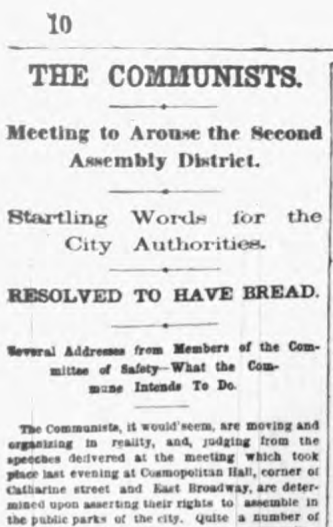
New York Herald, 18 January 1874: “The Communists of New York–Their Secret Meetings and Movements,” and “The Communists: Meeting to Arouse the Second Assembly District”

Here are a pair of stories from the New York Herald in 1874, on "The Communists" and their meetings. The stories are typical examples of mainstream journalism reporting on radical movements in the wake of the United States' first great Red Scare -- the reaction to the Red uprisings in France in 1871 and the proclamation of the Paris Commune. Although the communards had been conquered, massacred and exiled by the Versailles government years before in 1871, the economic depression following the Panic of 1873, and an upsurge in worker protests and labor organizing, left many mainstream papers panicked about the prospects for conspiracy and insurgency in the United States.

Many thanks to Jesse Walker for pointing me to this issue of the Herald.

These stories appeared on Sunday, January 18, 1874. First, on p. 6, the column advertising "To-Day's Contents of the Herald" includes the following item:

THE COMMUNIST SNAKE "SCOTCHED" NOT KILLED: AN ALARMING PRONOUNCEMENT! THEY "WILL HAVE BREAD!" -- Tenth Page.

More on that in a minute. But first, in another column on p. 6:

The Communists of New York--Their Secret Meetings and Movements.

That there exists in the city of New York a disturbing element known as the "Communists" was demonstrated on Tuesday last in Tompkins square, and again last night in Cosmopolitan Hall. Although frustrated in Tuesday's open attempt to defy the lawful authorities which forbade their assembling, or at least their parading the streets in procession, there is no knowing at what hour or by what preconcerted and secret action they may commit some overt act and cause widespread consternation among the community.

These dangerous conspirators against society are not confined to New York nor to Paris; they are spread the world over. They declare, as one of the prisoners arrested on Tuesday last did, that the red flag is their only flag; that they spit upon all other flags; that they demand equal rights in all things, the equalization of property, the apportionment of "good things," and "free love," as it is commonly known, in its broadest sense. They have no religion and no respect for person or station. In New York the body is controlled in a mysterious manner by an unseen so-called "Committee of Safety," only a few of whom have appeared upon the surface. The movements of this committee are as secret and mystical as those of any known secret organization. Their leaders attempt to cover their own peculiar objects and schemes by advocating--nay, "demanding"--the employment of laborers upon the public works. These laborers, it is known, are mostly Irish Catholics, and if by their demands they succeed in securing employment for this class of people they take all the credit therefor, and hope thereby to win the Catholic laboring element to their side and obtain their assistance in their machinations. In these ridiculous demands, however, they have thus far failed. And when the Irish Catholic laborers are made to realize the hideous conduct of these Communists during their reign of carnage and terror in Paris, when the highest prelate in their Church in that unfortunate metropolis--the beloved Archbishop Darboy--together with other venerated and venerable magnates of the Church, was savagely butchered by these frenzied semi-barbarians, and the sacred shrines of their churches ruthlessly robbed of their precious jewels and treasures, they shun, as they would a pestilence, all affiliation with these foes of Christianity and civilization as well as of law and order. Evidence of this may be gleaned from the fact that of the large number of arrests at Tompkins square on Tuesday not a single Irish Catholic was found among the number. And another significant fact may be mentioned here--that of all those arrested, with only two or three exceptions, none were either native born or adopted citizens or foreigners who had declared their intentions of becoming citizens; in short, the great majority were men who recognized only the "red flag" as the flag of their nationality, and who "spat upon all others." The Communists attempt to cajole the German laborers in the same way they have the Irish; but they to almost as great an extent have failed with them as with the Irish. It is even intimated that the Communists have threatened to burn schoolhouses in order to give employment in their reconstruction to both Irish and German laborers.

It may be asked, where does all the money come from to support the extraordinary operations of these men--men who work like machines, or as an engineer moves his locomotive, with people's passions for tramways? They must have money, though professedly poor and starving, for if allowed to appear in procession they are ready to make a gorgeous display of banners and legends, of regalia, gold shields and other paraphenalia that must have cost thousands of dollars. At their meetings, which are seldom held twice in the same place or at the same hour when the places are changed, they have a free lunch at which many a poor fellow, out of work and out of money, is glad to get the wherewith to appease the pangs of hunger. These cost money, and it is the best possible way for them to spend it. The leaders--the engineers of the "Committee of Safety"--do not seem to be very impecunious, one of them (if not of this, of some other similar, if not so radical an organization) exhibiting in his shirt bosom on a certain occasion a thousand dollar breastpin while shrieking for "bread or blood." The money to support all these things, we say, must come from some source, or may it not be here already? May not the booty of the plundered churches of Paris be now furnishing the material aid to carry on these nefarious projects--projects so menacing to the peace and safety of this whole community? It is known, as has been before intimated in this paper, that large amounts of precious stones, without setting, and concealed in balls of wax, together with numerous other treasures, the spoils of the Paris churches we refer to, were secretly conveyed to this country during the temporary but sanguinary régime of the Communists in Paris. Hence is it not reasonable to suppose that the product of these treasures of the sanctuaries is employed in the work of these incendiaries, conspirators and revolutionists?

We do not think that there is any immediate cause for serious alarm in regard to the operations of these desperate people; but it manifestly behooves the authorities to take such steps as will prevent their obtaining the upper hand in any single demonstrative movement they may undertake.

On the first column p. 10, the Herald carries its second story:

>

THE COMMUNISTS.

>

Meeting to Arouse the Second Assembly District.

>

Startling Words for the City Authorities

>

RESOLVED TO HAVE BREAD.

>
Several Addresses from Members of the Committee of Safety--What the Commune Intends To Do.
>

>

The Communists, it would seem, are moving and organizing in reality, and, judging from the speeches delivered at the meeting which took place last evening at Cosmopolitan Hall, corner of Catharine street and East Broadway, are determined upon asserting their rights to assemble in the public parks of the city. Quite a number of the organization were present, representing almost every nationality. Applause was freely given whenever any of the speakers alluded to the Police Commissioners or the police as tyrants and despots.

Citizen Banks

>

was on hand at an early hour, and as each newcomer made his appearance he would immediately rise and grasp him by the hand, and at the same time whisper to him in a subdued tone information of a secret character. About eight o'clock there were about sixty or seventy present. Citizen Banks then stepped up to the table at the further end of the room and called the meeting to order. He proposed that Mr. Roger Burke be requested to act as chariman. The motion was seconded and carried, and

Mr. Burke mounted the rostrum.

>

All eyes were now turned upon Citizen Burke, and as he prepared to deliver his address of thanks a faint applause greeted his ears. As soon as order was restored Citizen Burke delivered himself of hte following speech:--

Citizen Burke's Speech

>

Gentlemen--I am thankful to you for having elected me to this position. It is not the first time that I have held similar positions among workingmen. I am sorry to state that last evening one of our meetings was broken up by the police, and several of those present were "pulled." I am happy to be able to announce to you that every district in the city is undergoing a thorough organization. This district, however, is more behind than any other, and we must endeavor to protect our organization here also. The police have endeavored again to infringe upon our rights, for to-day, hearing of our proposed meeting this evening, they were sent around to dissuade the workingmen from putting in an appearance. I understand that at this very moment policement in citizens' clothes are placed around the building to watch us, and that detectives are also in our very midst prepared to note down every word we may give utterance to. The Committee of Safety desire, for the purpose of perfecting our organization, that every one present this evening step forward and transcribe his name upon the roll. At this juncture onf of the audience requested information of the speaker as to whether or not the police of New York city had been empowered to amend the constitution of the United States so as to prevent the right of free speech. This remark was received with applause by the entire assemblage.

Having concluded his remarks, Citizen Burke then introduced

Citizen Elliott.

>

Citizen Elliott announced the fact that the German wards were already thoroughly organized and that the only thing which remained to secure a thorough and effective organization was the enrolment of the English speaking wards. The proper manner of procedure, the speaker stated, for those in sympathy with the movement now on foot to redeem the workingmen was to perfect district and ward organizations throughout the entire city, the same as is done previous to the holding of the political elections. Rumors had gone abroad that the Committee of Safety had determined to resign their trust, but such was not the case. The

Committee of Safety

>

would always remain in active existence. The members of that committee had pledged themselves to remain true to the principles which led to their organization. They would never relax their efforts, but would work night and day to promote the great cause of the workingmen. Not one of them sought any office, and they were all pledged never to accept any. The Committee of Safety have, moreover, determined to carry the cases of the men now in custody who were arrested for participation in the meeting on Tuesday last before the State courts, and no labor nor expense would be spared to free them from bondage. On last Tuesday the country at large had seen a most dastardly outrage perpetrated upon the rights of the workingmen.

Commissioner Duryee

>

had charged his police upon inoffensive workingmen like so many "bulldogs" (Voice in the audience--"Shame! Shame!") When a demonstration is made again let the workingmen go out in large numbers so that the police or military will not dare to resist them. (Loud applause. I request that those who are present here this evening will, before they depart, come forward and sign the roll so that we can form a good nucleus to perfect a solid organization in this ward.

Citizen Banks

>

was then introduced. During the interval between the organization of the meeting and the conclusion of the speech of Citizen Elliot the audience was considerably increased by the entry of quite a number of prominent Communists.

Citizen Banks immediately opened his remarks by alluding to the outrage committed by the police on last Tuesday. He then continued in the following strain:--To-night, again, it appears to me that an attempt is being made to intimidate us from holding our meetings as citizens and workingmen, and a second outrage is being perpetrated upon us. We are denied the right of even meeting in peace and quietness in this hall. Police guard all the entrances, and detectives have been placed in our midst to watch our every movement. This I consider even a greater outrage than the one which was perpetrated on Tuesday last; for they have even busied themselves in warning the workingmen to keep away, telling them that if we met there would be trouble. The committee, however, have met here in defiance of the police. We are not to be terrified. We are not to be coerced into giving up our rights as citizens. Outrages such as these leave men no other remedy than military action and to be prepared militarily, in order that we can meet whenever we desire to exchange opinions and prepare for action. At Tompkins square they prepared an anbuscade for us, and without a word of warning began an indiscriminate clubbing. Those who were endeavoring to run in order to escape laceration were clubbed unmercifully--one workingman being killed outright and another now lies at the point of death. The time has come and we

must now prepare for the worst.

>

We must resist as workingmen, and as such we must endeavor to put down all monopolies. Under the present laws which govern society how much better off are we than the former slaves in the South? (Voice in the audience--"They were well fed.") Yes, they were well fed, and they were cared for and provided with work, which we are denied. We are not even as fortunate as were the negroes. Talk about free America and the Stars and Stripes! Why, the Stars and Stripes are in disgrace. We must prepare to

fight those opposed to us.

>

We are tired of political demagogues. We have had enough of them. They talk about the Communists. The Communists are the only ones who look after the rights of the workingmen. (Loud applause.) Nowadays the workingman who dares to say a word draws down upon his head the anger of the press. The competitive system in existence makes all the trouble. We want the system of universal co-operation, and to this opinion we must all incline. The man who does not labor robs the man who does. He hires you for his good only and robs you of the profit which belongs to your labor. Independent action on the part of the workingmen is the only way we can gain our ends, and if we cannot meet pacifically we must organize militarily. We must have no sympathy for anybody but our families, and if the police will not allow us to meet quietly we must go armed to our meetings.

Other Speakers.

>

Citizen Samuels, of the Committee of Safety, then addressed the meeting, and was followed by Citizen Leander Thompson, chairman of the Committee of Safety, and Citizen McGuire. Subsequent to the speech of Citizen McGuire, Citizen Elliot offered and read the following resolutions, which were unanimously adopted:--

Resolutions.

>

Whereas we are passing through a great financial crisis which has thrown us suddenly out of employment; and whereas there is no destruction of the real wealth of the country, but speculation in gold, stocks and the people's lands, sanctioned by the government, has been the sole cause of the panic; and whereas we are industrious, law-abiding citizens, who wish to avoid all outrage on person or property, and deprecate violence or injustice in any form; and whereas we desire only the means of obtaining the necessities of life, not as objects of charity, but as law-abiding citizens, whose right it is to demand work of the government which we have always protected and supported; therefore, we are

Resolved. That we will not eat the bread of idleness nor starve in the midst of plenty; but that we demand work, and pay for that work, now and without delay.

Resolved. That we demand the rigid enforcement of the eight-hour system on all private as well as public work, and the instant and entire abolition of the whole government contract system.

Resolved. That if the government will not furnish work for the unemployed, we, through our Committee of Safety, will in this our time of need supply ourselves and our families with proper food, shelter and clothing and will send all our bills for the same to the City Treasury to be liquidated, until such times as we shall obtain work and pay.

Resolved. That we demand an immediate and permanent reduction of twenty-five per cent on all house rents until the 1st of May to the unemployed of all classes.

Resolved. That, in the furtherance of the objects set down in the above resolutions, we will enroll our names and organize, not in the interest of any political party, but in the interest of all the people who are suffering from the present condition of affairs.

Resolved. That we will appoint from this mass meeting a committee of twelve workingmen, residents of the ward, to organize the working classes of the ward and co-operate with the German ward organizations.

Resolved. That we will support and sustain the Committee of Safety in its work of securing the above objects.

Adjourned.

>

After a somewhat lengthy address from Mr. McMicken, of the Committee of Safety, the meeting adjourned. Those who had not already signed the roll of membership were then again invited to do so. Some fears had been entertained that when the meeting was over some altercation, if not a serious disturbance, might occur between the police and the men who had attended the meeting, but nothing took place that could in any way be considered reprehensible. The men quietly dispersed to their homes, without even hovering around the building.

A little further down p. 10, in the column on court reports, there is the following report from the Court of Special Sessions:

Court of Special Sessions.

>

The Tompkins Square Rioters.

>

Before Judges Kilbreth, Flammer and Kasmire.

Benjamin Sugden, Peter Ackerman, Charles Green, Lorenzo Solestro, Jacob Eickhoff, Herman Zizachefsky, Thomas McGraw, Terence Donnelly, James Donohue and Joseph Hoefflicher were arraigned at the bar of Special Sessions yesterday, charged with assault and battery on several different officers and with aiding and inciting riot.

They were arrested last Tuesday, in and near Tompkins square, at the time of the workingmen's demonstration, and have been locked up in Essex Market Prison ever since. Counsellor Theodore E. Tomlinson appeared for all of them except Hoefflicher and demanded for his clients a trial by jury. Their cases were, therefore, sent to the Court of General Sessions. Counsellor Price appeared for Hoefflicher and asked that his case might be tried in the Court of Special Sessions. The trial was set down by the presiding magistrate for next Tuesday, when all the witnesses are expected to be present. The prisoners were then removed to the Tombs prison and are at present confined on the fourth tier of that institution. Some of them are accused of felonious assault and battery, while others have no complaint against them except meting and talking wildly in the streets.

Sources

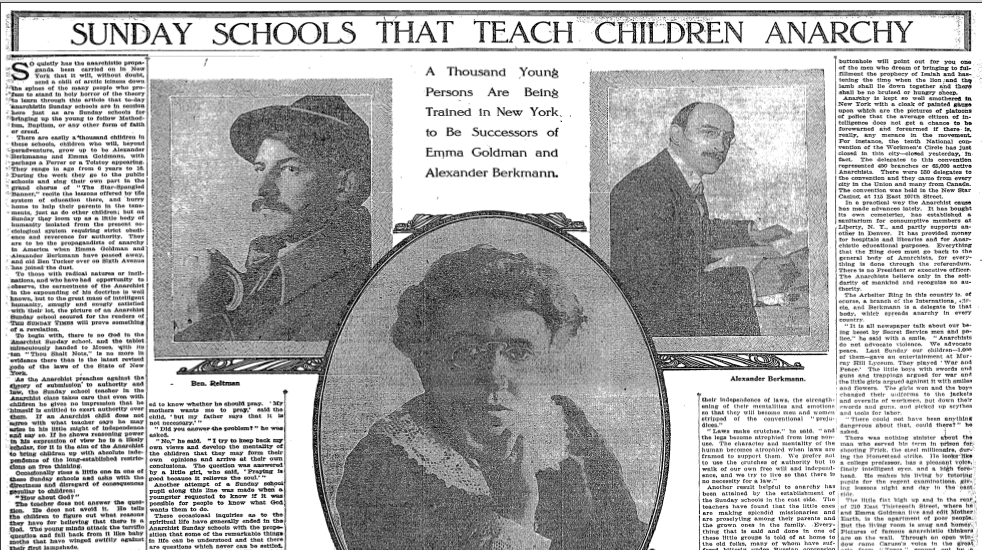
“Sunday Schools That Teach Children Anarchy,” from the New York Times (May 8, 1910)

Here's some more on mass-media reception of Anarchism during the early 20th century: a strange little piece from the Sunday New York Times magazine from May 8, 1910, on Anarchist Sunday schools in New York, focusing on the Ferrer Sunday School taught by Alexander Berkman. The Sunday schools were part of the large network of schools, cultural spaces and other institutions organized by Anarchists in large cities like New York during the early 20th century. (Like most Anarchistic educational projects, the Sundays were closely associated with the Modern School Movement and the thought of Francisco Ferrer). Either of the writer of the article, or his editor, couldn't quite seem to decide whether they wanted this story to be a straight interview of Berkman and a description of how the Sunday Schools were operated, or whether they wanted another cookie-cutter Anarchist-menace scare story.

SUNDAY SCHOOLS THAT TEACH CHILDREN ANARCHY

A Thousand Young Persons Are Being Trained in New York to Be Successors of Emma Goldman and Alexander Berkman.

So quietly has the anarchistic propaganda been carried on in New York that it will, without doubt, send a chill of arctic iciness down the spines of the many people who profess to stand in holy horror of the theory to learn through this article that to-day anarchistic Sunday schools are in session here just as are Sunday schools for bringing up the young to follow Methodism, Baptism, or any other form of faith or creed.

>

There are easily a thousand children in these schools, children who will, beyond peradventure, grow up to be Alexander Berkmanns and Emma Goldmans, with perhaps a Ferrer or a Tolstoy appearing. They range in age from 6 years to 16. During the week they go to the public schools and sing their own part in the grand chorus of "The Star-Spangled Banner," recite the lessons offered by the system of education there, and hurry home to help their parents in the tenements, just as do other children; but on Sunday they loom up as a little body of humanity isolated from the present sociological system requiring strict obedience and reverence for authority. They are to be the propagandists of anarchy in America when Emma Goldman and Alexander Berkmann have passed away, and old Ben Tucker over on Sixth Avenue has joined the dust.

To those with radical natures or inclinations, and who have had opportunity to observe, the earnestness of the Anarchist in the expounding of his doctrine is well known, but to the great mass of intelligent humanity, smugly and snugly satisfied with their lot, the picture of an Anarchist Sunday school secured for readers of The Sunday Times will prove something of a revelation.

To begin with, there is no God in the Anarchist Sunday school, and the tablet miraculously handed to Moses, with its ten Thou Shalt Nots, is no more in evidence there than is the latest revised code of the laws of the State of New York.

As the Anarchist preaches against the theory of submission to authority and law, the Sunday school teacher in the Anarchist class takes care that even with children he gives no impression that he himself is entitled to exert authority over them. If an Anarchist child does not agree with what teacher says he may arise in his little might of independence and say so. If he shows reasoning power in his expression of view he is a likely scholar, for it is the aim of the Anarchist to bring children up with absolute independence of the long-established restrictions on free thinking.

Occasionally rises a little one in one of these Sunday schools and asks with the directness and disregard of consequences peculiar to children:

How about God?

The teacher does not answer the question. He does not avoid it. He tells the children to figure out what reasons they have for believing that there is a God. The young minds attack the terrific question and fall back from it like baby moths that have winged swiftly against their first lampshade.

The largest of the Sunday schools is in Avenue A. It is called the Ferrer Sunday School, and was, until the killing of the Spanish philosopher, known as the Radical Sunday School. How the name was changed will prove a story that may stand out with striking novelty in the child life of New York to-day. It shall be told a little later in this article.

The Ferrer Sunday School is conducted by Alexander Berkmann. It has about eighty members and is in two classes. It meets on Sunday between 10 in the morning and noon. The youngest child is 7.

Berkmann has no laid-out system of teaching, depending on his comprehension of the psychology of the group at the time of the gathering. There are no rules. A song may be sung in chorus, a song dealing with freedom of mankind and hate for oppression. Some of the children may have learned by heart a poem or a fragment of an anarchistic argument and these provide recitations. The training of the mind anarchistically is then begun.

Berkmann, in a talk with a Times writer, in the office of Mother Earth, the Anarchist magazine, gave a sample of this teaching.

This was his talk to his Sunday school on Sabbath after the execution of Ferrer.

Once a single human being was swept from the sea to the shore of an island where there lived no human beings. There he found a great flock of sheep. He studied them and noticed that some of them were very powerfully built and finely fed. Some had even attained the strength and ferocity of wolves. But there were a great many of the sheep that were lean and worn. They were hungry and had been trampled down and hurt.

The man thought that he could so arrange it that these sheep, with little to eat and with bruises from being trampled, could be taught to care for themselves better and realize what the power of the strong and wolflike sheep had brought them to. He went among the sheep that suffered and began to point out to them what was the matter. The wolfish and strong ones heard of this and they turned upon the man and killed him.

When Berkmann finished this parable one of the children, a boy 18 years old, arose and said:

Why Mr. Berkmann, this story is just like the story of Ferrer's death.

The children were so impressed with the parable and the discussion which followed that the name of the school was then changed from the Radical Sunday School to the Ferrer Sunday School.

In the classes, said Berkmann, we generally use current events as subjects for discussion and study. For instance, one of our lessons was produced by the Hudson-Fulton Celebration in New York. The children of the east side saw a great deal of the sailors from the many men-of-war in the harbor. They saw the sailors of different nationalities entering and leaving the cafés, the best of friends, their arms about each other and acting like human brothers. The question naturally followed. Why should they be thus fond of each other and thus brotherly on land, and on sea be commanded to kill each other? They are brothers, and love each other, and there can be no fair reason for their slaying each other.

A man who had been raised in one of the old credal beliefs with care but who had come to be an agnostic in middle life once told the writer than when he realized that his religion had gone from him he felt that what he called reason had stepped into a nursery, and, like a willful bully, had gathered up the toys of a child sitting there and had destroyed them because he considered them useless. He considered the change from belief to agnosticism the tragedy of his life. The figure may be applied to thinking grown-ups easily, but it is hard to think of applying it to a child. And yet in the Anarchist Sunday school the tragedy of the destroyed toys is not infrequently enacted.

The pupil of the Anarchist Sunday school is taught to reason. The teacher only serves to direct their attention to a problem.

One child, said Berkmann, wanted to know whether he should pray. My mothers wants me to pray, said this child, but my father says that it is not necessary.

Did you answer the problem? he was asked.

No, he said. I try to keep back my own views and develop the mentality of the children that they may form their own opinions and arrive at their own conclusions. The question was answered by a little girl, who said, Praying is good because it relieves the soul.

Another attempt of a Sunday school pupil along this line was made when a youngster requested to know if it was possible for people to know what God wants them to do.

These occasional inquiries as to the spiritual life have generally ended in the Anarchist Sunday schools with the proposition that some of the remarkable things in life can be understood and that there are questions which never can be settled. The mental attitude of the children might be put in this way: We are not certain whether there are grounds for the belief that we should pray.

That, of course, leaves the question well in the field of agnosticism. The teacher of anarchy does not, with the children, declare that there is no God. Nor does he say that there is a God. The Sunday school class goes frequently to the Museum of Natural History, to Central Park, to the Zoological Gardens, and other places where, with the teacher, nature is studied.

The Ferrer Sunday school is only one of about fifteen similar schools in the greater city. Wherever the local groups of Anarchists can handle their own Sunday schools, carrying on the propaganda with literature, letters, lectures, &c., they do so without asking aid of others. When they cannot the State group helps. There is no central or superior group. Each has its own autonomy, although they all work to develop their principles of solidarity and mutual aid.

There are frequently conventions of the Sunday school teachers. Those who have classes get together and exchange experiences and ideas. In this city the Anarchists know that the fulfillment of their vision is afar, and they are already sowing their seed in the young and new fields that a generation of their kind may take hold of the propaganda when the present generation has withered and fallen.

These little Anarchists are being trained to believe in no authority. As Mr. Berkmann put it, everything is being done for them to aid them in the development of their independence of laws, the strengthening of their mentalities and emotions so that they will become men and women stripped of the conventional prejudices.

Laws make crutches, he said, and the legs become atrophied from long non-use. The character and mentality of human becomes atrophied when laws are framed to support them. We prefer not to use the crutches of authority but to walk of our own free will and independence, and we try to live so that there is no necessity for a law.

Another result helpful to anarchy has been attained by the establishment of the Sunday schools in the east side. The teachers have found that the little ones are making splendid missionaries and are proselyting among their parents and the grown ones in the family. Everything that is said and done in one of these little groups is told of at home to the old folks, many of whom have suffered bitterly under Russian oppression and who have revolution deep in their hearts. They write letters to the Anarchist teachers and get replies. They discuss the views expounded at home by their children and many of them become radicals and join the Anarchist groups.

The Anarchists also spread their propaganda by establishing little libraries which they make easily accessible to all who want to study the theory.

In the spreading of the propaganda among the children the littlest are not overlooked. There are some as young as six years of age who are getting kindergarten lessons in anarchy. One of these lessons is the lesson which preaches to a boy of health and strength at the age of six that he should not strike or abuse a boy who is not as strong as he is but should help him because he needs help. That is the very heart of the kindergarten lesson.

All of this work is done in what is called the Workmen's Circle. The Circle is the general group and is known as the Arbeiter Ring. A little white enamel badge with the letters A. R. in the buttonhole will point out for you one of the men who dream of bringing to fulfillment the prophecy of Isaiah and hastening the time when the lion and the lamb shall lie down together and there shall be no bruised or hungry sheep.

Anarchy is kept so well smothered in New York with a cloak of painted gauze upon which are the pictures of platoons of police that the average citizen of intelligence does not get a chance to be forewarned and forearmed if there is, really, any menace in the movement. For instance, the tenth National convention of the Workmen's Circle has just closed in this city--closed yesterday, in fact. The delegates to this convention represented 450 branches or 65,000 active Anarchists. There were 550 delegates to the convention and they came from every city in the Union and many from Canada. The convention was held in the New Star Casino, at 115 East 107th Street.

In a practical way the Anarchist cause has made advances lately. It has bought its own cemetaries, has established a sanitarium for consumptive members at Liberty, N. Y., and partly supports another in Denver. It has provided money for hospitals and libraries for Anarchistic educational purposes. Everything that the Ring does must go back to the general body of Anarchists, for everything is done through the referendum. There is no President or executive officer. The Anarchists believe only in the solidarity of mankind and recognize no authority.

The Arbeiter Ring in this country is, of course, a branch of the International Circle, and Berkmann is a delegate to that body, which spreads anarchy in every country.

It is all newspaper talk about our being beset by Secret Service men and police, he said with a smile. Anarchists do not advocate violence. We advocate peace. Last Sunday our children--1,000 of them--gave an entertainment at Murray Hill Lyceum. They played War and Peace. The little boys with swords and guns and trappings argued for war and the little girls argued against it with smiles and flowers. The girls won and the boys changed their uniforms to the jackets and overalls of workmen, put down their swords and guns, and picked up scythes and tools for labor.

There could not have been anything dangerous about that, could there? he asked.

There was nothing sinister about the man who served his term in prison for shooting Frick, the steel millionaire, during the Homestead strike. He looks like a college professor, has a pleasant voice, finely intelligent eyes, and a high forehead. He makes his living by tutoring pupils for the regent examinations, giving lessons night and day in the east side.

The little flat high up and in the rear of 210 East Thirteenth Street, where he and Emma Goldman live and edit Mother Earth, is the apartment of poor people. But the living room is snug and homey. Pictures of famous anarchistic thinkers are on the wall. Through an open window came Caruso's voice in the great aria from Tosca, ground out by a phonograph, as Berkmann talked with the Times man. It was a warm combination, but the night was warm, and we were glad for the breeze that swept the little place however burdened it might be.

We teach no ism, he said, harking back to the Sunday schools. Our aim is to develop character and mentality in the child. We try to make them think, criticise, and feel.

We want their emotional and intellectual natures developed. We want to make them men and women absolutely free of the old restrictions. We hope that they will grow up with the spirit of solidarity and co-operation in them. We try to teach them that in and out of school.

We try to teach them ethical right and reason. Our Radical Boys' Literary Club, boys about 13 or 14 years old, hold meetings after school, and they run their organization just as the grown people do. They have advanced to where they need no help from their elders.

Among the grown Anarchists the cause is kept warm by fervid preachings in their publications. These are the weekly paper Frei Arbiter Stimme, with a circulation of 12,000; Mother Earth, with a circulation of 6,000; Freiheit, with 5,000 circulation, and Voine Listy, a Bohemian paper, with a circulation of 4,500.

There are nine large groups of the grown Anarchists in New York. These have regular meetings, and conduct the propaganda with lectures, debates, &c.

In the district from Fourteenth Street to the Battery east of Broadway are 850,000 people living. Here beats the heart of anarchy. Nearly all of these people are foreign born, the native born element being insignificant in its percentage.

Forsyth Street, Chrystie, Cannon, Pitt, Columbia, Second Streets all have buildings in which are tiny halls that may be rented for a dollar or two for a wedding, a banquet, a lodge meeting, or a group meeting of Anarchists.

The man who lives awhile in this teeming corner of Manhattan does not take long to find out where he can go and hear all the anarchy he wants expounded. The writer once met in one of these little halls S. Yanofsky, the editor of the Frei Arbiter Stimme. A man with dreamy eyes, pointed beard, and nervous energy, he seemed to be looked up to as little short of a god by a clump of young men and women who were wating for him.

Yanofsky and Berkmann were both rounded up by the police after the Silverstein bomb explosion in Union Square in 1908, and as there was nothing against either of them nothing came of the call to Police Headquarters. Yanofsky, when asked by the writer what he thought of Silverstein's act, replied:

The man who commits a violent deed, if he is not mad, is desperate. Violence never did any good for anarchy. All government is a form of violence. Suppose Silverstein had suffered personally--and his act was that of an impatient and ignorant man--what did he accomplish? He only made himself dead and gave the chance to the enemies of anarchy to spread their calumnies. He only helped them to kill of the chances of gaining liberty.

Berkmann was a little clearer on the matter of violence and anarchy.

If a Republican or Democrat should throw a bomb or kill another, he said, the Republican Party or the Democratic Party would not be blamed for it. When an Anarchist does a thing like that we frankly say that anarchy did not inspire it, but that conditions of inequality and injustice caused the crime. To stop the crime, stop the cause. Anarchy is for justice and freedom. It cannot be blamed for individual acts of violence.

Among the favorite east side speakers for anarchy, besides Yanofsky and Berkmann, is Dr. Ben Reitman, whose method is to stir up the hearers with fiery sentences depicting the wrongs resulting from the present order of things. He with the others believes that anarchy is gathering strength, and will continue to gather it and will prove a living force in the slow movement of society through the ages.
Have You A Country? (Revolt, January 15, 1916)

This is a letter published in Vol. I, No. 2 of Revolt (dated January 15th, 1916), an Anarchist newspaper edited by Hippolyte Havel and published by the Revolt Publishing Association, 63 East 107th Street, New York, N. Y. The copy came to us by way of a facsimile edition published by The Match!, a journal of Ethical Anarchism, published from Tucson, Arizona. The letter was contributed by Robert Minor, and appears on pp. 6-7 of the issue.

British Labor shows fight. The army poison hasnt twisted their brains as much as their bosses had hoped for. It gives a fellow's heart a quicker throb to know that even in the mob-crazy war country, Labor can hold up its head and be Labor still. In times of peace, workers know that capitalists are their enemies; in time of war they are often fools enough to go fight their friend workers of another country for the sake of the capitalist enemies that they have been fighting at all other times. They've got to learn better, and it looks as though the English are learning. Hurrah for the English! (That means English Labor, not the Greedy British Empire, their greatest enemy.)

They are not perfect by a long sight, but neither are we, nor any other labor. They are improving, that's the point. They have got their bosses so badly worried as to be afraid to make a daring stand for their crooked privileges. It is really amusing. Go to it, friends; you may weaken and be fooled later on, but even then, the little start you have made in defying conscription will not be forgotten, and the world will profit by the example.

May we do as well here in America. It's our turn now. Conscription is at the door, the back door, trying to sneak in. Stand up, American Labor! You ought to do even better, without the disadvantage of actual war upon you. You haven't any country. No labor, anywhere, has any country. So don't be patriotic. Be Labor. And fight to GET your country, not to help your bosses hold it.

HAVE you a country? Then, why do you pay rent?

Robert Minor.

Emma Goldman Now Alien (New York Times, April 9, 1909)

This is a side column from Page 2 of the New York Times on April 9, 1909, reporting the U.S. Attorney's success in convincing a federal court to strip Emma Goldman of her citizenship, which she had gained by marriage to a naturalized citizen in 1887.

EMMA GOLDMAN NOW ALIEN.

Deprived of Rights of Citizenship by Disenfranchisement of Her Husband.
Special to The New York Times.

Buffalo, N.Y., April 8.--Judge Hazel, in the United States Court this morning, granted an order canceling the citizenship papers of Jacob A. Kersner. Through this order all rights of citizenship also are taken from Kersner's wife, who is none other than Emma Goldman, the woman leader of the Anarchists in this country, whose fiery teachings, it was charged by many, incited Leon Czolgosz to the assassination of President McKinley.

The order was granted upon motion of Special United States Attorney P. S. Chambers of Pittsburg, and the evidence upon which it was based was presented principally by Kersner's own father, who was subpoenaed from his home at Rochester.

Kersner obtained his citizenship documents in 1884, when the statutes governing such procedure were quite lax compared with the present laws. He was two years under age at the time. Three years later he married Emma Goldman. She was a foreigner herself, but by virtue of her marriage to a citizen she was clothed with the rights of citizenship. Emma was only a girl, then, and had barely begun the career that later connected her so closely with the Reds in the public eye.

--The New York Times (April 9, 1909), Page 2.

Now online: Full text of two more issues of MOTHER EARTH — Vol. VI., No. 11 (January, 1912) and Vol. VII., No. 12 (February, 1913)

Three months ago, I happily announced that the complete text of the November 1914 issue of Mother Earth had been made available at the Fair Use Repository. To-day, I'm pleased to follow up that announcement -- with the announcement that the Fair Use Repository now features the complete text of three issues of Mother Earth. The two issues recently made available are:

Mother Earth, Vol. VI., No. 11 (January, 1912)

This issue is mainly occupied with the arts and revolution. It leads off with Blaming the Fester, a poem by Rebekah E. Raney. The New Year is a fundraising appeal on the occasion of Christmastime and the New Year, while Observation and Comments includes short reports on current events -- delays in the publication of Prison Memoirs of an Anarchist, the trial of the bosses who'd locked workers into the the Triangle Shirtwaist Factory, strikes and conspiracy trials around the country, Big Bill Haywood's feud with the Socialist Party of America, and more.

Paul Orleneff offers a celebratory review (unsigned, but probably written by Emma Goldman) of the actor's performances in New York. A Review of the Year, by Harry Kelly, and the continuation of a serialized article by Voltairine de Cleyre on The Mexican Revolution, discuss revolutions and uprisings flaring up throughout the world in 1911. In The Right to Live M. B. argues that political rights are empty without workers' material control over the means of their own survival (the organization of society in a manner to insure to each the material basis of life and make it as self-evident as breathing). Max Baginski reviews the Autobiography of Richard Wagner, taking it as evidence of the old commonplace that one can be a great artist and yet small as a man, and concluding that The suffocating dependence of artistic production upon wealth and patronage should cause the true artist--who is not content to produce mere market ware--to turn relentlessly rebel against the existing standards, to become a communist. ... The dream that Wagner once dreamed in Art and Revolution will some day be realized by the people,--nor will they need the aid of philosopher or king. The issue concludes with a continuation of the serialized article Economy as Viewed by An Anarchist by C. L. James, on the historical emergence of the bourgeois system and its connections with past forms of economic hierarchy, as well as with the subjection of women.

Mother Earth, Vol. VII., No. 12 (February, 1913)

The February 1913 issue has a few things to say about the State and a lot to say about the union struggle, Syndicalism, and government repression of striking workers. The issue leads off with To Our Friends, an appeal for readers to help widen the circulation of the journal, followed by another monthly instalment of short reports in Observations and Comments -- including remarks on the inauguration of Woodrow Wilson, the futility of appeals to the law, the advantages of direct action, new strike arbitration laws in New Zealand (among the first such labor laws in the world), the legal repression of Anarchists in the U.S., police scandals in Denver, and the incorporation of the Rockefeller fund.

James Montgomery's The Black Hundreds of Plutocracy and Government discusses the use of private security forces, with tacit or explicit government approval, to inflict large-scale violence on striking workers. The New Idol, a translation of an excerpt from Friedrich Nietzsche's Also Sprach Zarathustra, declares the State the coldest of all cold monsters. Theodor Johnson's Help Save These Comrades! reports on the case of a group of striking Swedish dock workers, who had been sentenced to life imprisonment for a bomb plot, and calls for international solidarity to get their sentences commuted. Making a Strike a Crime government's assault on the rights to picket and speak freely, with the imprisonment of dozens of peaceful picketers and speakers in Little Falls, New York during a textile mill strike. Intolerance in the Union comments on growing regimentation and bureaucratic control within conservative trade unions and reprints a letter from a comrade discussing his objections to a corrupt bargain made by his union's labor bosses, which resulted in his being persecuted by the labor bosses and expelled from the union. Syndicalism: Its Theory and Practice concludes a long article by Emma Goldman on state-free Syndicalist organizing, with a discussion of Syndicalism's characteristic methods -- Direct Action, Sabotage, and the General Strike. The issue concludes with Anarchist writer and teacher Bayard Boyesen's review of Alexander Berkman's Prison Memoirs of an Anarchist, and with an announcement of dates for Emma Goldman's lecture tour through the Midwest.

Onward

These issues complete a set of three reprinted issues of Mother Earth that I picked up from a table at the Bay Area Anarchist Bookfair. I'd very much like to make available more of Mother Earth's print run online. A number of partial and complete issues -- mostly earlier issues -- are currently available from The Anarchy Archives, and a fair amount is available for browsing in Google Books. But I'd like to liberate the latter from the Google Books's inaccurate automatic markup, often capricious behavior, and hypertext-unfriendly environment. And in any case, there are a lot of gaps to fill in. If you have any suggestions on issues to prioritize, or good lines on copies to be transcribed, please feel free to leave a comment here, or contact me with the details.

Read, cite, and enjoy!

“The Personal Is Political,” by Carol Hanish (1969)

One of the most influential slogans that radical feminists contributed to revolutionary politics in the late 1960s and 1970s was the slogan The personal is political! which profoundly challenged the narrow limits that Marxism, National Liberation movements, and other popular ideologies had set on what topics could be discussed as real political issues, which people's problems were or were not counted as serious problems to be addressed by organized movements, and what sorts of strategies might be seriously considered as means to liberation. The phrase quickly spread throughout the women's movement during the 1970s, and was soon being widely discussed without any reference back to the original source of the idea. But originally the phrase came about as the title of a 1969 position paper by Carol Hanish -- a radical feminist who played a founding role in the formation of New York Radical Women and later the Redstockings -- in which she defended the Women's Liberation movement's practice of small-group consciousness-raising meetings, against Left-wing criticisms that c.r. groups were doing therapy rather than politics, and complaints from movement politicos that feminist groups should spend less time talking about problems amongst themselves and more time taking public protest actions.

Hanisch's paper was printed as part of the movement anthology Notes from the Second Year. The text for this edition is taken from the reprinting of the paper in the Appendix to the Redstockings anthology, Feminist Revolution (1975/1978), pp. 204-205.

The Personal Is Political

For this paper I want to stick pretty close to an aspect of the Left debate commonly talked about--namely therapy vs. therapy and politics. Another name for it is personal vs. political and it has other names, I suspect, as it has developed across the country. I haven't gotten over to visit the New Orleans group yet, but I have been participating in groups in New York and Gainesville for more than a year. Both of these groups have been called therapy and personal groups by women who consider themselves more political. So I must speak about so-called therapy groups from my own experience.

The very word therapy is obviously a misnomer if carried to its logical conclusion. Therapy assumes that someone is sick and that there is a cure, e.g., a personal solution. I am greatly offended that I or any other woman is thought to need therapy in the first place. Women are messed over, not messed up! We need to change the objective conditions, not adjust to them. Therapy is adjusting to your bad personal alternative.

We have not done much trying to solve immediate personal problems of women in the group. We've mostly picked topics by two methods: in a small group it is possible for us to take turns bringing questions to the meeting (like, Which do/did you prefer, a girl or a boy baby or no children, and why? What happens to your relationship if your man makes more money than you? Less than you?). Then we go around the room answering the questions from our personal experiences. Everybody talks that way. At the end of the meeting we try to sum up and generalize from what's been said and make connections.

I believe at this point, and maybe for a long time to come, that these analytical sessions are a form of political action. I do not go to these sessions because I need or want to talk about my personal problems. In fact, I would rather not. As a movement woman, I've been pressured to be strong, selfless, other-oriented, sacrificing, and in general pretty much in control of my own life. To admit to the problems in my life is to be deemed weak. So I want to be a strong woman, in movement terms, and not admit I have any real problems that I can't find a personal solution to (except those directly related to the capitalist system). It is at this point a political action to tell it like it is, to say what I really believe about my life instead of what I've always been told to say.

So the reason I participate in these meetings is not to solve any personal problem. One of the first things we discover in these groups is that personal problems are political problems. There are no personal solutions at this time. There is only collective action for a collective solution. I went, and I continue to go to these meetings because I have gotten a political understanding which all my reading, all my political discussions, all my political action, all my four-odd years in the movement never gave me. I've been forced to take off the rose-colored glasses and face the awful truth about how grim my life really is as a woman. I am getting a gut understanding of everything as opposed to the esoteric, intellectual understandings and noblesse oblige feelings I had in other people's struggles.

This is not to deny that these sessions have at least two aspects that are therapeutic. I prefer to call even this aspect political therapy as opposed to personal therapy. The most important is getting rid of self-blame. Can you imagine what would happen if women, blacks, and workers (my definition of worker is anyone who has to work for a living as opposed to those who don't. All women are workers) would stop blaming ourselves for our sad situations? It seems to me the whole country needs that kind of political therapy. That is what the black movement is doing in its own way. We shall do it in ours. We are only starting to stop blaming ourselves.

We also feel like we are thinking for ourselves for the first time in our lives. As the cartoon in Lilith puts it, I'm changing. My mind is growing muscles. Those who believe that Marxd, Lenin, Engels, Mao, and Ho have the only and last good word on the subject and that women have nothing more to add will, of course, find these groups a waste of time.

The groups that I have been in have also not gotten into alternative life-styles or what it means to be a liberated woman. We came early to the conclusion that all alternatives are bad under present conditions. Whether we live with or without a man, communally or in couples or alone, are married or unmarried, live with other women, go for free love, celibacy, or lesbianism, or any combination, there are only good and bad things about each bad situation. There is no more liberated way; there are only bad alternatives.

This is part of one of the most important theories we are beginning to articulate. We call it the pro-woman line. What it says basically is that women are really neat people. The bad things that are said about us as women are either myths (women are stupid), tactics women use to struggle individually (women are bitches), or are actually things we want to carry into the new society and want men to share too (women are sensitive, emotional). Women as oppressed people act out of necessity (act dumb in the presence of men), not out of choice. Women have developed great shuffling techniques for their own survival (look pretty and giggle to get or keep a job or man) which should be used when necessary until such time as the power of unity can take its place. Women are smart not to struggle alone (as are blacks and workers). It is no worse to be in the home than in the rat race of the job world. They are both bad. Women, like blacks, workers, must stop blaming ourselves for our failures.

It took us some ten months to get to the point where we could articulate these things from the standpoint of what kind of action we are going to do. When our group first started, going by majority opinion, we would have been out in the streets demonstrating against marriage, against having babies, for free love, against women who wore makeup, against housewives, for equality without recognition of biological differences, and god knows what else. Now we see all these things as what we call personal solutionary. Many of the actions taken by action groups have been along these lines. The women who did the anti-woman stuff at the Miss America Pageant were the ones who were screaming for action without theory. The members of one group want to set up a private day-care center without any real analysis of what could be done to make it better for little girls, much less any analysis of how that center hastens the revolution.

That is not to say, of course, that we shouldn't do action. There may be some very good reasons why women in the group don't want to do anything at the moment. One reason that I often have is that this thing is so important to me that I want to be very sure that we're doing it the best way we know how, and that it is a right action that I feel sure about. I refuse to go out and produce for the movement. We had a lot of conflict in our New York group about whether or not to do action. When the Miss America Protest was proposed there was no question but that we wanted to do it. I think it was because we all saw how it related to our lives. We felt it was a good action. There were things wrong with the action, but the basic idea was there.

This has been my experience in groups that are accused of being therapy or personal. Perhaps certain groups may well be attempting to do therapy. Maybe the answer is not to put down the method of analyzing from personal experiences in favor of immediate action, but to figure out what can be done to make it work. Some of us started to write a handbook about this at one time and never got past the outline. We are working on it again.

It's true we all need to learn how to better draw conclusions from the experiences and feelings we talk about and how to draw all kinds of connections. Some of us haven't done a very good job of communicating them to others.

One more thing: I think we must listen to what so-called apolitical women have to say--not so we can do a better job of organizing them but because together we are a mass movement. I think we who work full-time in the movement tend to become very narrow. What is happening now is that when nonmovement women disagree with us, we assume it's because they are apolitical, not because there might be something wrong with our thinking. Women have left the movement in droves. The obvious reasons are that we are tired of being sex slaves and doing shitwork for men whose hypocrisy is so blatant in their political stance of liberation for everybody (else). But there is really a lot more to it than that. I can't quite articulate it yet. I think apolitical women are not in the movement for very good reasons, and as long as we say, You have to think like us and live like us to join the charmed circle, we will fail. What I am trying to say is that there are things in the consciousness of apolitical women (I find them very political) that are as valid as any political consciousness we think we have We should figure out why many women don't want to do action. Maybe there is something wrong with the action or something wrong with why we are doing the action or maybe the analysis of why the action is necessary is not clear enough in our minds.

Carol Hanish (March, 1969)

The themes that Hanisch develops in this position paper are very similar to, but apparently were not directly influenced by, ideas developed in the earlier work of Claudia Jones, an black American Communist, whose 1949 essay "An End to the Neglect of the Problems of the Negro Woman!" similarly challenged the male Left's attempt to exclude personal issues like marriage, social life, and family relationships from political organizing. Although the title of Hanisch's paper is the original source of the slogan, and the discussion in the paper is an early major source for the analysis that the slogan represented, Hanisch does not take credit for coining the slogan itself; she made clear in later interviews that the title The Personal Is Political was given to the paper by Shulamith Firestone and Anne Koedt, as editors of Notes from the Second Year.