Fair Use Blog

Now available: the “Plumb-Line or Cork-Screw” debate, on anarchism and political compromise, from the pages of Liberty, 1886

liberty-masthead

In the Spring and Summer of 1886, a number of the contributors to Benjamin Tucker's individualist anarchist newspaper Liberty debated the value of political compromise. The debate intersected with other debates that Tucker, Henry Appleton and Gertrude B. Kelly, as well as Dyer Lum and others, were engaged in over participation in the Knights of Labor, the relationship between anarchist radicalism and organized labor movements, and other long-running debates over social reform, Irish land politics, Malthusianism, sexual liberation, and so on. In the debate, the images that Tucker used for reasoning from radical principle, and adopting compromise stances in an effort to persuade indirectly -- the plumb-line and the cork-screw -- remained as characteristic phrases in individualist anarchist literature throughout the remaining decades of Liberty and its circle, with the term plumb-line Anarchism or plumb-line Individualism came to be used often as a in-group label for Tucker's school of individualist anarchist thought. (See, for example, Will and Lizzie Holmes's reference to our old plumbline friends decades later in Instead of a Magazine.)

Now at fair-use.org, I've made available full HTML hypertext transcriptions of 11 articles from the debate, including contributions by Henry Appleton, Benjamin Tucker, Gertrude B. Kelly, Victor S. Yarros, J. William Lloyd, and the pseudonymous D.D. The debate as a whole is collected here, at fair-use.org; the individual articles now available online are:

  1. X. Anarchism and Expediency in Liberty IV.1 (#79). 4.
  2. T. Plumb-Line or Cork-Screw, Which? in Liberty IV.1 (#79). 4-5.
  3. Benjamin Tucker. On Picket Duty in Liberty IV.1 (#79). 1.
  4. X. and T. Liberty and Compromise in Liberty IV.2 (#80). 4-5.
  5. V. Yarros. The Plumb-Line at New Haven in Liberty IV.2 (#80). 8.
  6. J. Wm. Lloyd. Plumb-Centre in Liberty IV.4 (#82). 1.
  7. Benjamin Tucker. On Picket Duty in Liberty IV.4 (#82). 1.
  8. X. The Nub of It All in Liberty IV.5 (#83). 4.
  9. D.D. and Editor Liberty. Plumb-Line and Cork-Screw in Liberty IV.5 (#83). 4.
  10. Gertrude B. Kelly. Justice or Force, Which? in Liberty IV.5 (#83). 7.
  11. X. and T. Anarchistic Small Fry in Liberty IV.6 (#84). 4-5.

J.M. Clarke, “Who are the Philosophers?” from FREE SOCIETY IX.18 (May 4, 1902)

During the early 1900s, partly as a result of intense government scrutiny in the wake of the assassination of William McKinley, a number of anarchist journals featured heated debates over questions of methods, as well as the different meanings of "philosophic," "revolutionary," and other sorts of Anarchism. During 1902, some of that heat was concentrated in debates between writers in Free Society (a leading movement paper published in Chicago) and in Discontent (one of the anarchist papers published from the Home colony in northwest Washington). Here is a letter from that exchange, in which J. M. Clarke (in Free Society) calls J. F. Morton (of Discontent) to task for his articles claiming the title of "philosophic Anarchism." This letter appeared in Free Society, Volume IX, No. 18, Whole No. 360 (May 4, 1902), p. 3.

Who are the Philosophers?

I observe that there is no little friction just now among those designated under the general name Anarchists as to whom the designation properly applies. J. F. Morton, editor of Disconent, has defined the matter down to a very plain thing! Some of us more rudimentary ones have supposed that Anarchy was a social state in which there would be in all our social and personal conditions absolute individual liberty--at least as far as the possibilities of humanity would permit. We had supposed that all that stood in the way of this, law, Church, custom, or government, any restraint by any other person is contrary to Anarchist theory; that the means taken to attain this end, either the passive resistance methods of Tolstoy, the revolutionary theories of the "reds," as commonly called, the assassinatory violence of a Bresci or a Czolgosz, have nothing to do with the question of whether a person is an Anarchist or not. Some of us too had the temerity to suppose that as individuals, we were philosophic to a degree at least in maintaining our separate ideals, differing tho they might, each with the other. But now it seems we were all mistaken, we rudimentary ones: there is a cut-and-dried "philosophical" that just fits to real Anarchy and all other kinds are "no good." Love, taffy, goody-goody non-resistance, gentle cooing with our opponents as a whole, who are "obeying their convictions of duty," etc. Anarchism is also, we have found out, to "obey the law while it exists"! O wonderful philosophic Anarchy! This kind is doubtless simon pure, it out-Tuckers Tucker himself. It relegates "Instead of a Book" to a back seat, and in its stead places absolute, unquestioning obedience to law, for when it does not "exist" is the only time that we must not obey!

Seriously, is it not about time for us Anarchists to have done with such quibbling evasions? Let us manfully acknowledge there are Anarchists and Anarchists; that some do believe in assassinating tyrants, some in non-resistance, some in self-defense, some in collective effort, some in purely individual effort; but all in absolute individual liberty, believing that results will be the best guide to a normal use of the same. I am a believer in such action as shall in the light of my own reason, aided by my own instinctive expression, seem the truly advisable in the conditioning of the hour. One cannot say one method or another is best independently of circumstances of the case. Anarchists acknowledge no pronunciamento. We have certain ideas: we propose to live them each for himself. We do not propose to have anybody, not even a comrade, define us out of our individuality by allowing anybody to judge for us whether we are "philosophical" or not!

J. M. Clarke

Now available: William Bailie and Benjamin Tucker in LIBERTY (1892)

Here are two new items, now available from the Fair Use Repository main site. Both are from the issue of Liberty for September 24, 1892.

  • Ireland’s Need of a Free Currency, by William Bailie, in Liberty, Vol. IX.–No. 4, Whole No. 238 (September 24, 1892). 2.

    At all periods of human history it is possible to observe a combination of times and conditions that seems conspicuously ripe for the recognition and adoption of certain instalments of general truth embodied in particular ideas and principles borne mostly on the obscure banners of hitherto unnoticed reform. Such an occasion, I venture to believe, is presented by the dawning hopes to which the impending political change gives birth in the state of long-scourged and ever-suffering Ireland.... The economic regeneration of that country through the death of Interest by means of a free currency is the idea which the writer believes peculiarly fitting at this juncture of her career to inaugurate the industrial and social Revolution.

  • On Picket Duty, by Benjamin Tucker in Liberty IX.4, Whole No. 238 (September 24, 1892). 1.

    Comrade Bailie’s article in this issue on Ireland’s Need of a Free Currency is suggestive. It certainly is none too early to begin to prepare that unhappy country to make the most of her freedom when she shall get it. The Irishman or Irish-American who devotes himself to that work will do his country immeasurable service. But Ireland’s situation is peculiar. Unlike all other civilized nations, her first and greatest need is free land, not free money....

    The column also includes comments on Wagner, copyright protectionism, and Whitman's verses in praise of Kaiser Wilhelm.

As usual, these transcriptions were made possible by facsimiles provided through the magnificent work of Shawn P. Wilbur at his Travelling in Liberty online archive.

Read, cite and enjoy!

“Change of Name Requested,” from The Egoist (July 1925).

This is an item from The Egoist, an individualist anarchist paper published by Edward H. Fulton under a series of at least five different names from 1919 to at least 1928, which provided a major forum for plumb-line individualist anarchists, American mutualists, and many former members of Tucker's Liberty circle during the 1920s. (The paper, for example, provided a new home for Jo Labadie's Cranky Notions columns, published articles by Austin Wright, Clarence Lee Swartz, Henry Cohen, etc. The periodical began as The New Order (1919), was changed to the 1776 American in 1920, changed to EGO in 1921, went on hiatus for a few years, and then reappeared as The Egoist in 1924. After this issue, Fulton, based on reader responses, changed the title again to The Mutualist, which ran from 1925 until at least 1928. This article appeared at the back of The Egoist IV.6, on page 7 (July 1925).

The most liberal supporters of this paper, some of them egoists, have asked me change the name of the paper. John Basil Barnhill was the first to suggest a change. I refused. (See No. 4). Many others have made the suggestion, because egoism refers to a moral doctrine and egoist is not generally understood as individualist, notwithstanding the Standard Dictionary, and others, define "individualist" as "an egoist." I answered these friends that as I had used various names for small leaflets--names that would suit my only font of big type for change in size of paper--that another change might tend to give me the title of "nut" or "quick-change artist" in regard to names. But they still write urging change of the name--don't think the name is appropriate for a individualistic discussing political, social and economic matters almost exclusively.

If no one objected to the name, The Egoist, I would make no change, (as no name would compel me to pay an income tax), but some of my best friends want another name--most ANY OTHER name--for the paper. I am not obstinate on immaterial things, so will put the matter up to subscribers. Any name chosen by subscribers will suit me--BUT IT MUST STAND AS LONG AS I LIVE--I hate changes, notwithstanding many publications I see have little red or blue lines below a big new name saying "Formerly, etc., etc." ["Fawcett's," formerly "True Confessions"; "Tax-Payers' Magazine," formerly "The Yeoman" for example].

Arthur R. Woolsey suggests the modern style--an engraved heading, "FULTON'S" in large letters, with "Magazine" in small letters beneath in an ornamental extension.

Names suggested:

  • Fulton's Magazine. (Engraved heading.)
  • The Individualist.
  • Equal Freedom.
  • The Plumbliner.
  • The Mutualist.
  • The Egoist. (Present name.)

None of the new names were chosen or suggested by me. I am leaving the selection to subscribers. Send first, second and third choice. ANY of these names will suit the publisher.

FULTON.

Now available: “The Relation of Anarchism to Organization” (1899), by Fred Schulder

Here's a photograph of...

Fred Schulder (left, with Adeline Champney, right)

I am happy to announce a new transcription now available over at the main Fair Use Repository site: a rare Anarchist pamphlet from Cleveland, in 1899, of Fred Schulder's essay, The Relation of Anarchism to Organization:

[. . .]

>

The theory of anarchism has a destructive, as well as a constructive side. It, being the doctrine of equal liberty, it is necessarily opposed to all that destroys this equal liberty, classing all such destructive agencies under the general term "government." This word has been defined by anarchists as invasion of the non-invasive individual’s liberty. In this sense, I must insist that the word be used in this discussion, for in this sense I shall use it: and if, in criticising my statements, you use the word in a different sense, you are not criticising the thought expressed by me, but only a thing of your own manufacture.

It may be claimed, however, that government, even in this sense, is but imperfectly defined until we know what does, and what does not, constitute invasion of equal liberty in every imaginable case. I concede that a difficulty exists here—that the line cannot be quite definitely drawn. But pray, have those who thus object, a remedy to offer? Have their courts of justice (?) ever discovered the true line? Have they ever discovered what, as an argument against a social theory, is claimed to be undiscoverable? Or, have they not, on the contrary, perpetrated invasions of equal liberty so gross that even the dullest mind must perceive it and cry out in disgust? Under liberty, however, this difficulty will continue to grow less; men will ever more realize their mutual dependence, and this must increase with the development of the social organism. And realizing this mutual dependence, they will adjust these minor differences according to their intelligence—an adjustment which government often prevents.

Now let us get back to the main point: anarchism is necessarily opposed to all government; the state is essentially governmental (that is to say, invasive), not only in its reaction on other organisms, but also in the forming of its own organization; it invades the liberty of its own members. What the anarchist objects to in the state is not the element of organization but the element of government.

Take the element of government out of the state, and no anarchist will object to the remains.

Since organization vastly increases the strength and efficiency of that which is organized, the anarchist sees in organized government—that is, organized invasion—the most effective and the most dangerous kind of invasion. The doctrine of equal liberty necessarily implying the unconditional self-ownership of the individual, it logically follows that it implies, also, the ownership of his product. The taking of the producer’s product without his consent is described by the anarchist as robbery. Hence anarchism is opposed to robbery—to all robbery. And again it finds in organized robbery the most effective form. Through the instrumentality of the state some individuals acquire a monopoly of opportunities, some of which are absolutely necessary to the production of wealth, and others very helpful to it. Such opportunities are freedom to the use of land, the freedom of trade, the freedom to use any medium of exchange which will be accepted, the freedom to invent or to copy, etc.,—monopolies which are unthinkable in absence of government, and which enable their holders to extract from the producer, as a tribute for allowing him to utilize whatever is so monopolized, such a portion of his product as is equaled by the benefits derived from this utilization. Now, since the monopolization of natural opportunities is based on invasion of equal freedom—on government,—its necessary economic result, the exaction of this tribute, (which, I believe, I am safe in saying, constitutes the greater part of the whole product) is also based on government.

Such is the fruit of organized robbery. And again, anarchism is opposed, not to the organization, but to the robbery. Although, of course, without the robbery, the organization would be without purpose in this instance, and consequently would not exist.

Having seen that anarchism is not opposed to organization itself, let us now go a little further and see if it does not in some cases indirectly further organization, by opposing that which tends to prevent or retard this organization. Since organization, as we have seen, is the life-principle of all aggregation or association, it is obvious that it would take place naturally wherever the individuals composing an association found it mutually advantageous. And it would take place as rapidly as they fuond it to be to their mutual advantage, provided this organization were not opposed by other forces. All such opposition must necessarily be in the nature of invasion of liberty; such opposition must be government. Anarchism then, by opposing government, would indirectly further such organization.

Instances of government opposing organization are numerous. Let us take society in general. There is a natural tendency for people to shift about, until they finally settle where they find surroundings to which they are best adapted. This tendency is being interfered with by organized government—the state—through emigration and immigration laws. In thickly-populated parts of the earth we find government prohibiting emigration, while in relatively thinly-populated countries the same force is directed against immigration.

In the industrial organism, government interference is so obvious that it is needless to point out any particular case. Wherever we turn, we find ourselves confronted by tariffs, patents, copyrights, licenses, and numerous other legislation. While these laws effectually rob the producer, they also retard industrial organization. For in the absence of these interferences, under free competition, each, after taking into account the economic demand and natural opportunities, would take to such employment as would be best fitted to his peculiar abilities. This he does now, after taking into account also the tax, fine, or (as I should call it) the robbery, which is attached to the consumption of some products, and which tends to disturb the demand. Now, if this legislation remained unchanged, the adaptation would at last become perfect, and although the producer would still be robbed, the organization of industry would not be retarded. But on account of the constant fighting among the robbers for the plunder, and through other causes, this legislation is ever changing, and the energy, which under freedom, would be used for further organization, is wasted in re-adaptation to changed interfering agencies. Hence, such legislation retards industrial organization; and anarchism, since it opposes government, both organized and unorganized, indirectly furthers social and industrial organization.

[. . .]

>

--From Fred Schulder, The Relation of Anarchism to Organization (1899; Cleveland, Horace E. Carr)

Schulder (1874-1961) was a anarchist writer, speaker, and sometime traveling salesman -- during 1907-1908, he made a living travelling throughout America selling books from Benjamin Tucker's publishing house and subscriptions to Liberty. He had a conscience marriage with fellow anarchist writer Adeline Champney; their son, Horace Champney, was an anti-war radical involved with A Quaker Action Group, who sailed a boat full of medical supplies to North Vietnam during the American War. James J. Martin described this pamphlet by Schulder in the context of the younger generation of individualists trying to build on the work of Tucker and the Liberty circle: Others attempted the task assumed by [William] Bailie in reconciling the many elements which went to make up individualist anarchism from the combined influence of Spencerian and Stirnerite doctrines. One of these projected syntheses was the brief outline of Fred Schulder, The Relation of Anarchism to Organization. Another was Francis D. Tandy, an associate of Cohen in Denver, whose Modern Social Tendencies and Voluntary Socialism were anarchist works of considerable repute, showing influence of Tucker, Spencer and Thoreau. Both Tandy and Schulder were recipients of Tucker's approval in their activities along the program of educational propaganda for the anarchist cause (Men Against the State [1970/2009], p. 258). (Tucker may well have approved of Schulder's efforts, on the whole, but the reaction to the pamphlet in Liberty ["On Picket Duty," XIII.12, p. 1] was to make fun of the typesetting. Having read the original, I can say that this was an accurate enough complaint; but perhaps not entirely to the point.) Schulder's essay is, in any case, an interesting attempt at discussing the possibilities of consensual social organization, and the anti-social, anti-coordinative features of State force, from a framework based on Spencerian evolutionary theory.

Friday’s Reading: one on post-WWII bohemian-anarchism, one on early anarcho-capitalism, and some mutualist portraits

I spent most of the day booked with a consulting client and doing some house-cleaning, which was much-needed anyway but especially so in light of an impending family visit from Michigan and from Maine. Still, I had the time to catch up on some things I’ve been meaning to read. It all turned out to be PDFs I’d accumulated, but now that I have a Kindle (thanks to a Christmas present) it’s actually no longer excruciating for me to sit around reading PDFs. In any case:

  • I got the chance to read The New Cult of Sex and Anarchy (!), Mildred Edie Brady’s shocking exposé of the emerging Northern California counter-culture — of 1947. (The article went into the April 1947 issue of Harpers. (Suggested by Jesse Walker.)

    This is, roughly, the intellectual and artistic milieu that the Beats would eventually emerge from, and monopolize in the public consciousness; but that particular coffeeklatsch was still 10 years away from their public breakthrough, and in 1947 there was a lot more attention on Henry Miller, California surrealism, and the occasional cameo by Man Ray and Kenneth Rexroth. I should say that the article is not as stupidly alarmist as the title that some editor no doubt inflicted on it; maybe the whole thing would have read like more of an awful calumny when the story was published, on the eve of the Great Sexual Backlash, when sexualism was something more hotly contested than it now is.

    Anyway the sex part in the article has to do with the author’s obsession with the bohemian mens’ obsession with Wilhelm Reich. The anarchy part refers, by turns, either to an artistic radical indifference to State and social authority; or, at times, to genuine intellectual anarchism. Anyway, I don’t know that the article will offer you any really deep insights, but it’s fun, and a nice time-piece, and also a rare glimpse (even if distinctly from the outside) of the anarchist/bohemian milieu, such as it was, in the now-rarely-discussed, now-mostly-forgotten years just after World War II. It also told me little about, but gave me the titles of, a number of new little publications to chase down. Anyway. Here’s some of the interesting, and some of the ugly, on the part of the subjects:

    Pacifica Views was openly anarchist and its influence was enhanced by the sympathetic representation of the [Conscientious Objector’s] position in the community. Its editor, George B. Reeves, successfully accomplished this not only through the magazine itself but also in the Human Events pamphlet Men Against the State. Even in Pacifica Views, however, the anarchism-sexualism tie was aired by several weeks’ discussion of Wilhelm Reich’s thesis and the magazine’s political position was embellished with a sure come-on for the young—sexual freedom for the adolescent and the deep political significance that lies in developing a healthy sexuality among the masses of the people who are endemically neurotic and sexually sick.

    ANARCHISM is, of course, nothing new to the West. There have been in both Seattle and San Francisco small anarchist groups ever since the first World War and before, and remnants of them have persisted. Some are hangovers from the days of the Wobblies. Others are made up of first and second generation European immigrants—like the San Francisco group, the Libertarians, which is largely Italian. All during the thirties these small groups existed without benefit of attention from young intellectuals who in those days were most apt to be thumping their typewriters on behalf of the United Front.

    Not long after December 7, 1941, however, the poet Kenneth Rexroth left the ranks of the Communists in San Francisco and turned both anarchist and pacifist. Around him, as around Miller, there collected a group of young intellectuals and writers who met weekly in self-education sessions, reading the journals of the English anarchists, studying the old-line anarchist philosophers like Kropotkin, and leavening the politics liberally with psychoanalytic interpretations from Reich. It was and is, however, a decidedly literary group in which politics is all but submerged by art, where poems, not polemics, are written, and where D. H. Lawrence outshines Bakunin—Lawrence the philosopher, of Fantasia and the Unconscious rather than Lawrence the novelist.

    Nevertheless, the anarchism of this group is taken seriously enough to call forth tokens to the political as well as the sexual; and at meetings of the Libertarians, today, you will be apt to find young intellectuals sprinkled among the moustachioed papas and bosomed mamas [sic! Really? —R.G.] who, until recently, had no such high-toned co-operation. In this particular group around Rexroth, the Henry Miller kind of anarchism is held to be irresponsible, for Miller goes so far on the lonely individualistic trail as to sneer at even anarchist organization.

    To the outside observer, however, the differences between the Miller adherents and the Rexroth followers are more than outweighed by their similarities. They both reject rationalism, espouse mysticism, and belong to the select few who are orgastically potent. And they both share in another attitude that sets them sharply apart from the bohemians of the twenties. They prefer their women subdued—verbally and intellectually.

    No budding Edna St. Vincent Millay or caustic Dorothy Parker appears at their parties. If the girls want to get along they learn, pretty generally, to keep their mouths shut, to play the role of the quiet and yielding vessel through which man finds the cosmos. Although there are a few women writers found now and then in Circle [a prominent literary magazine from the San Francisco scene] — Anais Nin is a favorite and Maude Phelps Hutchins (wife of Robert Hutchins, chancellor of the University of Chicago) has appeared—the accepted view of both the wome nand the men seems to be that woman steps out of her cosmic destiny when the goal of her endeavor shifts beyond bed and board. This doesn’t mean that the women are economically dependent, however. Most of the girls hold down jobs. But the job is significant only in that it contributes to a more satisfactory board.

    — Mildred Edie Brady (1947), The New Cult of Sex and Anarchy, Harper’s (April 1947).

    Well, nobody could say that revolooshunerry chauvinism is some kind of new problem in the scene; Manarchy abides.

  • I also finished off Jarret Wollstein’s Society Without Coercion: A New Concept of Social Organization (1969), one of the first documents (to my knowledge) to advocate self-described, self-identified anarcho-capitalism. Wollstein was a dissident Objectivist (less dissident and more uniformly Objectivist-influenced than, say, Roy Childs). It’s been suggested that Wollstein was the first to coin the phrase anarcho-capitalism. I don’t know if that’s right or not, but in any case here’s some of his reasons for employing the term; in this one he mentions it as a term already floating around the circles he’s a part of.

    2.4 Naming A Free Society

    To name the social system of a free society is not as nominal a task as at first it may appear to be. It is not only the existence of complete social freedom which is absent from today’s world, but also the idea of such freedom. There is, in truth, probably no word in the English language which properly denotes and connotes the concept of the social system of a free society.

    A number of persons who have recognized the fallacies in the advocacy of not just this or that government, but who have also recognized the inherent contradiction in government itself (such as Murray Rothbard and Karl Hess) have decided that since archy means rule, or the presence of government — which they are against — they will designate their sociological position as anarchy — no rule, or the total absence of government. This decision is unfortunate, to say the least, since it embodies several epistemological fallacies. Firstly, the term anarchy is a negative one; to say that one is for anarchy is only to say that one is against government. It is not to say what are the positive social forms which one advocates. This may be perfectly fine if one, in fact, advocates no positive social forms. However, if one advocates freedom and its economic expression laissez-faire capitalism, the designation anarchy or anarchism, of itself, will hardly suffice. Secondly, anarchy merely means no rule not no coercion. It is perfectly possible to have an anarchist society with coercion initiated by random individuals and robber gangs. So long as these persons do not claim legal sanction or create formal and enduring institutions, one would have a very coercive anarchist society. Further, it is possible for there to be an anarchist society in which no force was initiated, although due to the personal irrationality and mysticism of its occupants, no rational person would want to live in it. For example, imagine a society occupied exclusively by non-violent schizophrenics, or equivalently, by Zen Buddhists. [sic. Really? —RG]

    Less important, but also significant, is the fact that the term anarchy, in present usage, has come to mean not only no rule but also has come to imply social chaos and senseless violence. This is a corruption of the original meaning of the term, but nevertheless it makes the word anarchy an impediment rather than an implement to communicating the concept of a free society. When one wishes to defend in principle and implement in reality a free society, it is irrational to deliberately choose a term which one knows will alienate, at the outset, persons with whom one eventually intends to deal.

    Another term has been suggested by Robert LeFevre, advocate of the free market and founder of Ramparts College [sic—RG] in California. Mr. LeFevre rejects the term anarchy primarily because of its past close association with collectivism and, recognizing the fallacy of limited government, proposes in its stead the word autarchy, meaning self-rule. Again this term suffers several epistemological faults. It fails to state how one should rule oneself, and in fact says nothing about the nature of social order.

    Next we have the term voluntarism, also advocated by many proponents of the term anarchism. This expression is superior to the term anarchy in that it does exclude coercion from its subsumed concept of social order. It is therefore acceptable for this communicative purpose. However, several necessary differentia in the valid concept of a free society are still lacking. Conceivably one could have a voluntary collectivist society (at least for a while), in which individuals voluntarily become slaves, as well as a voluntary individualist society, in which the individual is his [sic —RG] own master. Consequently, this term is not fully satisfactory.

    A phrase in increasingly popular use which I advocate as the best presently available specification of the socio-economic position of persons advocating a society of consistent rational freedom is anarcho-capitalism. Here the prefix anarcho indicates the lack of coercive government, and the word capitalism indicates the positive presence of free trade based upon respect for man’s [sic] rights. This term is not ideal: the prefix anarcho has negative semantic value, and the term capitalism is intimately associated with the present American statist mixed economy. However, it would seem to be the best term which we now have, and consequently we will use it (and in more limited contexts voluntarism) in the remainder of this essay.

    — Jarret B. Wollstein (1969), Society Without Coercion: A New Concept of Social Organization. Society for Rational Individualism. 21-22.

    A bit further down there’s also some material on strategy. After rejecting retreatism, and purely theoretical education, Wollstein advocates counter-institutions. Sort of….

    4.1 Alternatives to Government Institutions

    How often have you presented a brilliantly stated, logically air-tight thesis to a collectivist only to have him [sic] say, That’s fine in theory, but in practice it wouldn’t work. THis of course is an absurdity, but it is next to impossible to convince most collectivists of this fact by purely forensic ability. Clearly, if we are to convince the great majority of American intellectuals, something more than logical theorizing is necessary.

    What I propose is the actual creation of alternatives to government institutions — initially schools, post offices, fire departments and charity; later, roads, police, courts and armed forces. Libertarians recognize that government services are hopelessly obsolete and inherently economically unsound. With the present system it is patently impossible to assess the costs of education and police investigations at all. Rather than trying to politically convince two hundred million Americans that this is so on the basis of rational economic theory, libertarians should instead demonstrate the fact by actually creating the far superior institutions of a free society. Fire departments, schools and post offices should immediately be set up by men and women who understand the free market and who are competent as businessmen [sic].

    One way to do this would be for rational businessmen [sic] to cooperate with libertarian students and theorists in order to establish such enterprises as franchise operations, using all of the skills of modern industry. Simultaneously, libertarians should act politically to free the market to facilitate these enterprises; meanwhile theoreticians should attempt to infiltrate the mass media, or start their own popular magazines and telecommunications facilities to emphasize to the American people that these institutions are working far better than their governmental equivalents; and then to explain why they are doing so. Such a dramatic demonstration of the efficacy of the free market might well accomplish what mere talk alone is unable to do: free America.

    How can the men and women of America fail to understand the value of freedom in all areas of human enterprise when private post offices, roads and police are actually providing far better services than government is capable of delivering?

    — Jarret B. Wollstein (1969), Society Without Coercion: A New Concept of Social Organization. Society for Rational Individualism. 40.

  • Finally, I got a start on Dear Tucker: The Letters from John Henry Mackay to Benjamin R. Tucker, which run from 1905 to 1933 (ed. and trans. by Hubert Kennedy, 2002). I haven’t gotten deep enough in for any interesting pull-quotes from the text. But I did come across these rad portraits of Clarence Lee Swartz (a frequent contributor to Liberty and author of What Is Mutualism?) and Steven T. Byington (another frequent Liberty correspondent, founder of Liberty’s Anarchist Letter Writing Corps, and the translator of Stirner). Both photos are from the Labadie Collection.

    Clarence Lee Swartz (1868-1936)

    Steven T. Byington (1869-1957)

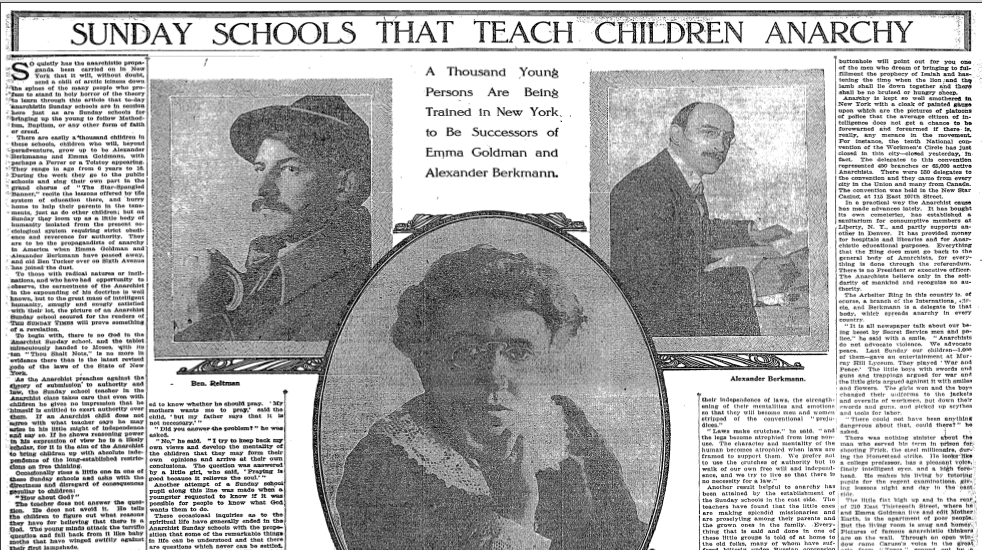
“Sunday Schools That Teach Children Anarchy,” from the New York Times (May 8, 1910)

Here's some more on mass-media reception of Anarchism during the early 20th century: a strange little piece from the Sunday New York Times magazine from May 8, 1910, on Anarchist Sunday schools in New York, focusing on the Ferrer Sunday School taught by Alexander Berkman. The Sunday schools were part of the large network of schools, cultural spaces and other institutions organized by Anarchists in large cities like New York during the early 20th century. (Like most Anarchistic educational projects, the Sundays were closely associated with the Modern School Movement and the thought of Francisco Ferrer). Either of the writer of the article, or his editor, couldn't quite seem to decide whether they wanted this story to be a straight interview of Berkman and a description of how the Sunday Schools were operated, or whether they wanted another cookie-cutter Anarchist-menace scare story.

SUNDAY SCHOOLS THAT TEACH CHILDREN ANARCHY

A Thousand Young Persons Are Being Trained in New York to Be Successors of Emma Goldman and Alexander Berkman.

So quietly has the anarchistic propaganda been carried on in New York that it will, without doubt, send a chill of arctic iciness down the spines of the many people who profess to stand in holy horror of the theory to learn through this article that to-day anarchistic Sunday schools are in session here just as are Sunday schools for bringing up the young to follow Methodism, Baptism, or any other form of faith or creed.

>

There are easily a thousand children in these schools, children who will, beyond peradventure, grow up to be Alexander Berkmanns and Emma Goldmans, with perhaps a Ferrer or a Tolstoy appearing. They range in age from 6 years to 16. During the week they go to the public schools and sing their own part in the grand chorus of "The Star-Spangled Banner," recite the lessons offered by the system of education there, and hurry home to help their parents in the tenements, just as do other children; but on Sunday they loom up as a little body of humanity isolated from the present sociological system requiring strict obedience and reverence for authority. They are to be the propagandists of anarchy in America when Emma Goldman and Alexander Berkmann have passed away, and old Ben Tucker over on Sixth Avenue has joined the dust.

To those with radical natures or inclinations, and who have had opportunity to observe, the earnestness of the Anarchist in the expounding of his doctrine is well known, but to the great mass of intelligent humanity, smugly and snugly satisfied with their lot, the picture of an Anarchist Sunday school secured for readers of The Sunday Times will prove something of a revelation.

To begin with, there is no God in the Anarchist Sunday school, and the tablet miraculously handed to Moses, with its ten Thou Shalt Nots, is no more in evidence there than is the latest revised code of the laws of the State of New York.

As the Anarchist preaches against the theory of submission to authority and law, the Sunday school teacher in the Anarchist class takes care that even with children he gives no impression that he himself is entitled to exert authority over them. If an Anarchist child does not agree with what teacher says he may arise in his little might of independence and say so. If he shows reasoning power in his expression of view he is a likely scholar, for it is the aim of the Anarchist to bring children up with absolute independence of the long-established restrictions on free thinking.

Occasionally rises a little one in one of these Sunday schools and asks with the directness and disregard of consequences peculiar to children:

How about God?

The teacher does not answer the question. He does not avoid it. He tells the children to figure out what reasons they have for believing that there is a God. The young minds attack the terrific question and fall back from it like baby moths that have winged swiftly against their first lampshade.

The largest of the Sunday schools is in Avenue A. It is called the Ferrer Sunday School, and was, until the killing of the Spanish philosopher, known as the Radical Sunday School. How the name was changed will prove a story that may stand out with striking novelty in the child life of New York to-day. It shall be told a little later in this article.

The Ferrer Sunday School is conducted by Alexander Berkmann. It has about eighty members and is in two classes. It meets on Sunday between 10 in the morning and noon. The youngest child is 7.

Berkmann has no laid-out system of teaching, depending on his comprehension of the psychology of the group at the time of the gathering. There are no rules. A song may be sung in chorus, a song dealing with freedom of mankind and hate for oppression. Some of the children may have learned by heart a poem or a fragment of an anarchistic argument and these provide recitations. The training of the mind anarchistically is then begun.

Berkmann, in a talk with a Times writer, in the office of Mother Earth, the Anarchist magazine, gave a sample of this teaching.

This was his talk to his Sunday school on Sabbath after the execution of Ferrer.

Once a single human being was swept from the sea to the shore of an island where there lived no human beings. There he found a great flock of sheep. He studied them and noticed that some of them were very powerfully built and finely fed. Some had even attained the strength and ferocity of wolves. But there were a great many of the sheep that were lean and worn. They were hungry and had been trampled down and hurt.

The man thought that he could so arrange it that these sheep, with little to eat and with bruises from being trampled, could be taught to care for themselves better and realize what the power of the strong and wolflike sheep had brought them to. He went among the sheep that suffered and began to point out to them what was the matter. The wolfish and strong ones heard of this and they turned upon the man and killed him.

When Berkmann finished this parable one of the children, a boy 18 years old, arose and said:

Why Mr. Berkmann, this story is just like the story of Ferrer's death.

The children were so impressed with the parable and the discussion which followed that the name of the school was then changed from the Radical Sunday School to the Ferrer Sunday School.

In the classes, said Berkmann, we generally use current events as subjects for discussion and study. For instance, one of our lessons was produced by the Hudson-Fulton Celebration in New York. The children of the east side saw a great deal of the sailors from the many men-of-war in the harbor. They saw the sailors of different nationalities entering and leaving the cafés, the best of friends, their arms about each other and acting like human brothers. The question naturally followed. Why should they be thus fond of each other and thus brotherly on land, and on sea be commanded to kill each other? They are brothers, and love each other, and there can be no fair reason for their slaying each other.

A man who had been raised in one of the old credal beliefs with care but who had come to be an agnostic in middle life once told the writer than when he realized that his religion had gone from him he felt that what he called reason had stepped into a nursery, and, like a willful bully, had gathered up the toys of a child sitting there and had destroyed them because he considered them useless. He considered the change from belief to agnosticism the tragedy of his life. The figure may be applied to thinking grown-ups easily, but it is hard to think of applying it to a child. And yet in the Anarchist Sunday school the tragedy of the destroyed toys is not infrequently enacted.

The pupil of the Anarchist Sunday school is taught to reason. The teacher only serves to direct their attention to a problem.

One child, said Berkmann, wanted to know whether he should pray. My mothers wants me to pray, said this child, but my father says that it is not necessary.

Did you answer the problem? he was asked.

No, he said. I try to keep back my own views and develop the mentality of the children that they may form their own opinions and arrive at their own conclusions. The question was answered by a little girl, who said, Praying is good because it relieves the soul.

Another attempt of a Sunday school pupil along this line was made when a youngster requested to know if it was possible for people to know what God wants them to do.

These occasional inquiries as to the spiritual life have generally ended in the Anarchist Sunday schools with the proposition that some of the remarkable things in life can be understood and that there are questions which never can be settled. The mental attitude of the children might be put in this way: We are not certain whether there are grounds for the belief that we should pray.

That, of course, leaves the question well in the field of agnosticism. The teacher of anarchy does not, with the children, declare that there is no God. Nor does he say that there is a God. The Sunday school class goes frequently to the Museum of Natural History, to Central Park, to the Zoological Gardens, and other places where, with the teacher, nature is studied.

The Ferrer Sunday school is only one of about fifteen similar schools in the greater city. Wherever the local groups of Anarchists can handle their own Sunday schools, carrying on the propaganda with literature, letters, lectures, &c., they do so without asking aid of others. When they cannot the State group helps. There is no central or superior group. Each has its own autonomy, although they all work to develop their principles of solidarity and mutual aid.

There are frequently conventions of the Sunday school teachers. Those who have classes get together and exchange experiences and ideas. In this city the Anarchists know that the fulfillment of their vision is afar, and they are already sowing their seed in the young and new fields that a generation of their kind may take hold of the propaganda when the present generation has withered and fallen.

These little Anarchists are being trained to believe in no authority. As Mr. Berkmann put it, everything is being done for them to aid them in the development of their independence of laws, the strengthening of their mentalities and emotions so that they will become men and women stripped of the conventional prejudices.

Laws make crutches, he said, and the legs become atrophied from long non-use. The character and mentality of human becomes atrophied when laws are framed to support them. We prefer not to use the crutches of authority but to walk of our own free will and independence, and we try to live so that there is no necessity for a law.

Another result helpful to anarchy has been attained by the establishment of the Sunday schools in the east side. The teachers have found that the little ones are making splendid missionaries and are proselyting among their parents and the grown ones in the family. Everything that is said and done in one of these little groups is told of at home to the old folks, many of whom have suffered bitterly under Russian oppression and who have revolution deep in their hearts. They write letters to the Anarchist teachers and get replies. They discuss the views expounded at home by their children and many of them become radicals and join the Anarchist groups.

The Anarchists also spread their propaganda by establishing little libraries which they make easily accessible to all who want to study the theory.

In the spreading of the propaganda among the children the littlest are not overlooked. There are some as young as six years of age who are getting kindergarten lessons in anarchy. One of these lessons is the lesson which preaches to a boy of health and strength at the age of six that he should not strike or abuse a boy who is not as strong as he is but should help him because he needs help. That is the very heart of the kindergarten lesson.

All of this work is done in what is called the Workmen's Circle. The Circle is the general group and is known as the Arbeiter Ring. A little white enamel badge with the letters A. R. in the buttonhole will point out for you one of the men who dream of bringing to fulfillment the prophecy of Isaiah and hastening the time when the lion and the lamb shall lie down together and there shall be no bruised or hungry sheep.

Anarchy is kept so well smothered in New York with a cloak of painted gauze upon which are the pictures of platoons of police that the average citizen of intelligence does not get a chance to be forewarned and forearmed if there is, really, any menace in the movement. For instance, the tenth National convention of the Workmen's Circle has just closed in this city--closed yesterday, in fact. The delegates to this convention represented 450 branches or 65,000 active Anarchists. There were 550 delegates to the convention and they came from every city in the Union and many from Canada. The convention was held in the New Star Casino, at 115 East 107th Street.

In a practical way the Anarchist cause has made advances lately. It has bought its own cemetaries, has established a sanitarium for consumptive members at Liberty, N. Y., and partly supports another in Denver. It has provided money for hospitals and libraries for Anarchistic educational purposes. Everything that the Ring does must go back to the general body of Anarchists, for everything is done through the referendum. There is no President or executive officer. The Anarchists believe only in the solidarity of mankind and recognize no authority.

The Arbeiter Ring in this country is, of course, a branch of the International Circle, and Berkmann is a delegate to that body, which spreads anarchy in every country.

It is all newspaper talk about our being beset by Secret Service men and police, he said with a smile. Anarchists do not advocate violence. We advocate peace. Last Sunday our children--1,000 of them--gave an entertainment at Murray Hill Lyceum. They played War and Peace. The little boys with swords and guns and trappings argued for war and the little girls argued against it with smiles and flowers. The girls won and the boys changed their uniforms to the jackets and overalls of workmen, put down their swords and guns, and picked up scythes and tools for labor.

There could not have been anything dangerous about that, could there? he asked.

There was nothing sinister about the man who served his term in prison for shooting Frick, the steel millionaire, during the Homestead strike. He looks like a college professor, has a pleasant voice, finely intelligent eyes, and a high forehead. He makes his living by tutoring pupils for the regent examinations, giving lessons night and day in the east side.

The little flat high up and in the rear of 210 East Thirteenth Street, where he and Emma Goldman live and edit Mother Earth, is the apartment of poor people. But the living room is snug and homey. Pictures of famous anarchistic thinkers are on the wall. Through an open window came Caruso's voice in the great aria from Tosca, ground out by a phonograph, as Berkmann talked with the Times man. It was a warm combination, but the night was warm, and we were glad for the breeze that swept the little place however burdened it might be.

We teach no ism, he said, harking back to the Sunday schools. Our aim is to develop character and mentality in the child. We try to make them think, criticise, and feel.

We want their emotional and intellectual natures developed. We want to make them men and women absolutely free of the old restrictions. We hope that they will grow up with the spirit of solidarity and co-operation in them. We try to teach them that in and out of school.

We try to teach them ethical right and reason. Our Radical Boys' Literary Club, boys about 13 or 14 years old, hold meetings after school, and they run their organization just as the grown people do. They have advanced to where they need no help from their elders.

Among the grown Anarchists the cause is kept warm by fervid preachings in their publications. These are the weekly paper Frei Arbiter Stimme, with a circulation of 12,000; Mother Earth, with a circulation of 6,000; Freiheit, with 5,000 circulation, and Voine Listy, a Bohemian paper, with a circulation of 4,500.

There are nine large groups of the grown Anarchists in New York. These have regular meetings, and conduct the propaganda with lectures, debates, &c.

In the district from Fourteenth Street to the Battery east of Broadway are 850,000 people living. Here beats the heart of anarchy. Nearly all of these people are foreign born, the native born element being insignificant in its percentage.

Forsyth Street, Chrystie, Cannon, Pitt, Columbia, Second Streets all have buildings in which are tiny halls that may be rented for a dollar or two for a wedding, a banquet, a lodge meeting, or a group meeting of Anarchists.

The man who lives awhile in this teeming corner of Manhattan does not take long to find out where he can go and hear all the anarchy he wants expounded. The writer once met in one of these little halls S. Yanofsky, the editor of the Frei Arbiter Stimme. A man with dreamy eyes, pointed beard, and nervous energy, he seemed to be looked up to as little short of a god by a clump of young men and women who were wating for him.

Yanofsky and Berkmann were both rounded up by the police after the Silverstein bomb explosion in Union Square in 1908, and as there was nothing against either of them nothing came of the call to Police Headquarters. Yanofsky, when asked by the writer what he thought of Silverstein's act, replied:

The man who commits a violent deed, if he is not mad, is desperate. Violence never did any good for anarchy. All government is a form of violence. Suppose Silverstein had suffered personally--and his act was that of an impatient and ignorant man--what did he accomplish? He only made himself dead and gave the chance to the enemies of anarchy to spread their calumnies. He only helped them to kill of the chances of gaining liberty.

Berkmann was a little clearer on the matter of violence and anarchy.

If a Republican or Democrat should throw a bomb or kill another, he said, the Republican Party or the Democratic Party would not be blamed for it. When an Anarchist does a thing like that we frankly say that anarchy did not inspire it, but that conditions of inequality and injustice caused the crime. To stop the crime, stop the cause. Anarchy is for justice and freedom. It cannot be blamed for individual acts of violence.

Among the favorite east side speakers for anarchy, besides Yanofsky and Berkmann, is Dr. Ben Reitman, whose method is to stir up the hearers with fiery sentences depicting the wrongs resulting from the present order of things. He with the others believes that anarchy is gathering strength, and will continue to gather it and will prove a living force in the slow movement of society through the ages.

Now Available: Three from Liberty on Alaskan Anarchy

I'm happy to announce that the Fair Use Repository now features full-text transcriptions of three articles from an early number of Benjamin Tucker's Liberty -- a discussion of stateless living amongst Alaskan indigenous tribes and what it might mean.

  • A. P. Kelly, then associate editor of Liberty, leads off with Anarchy in Alaska, in Liberty Vol II., No. 16 (May 17, 1884).

  • F. R. B. replied with a general question about Anarchy and fallen humanity, and Kelly printed it along with his rejoinder, in The Cause of Crime, in Liberty Vol. II., No. 17 (May 31, 1884).

  • The Anarchist pamphleteer C. L. James replied in his turn, calling attention to the fact of violence against women in the society that Kelly had described, and challenging Kelly's optimism about criminality in a free society. Kelly printed the letter, and his own, rather intemperate, rejoinder, in A Shadow in the Path, in Liberty Vol. II., No. 19 (June 28, 1884).

Many thanks to Shawn Wilbur's invaluable Travelling in Liberty repository for making the needed issues of Liberty easily available.

Gertrude B. Kelly, “Mr. Walker’s Neo-Nonsense,” from Liberty Vol. IV. No. 4 (June 19, 1886)

This is a contribution to the debate over Malthusianism that was conducted in the pages of Benjamin Tucker's newspaper Liberty, in which the natural-rights anarchist and individualist feminist Gertrude B. Kelly called fellow anarchist E. C. Walker, also a free-love and birth control advocate, to task over his advocacy of "Neo-Malthusianism," an rehabilitate the work of Thomas Malthus as a component of radical, pro-labor economics. The column appears as "Mr. Walker's Neo-Nonsense," on the back page (p. 8) of Liberty Vol. IV., No. 4 (June 19, 1886).

Mr. Walker's Neo-Nonsense

I am sorry to see that E. C. Walker, having taken a position on Malthusianism, probably without due consideration, seems to feel himself bound now, for the sake of consistency, to maintain that position at all hazards. Consistency is a very fine thing but truth is far finer. Mr. Walker is still determined to call himself a Malthusian, though he denies the fundamental doctrine of Malthusianism,--i.e., that the working-people would be better off, everything else remaining unchanged, if their numbers were diminished. Does Mr. Walker know that Malthus's "Theory of Population" was written in answer to Condorcet's "Esquisse des Progrès de l'Espirit Humain" and Godwin's "Political Justice," the two most Anarchistic works of the last century, which demonstrated that poverty and vice and crime were due to the inequality of conditions, generated and fostered by unjust political systems. Both Godwin and Condorcet foresaw that some day the population question would come up for consideration but they saw also, as we see today, that it was not the burning question, calling for immediate solution, not the question on the solution of which depended the solution of all the others, but that it was a dependent question, secondary to that of justice. Condorcet especially has shown that with improved conditions, and the increased morality necessarily resulting from this improvement, the population question would settle itself, for no man would then desire to bring beings into existence for whose happiness he could not provide, and that recklessness in this respect today was due to the general degradation of the people. Malthus came to the rescue of the rising bourgeoisie, and was one of the most noted signs of the reaction following the French Revolution. He endeavored to show that any attempt made to improve the conditions of the people would only make things worse, as it would make room for a larger population. Mr. Malthus's followers have since pointed with pride to India as a proof of their master's insight. The positive checks, of war, of pestilence, etc., to overpopulation having been removed by the motherly care of the British government, the Indian people have been reduced to a condition of more hopeless poverty than that in which they were before. They take no note of the part which the fostering care of the British userers has had in the production of this poverty; it is not part of their scheme to recognize that.

A large part of Mr. Walker's article is more suited to the columns of the Women's Christian Temperance papers than to the columns of Liberty. It betrays about as much sense in regard to the population question as the ordinary Christian is in relation to the temperance question. Mr. Walker probably admits that the condition of the individual workingman is made worse by intemperate habits, but nevertheless he would consider it a very superficial movement which confined itself to treating the intemperance, but left the poverty which produced the intemperance untouched. Intemperance and the large families will disappear with the conditions that produce them, and therefore it is to these conditions that our attention must be directed.

In his desperate thundering endeavor to maintain the position which he has assumed, Mr. Walker has deserted the high plane of the Anarchist for that of the ordinary bourgeois or trade-unionist. He says that the workingman "is living in the present, and not in some millennial future." In his criticisms of the ideas and actions of the trades-unionists, Mr. Walker has shown an impatience and disgust with them which a really philosophical student of society would never have displayed, and just because of this very impatience and this disgust I am not at all surprised to see him descending to the arguments of the trades-unionists. The trades-unionists always tell us:--"Your theories are very fine, but what we want now are better wages and shorter hours." When we say that, when these become general, they will be no better off than they were before, they answer that they are dealing "with the present, and not with some millennial future. When we have higher wages and fewer hours, we will then have more intelligence to consider the labor question," etc. etc. Mr. Walker ought to join Mr. Atkinson in his improved system of domestic economy, and also to take lessons from Miss Corson on how to make a neck of beef last a family of six persons for three weeks. All these subjects are highly important, and deal with the "here and now."

But Mr. Walker has really begged the whole question of Malthusianism. Malthus said that, in proportion to the food-producing capacity of the world at any time, the number of people has always been too great, and hence war, famine, and pestilence are absolutely necessary, and that the only way poverty (which is due to over-population) can be removed is by lessening the population. Mr. Walker says that the individual workingman is better off when his family is small, but admits that, if small families become general, poverty would exist in as great a degree as before, but that all men, from the training they had received in lessening the size of their families, would be more fitted to combat the difficulty. Wondrous training-school! He has changed the discussion from a question of political economy to one of domestic economy, with which the question of the just distribution of wealth has nothing whatsoever to do.

As to France, France is a proof that Malthusianism--that is, a restriction of the population--is a failure as a means for the destruction of poverty. It is in the country districts of France, if I understand J. S. Mill rightly, that the small families originated, for it was to the country people and not to the city people that the Revolution guaranteed a certain means of support which could not be easily increased. In the tables of population of France from 1870 to 1880, I find that more than one-third of the increase of population is credited to the large cities. Now whether this increase in the cities be due to an increased number of births in the cities, or to increased emigration from the country, the population of the country districts must in either case be almost stationary, and, according to the theory of Malthus, the country people should be much better off than in those countries in which large families prevail. This we have already shown not to be the case. Much admiration as I have for the French people, I cannot admit that "they more quickly and effectively than any other modern people resent invasions of their rights, and have a higher ideal of industrial and social life." In the first place, they do not resent invasions of their rights by the State nearly as much as the English people do, but are constantly clamoring for more and more State regulation, and in the next, the ideal of even the most advanced of them is not all that high in our sense of that word, as even "Le Révolté" cannot keep out of communism.

No, the Anarchists or Anti-Malthusians do not assume that the "wage-system is to be eternal," and it is for this reason that they are not Malthusians, for the true Malthusian does assume the wage-system to be eternal. I will quote from what seems to be Mr. Walker's Book of Common Prayer, "The Elements of Social Science," which he recommended to Mr. Heywood in the last number of "Lucifer" as representing his views on Malthusianism: "There is one method, and one only by which they [the working class] may escape from the great evils which oppress them,--the want of food and leisure, hard work and low wages. This is, by reducing their numbers, and so lessening the supply of labor in proportion to the demand." One method only, remember; no hint at the abolition of the wage-system. And again: "Wages cannot rise, except through there being more capital or less laborers, nor fall, except through there being less capital or more laborers." "Poverty arises from an overcrowding of the labor-market and an undue depression of the margin of cultivation." "The great social evils of old countries, when reduced to their simplest expression, are found to arise from the vast superiority of increase in man, over the powers of increase in the land." "Profits are the rewards of abstinence [not of monopoly] as wages are the rewards of labor." This book not only supports all the theories of the orthodox economists, which are true under present conditions, and all the orthodox deductions from these theories, but also all their absurdities, such as the existence of a "wages-fund," and Mill's absurd proposition that a "demand for commodities is not a demand for labor." The book is so full of economic absurdities that I am not at all surprised at Mr. Walker's temporary state of mental aberration after reading it.

A true Malthusian (I have been unable to discover what constitutes a Neo-Malthusian) sees no other cause for poverty but over-population, no other remedy for poverty but a reduction of the population, and therefore a Malthusian who is a labor-reformer is an anomaly, a contradiction, an absurdity. As to the Malthusians tending towards Anarchy, I wish Mr. Walker would point them out. Mr. Walker and Mr. James tend toward Anarchism, but Mrs. Besant tends just as strongly towards State Socialism. Which tendency is due to the Malthusianism? Are not both in opposition to it? And the people who practically carry out Malthusianism, the French, have a very much stronger leaning towards State Socialism and Communism than the English, whose families are proverbially large.

Gertrude B. Kelly.

Now available from Liberty: “A Retrospect,” by A. L. Ballou

I'm happy to announce that the Fair Use Repository has added a new article to its collection: A Retrospect, an autobiographical sketch of the political development of A. L. Ballou, the individualist Anarchist and sometime contributor to Benjamin Tucker's Liberty. (This A. L. Ballou should not be confused with Adin Ballou, 1803-1890, the abolitionist minister and advocate of Christian non-resistance.) The article, discussing Ballou's development from Republican Party politics, to the freethought movement and the temperance movement, to the Greenback movement and Georgism, and ultimately out of electoral politics entirely to Anarchism and the method of passive resistance.