Fair Use Blog

“Justus Schwab Mourned: Anarchists Forget Their Differences at His Funeral,” in the New York Times (December 21, 1900)

Yesterday's post mentioned Justus Schwab, a German-American radical and a fixture of the New York Anarchist milieu, who kept a radical "Beer-Hole" on First Street where Anarchists, socialists, writers, artists, and other radicals and misfits met to drink and talk into the night. Emma Goldman later described his saloon as "the most famous radical center in New York." Here is an item from the December 21, 1900 issue of the New York Times, on Schwab's death and his funeral, which brought together New York radicals across factional lines and putting aside schisms and personal breaks to celebrate his memory.

>

JUSTUS SCHWAB MOURNED

>

Anarchists Forget Their Differences at His Funeral.

>
The Tribute of John Swinton--Most in Tears--Emma Goldman Looks Calmly On.
>

>

The disciples of extreme Socialism and Anarchy in this city were assembled in harmony yesterday under one roof. This, it is declared, is without a precedent. The occasion was the funeral of Justus Schwab.

The Anarchists gathered in a dingy hall on East Fourth Street. All differences were forgotten, and there was not a single man or woman who gave evidence of any feeling other than sorrow at the loss of the dead disciple. At times during the speeches which were made over the body almost every one there broke down and wept. Dark, bearded faces that had worn a scowl of discontent for years were softened with grief, and men who had been bitter enemies of Justus Schwab while he was alive cried like children.

Emma Goldman, the woman Anarchist leader, who had been the dead man's closest friend, was the only one present who did not give some indication of emotion. She sat calmly throughout the ceremonies, although John Most, who had been opposed to Schwab for years, gave way completely to his grief several times.

The funeral services were held in the assembly room of the Labor Lyceum at 64 East Fourth Street. The body was taken from the room over the saloon at 50 First Street, where Schwab had lived, early in the day and placed on a bier in the middle of the assembly room. The coffin was open so that the face of the dead man could be seen, and coffin and bier were draped with flags. The emblem of Anarchy was wrapped around the coffin and thrown over the lower part of it, and flags from various labor unions hung below. There was a pile of flowers that brightened up the dark hall, arranged on a table at one end. There were wreaths from Cigar Makers' Union No. 90, from an Italian Anarchist society, and from the Social Science Club.

The funeral service was marked by the absolute absence of any religious ceremonial, and consisted of speeches by various friends of the dead man. The band of the Carl Sahm Club, which was stationed at one end of the hall, played a dirge that seemed to harmonize with the sombre surroundings, and the Lieber Tafel Singing Society, which the dead Anarchist had founded, sang Eventide. George Biederkapp, the author of a book of Socialist poems, recited an original poem eulogizing Schwab, entitled, The Storm Has Passed, and when he had taken his seat almost every one in the room was in tears. Alexander Jonas, a Socialist leader, made a short speech in German and was followed by John Swinton, who spoke in English.

I am entirely overcome, he said, when I attempt to speak of our dead brother. I have never known a man so self-sacrificing, so faithful, so noble.

John Most, who had been the leader of the Anarchist faction opposed to Schwab, was the next speaker. He spoke in German and in the most dramatic manner. When he had completed his speech he was evidently exhausted, and sank into a chair as the pall-bearers lifted the coffin and carried it out to the hearse, which was waiting for it.

As the hearse started slowly down Second Avenue, followed by a few carriages, nearly 2,000 people, many of them in tears, fell in line behind it. The procession passed by the little saloon where Schwab had lived and then proceeded slowly to the ferry at the foot of East Houston Street. All along the route the windows of the tenements were filled with people. At the ferry the carriages followed the hearse and the Anarchists on foot dispersed quietly. The body was taken to Fresh Pond, L. I., for cremation.

Source

Buenaventura Durruti: A New World in Our Hearts (Spain 1936)

Now available thanks to Robert Graham at Robert Graham's Anarchism Weblog:

Robert Graham's Anarchism: A Documentary History of Libertarian Ideas presents Buenventura Durutti on the Spanish Revolution.

Read the whole thing at Robert Graham's Anarchism Weblog.

Letter from Eugene V. Debs to Joseph Labadie, May 5, 1908

This is a letter from the labor organizer and Socialist Party of America leader Eugene V. Debs to his fellow organizer, the individualist anarchist Joseph A. Labadie, in reply to an earlier letter from Labadie about misrepresentations of Anarchism coming in from Socialist Party members. The letter also refers to Debs's correspondence with Voltairine de Cleyre. At the time, Debs was running for President of the United States on the SP ticket.

May 5, 1908
Girard, Kansas

My dear Joe:--

Some days ago a letter came from you which I had but time to glance at and meant to answer later, but to my regret I am now unable to find it. In the thousand or more letters which pour in here daily yours seems to have gone astray. I remember, I think, the substance of your letter and regret you felt that ytou had cause for writing it. It is quite probable that there is good ground for your complaint. I do not justify nor attempt to justify any misrepresentation of anarchism or anarchists. But this sort of thing has been engaged in on both sides. At Chicago and some other places there are those who call themselves anarchists who are to be found in every election with the money of capitalist politicians in their pockets and doing the service of ward-heeling politicians, denouncing Socialists and visiting their wrath on the Appeal to Reason and other Socialist papers. Between elections of course, they have no use for politics and denounce all politics as corrupt but when there is an opening to make a few dirty dollars they are in the thick of the vilest kind of politics. But I know you do not defend this and I am simply mentioning it to show that there are those on both sides who are engaged in the reprehensible work which you and I both condemn.

I have a letter from Voltairine de Cleyre on the same subject and have just answered her. Of course you know that I am not an anarchist and do not agree to the anarchist philosophy, but I can none the less admire such a comrade as Voltairine de Cleyre, in whose letter which lies before me there is everything that is commendable and not one word to which any fair and decent person could take exception.

I have often defended anarchists and I think no one more fully appreciates the moral heroism of the Chicago anarchists who were legally murdered than I. Certain anarchists have at times treated me unfairly but I have rarely paid any attention to them for the very reason that I do not wish any personal controversy with those who are opposed to capitalism. So far as we can work together well and good. Where we cannot do this we can each pursue his own course with all due respect for the other. I number some anarchists among my warmest personal friends and the only change I could wish in them is that they were Socialists.

I appreciate the kindly spirit in which you have written me and you may rely upon me to do what I can to prevent any misrepresentation of anarchism on the part of Socialists.

I am glad your mail has been held up by the government. This gives you fresh credentials and increases, if possible, my personal regard for you. In any such fight, if it became serious, I need not assure you that you could count on me without fear of disappointment.

I hope you are well and cheerful, and with all good wishes, remain as ever,

Yours faithfully,

E. V. Debs

The letter is printed in Letters of Eugene V. Debs, Vol. 1, ed. J. Robert Constantine (University of Illinois Press, 1990), pp. 264-266. It is preserved in the Labadie Collection at the University of Michigan.

The Manifesto of the Sixteen (1916)

Now available thanks to Shawn P. Wilbur at Two-Gun Mutualism & the Golden Rule:

[Here is a translation of the controversial "Manifesto of the Sixteen," the document issued by Peter Kropotkin, Jean Grave and others, advocating support for the Allies and opposition to Germany in World War I. I had promised this to members of the Anarchist Task Force on Wikipedia quite awhile back, to go with their article on the Manifesto.]

The Manifesto of the Sixteen

From various sides, voices are raised to demand immediate peace. There has been enough bloodshed, enough destruction, they say, and it is time to finish things, one way or another. More than anyone and for a long time, we and our journals have been against every war of aggression between peoples and against militarism, whatever uniform, imperial or republican, it dons. So we would be delighted to see the conditions of peace discussed—if that was possible—by the European workers, gathered in an international congress. Especially since the German people let itself be deceived in August 1914, and if they had really believed that they mobilized for the defense of their territory, they have since had time to realize that they were wrong to embark on a war of conquest.

Indeed, the German workers, at least in their associations, more or less advanced, must understand now that the plans for the invasion of France, of Belgium, and of Russian had long been prepared and that, if that war did not erupt in 1875, 1886, 1911 or in 1913, it was because international relations did not present themselves then as favorably and because the military preparations were not complete enough to promise victory to Germany. (There were strategic lines to complete, the Kiel canal to expand, the great siege guns to perfect). And now, after twenty months of war and dreadful losses, they should realize that the conquests ...

Read the whole thing at Two-Gun Mutualism & the Golden Rule.

Now available: “Is Tyranny Necessary?” Joseph A. Labadie (Liberty, February 23, 1895)

Over at the main Fair Use Repository site, there's been some ongoing work on transcribing material from Liberty, availing ourselves of the fantastic resources that Shawn Wilbur has made available at Travelling in Liberty. (Travelling in Liberty is a complete online archive of PDF facsimiles of all 403 issues of Liberty, as well as the 7 issues of its German-language sister publication, Libertas.) One of the major ongoing projects over here at Fair Use is to transcribe the text available in these PDF facsimiles and make it available in readily-searchable, readily-readable, readily-citable HTML.

To-day, the ongoing Liberty transcriptions have given us a letter from the Michigan labor organizer, poet and individualist Anarchist agitator, Joseph A. (Jo) Labadie. The letter, framed as a response to a friend's worries about the possibility of civil order under Anarchy (or, alternatively, about the legitimacy of using statist laws to establish civil order in a governed society), appeared in the February 23, 1895 issue of Liberty:

Read, cite and enjoy!

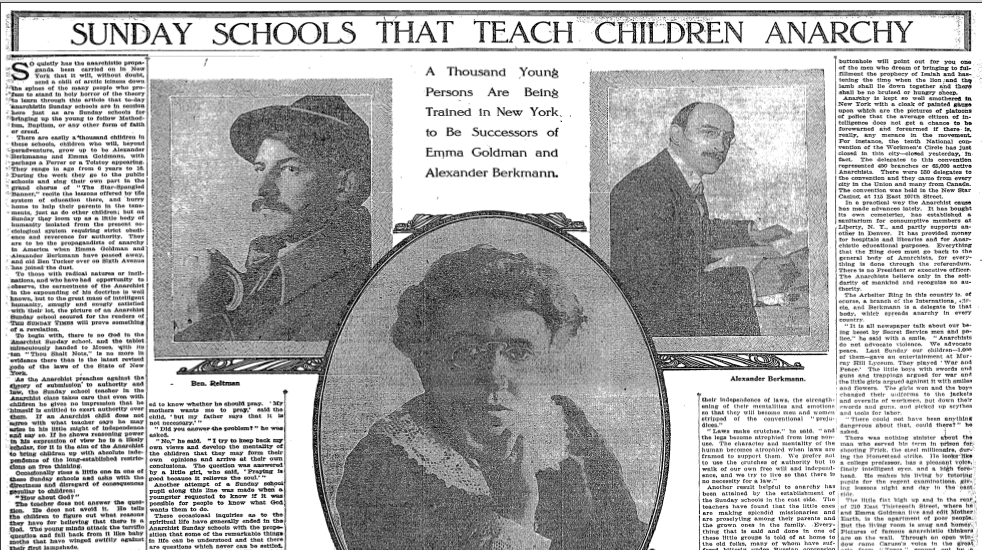
“Sunday Schools That Teach Children Anarchy,” from the New York Times (May 8, 1910)

Here's some more on mass-media reception of Anarchism during the early 20th century: a strange little piece from the Sunday New York Times magazine from May 8, 1910, on Anarchist Sunday schools in New York, focusing on the Ferrer Sunday School taught by Alexander Berkman. The Sunday schools were part of the large network of schools, cultural spaces and other institutions organized by Anarchists in large cities like New York during the early 20th century. (Like most Anarchistic educational projects, the Sundays were closely associated with the Modern School Movement and the thought of Francisco Ferrer). Either of the writer of the article, or his editor, couldn't quite seem to decide whether they wanted this story to be a straight interview of Berkman and a description of how the Sunday Schools were operated, or whether they wanted another cookie-cutter Anarchist-menace scare story.

SUNDAY SCHOOLS THAT TEACH CHILDREN ANARCHY

A Thousand Young Persons Are Being Trained in New York to Be Successors of Emma Goldman and Alexander Berkman.

So quietly has the anarchistic propaganda been carried on in New York that it will, without doubt, send a chill of arctic iciness down the spines of the many people who profess to stand in holy horror of the theory to learn through this article that to-day anarchistic Sunday schools are in session here just as are Sunday schools for bringing up the young to follow Methodism, Baptism, or any other form of faith or creed.

>

There are easily a thousand children in these schools, children who will, beyond peradventure, grow up to be Alexander Berkmanns and Emma Goldmans, with perhaps a Ferrer or a Tolstoy appearing. They range in age from 6 years to 16. During the week they go to the public schools and sing their own part in the grand chorus of "The Star-Spangled Banner," recite the lessons offered by the system of education there, and hurry home to help their parents in the tenements, just as do other children; but on Sunday they loom up as a little body of humanity isolated from the present sociological system requiring strict obedience and reverence for authority. They are to be the propagandists of anarchy in America when Emma Goldman and Alexander Berkmann have passed away, and old Ben Tucker over on Sixth Avenue has joined the dust.

To those with radical natures or inclinations, and who have had opportunity to observe, the earnestness of the Anarchist in the expounding of his doctrine is well known, but to the great mass of intelligent humanity, smugly and snugly satisfied with their lot, the picture of an Anarchist Sunday school secured for readers of The Sunday Times will prove something of a revelation.

To begin with, there is no God in the Anarchist Sunday school, and the tablet miraculously handed to Moses, with its ten Thou Shalt Nots, is no more in evidence there than is the latest revised code of the laws of the State of New York.

As the Anarchist preaches against the theory of submission to authority and law, the Sunday school teacher in the Anarchist class takes care that even with children he gives no impression that he himself is entitled to exert authority over them. If an Anarchist child does not agree with what teacher says he may arise in his little might of independence and say so. If he shows reasoning power in his expression of view he is a likely scholar, for it is the aim of the Anarchist to bring children up with absolute independence of the long-established restrictions on free thinking.

Occasionally rises a little one in one of these Sunday schools and asks with the directness and disregard of consequences peculiar to children:

How about God?

The teacher does not answer the question. He does not avoid it. He tells the children to figure out what reasons they have for believing that there is a God. The young minds attack the terrific question and fall back from it like baby moths that have winged swiftly against their first lampshade.

The largest of the Sunday schools is in Avenue A. It is called the Ferrer Sunday School, and was, until the killing of the Spanish philosopher, known as the Radical Sunday School. How the name was changed will prove a story that may stand out with striking novelty in the child life of New York to-day. It shall be told a little later in this article.

The Ferrer Sunday School is conducted by Alexander Berkmann. It has about eighty members and is in two classes. It meets on Sunday between 10 in the morning and noon. The youngest child is 7.

Berkmann has no laid-out system of teaching, depending on his comprehension of the psychology of the group at the time of the gathering. There are no rules. A song may be sung in chorus, a song dealing with freedom of mankind and hate for oppression. Some of the children may have learned by heart a poem or a fragment of an anarchistic argument and these provide recitations. The training of the mind anarchistically is then begun.

Berkmann, in a talk with a Times writer, in the office of Mother Earth, the Anarchist magazine, gave a sample of this teaching.

This was his talk to his Sunday school on Sabbath after the execution of Ferrer.

Once a single human being was swept from the sea to the shore of an island where there lived no human beings. There he found a great flock of sheep. He studied them and noticed that some of them were very powerfully built and finely fed. Some had even attained the strength and ferocity of wolves. But there were a great many of the sheep that were lean and worn. They were hungry and had been trampled down and hurt.

The man thought that he could so arrange it that these sheep, with little to eat and with bruises from being trampled, could be taught to care for themselves better and realize what the power of the strong and wolflike sheep had brought them to. He went among the sheep that suffered and began to point out to them what was the matter. The wolfish and strong ones heard of this and they turned upon the man and killed him.

When Berkmann finished this parable one of the children, a boy 18 years old, arose and said:

Why Mr. Berkmann, this story is just like the story of Ferrer's death.

The children were so impressed with the parable and the discussion which followed that the name of the school was then changed from the Radical Sunday School to the Ferrer Sunday School.

In the classes, said Berkmann, we generally use current events as subjects for discussion and study. For instance, one of our lessons was produced by the Hudson-Fulton Celebration in New York. The children of the east side saw a great deal of the sailors from the many men-of-war in the harbor. They saw the sailors of different nationalities entering and leaving the cafés, the best of friends, their arms about each other and acting like human brothers. The question naturally followed. Why should they be thus fond of each other and thus brotherly on land, and on sea be commanded to kill each other? They are brothers, and love each other, and there can be no fair reason for their slaying each other.

A man who had been raised in one of the old credal beliefs with care but who had come to be an agnostic in middle life once told the writer than when he realized that his religion had gone from him he felt that what he called reason had stepped into a nursery, and, like a willful bully, had gathered up the toys of a child sitting there and had destroyed them because he considered them useless. He considered the change from belief to agnosticism the tragedy of his life. The figure may be applied to thinking grown-ups easily, but it is hard to think of applying it to a child. And yet in the Anarchist Sunday school the tragedy of the destroyed toys is not infrequently enacted.

The pupil of the Anarchist Sunday school is taught to reason. The teacher only serves to direct their attention to a problem.

One child, said Berkmann, wanted to know whether he should pray. My mothers wants me to pray, said this child, but my father says that it is not necessary.

Did you answer the problem? he was asked.

No, he said. I try to keep back my own views and develop the mentality of the children that they may form their own opinions and arrive at their own conclusions. The question was answered by a little girl, who said, Praying is good because it relieves the soul.

Another attempt of a Sunday school pupil along this line was made when a youngster requested to know if it was possible for people to know what God wants them to do.

These occasional inquiries as to the spiritual life have generally ended in the Anarchist Sunday schools with the proposition that some of the remarkable things in life can be understood and that there are questions which never can be settled. The mental attitude of the children might be put in this way: We are not certain whether there are grounds for the belief that we should pray.

That, of course, leaves the question well in the field of agnosticism. The teacher of anarchy does not, with the children, declare that there is no God. Nor does he say that there is a God. The Sunday school class goes frequently to the Museum of Natural History, to Central Park, to the Zoological Gardens, and other places where, with the teacher, nature is studied.

The Ferrer Sunday school is only one of about fifteen similar schools in the greater city. Wherever the local groups of Anarchists can handle their own Sunday schools, carrying on the propaganda with literature, letters, lectures, &c., they do so without asking aid of others. When they cannot the State group helps. There is no central or superior group. Each has its own autonomy, although they all work to develop their principles of solidarity and mutual aid.

There are frequently conventions of the Sunday school teachers. Those who have classes get together and exchange experiences and ideas. In this city the Anarchists know that the fulfillment of their vision is afar, and they are already sowing their seed in the young and new fields that a generation of their kind may take hold of the propaganda when the present generation has withered and fallen.

These little Anarchists are being trained to believe in no authority. As Mr. Berkmann put it, everything is being done for them to aid them in the development of their independence of laws, the strengthening of their mentalities and emotions so that they will become men and women stripped of the conventional prejudices.

Laws make crutches, he said, and the legs become atrophied from long non-use. The character and mentality of human becomes atrophied when laws are framed to support them. We prefer not to use the crutches of authority but to walk of our own free will and independence, and we try to live so that there is no necessity for a law.

Another result helpful to anarchy has been attained by the establishment of the Sunday schools in the east side. The teachers have found that the little ones are making splendid missionaries and are proselyting among their parents and the grown ones in the family. Everything that is said and done in one of these little groups is told of at home to the old folks, many of whom have suffered bitterly under Russian oppression and who have revolution deep in their hearts. They write letters to the Anarchist teachers and get replies. They discuss the views expounded at home by their children and many of them become radicals and join the Anarchist groups.

The Anarchists also spread their propaganda by establishing little libraries which they make easily accessible to all who want to study the theory.

In the spreading of the propaganda among the children the littlest are not overlooked. There are some as young as six years of age who are getting kindergarten lessons in anarchy. One of these lessons is the lesson which preaches to a boy of health and strength at the age of six that he should not strike or abuse a boy who is not as strong as he is but should help him because he needs help. That is the very heart of the kindergarten lesson.

All of this work is done in what is called the Workmen's Circle. The Circle is the general group and is known as the Arbeiter Ring. A little white enamel badge with the letters A. R. in the buttonhole will point out for you one of the men who dream of bringing to fulfillment the prophecy of Isaiah and hastening the time when the lion and the lamb shall lie down together and there shall be no bruised or hungry sheep.

Anarchy is kept so well smothered in New York with a cloak of painted gauze upon which are the pictures of platoons of police that the average citizen of intelligence does not get a chance to be forewarned and forearmed if there is, really, any menace in the movement. For instance, the tenth National convention of the Workmen's Circle has just closed in this city--closed yesterday, in fact. The delegates to this convention represented 450 branches or 65,000 active Anarchists. There were 550 delegates to the convention and they came from every city in the Union and many from Canada. The convention was held in the New Star Casino, at 115 East 107th Street.

In a practical way the Anarchist cause has made advances lately. It has bought its own cemetaries, has established a sanitarium for consumptive members at Liberty, N. Y., and partly supports another in Denver. It has provided money for hospitals and libraries for Anarchistic educational purposes. Everything that the Ring does must go back to the general body of Anarchists, for everything is done through the referendum. There is no President or executive officer. The Anarchists believe only in the solidarity of mankind and recognize no authority.

The Arbeiter Ring in this country is, of course, a branch of the International Circle, and Berkmann is a delegate to that body, which spreads anarchy in every country.

It is all newspaper talk about our being beset by Secret Service men and police, he said with a smile. Anarchists do not advocate violence. We advocate peace. Last Sunday our children--1,000 of them--gave an entertainment at Murray Hill Lyceum. They played War and Peace. The little boys with swords and guns and trappings argued for war and the little girls argued against it with smiles and flowers. The girls won and the boys changed their uniforms to the jackets and overalls of workmen, put down their swords and guns, and picked up scythes and tools for labor.

There could not have been anything dangerous about that, could there? he asked.

There was nothing sinister about the man who served his term in prison for shooting Frick, the steel millionaire, during the Homestead strike. He looks like a college professor, has a pleasant voice, finely intelligent eyes, and a high forehead. He makes his living by tutoring pupils for the regent examinations, giving lessons night and day in the east side.

The little flat high up and in the rear of 210 East Thirteenth Street, where he and Emma Goldman live and edit Mother Earth, is the apartment of poor people. But the living room is snug and homey. Pictures of famous anarchistic thinkers are on the wall. Through an open window came Caruso's voice in the great aria from Tosca, ground out by a phonograph, as Berkmann talked with the Times man. It was a warm combination, but the night was warm, and we were glad for the breeze that swept the little place however burdened it might be.

We teach no ism, he said, harking back to the Sunday schools. Our aim is to develop character and mentality in the child. We try to make them think, criticise, and feel.

We want their emotional and intellectual natures developed. We want to make them men and women absolutely free of the old restrictions. We hope that they will grow up with the spirit of solidarity and co-operation in them. We try to teach them that in and out of school.

We try to teach them ethical right and reason. Our Radical Boys' Literary Club, boys about 13 or 14 years old, hold meetings after school, and they run their organization just as the grown people do. They have advanced to where they need no help from their elders.

Among the grown Anarchists the cause is kept warm by fervid preachings in their publications. These are the weekly paper Frei Arbiter Stimme, with a circulation of 12,000; Mother Earth, with a circulation of 6,000; Freiheit, with 5,000 circulation, and Voine Listy, a Bohemian paper, with a circulation of 4,500.

There are nine large groups of the grown Anarchists in New York. These have regular meetings, and conduct the propaganda with lectures, debates, &c.

In the district from Fourteenth Street to the Battery east of Broadway are 850,000 people living. Here beats the heart of anarchy. Nearly all of these people are foreign born, the native born element being insignificant in its percentage.

Forsyth Street, Chrystie, Cannon, Pitt, Columbia, Second Streets all have buildings in which are tiny halls that may be rented for a dollar or two for a wedding, a banquet, a lodge meeting, or a group meeting of Anarchists.

The man who lives awhile in this teeming corner of Manhattan does not take long to find out where he can go and hear all the anarchy he wants expounded. The writer once met in one of these little halls S. Yanofsky, the editor of the Frei Arbiter Stimme. A man with dreamy eyes, pointed beard, and nervous energy, he seemed to be looked up to as little short of a god by a clump of young men and women who were wating for him.

Yanofsky and Berkmann were both rounded up by the police after the Silverstein bomb explosion in Union Square in 1908, and as there was nothing against either of them nothing came of the call to Police Headquarters. Yanofsky, when asked by the writer what he thought of Silverstein's act, replied:

The man who commits a violent deed, if he is not mad, is desperate. Violence never did any good for anarchy. All government is a form of violence. Suppose Silverstein had suffered personally--and his act was that of an impatient and ignorant man--what did he accomplish? He only made himself dead and gave the chance to the enemies of anarchy to spread their calumnies. He only helped them to kill of the chances of gaining liberty.

Berkmann was a little clearer on the matter of violence and anarchy.

If a Republican or Democrat should throw a bomb or kill another, he said, the Republican Party or the Democratic Party would not be blamed for it. When an Anarchist does a thing like that we frankly say that anarchy did not inspire it, but that conditions of inequality and injustice caused the crime. To stop the crime, stop the cause. Anarchy is for justice and freedom. It cannot be blamed for individual acts of violence.

Among the favorite east side speakers for anarchy, besides Yanofsky and Berkmann, is Dr. Ben Reitman, whose method is to stir up the hearers with fiery sentences depicting the wrongs resulting from the present order of things. He with the others believes that anarchy is gathering strength, and will continue to gather it and will prove a living force in the slow movement of society through the ages.
Review of C. L. James’s The French Revolution, from the New York Times (April 25, 1903)

We've been spending some time lately gathering material on C. L. James (1846-1911), the prolific but reclusive Anarchist pamphleteer and song-writer of Eau Claire, Wisconsin. James was something of an intellectual heavy in his day, and maintained frequent correspondence with (among others) The Alarm, Liberty, Free Society and Mother Earth, but he has since been almost entirely forgotten. Well, if the Fair Use Repository is good for anything, hopefully it is providing a platform for some diligent un-forgetting.

Along with a steady stream of pamphlets and articles, James wrote a book-length History of the French Revolution; for to-day's post, we have a very mildly positive review of the book that ran in the New York Times, of all places, on April 25, 1903. Well, it's certainly a kinder review than some he got in the Anarchist press. In any case, here we are.

The French Revolution

New York Times, April 25, 1903

History of the French Revolution. By C. L. James. Pp. 343. Cloth 8vo. Chicago: Abe Isaac, Jr.

A sketch of the French Revolution by a theoretical Anarchist is likely to have whatever interest attaches to a peculiar point of view. Mr. James seems to be a theoretic Anarchist, and his book has the special interest that might be expected of such a work. It is, in fact, a readable essay, for the most part moderate in expression, usually distinguished by lucidity of style, and apparently based on wide reading. After that the book is a piece of special pleading. Mr. James's method is not to exult over the bloodshed and madness of the Revolution, rarely to defned, though often to excuse, the atrocities of the time.

The Reign of Terror he regards as a dreadful period, and the Government of that time one of the worst that the world has known, but one of the strongest. He thinks the idyllic time of the revolution was the period of a year or more before the execution of the King, when France bordered close upon true anarchy, being almost without government. This opinion, as might be expected of an Anarchist, Mr. James is fond of repeating. He also declares that the influential men of the Revolution were not Socialists or Communists. Even while he condemns the government of the Jacobins, and many of their tyrannical measures, as a consistent Anarchist must, he is anxious to find acts of theirs to praise, and he is not often struck with the absurdities of the time. But perhaps Mr. James with all his keenness is a little defective in the sense of humor.

The attitude of the author is best illustrated by concrete examples. He appreciates the virtues of Louis XVI., and thinks imprisonment would have been better than death in his case, but believing him to have been guilty of the crimes of which he was convicted, is not struck with the travesty of justice implied in a trial by Judges who were constantly under the eyes and influence of an outspoken populace bitterly hostile to the accused. The Queen he thinks to have been guilty also of treason, but he is moved to generous disgust at the revolting charges of Hébert. Nevertheless he hardly permits himself one expression of pity for her fate, though he thinks her death a political mistake. The September massacres, the atrocities of Lyons and of Nantes he does not defend, but impliedly excuses by citing parallels in the doings of settled governments. This last is his favorite method of excuse, and it is sometimes effective. He pities the Girondists, but thinks they brought upon themselves their hard fate. Of Danton's end he says: Thus died, in the noblest of causes, the best champion of freedom whom the crisis of his time produced. Robespierre he does not defend so earnestly as do some recent students of the period, possibly because he cannot forgive Robespierre's ambition to be dictator. Marat's demand for 200,000 heads, though repeated in open convention, Mr. James thinks hardly more than a piece of insincere bravado. He pronounces the terrible doctor of the sewers the most misrepresented man in the revolution.

This book is well worth reading, if only that one may see how hard it is for the historian, however intelligent, to do much more than make ex parte statement of his case. It is well, however, that we should have such a statement from the revolutionary side, for the larger part of what has been written on the subject in English deals with it from the very opposite point of view.

Now Available: Three from Liberty on Alaskan Anarchy

I'm happy to announce that the Fair Use Repository now features full-text transcriptions of three articles from an early number of Benjamin Tucker's Liberty -- a discussion of stateless living amongst Alaskan indigenous tribes and what it might mean.

  • A. P. Kelly, then associate editor of Liberty, leads off with Anarchy in Alaska, in Liberty Vol II., No. 16 (May 17, 1884).

  • F. R. B. replied with a general question about Anarchy and fallen humanity, and Kelly printed it along with his rejoinder, in The Cause of Crime, in Liberty Vol. II., No. 17 (May 31, 1884).

  • The Anarchist pamphleteer C. L. James replied in his turn, calling attention to the fact of violence against women in the society that Kelly had described, and challenging Kelly's optimism about criminality in a free society. Kelly printed the letter, and his own, rather intemperate, rejoinder, in A Shadow in the Path, in Liberty Vol. II., No. 19 (June 28, 1884).

Many thanks to Shawn Wilbur's invaluable Travelling in Liberty repository for making the needed issues of Liberty easily available.

Gertrude B. Kelly, “Mr. Walker’s Neo-Nonsense,” from Liberty Vol. IV. No. 4 (June 19, 1886)

This is a contribution to the debate over Malthusianism that was conducted in the pages of Benjamin Tucker's newspaper Liberty, in which the natural-rights anarchist and individualist feminist Gertrude B. Kelly called fellow anarchist E. C. Walker, also a free-love and birth control advocate, to task over his advocacy of "Neo-Malthusianism," an rehabilitate the work of Thomas Malthus as a component of radical, pro-labor economics. The column appears as "Mr. Walker's Neo-Nonsense," on the back page (p. 8) of Liberty Vol. IV., No. 4 (June 19, 1886).

Mr. Walker's Neo-Nonsense

I am sorry to see that E. C. Walker, having taken a position on Malthusianism, probably without due consideration, seems to feel himself bound now, for the sake of consistency, to maintain that position at all hazards. Consistency is a very fine thing but truth is far finer. Mr. Walker is still determined to call himself a Malthusian, though he denies the fundamental doctrine of Malthusianism,--i.e., that the working-people would be better off, everything else remaining unchanged, if their numbers were diminished. Does Mr. Walker know that Malthus's "Theory of Population" was written in answer to Condorcet's "Esquisse des Progrès de l'Espirit Humain" and Godwin's "Political Justice," the two most Anarchistic works of the last century, which demonstrated that poverty and vice and crime were due to the inequality of conditions, generated and fostered by unjust political systems. Both Godwin and Condorcet foresaw that some day the population question would come up for consideration but they saw also, as we see today, that it was not the burning question, calling for immediate solution, not the question on the solution of which depended the solution of all the others, but that it was a dependent question, secondary to that of justice. Condorcet especially has shown that with improved conditions, and the increased morality necessarily resulting from this improvement, the population question would settle itself, for no man would then desire to bring beings into existence for whose happiness he could not provide, and that recklessness in this respect today was due to the general degradation of the people. Malthus came to the rescue of the rising bourgeoisie, and was one of the most noted signs of the reaction following the French Revolution. He endeavored to show that any attempt made to improve the conditions of the people would only make things worse, as it would make room for a larger population. Mr. Malthus's followers have since pointed with pride to India as a proof of their master's insight. The positive checks, of war, of pestilence, etc., to overpopulation having been removed by the motherly care of the British government, the Indian people have been reduced to a condition of more hopeless poverty than that in which they were before. They take no note of the part which the fostering care of the British userers has had in the production of this poverty; it is not part of their scheme to recognize that.

A large part of Mr. Walker's article is more suited to the columns of the Women's Christian Temperance papers than to the columns of Liberty. It betrays about as much sense in regard to the population question as the ordinary Christian is in relation to the temperance question. Mr. Walker probably admits that the condition of the individual workingman is made worse by intemperate habits, but nevertheless he would consider it a very superficial movement which confined itself to treating the intemperance, but left the poverty which produced the intemperance untouched. Intemperance and the large families will disappear with the conditions that produce them, and therefore it is to these conditions that our attention must be directed.

In his desperate thundering endeavor to maintain the position which he has assumed, Mr. Walker has deserted the high plane of the Anarchist for that of the ordinary bourgeois or trade-unionist. He says that the workingman "is living in the present, and not in some millennial future." In his criticisms of the ideas and actions of the trades-unionists, Mr. Walker has shown an impatience and disgust with them which a really philosophical student of society would never have displayed, and just because of this very impatience and this disgust I am not at all surprised to see him descending to the arguments of the trades-unionists. The trades-unionists always tell us:--"Your theories are very fine, but what we want now are better wages and shorter hours." When we say that, when these become general, they will be no better off than they were before, they answer that they are dealing "with the present, and not with some millennial future. When we have higher wages and fewer hours, we will then have more intelligence to consider the labor question," etc. etc. Mr. Walker ought to join Mr. Atkinson in his improved system of domestic economy, and also to take lessons from Miss Corson on how to make a neck of beef last a family of six persons for three weeks. All these subjects are highly important, and deal with the "here and now."

But Mr. Walker has really begged the whole question of Malthusianism. Malthus said that, in proportion to the food-producing capacity of the world at any time, the number of people has always been too great, and hence war, famine, and pestilence are absolutely necessary, and that the only way poverty (which is due to over-population) can be removed is by lessening the population. Mr. Walker says that the individual workingman is better off when his family is small, but admits that, if small families become general, poverty would exist in as great a degree as before, but that all men, from the training they had received in lessening the size of their families, would be more fitted to combat the difficulty. Wondrous training-school! He has changed the discussion from a question of political economy to one of domestic economy, with which the question of the just distribution of wealth has nothing whatsoever to do.

As to France, France is a proof that Malthusianism--that is, a restriction of the population--is a failure as a means for the destruction of poverty. It is in the country districts of France, if I understand J. S. Mill rightly, that the small families originated, for it was to the country people and not to the city people that the Revolution guaranteed a certain means of support which could not be easily increased. In the tables of population of France from 1870 to 1880, I find that more than one-third of the increase of population is credited to the large cities. Now whether this increase in the cities be due to an increased number of births in the cities, or to increased emigration from the country, the population of the country districts must in either case be almost stationary, and, according to the theory of Malthus, the country people should be much better off than in those countries in which large families prevail. This we have already shown not to be the case. Much admiration as I have for the French people, I cannot admit that "they more quickly and effectively than any other modern people resent invasions of their rights, and have a higher ideal of industrial and social life." In the first place, they do not resent invasions of their rights by the State nearly as much as the English people do, but are constantly clamoring for more and more State regulation, and in the next, the ideal of even the most advanced of them is not all that high in our sense of that word, as even "Le Révolté" cannot keep out of communism.

No, the Anarchists or Anti-Malthusians do not assume that the "wage-system is to be eternal," and it is for this reason that they are not Malthusians, for the true Malthusian does assume the wage-system to be eternal. I will quote from what seems to be Mr. Walker's Book of Common Prayer, "The Elements of Social Science," which he recommended to Mr. Heywood in the last number of "Lucifer" as representing his views on Malthusianism: "There is one method, and one only by which they [the working class] may escape from the great evils which oppress them,--the want of food and leisure, hard work and low wages. This is, by reducing their numbers, and so lessening the supply of labor in proportion to the demand." One method only, remember; no hint at the abolition of the wage-system. And again: "Wages cannot rise, except through there being more capital or less laborers, nor fall, except through there being less capital or more laborers." "Poverty arises from an overcrowding of the labor-market and an undue depression of the margin of cultivation." "The great social evils of old countries, when reduced to their simplest expression, are found to arise from the vast superiority of increase in man, over the powers of increase in the land." "Profits are the rewards of abstinence [not of monopoly] as wages are the rewards of labor." This book not only supports all the theories of the orthodox economists, which are true under present conditions, and all the orthodox deductions from these theories, but also all their absurdities, such as the existence of a "wages-fund," and Mill's absurd proposition that a "demand for commodities is not a demand for labor." The book is so full of economic absurdities that I am not at all surprised at Mr. Walker's temporary state of mental aberration after reading it.

A true Malthusian (I have been unable to discover what constitutes a Neo-Malthusian) sees no other cause for poverty but over-population, no other remedy for poverty but a reduction of the population, and therefore a Malthusian who is a labor-reformer is an anomaly, a contradiction, an absurdity. As to the Malthusians tending towards Anarchy, I wish Mr. Walker would point them out. Mr. Walker and Mr. James tend toward Anarchism, but Mrs. Besant tends just as strongly towards State Socialism. Which tendency is due to the Malthusianism? Are not both in opposition to it? And the people who practically carry out Malthusianism, the French, have a very much stronger leaning towards State Socialism and Communism than the English, whose families are proverbially large.

Gertrude B. Kelly.

“To Drive Anarchists Out of the Country,” from the New York Times (March 4, 1908)

In line with some of our other recent material from the anti-immigrant and anti-Anarchist panic of the 19-aughts, here is a long front-page story from the New York Times in 1908, in which the Times declared that The United States has declared open war on Anarchists. The form that the war would take was a mass crackdown on immigrants -- one of the first major immigration enforcement actions in United States history -- in order to round up and deport Anarchists with radical political beliefs.

TO DRIVE ANARCHISTS OUT OF THE COUNTRY


Secretary Straus Orders Immigration Men to Co-operate with Police in Locating Criminals.


INDORSED BY ROOSEVELT


Added Precautions to be Taken in Excluding Aliens--Three Assassinations Were Plotted in Chicago.


Special to The New York Times.

WASHINGTON, March 3.--The United States has declared open war on Anarchists. As a result of the great increase in crime and the growing boldness of those who are enlisted under the red flag, Commissioners of Immigration and immigrant Inspectors have been instructed by Secretary Straus of the Department of Commerce and Labor to ally themselves with the police and detectives of the cities and aid in putting an end to terrorism. The order was issued to-day, and is said to have the hearty indorsement of President Roosevelt.

Secretary Straus orders that the immigration authorities shall take steps necessary to securing the co-operation of the police and detective forces in an effort to rid the country of alien Anarchists and criminals falling within the law relating to deportation.

Secretary Straus's Order.

The order of Secretary Straus follows:

To all Commissioners of Immigration and Immigrant Inspectors in charge: It is hereby directed that, with a view to promptly obtaining definite information with regard to alien Anarchists and criminals located in the Untied States, you shall confer fully with the Chief of Police or the Chief of the Secret Service of the city in which you are located, furnishing such official with detailed information with regard to the inhibition of that statute against aliens of the criminal classes, explaining the powers and limitations imposed by said statute upon the immigration officials with respect to such persons.

You should call to the attention of the Chief of Police or Chief of the Secret Service the definition of Anarchist contained in Sections 2 and 38 of the act of Feb. 20, 1907, and the provisions of Section 2 placing within the excluded classes persons who have been convicted of or admit having committed a felony or other crime or misdemeanor involving moral turpitude, pointing out that if any such person is found within the United States within three years after landing or entry therein he is amenable to deportation under the provisions of Section 21 of said act.

The co-operation of said officials should be requested, making it clear that in order that any particular Anarchist or criminal may be deported, evidence must be furnished showing (1) that the person in question is an alien subject to the immigration acts; (2) that he is an Anarchist or criminal as defined in the statute; (3) the date of his arrival in the United States, which must be within three years of the date of his arrest; (4) the name of the vessel or of the transportation line by which he came, if possible, and (5) the name of the country whence he came, the details with respect to the last three items being kept at the various ports of entry in such a manner as to be available if information is furnished with respect to the Anarchist's name, the date of his arrival, and the port of entry.

It is desired that the above indicated steps shall be taken at once and that no proper effort shall be spared to secure and retain the co-operation of the local police and detective forces in an effort to rid the country of alien Anarchists and criminals falling within the provisions of the statute relating to deportation.

Uneasy Over Anarchy's Spread.

The Administration has viewed with increasing uneasiness the spread of Anarchy and Socialistic teachings. The threats made against citizens of wealth and position are becoming more numerous with every month. The attempt to kill the Chief of Police of Chicago, the riot in Philadelphia following the dispersal of an Anarchistic meeting, and the threats made against clergymen have brought the Government to a realization that something must be done to make life and property more secure.

With the activity of the immigration authorities and the police in running down criminals in the United States, there will be taken added precautions against admitting to the country any more of the same class. The examination of the hordes of aliens that come yearly to these shores will be made so severe that it will in the future partake of the nature of an inquisition. The Government is beginning to realize that it has been employing too lax methods in the past.

A case in point, they say, is the presence in this country of Emma Goldman. This woman is declared to be a firebrand and an Anarchist of the most rabid type. She went abroad some months ago, and at that time it was openly stated that she would not be readmitted to the country. In spite of these declarations Miss Goldman is back again in the United States spreading the propaganda of revolutionary Socialism.

It is cases such as these, in the opinion of officials, that lend encouragement to the vicious element. The laws, in the first place, are held to be too lenient, and secondly, they are not administered with the severity the situation demands. More stringent laws, coupled with emphatic application of them, are said to be the crying need of the time.

As the law now stands, an Anarchist may go about unmolested by the police after he has spent three years in this country and has not been connected with the perpetration of a crime in that time. He is immune from deportation. It does not matter whether the criminal is a citizen or not, he can legally resist all efforts to return him to the country from whence he came.

Possible to Exclude Anarchists.

It is possible, however, under the existing law to exclude Anarchists. The law declares that, among others, there may be excluded from the country anarchists, or persons who believe in or advocate the overthrow by force or violence of the Government of the United States or of all government or of all forms of law, or the assassination of public officials.

Section 20 of the Immigration act, which covers the exclusion of aliens, provides: That any alien who shall enter the United States in violation of the law shall, upon the warrant of the Secretary of Commerce and Labor, be taken into custody and deported to the country whence he came at any time within three years after the date of his entry into the United States.

Section 21 provides that in case the Secretary of Commerce and Labor shall be satisfied that an alien has been found in the United States in violation of this act, or that an alien is subject to deportation under any law of the United States, he shall cause such alien within the period of three years after landing to be taken into custody and returned to the country whence he came.

This makes it mandatory upon the Secretary to deport any alien Anarchist whom he may discover who has not been in the country three years.

General Enemies of Society.

In addition to these provisions, which ordinarily would cover the case of an Anarchist, a separate section dealing with enemies of society generally was included in the act. Section 38 says:

That no person who believes in or who is opposed to all organized government, or who is a member of or affiliated with any organization entertaining and teaching such disbelief in or opposition to all organized government, or who advocates or teaches the duty, necessity, or propriety of the unlawful assaulting or killing of any officer or officers, whether of specific individuals or of officers generally, of the Government of the United States, or of any other organized government, because of his or their official character, shall be permitted to enter the United States or any territory or place subject to the jurisdiction thereof.

This section shall be enforced by the Secretary of Commerce and Labor under such rules and regulations as he shall prescribe. That any person who knowingly aids or assists any such person to enter the United States or any territory or place subject to the jurisdiction thereof, or who connives or conspires with any such person or persons to allow, procure, or permit any such person to enter therein, except pursuant to such rules and regulations made by the Secretary of Commerce and Labor shall be fined not more than $5,000, or imprisoned for not more than five years, or both.

--The New York Times, March 4, 1908, pp. 1-2.