I'm happy to announce that the Fair Use Repository now features full-text transcriptions of three articles from an early number of Benjamin Tucker's Liberty -- a discussion of stateless living amongst Alaskan indigenous tribes and what it might mean.
A. P. Kelly, then associate editor of Liberty, leads off with Anarchy in Alaska, in Liberty Vol II., No. 16 (May 17, 1884).
F. R. B. replied with a general question about Anarchy and fallen humanity, and Kelly printed it along with his rejoinder, in The Cause of Crime, in Liberty Vol. II., No. 17 (May 31, 1884).
The Anarchist pamphleteer C. L. James replied in his turn, calling attention to the fact of violence against women in the society that Kelly had described, and challenging Kelly's optimism about criminality in a free society. Kelly printed the letter, and his own, rather intemperate, rejoinder, in A Shadow in the Path, in Liberty Vol. II., No. 19 (June 28, 1884).
Many thanks to Shawn Wilbur's invaluable Travelling in Liberty repository for making the needed issues of Liberty easily available.
posted 6:03 pm by Rad Geek | no comments
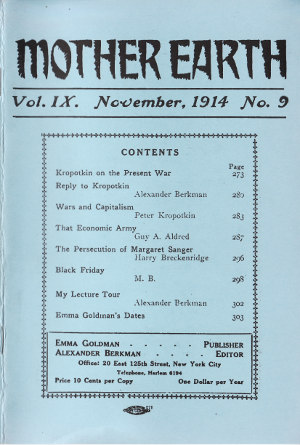
I'm happy to announce that the Fair Use Repository now features four complete articles from the November, 1914 issue of Mother Earth:
Kropotkin on the Present War by Peter Kropotkin -- a reprint of Kropotkin's letter supporting the French government's fighting in World War I;
In Reply to Kropotkin by Alexander Berkman -- in which Berkman calls Kropotkin to task, argues that the international working class has no real stake in bosses' wars, and calls on Anarchists to oppose all sides in all government wars.
Wars and Capitalism (Chapter I) by Peter Kropotkin, a reprint of Kropotkin's earlier analysis of war, from 1913, in which he argued that the reason for modern war is always the competition for markets and the right to exploit nations backward in industry.
Black Friday of 1887, by M. B.,
a slashing review of the Socialist journalist Charles Edward Russell's discussion of Haymarket in his memoirs, and a commemoration of the Haymarket martyrs hanged 11 November 1887.
These are the first set of articles to be put online from Mother Earth Volume IX, Number 9; more will come soon. I believe that the complete issue should be available online by the end of the week.
Read, cite, and enjoy!
posted 1:11 pm by Rad Geek | 1 comment
I am happy to announce that the full content of Benjamin Tucker's Instead Of A Book, By A Man Too Busy To Write One is now available, online, through the Fair Use Repository!
The completion of the online edition adds the following new essays:
- General Walker and the Anarchists.
- Herr Most on Libertas.
- Still Avoiding the Issue
- Herr Most Distilled and Consumed.
- Should Labor be Paid or Not?
- Does Competition Mean War?
- Competition and Monopoly Confounded.
- On Picket Duty.
- The Power of Passive Resistance.
- The Irish Situation in 1881.
- The Method of Anarchy.
- Theoretical Methods.
- A Seed Planted.
- The
Home Guard
Heard From.
- Colonization.
- Labor’s New Fetich.
- Mr. Pentecost’s Belief in the Ballot.
- A Principle of Social Therapeutics.
- The Morality of Terrorism.
- The Beast of Communism.
- Time Will Tell.
- The Facts Coming to Light.
- Liberty and Violence.
- Convicted by a Packed Jury.
- Why Expect Justice from the State?
- The Lesson of the Hour
- Convicted for their Opinions.
- To the Breach, Comrades!
- On Picket Duty.
- The Lesson of Homestead.
- Save Labor from its Friends
- Is Frick a Soldier of Liberty?
- Shall Strikers be Court-Martialled?
- Census-Taking Fatal to Monopoly.
- Anarchy Necessarily Atheistic.
- A Fable for Malthusians
- Auberon Herbert and his Work.
- Solutions of the Labor Problem.
- Karl Marx as Friend and Foe.
- Do the Knights of Labor Love Liberty?
- Play-House Philanthropy.
- Beware of Batterson!
- A Gratifying Discovery.
- Cases of Lamentable Longevity.
- Spooner Memorial Resolutions.
- On Picket Duty.
There are still the usual finishing touches (internal links, details of the front matter, minor points of formatting, etc.) to apply. But this book is basically done, and all 497 pages worth of content are, in any case, available for you to read, cite, and enjoy!
posted 7:23 pm by Rad Geek | 1 comment
Part IV of Benjamin Tucker's Instead of a Book, by a Man Too Busy To Write One, on Socialism, is now available in full in the Fair Use Repository's online edition of the work. This adds several newly transcribed essays focusing on the meaning of socialism,
arguing that Anarchistic Socialism is the most consistent form of socialism and arguing against the common assumption that socialism is synonymous with State monopoly over production. The essays newly available are:
- Socialism: What It Is, which argues that the word
Socialism
should be proudly claimed, or reclaimed, by Anarchists, in spite of the appropriation of the word by State Socialists. Tucker argues that Anarchistic Socialism is the most consistent form of socialism.
- Armies That Overlap, in which Tucker claims (against the claims of the paper Twentieth Century) that Anarchism and Socialism, properly defined, are neither coextensive nor exclusive; they are two overlapping struggles.
- Socialism and the Lexicographers, which compiles a large list of dictionary and encyclopaedia definitions of the word
Socialism
in response to State Socialists' recent attempts to use a dictionary definition to read Anarchists out of the socialist movement.
- The Sin of Herbert Spencer, discussing the apparent class bias in Spencer's later work, which Tucker interprets as attacking only government privilege for the poor, while remaining silent about government privilege for the rich. Tucker also praises the work of Spencer's English followers, especially Auberon Herbert, as more consistent.
- Will Professor Sumner Choose? addresses remarks by the liberal political economist William Graham Sumner, arguing that while his arguments against State Socialism are quite telling, consistency demands that he should endorse the radical laissez-faire position of Anarchistic Socialism.
- After Freiheit, Der Sozialist responds to a polemical attack on the German edition of Liberty by a State Socialist newspaper.
- State Socialism and Liberty argues that State monopoly over the means of production necessarily involves tyranny, and that free individual people must be able to withdraw and form their own arrangements at will.
- On Picket Duty discusses arguments from the English Marxist Edward Aveling on the tyranny of State Socialism, the relationship between individualist anarchism and communist anarchism, the relationship between individualist anarchism and laissez-faire classical liberalism, gradualists who see State Socialism as part of a transition to Anarchism, and Terence Powderly's attacks on Oscar Wilde.
posted 12:28 pm by Rad Geek | 1 comment
Part III of Benjamin Tucker's Instead of a Book, by a Man Too Busy to Write One, on Land and Rent, is now available in full in the Fair Use Repository's online edition. This adds the following new transcribed essays.
There are a series of articles setting out basic principles and defending the occupancy-and-use standard for land ownership, including discussions with Edgeworth
and Auberon Herbert:
Next come a series of discussions on Henry George's theories on land tenure and the single tax:
Followed by a long debate with the correspondent Egoist,
on the abolition of the State and the merits of Georgist theory:
Then an exchange with Stephen T. Byington, later a major translator of anarchist works into English, on whether a free market will eliminate economic rent; if so, how; and if not, whether Georgist confiscation of rent is permissible. Tucker makes clear that the notion of liberty that he defends is intimately connected with a defense of private property:
And two short articles in which Tucker argues that Georgist land-tax schemes would result in homesteaders being unjustly evicted from their homes due to increasing population in their neighborhood:
Finally, a collection of short remarks from the On Picket Duty columns of Liberty, focusing almost entirely on debates with Henry George:
posted 11:56 pm by Rad Geek | 1 comment
