Fair Use Blog

Countereconomics on the shopfloor

So lately I’ve been reading through a cache of syndicalist and autonomist booklets that I picked up a couple years ago from a NEFACker friend of mine who was soon to move out of Vegas. Partly for my own edutainment, but also because I am doing some prep work for possibly introducing a sort of Little Libertarian Labor Library to the ALL Distro.[1] Anyway, here’s a really interest passage I ran across in a booklet edition of Shopfloor Struggles of American Workers — a talk by the Detroit auto-worker and autonomist Marxist Martin Glaberman — on the difference between asking workers to vote on an issue and asking them to strike over it, taking as an example the internal conflicts over the union bosses’ no-strike pledge during World War II.

One of the things I want to start with, because it does provide a framework, and is not simply an event from the past, is something I did some work on a number of years ago about auto workers in the United States during World War II, the kinds of struggles that went on on the shop floor, within the union, between the workers and the government, a complex reality. What it revolved around was the struggle against the no-strike pledge in the UAW When the United States entered World War II, virtually all of America’s labor leaders graciously granted in the name of their members a pledge not to strike at all during the war.

In the first months of the war, the first year, there was an actual drop off in strikes. The end of 1941 through 1942 was a period that put a finish to the late thirties, the massive organizational drives, the sit-down strikes, the violence, all the things that created the big industrial unions. The job hadn’t been entirely done. Ford wasn’t organized until early 1941. Little Steel wasn’t organized, unionized, until the war was well under way, and so on.

Gradually, however, as the war went on, the number of strikes, (by definition all of them were wildcats, all of them were illegal under union contracts and under union constitutions) began to escalate until by the end of the war, the number of workers on strike exceeded anything in past American labor history. What was distinct about the UAW wasn’t just that the wildcat strikes were larger in number and more militant, but the fact that something took place which made it possible to make a certain kind of record. It was the only union in which, because there were still two competing caucuses, leaving rank and file workers a certain amount of democratic leeway to press for their point of view, an actual formal debate and vote took place on the question of the no-strike pledge.

A small, so-called rank and file, caucus was organized late in 1943 and early 1944, to begin a campaign around a number of issues, but the central issue was the repeal of the no-strike pledge. … So[2] they proceeded to have a referendum. This referendum was in some respects the classic sociological survey. Everyone got a postcard ballot. Errors, cheating, etc. were really kept to a minimum. Everyone on the commission thought that it was as fair as you get in an organization of a million or more members. It took several months to do. When the vote was finally in, the membership of the UAW had voted about two to one to reaffirm the no-strike pledge.

The conclusion any decent sociologist would draw is that autoworkers on the whole thought that patriotism was a little bit more important than class interests, that they supported the war rather than class struggle and strikes, etc. There was a little problem, however, and this is why this is such a fascinating historical experience. The problem was that at the very same time that the vote was going on, in which workers voted two to one to reaffirm the no-strike pledge, a majority of autoworkers struck ….

To visualize it is fairly simple: you’re not voting on the shop floor; you get this postcard, you’re sitting at the kitchen table, you’re listening to the radio news with the casualty reports from Europe and the Pacific and you think, yes, we really should have a no-strike pledge, we’ve got to support our boys. Then you go to work the next day and your machine breaks down and the foreman says, Don’t stand around, grab a broom and sweep up, and you tell him to go to hell because it’s not your job and the foreman says he’s going to give you time off and the next thing you know, the department walks out. … The reality is that in a war which was probably the most popular war that America took part in, workers in fact, if not in their minds or in theory, said that given the choice between supporting the war or supporting our interests and class struggle, we take class struggle.

— Martin Glaberman, Shopfloor Struggles of American Workers (1993?)

Glaberman puts this out as a distinction between what workers say in their minds or in theory and what they say or do in fact. I’m not sure that’s right — doesn’t the story about the foreman involve the workers’ mind and beliefs just as much as the story about the kitchen table? — but I think the most important thing here is Glaberman’s attention to the context at the point of decision, and how that shapes what kind of decision a worker thinks of herself as making. Not just the outcome of the choice, but really the topic, whether the worker is asked to make some kind of political choice about what she ought, in some general and detached sense, she ought to value (isn’t Patriotism important?), or she finds herself making an engaged, personal choice about what’s happening — what’s being done — to her and her fellow workers right now, on the margin. There is a lesson here for counter-economists.

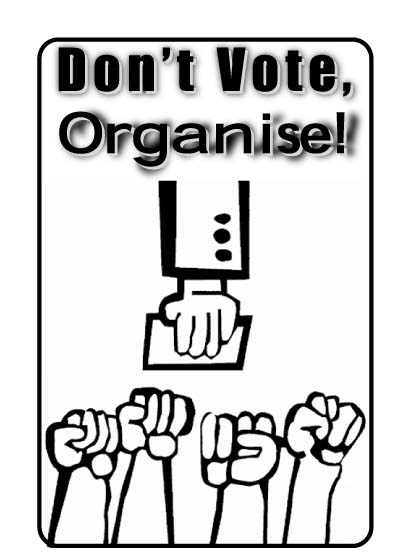
Freedom is not something you vote on. It’s something you struggle for. And what’s far more important than trying to figure out how to get people to endorse the right ideology, or, worse, the least-bad set of policies and candidates to each other across the kitchen table, is figuring out how you and your neighbors can best cooperate with each other, practice solidarity and withdraw from maintaining and collaborating with the state. People who would never respond to a smaller-government candidate or a libertarian ideological pitch often will act very differently when you open up opportunities to support grassroots alternatives and withdraw from the day-to-day inhumanities of war taxes, regulations, police, prisons, borders, and the state-supported and state-supporting corporate capitalist economy. Meanwhile, those who talk all day about changing votes, and building parties to more effectively capture a few more votes here and there, and have nothing else to offer, are wasting time, resources, and organizing energy on efforts that are not merely futile, but in fact actively lethal to any hope of motivating and coordinating effective practical action.

See also:

  1. [1] The basic idea: L4 would encompass some of the material we already have (Chaplin’s General Strike, Carson’s Ethics of Labor Struggle) and a lot of new and classic material, with new titles published at regular intervals, all with the basic underlying goal of (1) providing some decent labor-oriented materials for ALL locals, and (2) providing a decent source (mostly, currently, lacking) for IWW local organizing committees and other radical labor efforts to find some decently produced, low-cost booklet-style materials for lit drops and outreach tables, beyond just the IW, Anarcho-Syndicalist Review, and the relatively expensive books you can purchase through GHQ. ↩
  2. [2] [After an inconclusive floor debate in convention. —RG] ↩

Over My Shoulder #48: from Nicholson Baker, “Human Smoke”

You know the rules. Here’s the quote. This is from Human Smoke, Nicholson Baker’s sparely-written, chapterless skein of documentary vignettes retelling the events that led up to World War II.

Cyril Joad, a philosopher who was writing a book called Journey Through the War Mind, had a talk with his pacifist friend D. Joad asked D. whether D. thought Chamberlain should have negotiated with Hitler after Hitler’s peace offer. Yes, of course, said D.: Wars should never be begun, and as soon as they were begun, they should be stopped. D. then listed off many war evils: the physical and moral mutilation, the intolerance, the public lying, the enthronement of the mob. He quoted from the text of Chamberlain’s refusal—that by discussing peace with Hitler, Britain would forfeit her honor and abandon her claim that international disputes should be settled by discussion and not by force. Our claim is, you see, D. told Joad, that international disputes are not to be settled by force, and this claim we propose to make good by settling an international dispute by force. We are fighting to show that you cannot, or at least must not, impose your will upon other people by violence. Which made no sense.

Once a war has started, D. said, the only thing to do is to get it stopped as soon as possible. Consequently I should negotiate with Hitler.

Joad said: Ah, but you couldn’t negotiate with Hitler because you couldn’t trust him—Hitler would break any agreement as soon as it benefited him to do so.

Suppose you were right, D. said—suppose that Hitler violated the peace agreement and England had to go back to war. What had they lost? If the worst comes to the worst, we can always begin the killing again. Even a day of peace was a day of peace. Joad found he had no ready answer to that.


Cyril Joad talked about the war with another acquaintance, Mrs. C., a vigorous Tory. War was natural and unavoidable, said Mrs. C. The Germans weren’t human—they were brute blond perverted morons.

Joad asked C. what she would do with Germany, and a light came into her eyes.

I would make a real Carthaginian peace, she told Joad. Raze their cities to the ground, plough up the land and sow it afterwards with salt; and I would kill off one out of every five German women, so that they stopped breeding so many little Huns.

Mrs. C.’s ideas were shared by others, Joad had noticed; he’d recently read a letter to the editor about Germany in London’s News Chronicle: Quite frankly, said the letter, I would annihilate every living thing, man, woman, and child, beast, bird and insect; in fact, I would not leave a blade of grass growing even; Germany should be laid more desolate than the Sahara desert, if I could have my way.

The longer the war lasted, Joad believed, the more this kind of viciousness would multiply: Already Joad wrote, Mr. Churchill was reviving the appellation Huns.

— Nicholson Baker (2008), Human Smoke: The Beginnings of World War II, the End of Civilization. ISBN 1-4165-7246-5. 154–155

Over My Shoulder #48: from Nicholson Baker, “Human Smoke”

You know the rules. Here’s the quote. This is from Human Smoke, Nicholson Baker’s sparely-written, chapterless skein of documentary vignettes retelling the events that led up to World War II.

Cyril Joad, a philosopher who was writing a book called Journey Through the War Mind, had a talk with his pacifist friend D. Joad asked D. whether D. thought Chamberlain should have negotiated with Hitler after Hitler’s peace offer. Yes, of course, said D.: Wars should never be begun, and as soon as they were begun, they should be stopped. D. then listed off many war evils: the physical and moral mutilation, the intolerance, the public lying, the enthronement of the mob. He quoted from the text of Chamberlain’s refusal–that by discussing peace with Hitler, Britain would forfeit her honor and abandon her claim that international disputes should be settled by discussion and not by force. Our claim is, you see, D. told Joad, that international disputes are not to be settled by force, and this claim we propose to make good by settling an international dispute by force. We are fighting to show that you cannot, or at least must not, impose your will upon other people by violence. Which made no sense.

Once a war has started, D. said, the only thing to do is to get it stopped as soon as possible. Consequently I should negotiate with Hitler.

Joad said: Ah, but you couldn’t negotiate with Hitler because you couldn’t trust him–Hitler would break any agreement as soon as it benefited him to do so.

Suppose you were right, D. said–suppose that Hitler violated the peace agreement and England had to go back to war. What had they lost? If the worst comes to the worst, we can always begin the killing again. Even a day of peace was a day of peace. Joad found he had no ready answer to that.


Cyril Joad talked about the war with another acquaintance, Mrs. C., a vigorous Tory. War was natural and unavoidable, said Mrs. C. The Germans weren’t human–they were brute blond perverted morons.

Joad asked C. what she would do with Germany, and a light came into her eyes.

I would make a real Carthaginian peace, she told Joad. Raze their cities to the ground, plough up the land and sow it afterwards with salt; and I would kill off one out of every five German women, so that they stopped breeding so many little Huns.

Mrs. C.’s ideas were shared by others, Joad had noticed; he’d recently read a letter to the editor about Germany in London’s News Chronicle: Quite frankly, said the letter, I would annihilate every living thing, man, woman, and child, beast, bird and insect; in fact, I would not leave a blade of grass growing even; Germany should be laid more desolate than the Sahara desert, if I could have my way.

The longer the war lasted, Joad believed, the more this kind of viciousness would multiply: Already Joad wrote, Mr. Churchill was reviving the appellation Huns.

— Nicholson Baker (2008), Human Smoke: The Beginnings of World War II, the End of Civilization. ISBN 1-4165-7246-5. 154–155

A Dance in the Bunker, from William Shirer’s The Rise and Fall of the Third Reich

This is from William Shirer's 1960 The Rise and Fall of the Third Reich, a History of Nazi Germany, as quoted by Randall McElroy at The Distributed Republic (2007-09-30)

Evening had now come, the last of Adolf Hitler's life. He instructed Frau Junge, one of his secretaries, to destroy the remaining papers in his files and he sent out word that no one in the bunker was to go to bed until further orders. This was interpreted by all as meaning that he judged the time had come to make his farewells. But it was not until long after midnight, at about 2:30 A.M. of April 30, as several witnesses recall, that the Fuehrer emerged from his private quarters and appeared in the general dining passage, where some twenty persons, mostly the women members of his entourage, were assembled. He walked down the line shaking hands with each and mumbling a few words that were inaudible. There was a heavy film of moisture on his eyes and, as Frau Junge remembered, they seemed to be looking far away, beyond the walls of the bunker.

After he retired, a curious thing happened. The tension broke which had been building up to an almost unendurable point in the bunker broke, and several persons went to the canteen—to dance. The weird party soon became so noisy that word was sent from the Fuehrer's quarters requesting more quiet. The Russians might come in a few hours and kill them all—though most of them were already thinking of how they could escape—but in the meantime for a brief spell, now that the Fuehrer's strict control of their lives was over, they would seek pleasure where and how they could find it. The sense of relief among these people seems to have been enormous and they danced on through the night.

--William Shirer (1960). The Rise and Fall of the Third Reich, a History of Nazi Germany, p. 1132.

Over My Shoulder #26: Robert Paul Wolff on democracy, anarchy, and elective guardianship, from In Defense of Anarchism (1970)

Here’s the rules:

  1. Pick a quote of one or more paragraphs from something you’ve read, in print, over the course of the past week. (It should be something you’ve actually read, and not something that you’ve read a page of just in order to be able to post your favorite quote.)

  2. Avoid commentary above and beyond a couple sentences, more as context-setting or a sort of caption for the text than as a discussion.

  3. Quoting a passage doesn’t entail endorsement of what’s said in it. You may agree or you may not. Whether you do isn’t really the point of the exercise anyway.

Here’s the quote. This is beach reading, from Robert Paul Wolff’s In Defense of Anarchism (1970), one of the few widely-read defenses of philosophical anarchism in contemporary academic political philosophy. Wolff’s central argument is that there is an irreconcilable conflict between any claim of legitimate State authority, and the duty of each person to live up to something like Kant’s notion of moral autonomy. In this passage, he’s just finished presenting the sole exception to this rule: the limiting case of a government based solely on unanimous direct democracy (in which the problem vanishes precisely because the distinction between goverors and subjects breaks down, and no-one is subject to a law that she did not legislate for herself). He goes on to critically discuss the excuses that are made for trying to transfer the legitimacy of unanimous direct democracy to systems based on either or both of two deviations from it: first, by putting direct legislative authority in the hands of elected representatives, and second, by making decisions (whether on the laws themselves or on the representatives to make the laws) on the basis of majority rule rather than unanimity. This is from the section on representative democracy:

We may distinguish a number of types of representation, ranging from the mere delegation of the right to vote a proxy to a complete turning over of all decision-making functions. The question to be answered is whether any of these forms of representation adequately preserve the autonomy which men [sic] exercise through decisions taken unanimously by the entire community. In short, should a responsible man commit himself to obey the laws made by his representatives?

The simplest sort of representation is strict agency. If I am unable to attend the assembly at which votes are taken, I may turn over my proxy to an agent with instructions as to how to vote. In that case, it is obvious that I am as obligated by the decisions of the assembly as though I had been physically present. The role of legal agent is too narrowly drawn, however, to serve as an adequate model for an elected representative. In practice, it is impossible for representatives to return to their districts before each vote in the assembly and canvass their constituents. The citizens may of course arm their representative with a list of their preferences on future votes, but many of the issues which come before the assembly may not have been raised in the community at the time the representative was chosen. Unless there is to be a recall election on the occasion of each unforseen deliberation, the citizens will be forced to choose as their representative a man [sic] whose general platform and political bent suggests that he [sic] will, in the future, vote as they imagine they would themselves, on issues which neither the citizens nor their representative yet have in mind.

When matters have reached this degree of removal from direct democracy, we may seriously doubt whether the legitimacy of the original arrangement has been preserved. I have an obligation to obey the laws which I myself enact. I have as well an obligation to obey the laws which are enacted by my agent in strict accord with my instructions. But on what grounds can it be claimed that I have an obligation to obey the laws which are made in my name by a man [sic] who has no obligation to vote as I would, who indeed has no effective way of discovering what my preferences are on the measure before him? Even if the parliament is unanimous in its adoption of some new measure, that fact can only bind the deputies and not the general citizenry who are said to be represented by them.

It can be replied that my obligation rests upon my promise to obey, and that may in fact be true. But insofar as a promise of that sort is the sole ground of my duty to obey, I can no longer be said to be autonomous. I have ceased to be the author of the laws to which I submit and have become the (willing) subject of another person. Precisely the same answer must be given to the argument that good effects of some sort will result from my obeying the duly elected parliament. The moral distinction of representative government, if there is any, does not lie in the general good which it does, nor in the fact that its subjects have consented to be ruled by a parliament. Benevolent elective kingship of a sort which has existed in past societies can say as much. The special legitimacy and moral authority of representative government is thought to result from its being an expression of the will of the people whom it rules. Representative democracy is said not simply to be government for the people but also government (indirectly) by the people. I must obey what the parliament enacts, whatever that may be, because its will is my will, its decisions my decisions, and hence its authority merely the collected authority of myself and my fellow citizens. Now, a parliament whose deputies vote without specific mandate from their constituents is no more than the expression of their will than is a dictatorship which rules with kindly intent but independently of its subjects. It does not matter that I am pleased with the outcome after the fact, nor even that my representative has voted as he [sic] imagines I would have liked him to. So long as I do not, either in person or through my agent, join in the enactment of the laws by which I am governed, I cannot justly claim to be autonomous.

Unfounded as is traditional representative government’s claim to the mantle of legitimacy, it seems impeccable in comparison with the claims of the form of democratic politics which actually exist in countries like the United States today. Since World War II, governments have increasingly divorced themselves in their decision-making from anything which could be called the will of the people. The complexity of the issues, the necessity of technical knowledge, and most important, the secrecy of everything having to do with national security, have conspired to attenuate the representative function of elected officials until a point has been reached which might be called political stewardship, or, after Plato, elective guardianship. The President of the United States is merely pledged to serve the unspecified interests of his [sic] constituents in unspecified ways.

—Robert Paul Wolff, In Defense of Anarchism (ISBN 0520215737), pp. 28–31.