Fair Use Blog

Countereconomics on the shopfloor

So lately I’ve been reading through a cache of syndicalist and autonomist booklets that I picked up a couple years ago from a NEFACker friend of mine who was soon to move out of Vegas. Partly for my own edutainment, but also because I am doing some prep work for possibly introducing a sort of Little Libertarian Labor Library to the ALL Distro.[1] Anyway, here’s a really interest passage I ran across in a booklet edition of Shopfloor Struggles of American Workers — a talk by the Detroit auto-worker and autonomist Marxist Martin Glaberman — on the difference between asking workers to vote on an issue and asking them to strike over it, taking as an example the internal conflicts over the union bosses’ no-strike pledge during World War II.

One of the things I want to start with, because it does provide a framework, and is not simply an event from the past, is something I did some work on a number of years ago about auto workers in the United States during World War II, the kinds of struggles that went on on the shop floor, within the union, between the workers and the government, a complex reality. What it revolved around was the struggle against the no-strike pledge in the UAW When the United States entered World War II, virtually all of America’s labor leaders graciously granted in the name of their members a pledge not to strike at all during the war.

In the first months of the war, the first year, there was an actual drop off in strikes. The end of 1941 through 1942 was a period that put a finish to the late thirties, the massive organizational drives, the sit-down strikes, the violence, all the things that created the big industrial unions. The job hadn’t been entirely done. Ford wasn’t organized until early 1941. Little Steel wasn’t organized, unionized, until the war was well under way, and so on.

Gradually, however, as the war went on, the number of strikes, (by definition all of them were wildcats, all of them were illegal under union contracts and under union constitutions) began to escalate until by the end of the war, the number of workers on strike exceeded anything in past American labor history. What was distinct about the UAW wasn’t just that the wildcat strikes were larger in number and more militant, but the fact that something took place which made it possible to make a certain kind of record. It was the only union in which, because there were still two competing caucuses, leaving rank and file workers a certain amount of democratic leeway to press for their point of view, an actual formal debate and vote took place on the question of the no-strike pledge.

A small, so-called rank and file, caucus was organized late in 1943 and early 1944, to begin a campaign around a number of issues, but the central issue was the repeal of the no-strike pledge. … So[2] they proceeded to have a referendum. This referendum was in some respects the classic sociological survey. Everyone got a postcard ballot. Errors, cheating, etc. were really kept to a minimum. Everyone on the commission thought that it was as fair as you get in an organization of a million or more members. It took several months to do. When the vote was finally in, the membership of the UAW had voted about two to one to reaffirm the no-strike pledge.

The conclusion any decent sociologist would draw is that autoworkers on the whole thought that patriotism was a little bit more important than class interests, that they supported the war rather than class struggle and strikes, etc. There was a little problem, however, and this is why this is such a fascinating historical experience. The problem was that at the very same time that the vote was going on, in which workers voted two to one to reaffirm the no-strike pledge, a majority of autoworkers struck ….

To visualize it is fairly simple: you’re not voting on the shop floor; you get this postcard, you’re sitting at the kitchen table, you’re listening to the radio news with the casualty reports from Europe and the Pacific and you think, yes, we really should have a no-strike pledge, we’ve got to support our boys. Then you go to work the next day and your machine breaks down and the foreman says, Don’t stand around, grab a broom and sweep up, and you tell him to go to hell because it’s not your job and the foreman says he’s going to give you time off and the next thing you know, the department walks out. … The reality is that in a war which was probably the most popular war that America took part in, workers in fact, if not in their minds or in theory, said that given the choice between supporting the war or supporting our interests and class struggle, we take class struggle.

— Martin Glaberman, Shopfloor Struggles of American Workers (1993?)

Glaberman puts this out as a distinction between what workers say in their minds or in theory and what they say or do in fact. I’m not sure that’s right — doesn’t the story about the foreman involve the workers’ mind and beliefs just as much as the story about the kitchen table? — but I think the most important thing here is Glaberman’s attention to the context at the point of decision, and how that shapes what kind of decision a worker thinks of herself as making. Not just the outcome of the choice, but really the topic, whether the worker is asked to make some kind of political choice about what she ought, in some general and detached sense, she ought to value (isn’t Patriotism important?), or she finds herself making an engaged, personal choice about what’s happening — what’s being done — to her and her fellow workers right now, on the margin. There is a lesson here for counter-economists.

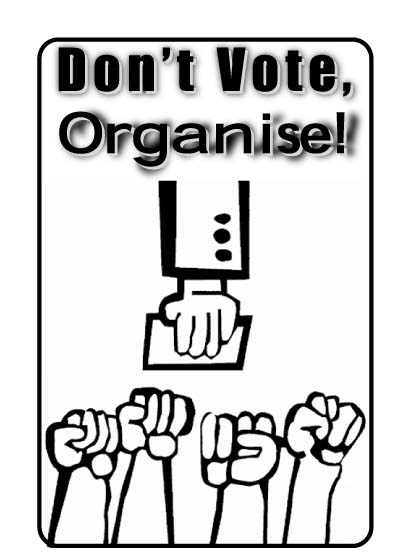
Freedom is not something you vote on. It’s something you struggle for. And what’s far more important than trying to figure out how to get people to endorse the right ideology, or, worse, the least-bad set of policies and candidates to each other across the kitchen table, is figuring out how you and your neighbors can best cooperate with each other, practice solidarity and withdraw from maintaining and collaborating with the state. People who would never respond to a smaller-government candidate or a libertarian ideological pitch often will act very differently when you open up opportunities to support grassroots alternatives and withdraw from the day-to-day inhumanities of war taxes, regulations, police, prisons, borders, and the state-supported and state-supporting corporate capitalist economy. Meanwhile, those who talk all day about changing votes, and building parties to more effectively capture a few more votes here and there, and have nothing else to offer, are wasting time, resources, and organizing energy on efforts that are not merely futile, but in fact actively lethal to any hope of motivating and coordinating effective practical action.

See also:

  1. [1] The basic idea: L4 would encompass some of the material we already have (Chaplin’s General Strike, Carson’s Ethics of Labor Struggle) and a lot of new and classic material, with new titles published at regular intervals, all with the basic underlying goal of (1) providing some decent labor-oriented materials for ALL locals, and (2) providing a decent source (mostly, currently, lacking) for IWW local organizing committees and other radical labor efforts to find some decently produced, low-cost booklet-style materials for lit drops and outreach tables, beyond just the IW, Anarcho-Syndicalist Review, and the relatively expensive books you can purchase through GHQ. ↩
  2. [2] [After an inconclusive floor debate in convention. —RG] ↩

Over My Shoulder #41: Paul Buhle on establishmentarian unionism, the decline of labor organizing, and the rise of Labor PAC. From Taking Care of Business: Samuel Gompers, George Meany, Lane Kirkland, and the Tragedy of American Labor.

Here’s the rules:

  1. Pick a quote of one or more paragraphs from something you’ve read, in print, over the course of the past week. (It should be something you’ve actually read, and not something that you’ve read a page of just in order to be able to post your favorite quote.)

  2. Avoid commentary above and beyond a couple sentences, more as context-setting or a sort of caption for the text than as a discussion.

  3. Quoting a passage doesn’t entail endorsement of what’s said in it. You may agree or you may not. Whether you do isn’t really the point of the exercise anyway.

Here’s the quote. These are a couple of passages from the final chapters of Paul Buhle’s book, Taking Care of Business: Sam Gompers, George Meany, Lane Kirkland, and the Tragedy of American Labor. They have a lot to say on the logical end-point of establishmentarian unionism and how, within the tripartite planning system of Big Government, Big Business, and Big Labor—particularly after the corporate merger and consolidation known as the AFL-CIO—the top union bosses tacked further and further away from industrial organization towards political organization — in effect, ceasing to be workers’ unions, and instead operating as an enormously wealthy but crumbling and increasingly irrelevant sort of Labor PAC.

The departure of Reuther and the UAW from the AFL-CIO in 1964 not only meant no charismatic personality was left combat meaning but also no block of aggressive unionists to offer significant, concerted resistance to rightward-drifting union leadership and social policies. The executive committee functioned as a glorified rubberstamping agency rather than a representative body. Seen in retrospect, centralization of power was the inner logic of the subsequent institutional consolidation. Neither William Green nor Walter Reuther nor even Samuel Gompers, an expert autocratic manipulator in his day, wielded as much personal control is to Meany and his entourage. One traditional labor historian, admiring the advance of the bureaucracy, put it most politely: labor evidently no longer had any great need for services beyond negotiation and enforcement of existing contracts. Everything else could more safely and efficiently be handled better from above. In December 1977 at the last national convention where Meany played an active role, the only names offered in nomination for president and secretary were Meany and Lane Kirkland. Neither was resistance offered to any of the nominees for the thirty-three vice presidencies. A lone dissident of sorts who did manage to get onto the council, the socialistic machinists’ president, William Winpisinger, was widely regarded as window-dressing for the steady rightward drift. Carefully directing his political views toward the public sphere, Winpisinger restrained his personal criticisms of Meany, much as some socialist craft unionists of the 1910s insisted that Gompers was a symptom and not the cause of labor conservatism, better endured than combated. Meany responded by savaging Winpisinger’s favorite views without mentioning Winpisinger himself.

By the 1970s, Meany grew more candid—or perhaps merely more arrogant. He held his ground proudly against his internal enemies and gleefully watched the mass social movements of the 1960s fade away. Admittedly, he also saw power within the Democratic Party slipped further from his potential grasp and the AFL-CIO fall precipitously by any measurement of size and influence. Asked in 1972 why AFL-CIO membership was thinking as a percentage of the workforce, he responded, I don’t know, I don’t care. When a reporter pressed the issue, Would you prefer to have a larger proportion? Meany snapped, not necessarily. We’ve done quite well without it. Why should we worry about organizing groups of people who do not appear to want to be organized? If they prefer to have others speak for them and make the decisions which affect their lives… that is their right. Asked whether he expected labor’s influence to be reduced, he responded, I used to worry about the… size of the membership…. I stopped worrying because to me it doesn’t make any difference… The organized fellow is the fellow that counts. This is just human nature. Unorganized and lower-paid workers were less-than-irrelevant to Meany; they were unwanted.

Never particularly supportive of strikes except those protecting jurisdictions, Meany became steadily more hostile to walkouts as time went on. (He made one key exception urging political strikes by merit time workers against, of all things, we being loaded onto Russian ships.) In 1970, he observed, where you have a well-established industry and a well-established union, you are getting more and more to the point where strike doesn’t make sense. Rather than strikes and organizing, Meany put his eggs into the basket of electoral campaigns, legislative activity, and involvement in a panoply of government-management-labor commissions and agencies in the Nixon, Ford, and Carter administrations. In some circles these activities actually reinforce the myth of the powerful Meany, labor statesmen and public figure. They did demonstrably little for labor. And no amount of them could quite dispel the image of the narrow-minded unabashedly feminist-baiting and gay-baiting labor boss eating at four-star restaurants and puffing a high-priced class of cigars once restricted to capitalists and mobsters.

The AFL-CIO politicked actively for Jimmy Carter in 1976, after its leaders have expressed their real preference for Scoop Jackson. Ironically, the Georgia Democrat’s narrow margin of victory actually made the support of labor, the African-American community, and feminists, among others, the crucial margin between defeat in victory. Once more, given a different approach, it might have been a moment for the labor movement to flex very real muscles and work for legislative assistance and breaking down barriers to organizing the unorganized, just as the women’s movement reached in early apex and as assorted movements among people of color looked to advances within the mainstream. For that kind of enterprise, however, Meany had no stomach whatever.

Once in office, Carter offered symbols instead of substance: a modest assortment of anti-poverty pilot programs amid a generalized retreat from the Great Society promises. Secretary of Labor Ray Marshall would be remembered not for his speeches saluting labor but because he was the last labor secretary who apparently believed the unions were necessary for working people. As so often, labor had rewarded its friends, gaining little in return. Meany soon let it be known that he was giving Carter a C- as president. Did he wish to see anyone else in the race for 1980? Yes, he shot back, Harry Truman. I wish he were here. To be fair, the old strike-breaking Give ‘Em Hell Harry could not likely have accelerated the growth of American weaponry any faster than Carter did after the Russian invasion of Afghanistan in 1979. He might have bombed Iran into oblivion, and he surely would have sounded tougher. That kind of rhetoric, joined perhaps with robust new liberal-led red-scare against peaceniks, feminists, and radicals at large, would surely have had more appeal to the frustrated, aging bully that Meany had become.

…

The AFL-CIO issued dire warnings before and after the crucial 1980 election. Union activists worked although with less enthusiasm than anxiety for Carter’s re-election. The aftermath of Reagan’s triumph (by a relatively small margin, it should be remembered, and due to the Iran crisis and the economy rather than any great public fondness for the former California Governor) quickly justified the forebodings. As the new president broke the air controllers’ strike and sent a message to the labor movement both Reagan’s rhetoric and policies proved brutal. The Republican administrations appointees to the National Labor Relations Board notoriously slanted against unions, moved quickly to remove restraints upon opposition to unionization and to all but encourage fresh efforts at decertification. Especially for people of color, disproportionately poor and barely-working class, the prospect of factory shutdowns and worsening health care with few resources was aggravated by their being depicted as the ungrateful recipients of various undue privileges and taxpayer largesse. Union membership fell for an assortment of other reasons as well, but heightened employer resistance stood near the head of the pack. And yet, if labor leaders distrusted or even despise Reagan’s allies, many experienced an unanticipated degree of self realization and hating Reagan’s enemies, those feminists, peaceniks, and assorted left-liberals to assistant to become radio host Rush Limbaugh’s favorite targets.

Besides, labor did have an elusive, thoroughly institutional fallback on the national political stage. In 1981, in the wake of Reagan’s victory, a hard-pressed Democratic National Committee granted the AFL-CIO 25 at-large seats and four out of 35 seats on its executive body. Within a diminished party suffering an early bout of Reaganism (and whose congressional delegation would indeed vote for so many of Reagan’s programs), the AFL-CIO became in return the largest single Democratic financial donor, supplying the DNC with more than a third of its annual budget. The defeat of a modest labor reform bill in Congress in 1978 showed that the conservative counteroffensive had begun in earnest with simultaneous Democratic president and Congress for the last time in at least a generation. Wall Street analysts warned that a new era of militant labor leadership might emerge a political defeat.

Instead, defeat bred timidity and an eagerness to shift foreign of rightward to recuperate the Reagan Democrats. As along with an increasingly unrealistic hope for a major change of labor laws, the specter of protectionism—which labor’s top leaders did not themselves particularly desire—offer the only popular fight-back issue imaginable. In the absence of a real internationalist program of protecting working people across borders, the new protectionism mainly added us mean-spiritedness to organized labor’s perennial self-concern. The downward spiral of labor’s claim to special protection within the liberal coalition thereby lead further and further to its isolation.

—Paul Buhle (1999), Taking Care of Business: Sam Gompers, George Meany, Lane Kirkland, and the Tragedy of American Labor, pp. 195–198, 219–220.