Fair Use Blog

“Defeat of the Communists,” in The New York Times (January 14, 1874)

Here's another account from the mainstream New York press -- this time, from the New York Times -- on the New York "Committee of Safety" and on the police attack on labor protesters in Tompkins Square. Like the previously posted stories from the Herald, the paper treated the protest as a project of "The Communists," in the midst of the United States' first great Red Scare. Also notable here is an early press appearance for Justus Schwab, here arrested with a red flag around his waist, later known and beloved by the Anarchist community in New York City as the owner of a "Beer-Hole" on First Street, which provided a meeting-place for radicals, political refugees, writers and artists that Emma Goldman remembered as "the most famous radical center in New York."

Here's the story, printed in the New York Times, on January 14, 1874.

>

DEFEAT OF THE COMMUNISTS

>

THE MASS-MEETING AND PARADE BROKEN UP.

>
ENCOUNTER BETWEEN THE MOB AND THE POLICE--ARREST OF RIOTERS.
>

>

The Police Commissioners wisely refused permission to the Communists to parade yesterday. There would have been no objection to an honest working men's parade, but the great majority of the working men, through their acknowledged representatives, disclaimed all connection with the projection display, and it was therefore considered unadvisable to permit a few malcontents to disturb the peace of the City. The events of yesterday sufficiently proved the wisdom of the prohibition, and the bad spirit that unfortunately is rife among the more worthless sections of the community. In spite of the refusal it was stated early in the day that the meeting would be held, and by 10 o'clock Tompkins square and vicinity were occupied by perhaps 3,000 persons of the lowest class, most of whom, however, were probably there out of idle curiosity. At 10:15 the Police, under Commissioner Duryee and Capts. Walsh, Murphy, Tynan, and Allaire, with platoons from their respective precincts, the Seventeenth, Eleveneth, Eighteenth, and Twenty-first, marched into and cleared the square, while a mounted squad scoured the streets in the vicinity. Capt. Walsh, with Sergts. Cass and Berghold and twenty-two men, made for the largest crowd, assembled round a banner inscribed The Tenth Ward Working Men's Organization, and here there was a fray, in which Sergt. Berghold had his head broken, and his assailants fared no better. They told their stories afterward at the Seventeenth Precinct Station-house, corner of Fifth street and Second avenue, where they were conveyed, and at which thenceforward the interest centered. Christian Meyer, who struck the Sergeant, confessed his misdeeds with much naivete, as he was sitting with head bandaged and a broken wrist in a sling in the officers' quarters. He said he was a painter by trade, belonging to an association with 3,000 members; that there were about 100 of them only present; that every one was armed in some way, his own weapon being a claw-hammer, with a thong to put his hand through; and that they had orders not to fight unless they were attacked. The Sergeant pushed him, so he obeyed orders and hit the Sergeant. Justus Schwab, another captive, who wore a red flag around his waist, said his father had served four years' imprisonment for riot at Frankfort, Germany: that he had been four years and eight months in the country, and fourteen weeks out of work. He thought every man should defend the State, and that the State should provide for every man. He thought the working men would triumph, and commenced to sing the Marseillaise, a performance which was checked. On Hofflicher, another leader, was found a somewhat elaborate Communistic badge. The vicinity of the station-house for several blocks was thronged until quite late in the afternoon, and in the Bowery as far down as Canal street, knots of men were gathered on the corners as late as 2 o'clock, waiting for the procession. In the vicinity of the Seventeenth Precinct Station-house the task of dispersing the multitude kept the officers well employed. There were incessant skirmishes in which clubs were judiciously applied with seasonable but not excessive severity, and prisoners were continually being brought in. The scrambles of the mob as the officers advanced were not unamusing; in fact, it seemed as if they rather enjoyed the exercise. The housetops and windows for blocks were crowded with patient spectators.

At 3:45 P. M. the prisoners were marched to Essex Market Police Court, and arraigned before Justice Flammer, who held them in default of $1,000 bail each. The schools soon after filled the streets with children and a more respectable class of citizens appeared. The trouble was evidently over. It was at no time beyond easy control. The forbearance and good humor of the Police were admirable. There were unpleasant incidents, however, which showed plainly that a neglected spark might have been fanned into a dangerous flame amid the unamiable passions abroad. Alderman Kehr, about noon, was passing through Fourth street, when he was recognized, and as the cry was raised, Here's an Alderman--go for him! he jumped on an Avenue A car, but was again recognized, the car boarded, and he had to jump off again and run for his life. Police Commissioners Charlick and Gardner visited the Seventeenth Precinct in a coupé at 4:30 P. M.

THE COMMITTEE OF SAFETY BEFORE THE MAYOR

>

The Mayor arrived at his office at noon. When he had taken his seat, his Secretary handed him a card containing the request, Mr. Leander Thompson would like to have an interview with his Honor. The Mayor recognized the name as that of a member of the Working Men's Committee of Safety, who had previously called upon him as a representative of the labor movement, and at whose request he had promised to address the laborers at Union square. The Mayor told his Secretary to admit Mr. Thompson, and the latter, accompanied by Messrs. John McMichael, George Buck, John Halbert, and Luceen Saniel, entered the office. Gen. Duryee, the Police Commissioner, was in an adjoining chamber, and, the moment Thompson entered, the Mayor called him to his side.

Well, gentlemen, said the Mayor, I am ready to hear what you have to say.

Mr. Thompson, in response, said the deputation represented the Committee of Safety, and they had called to escort his Honor to Tompkins square where, they hoped, he would address the people.

Mayor Havemeyer--I have heard what occurred this morning, and I do not desire to address crazy or excited people, who might be anxious to send brickbats flying.

Mr. Thompson--The people would like to hear your views. We will take you in a carriage. The working men are a peaceable and orderly class. They made an attempt to meet and express their views and were forcibly ejected by the Police, who clubbed and trampled upon them.

Mr. McMichael here stepped forward and said, Mr. Mayor, I hope you will come with us. We promised the people that you would speak to them, and they will be much disappointed if you do not. The meeting this morning was intended to be peaceable and orderly, but the Police interfered and clubbed every one they met. there were 20,000 persons in the square and its vicinity, and they were driven back without cause. I believe that it is absolutely necessary for you to come up and speak to the working men. They are very much excited about the treatment they have received from the Police, and consequences which we would wish to avert may follow if they are not spoken to.

Gen. Duryee interposed here. He said that all law-abiding citizens would act peaceably, and that he did not believe there would be any further trouble. But, resumed Mr. McMichael, the Police treated the meeting most mercilessly. Without a moment's warning they clubbed them off the ground.

Gen. [sic]Duryea[/sic], (warmly)--No, Sir; the Police did not act until a man came forward and struck a Sergeant on the head with a heavy hammer, which he had rigged so completely that it was taken from him with difficulty. Then an attack was made upon a Captain, so that it was time to disperse the crowd.

Mr. Thompson--The Park Commissioners gave us a permit to meet in Tompkins square, and they rescinded it last night, so that we had no time to tell the people to keep away.

Mr. McMichael--The meeting was intended to be peaceable: we promised the people that you would address them, and it is necessary for something to be done to allay the feeling that exists.

Mayor Havemeyer--I would have addressed the working men to-day if they carried out the programme they submitted to me. They agreed to march from Tompkins to Union square, and I told you that I would speak to them before they were dismissed at the latter place. Instead of doing what they agreed to do, they held a mass-meeting at Tompkins square without authority.

One of the deputation here remarked that the programme was changed on the previous night, so as to enable the working men to hear addresses.

Mr. Thompson--Our original intention was to march down to the City Hall, so as to see the authorities about getting employment.

Commissioner Duryee--But the Police Commissioners had to forbid that, because a large procession would interfere with business in the crowded thoroughfares below Canal street.

Mr. Halbert--This is a diversion. We desire to know if your Honor will come with us to address the working men.

Mayor Havemeyer--I must leave the matter to Commissioner Duryee.

Commissioner Duryee--I think it would be unadvisable for you to go. Let these gentlemen come again, and I am sure that all that can be done for the unemployed will be done by the City.

Mr. McMichael--We have been denounced by the press without cause. We have been called Communists, and our objects have been misrepresented. All we want is work.

Mayor Havemeyer--Well, there is one difficulty in the way. The market in this City is glutted with labor, and men will not work unless they can get the price they ask. I believe that there is work enough for everybody, but not at the wages demanded. (To Mr. McMichael.) What is your business?

Mr. McMichael--I am a painter.

Mayor Havemeyer--Well, many a man who can't, at the present rates, get his house painted for less than $300 would willingly give $200 to have it done. But, as he has got money, he can afford to wait until he can have the painting done at the sum he wishes to pay for it.

Mr. McMichael--It is necessary to get good prices to live now.

Mr. Thompson--The working men can't demand employment from private parties, so they must demand it from the Government.

Mayor Havemeyer--It is not the purpose or object of the City Government to furnish work to the industrious poor. That system belongs to other countries, not to ours. We can't tear down the City Hall so as to furnish work to the unemployed. We have to open streets and proceed with other works such as are rquired, and it takes time to authorize these according to law.

Mr. Thompson--But is it not the duty of the Government to furnish rations to starving men and their families?

Mayor Havemeyer--I agree with you that rations should be furnished to those who need them, and I am ready to advance a movement of that kind to the full extent of my power. The people of this City are too large-hearted to allow any person to suffer from starvation.

Mr. Thompson--Well, perhaps it's better for your Honor not to come with us to-day; so we shall not urge you. But we must see the people, lest they should blame us for not bringing you to Tompkins square. Will you (turning to Commissioner Duryee) give us a letter to the other Commissioners, so that we may procure a pass to enter Tompkins square. If we don't get a pass, we'll get clubbed by the Police.

Commissioner Duryee--There is no necessity for a note. See Commissioner Smith. You can easily see him.

The deputation then left. Immediately after they had retired, the Mayor said: I am in favor of raising subscriptions from merchants and others, so as to alleviate any suffering that may exist among working men and their families. Money would be soon forthcoming for the purpose, and a hall could be hierd and a clerk engaged to serve out rations of all kinds to the hungry. Money could also be advanced to those who were unable to pay their rent.

THE RIOTERS IN COURT.

>

Essex Market Police Court was particularly lively yesterday afternoon when Capt. Walsh, of the Seventeenth Precinct, assisted by twenty-five patrolmen marched in the prisoners whom they had arrested for riotous conduct around Tompkins square. The would-be Communists looked dogged and obstinate, evidently thinking that they would be at once discharged. They were considerably disappointed, however, when it was made known to them that the full penalty of the law would be meted out to them. They all expected friends would come forward and exert mysterious influence in their favor, but their expectations were all in vain. Some few of them, more impudent than others, said, Oh, the Judge dare not do anything to us; we are too powerful, and the people would tear down the prison. After the ordinary business had been disposed of, Justice Flammer directed the prisoners in charge of Capt. Walsh to be brought before him. The rioters were then all marched up to the desk, and formal complaints were entered against every one of them, charging them with assault and battery and riotous conduct. Justice Flammer, after the complaints of the officers were taken, committed all the prisoners, in default of $1,000 bail each, to stand their trial. They were all taken into the prison, and when there were visited by a Times reporter. They appeared only to be realizing the fact that they had committed very serious offenses against the law, and many of them regretted that they had ever been drawn into joining the demonstration.
Sources

“Sunday Schools That Teach Children Anarchy,” from the New York Times (May 8, 1910)

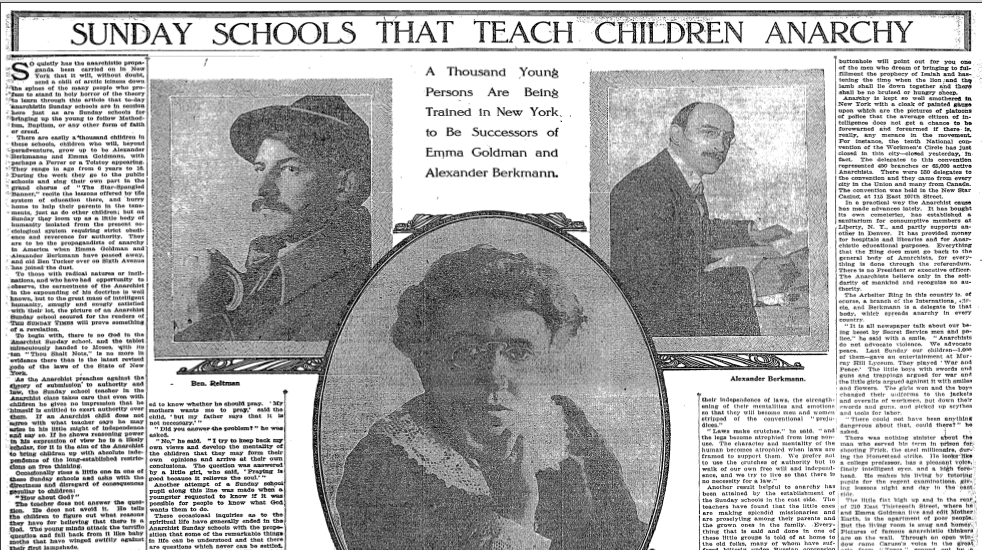
Here's some more on mass-media reception of Anarchism during the early 20th century: a strange little piece from the Sunday New York Times magazine from May 8, 1910, on Anarchist Sunday schools in New York, focusing on the Ferrer Sunday School taught by Alexander Berkman. The Sunday schools were part of the large network of schools, cultural spaces and other institutions organized by Anarchists in large cities like New York during the early 20th century. (Like most Anarchistic educational projects, the Sundays were closely associated with the Modern School Movement and the thought of Francisco Ferrer). Either of the writer of the article, or his editor, couldn't quite seem to decide whether they wanted this story to be a straight interview of Berkman and a description of how the Sunday Schools were operated, or whether they wanted another cookie-cutter Anarchist-menace scare story.

SUNDAY SCHOOLS THAT TEACH CHILDREN ANARCHY

A Thousand Young Persons Are Being Trained in New York to Be Successors of Emma Goldman and Alexander Berkman.

So quietly has the anarchistic propaganda been carried on in New York that it will, without doubt, send a chill of arctic iciness down the spines of the many people who profess to stand in holy horror of the theory to learn through this article that to-day anarchistic Sunday schools are in session here just as are Sunday schools for bringing up the young to follow Methodism, Baptism, or any other form of faith or creed.

>

There are easily a thousand children in these schools, children who will, beyond peradventure, grow up to be Alexander Berkmanns and Emma Goldmans, with perhaps a Ferrer or a Tolstoy appearing. They range in age from 6 years to 16. During the week they go to the public schools and sing their own part in the grand chorus of "The Star-Spangled Banner," recite the lessons offered by the system of education there, and hurry home to help their parents in the tenements, just as do other children; but on Sunday they loom up as a little body of humanity isolated from the present sociological system requiring strict obedience and reverence for authority. They are to be the propagandists of anarchy in America when Emma Goldman and Alexander Berkmann have passed away, and old Ben Tucker over on Sixth Avenue has joined the dust.

To those with radical natures or inclinations, and who have had opportunity to observe, the earnestness of the Anarchist in the expounding of his doctrine is well known, but to the great mass of intelligent humanity, smugly and snugly satisfied with their lot, the picture of an Anarchist Sunday school secured for readers of The Sunday Times will prove something of a revelation.

To begin with, there is no God in the Anarchist Sunday school, and the tablet miraculously handed to Moses, with its ten Thou Shalt Nots, is no more in evidence there than is the latest revised code of the laws of the State of New York.

As the Anarchist preaches against the theory of submission to authority and law, the Sunday school teacher in the Anarchist class takes care that even with children he gives no impression that he himself is entitled to exert authority over them. If an Anarchist child does not agree with what teacher says he may arise in his little might of independence and say so. If he shows reasoning power in his expression of view he is a likely scholar, for it is the aim of the Anarchist to bring children up with absolute independence of the long-established restrictions on free thinking.

Occasionally rises a little one in one of these Sunday schools and asks with the directness and disregard of consequences peculiar to children:

How about God?

The teacher does not answer the question. He does not avoid it. He tells the children to figure out what reasons they have for believing that there is a God. The young minds attack the terrific question and fall back from it like baby moths that have winged swiftly against their first lampshade.

The largest of the Sunday schools is in Avenue A. It is called the Ferrer Sunday School, and was, until the killing of the Spanish philosopher, known as the Radical Sunday School. How the name was changed will prove a story that may stand out with striking novelty in the child life of New York to-day. It shall be told a little later in this article.

The Ferrer Sunday School is conducted by Alexander Berkmann. It has about eighty members and is in two classes. It meets on Sunday between 10 in the morning and noon. The youngest child is 7.

Berkmann has no laid-out system of teaching, depending on his comprehension of the psychology of the group at the time of the gathering. There are no rules. A song may be sung in chorus, a song dealing with freedom of mankind and hate for oppression. Some of the children may have learned by heart a poem or a fragment of an anarchistic argument and these provide recitations. The training of the mind anarchistically is then begun.

Berkmann, in a talk with a Times writer, in the office of Mother Earth, the Anarchist magazine, gave a sample of this teaching.

This was his talk to his Sunday school on Sabbath after the execution of Ferrer.

Once a single human being was swept from the sea to the shore of an island where there lived no human beings. There he found a great flock of sheep. He studied them and noticed that some of them were very powerfully built and finely fed. Some had even attained the strength and ferocity of wolves. But there were a great many of the sheep that were lean and worn. They were hungry and had been trampled down and hurt.

The man thought that he could so arrange it that these sheep, with little to eat and with bruises from being trampled, could be taught to care for themselves better and realize what the power of the strong and wolflike sheep had brought them to. He went among the sheep that suffered and began to point out to them what was the matter. The wolfish and strong ones heard of this and they turned upon the man and killed him.

When Berkmann finished this parable one of the children, a boy 18 years old, arose and said:

Why Mr. Berkmann, this story is just like the story of Ferrer's death.

The children were so impressed with the parable and the discussion which followed that the name of the school was then changed from the Radical Sunday School to the Ferrer Sunday School.

In the classes, said Berkmann, we generally use current events as subjects for discussion and study. For instance, one of our lessons was produced by the Hudson-Fulton Celebration in New York. The children of the east side saw a great deal of the sailors from the many men-of-war in the harbor. They saw the sailors of different nationalities entering and leaving the cafés, the best of friends, their arms about each other and acting like human brothers. The question naturally followed. Why should they be thus fond of each other and thus brotherly on land, and on sea be commanded to kill each other? They are brothers, and love each other, and there can be no fair reason for their slaying each other.

A man who had been raised in one of the old credal beliefs with care but who had come to be an agnostic in middle life once told the writer than when he realized that his religion had gone from him he felt that what he called reason had stepped into a nursery, and, like a willful bully, had gathered up the toys of a child sitting there and had destroyed them because he considered them useless. He considered the change from belief to agnosticism the tragedy of his life. The figure may be applied to thinking grown-ups easily, but it is hard to think of applying it to a child. And yet in the Anarchist Sunday school the tragedy of the destroyed toys is not infrequently enacted.

The pupil of the Anarchist Sunday school is taught to reason. The teacher only serves to direct their attention to a problem.

One child, said Berkmann, wanted to know whether he should pray. My mothers wants me to pray, said this child, but my father says that it is not necessary.

Did you answer the problem? he was asked.

No, he said. I try to keep back my own views and develop the mentality of the children that they may form their own opinions and arrive at their own conclusions. The question was answered by a little girl, who said, Praying is good because it relieves the soul.

Another attempt of a Sunday school pupil along this line was made when a youngster requested to know if it was possible for people to know what God wants them to do.

These occasional inquiries as to the spiritual life have generally ended in the Anarchist Sunday schools with the proposition that some of the remarkable things in life can be understood and that there are questions which never can be settled. The mental attitude of the children might be put in this way: We are not certain whether there are grounds for the belief that we should pray.

That, of course, leaves the question well in the field of agnosticism. The teacher of anarchy does not, with the children, declare that there is no God. Nor does he say that there is a God. The Sunday school class goes frequently to the Museum of Natural History, to Central Park, to the Zoological Gardens, and other places where, with the teacher, nature is studied.

The Ferrer Sunday school is only one of about fifteen similar schools in the greater city. Wherever the local groups of Anarchists can handle their own Sunday schools, carrying on the propaganda with literature, letters, lectures, &c., they do so without asking aid of others. When they cannot the State group helps. There is no central or superior group. Each has its own autonomy, although they all work to develop their principles of solidarity and mutual aid.

There are frequently conventions of the Sunday school teachers. Those who have classes get together and exchange experiences and ideas. In this city the Anarchists know that the fulfillment of their vision is afar, and they are already sowing their seed in the young and new fields that a generation of their kind may take hold of the propaganda when the present generation has withered and fallen.

These little Anarchists are being trained to believe in no authority. As Mr. Berkmann put it, everything is being done for them to aid them in the development of their independence of laws, the strengthening of their mentalities and emotions so that they will become men and women stripped of the conventional prejudices.

Laws make crutches, he said, and the legs become atrophied from long non-use. The character and mentality of human becomes atrophied when laws are framed to support them. We prefer not to use the crutches of authority but to walk of our own free will and independence, and we try to live so that there is no necessity for a law.

Another result helpful to anarchy has been attained by the establishment of the Sunday schools in the east side. The teachers have found that the little ones are making splendid missionaries and are proselyting among their parents and the grown ones in the family. Everything that is said and done in one of these little groups is told of at home to the old folks, many of whom have suffered bitterly under Russian oppression and who have revolution deep in their hearts. They write letters to the Anarchist teachers and get replies. They discuss the views expounded at home by their children and many of them become radicals and join the Anarchist groups.

The Anarchists also spread their propaganda by establishing little libraries which they make easily accessible to all who want to study the theory.

In the spreading of the propaganda among the children the littlest are not overlooked. There are some as young as six years of age who are getting kindergarten lessons in anarchy. One of these lessons is the lesson which preaches to a boy of health and strength at the age of six that he should not strike or abuse a boy who is not as strong as he is but should help him because he needs help. That is the very heart of the kindergarten lesson.

All of this work is done in what is called the Workmen's Circle. The Circle is the general group and is known as the Arbeiter Ring. A little white enamel badge with the letters A. R. in the buttonhole will point out for you one of the men who dream of bringing to fulfillment the prophecy of Isaiah and hastening the time when the lion and the lamb shall lie down together and there shall be no bruised or hungry sheep.

Anarchy is kept so well smothered in New York with a cloak of painted gauze upon which are the pictures of platoons of police that the average citizen of intelligence does not get a chance to be forewarned and forearmed if there is, really, any menace in the movement. For instance, the tenth National convention of the Workmen's Circle has just closed in this city--closed yesterday, in fact. The delegates to this convention represented 450 branches or 65,000 active Anarchists. There were 550 delegates to the convention and they came from every city in the Union and many from Canada. The convention was held in the New Star Casino, at 115 East 107th Street.

In a practical way the Anarchist cause has made advances lately. It has bought its own cemetaries, has established a sanitarium for consumptive members at Liberty, N. Y., and partly supports another in Denver. It has provided money for hospitals and libraries for Anarchistic educational purposes. Everything that the Ring does must go back to the general body of Anarchists, for everything is done through the referendum. There is no President or executive officer. The Anarchists believe only in the solidarity of mankind and recognize no authority.

The Arbeiter Ring in this country is, of course, a branch of the International Circle, and Berkmann is a delegate to that body, which spreads anarchy in every country.

It is all newspaper talk about our being beset by Secret Service men and police, he said with a smile. Anarchists do not advocate violence. We advocate peace. Last Sunday our children--1,000 of them--gave an entertainment at Murray Hill Lyceum. They played War and Peace. The little boys with swords and guns and trappings argued for war and the little girls argued against it with smiles and flowers. The girls won and the boys changed their uniforms to the jackets and overalls of workmen, put down their swords and guns, and picked up scythes and tools for labor.

There could not have been anything dangerous about that, could there? he asked.

There was nothing sinister about the man who served his term in prison for shooting Frick, the steel millionaire, during the Homestead strike. He looks like a college professor, has a pleasant voice, finely intelligent eyes, and a high forehead. He makes his living by tutoring pupils for the regent examinations, giving lessons night and day in the east side.

The little flat high up and in the rear of 210 East Thirteenth Street, where he and Emma Goldman live and edit Mother Earth, is the apartment of poor people. But the living room is snug and homey. Pictures of famous anarchistic thinkers are on the wall. Through an open window came Caruso's voice in the great aria from Tosca, ground out by a phonograph, as Berkmann talked with the Times man. It was a warm combination, but the night was warm, and we were glad for the breeze that swept the little place however burdened it might be.

We teach no ism, he said, harking back to the Sunday schools. Our aim is to develop character and mentality in the child. We try to make them think, criticise, and feel.

We want their emotional and intellectual natures developed. We want to make them men and women absolutely free of the old restrictions. We hope that they will grow up with the spirit of solidarity and co-operation in them. We try to teach them that in and out of school.

We try to teach them ethical right and reason. Our Radical Boys' Literary Club, boys about 13 or 14 years old, hold meetings after school, and they run their organization just as the grown people do. They have advanced to where they need no help from their elders.

Among the grown Anarchists the cause is kept warm by fervid preachings in their publications. These are the weekly paper Frei Arbiter Stimme, with a circulation of 12,000; Mother Earth, with a circulation of 6,000; Freiheit, with 5,000 circulation, and Voine Listy, a Bohemian paper, with a circulation of 4,500.

There are nine large groups of the grown Anarchists in New York. These have regular meetings, and conduct the propaganda with lectures, debates, &c.

In the district from Fourteenth Street to the Battery east of Broadway are 850,000 people living. Here beats the heart of anarchy. Nearly all of these people are foreign born, the native born element being insignificant in its percentage.

Forsyth Street, Chrystie, Cannon, Pitt, Columbia, Second Streets all have buildings in which are tiny halls that may be rented for a dollar or two for a wedding, a banquet, a lodge meeting, or a group meeting of Anarchists.

The man who lives awhile in this teeming corner of Manhattan does not take long to find out where he can go and hear all the anarchy he wants expounded. The writer once met in one of these little halls S. Yanofsky, the editor of the Frei Arbiter Stimme. A man with dreamy eyes, pointed beard, and nervous energy, he seemed to be looked up to as little short of a god by a clump of young men and women who were wating for him.

Yanofsky and Berkmann were both rounded up by the police after the Silverstein bomb explosion in Union Square in 1908, and as there was nothing against either of them nothing came of the call to Police Headquarters. Yanofsky, when asked by the writer what he thought of Silverstein's act, replied:

The man who commits a violent deed, if he is not mad, is desperate. Violence never did any good for anarchy. All government is a form of violence. Suppose Silverstein had suffered personally--and his act was that of an impatient and ignorant man--what did he accomplish? He only made himself dead and gave the chance to the enemies of anarchy to spread their calumnies. He only helped them to kill of the chances of gaining liberty.

Berkmann was a little clearer on the matter of violence and anarchy.

If a Republican or Democrat should throw a bomb or kill another, he said, the Republican Party or the Democratic Party would not be blamed for it. When an Anarchist does a thing like that we frankly say that anarchy did not inspire it, but that conditions of inequality and injustice caused the crime. To stop the crime, stop the cause. Anarchy is for justice and freedom. It cannot be blamed for individual acts of violence.

Among the favorite east side speakers for anarchy, besides Yanofsky and Berkmann, is Dr. Ben Reitman, whose method is to stir up the hearers with fiery sentences depicting the wrongs resulting from the present order of things. He with the others believes that anarchy is gathering strength, and will continue to gather it and will prove a living force in the slow movement of society through the ages.