“Anarchism Exploded” posted by Rad Geek 09 Dec 2012 6:24 pm
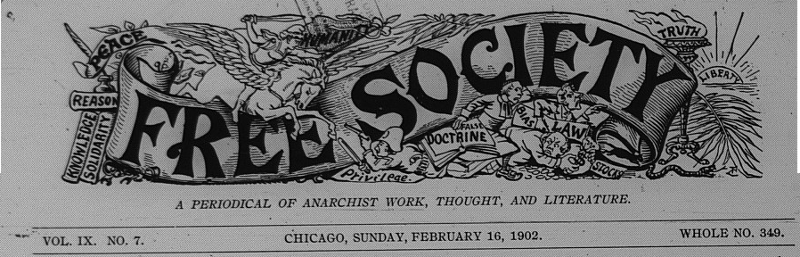
Here's an exchange from Free Society on liberty, trusts, and state socialism, from February 1902, between G. E. Lind and R. W. (presumably Ross Winn). The exchange appears in Free Society Vol. IX, No. 7, p. 3.
Anarchism Exploded.When the economic development had transformed the social relations of the past into a state of society in which the
material interestsof one class of individuals became diametrically opposed to the material interests of the other class or classes of individuals, there naturally appeared variouseconomic classeswhich in order to preserve themselves they were compelled to avail themselves of every opportunity in thestruggle for supremacywhich ensued. Therefore it was but natural that the class which had securedeconomic supremacyshould make some claim todivine authorityand the right togovernthe economically inferior, while at the same time claiming to protect society. All this was done in order that the class which had attainedeconomic supremacymight perpetuate its existence asrulersand exploit theeconomically inferiormore successfully, hence the appearance of the State or government, which the Anarchists talk so much about, but understand so little.(1) Then the State is simply an effect instead of a cause, hence the absurdity of advocating the “abolition of the State without abolishing theclass strugglewhich is the cause of the State.(2) Anarchism declares war on the State, which is just as nonsensical as the Democratssmashing the trusts,etc. Socialism would not smash the trusts or declare war on the State, but will absorb the State, and by so doing will absorb the trusts(3) and all the instruments of production and distribution, the result of which would be the abolition of economic classes and consequently the abolition of the oppressive capitalistic State, and the inauguration of the cooperative commonwealth.
G. E. Lind.
>
Comment
But it was the Anarchists who first traced the origin of the State to the existence of a privileged class, and demonstrated that the perpetuation of the privileged class is the inevitable result of the State--its raison d'etre. We prove that privilege is only possible thru the support of the State, and that the abolition of the State is necessary to eliminate privilege.
If, as you contend, the class struggle is the cause of the State's existence, and you wish to abolish the
class struggle,you are simply taking another line of reasoning to reach the same objective point--viz., the abolition of the State, which you say is impossible. You appear to be slightly mixed--not an uncommon phenomenon with State Socialists.By establishing the most gigantic trust conceivable--a State monopoly. It is not the forms of monopoly that are evil; but its essence--the principle that abrogates liberty--that sets bounds upon the play of social activity.
But your cooperative commonwealth, administered by State officials, will have society divided into two classes--the workers and the governmental directors of industries. The State
bosswith unlimited power, will constitute a class, and consequently the cooperative commonwealth will not abolishthe class struggle.You seem to be in a fair way toexplodethe fallacies of your own philosophy.
R.W.
>
--Free Society: A Periodical of Anarchist Work, Thought, and Literature, Vol. IX, No. 7, Whole No. 349 (February 16, 1902). Chicago: A. Isaak, publisher. 3.
