Fair Use Blog

Max Eastman Is ‘Sorry’ For Today’s Rebels (Alden Whitman, New York Times, Jan. 9, 1969)

Here is an article on Max Eastman and his reflections on the New Left in his old age. This article appeared in The New York Times of January 9, 1969 (p. 33).

Max Eastman Is 'Sorry' For Today's Rebels

By ALDEN WHITMAN.

One of the country's reigning radical writers and agitators of a half-century ago looked this week at today's young militants and found more to pity than to praise.

He is Max Eastman, editor of the Socialist periodical, The Masses, and its successor, The Liberator, in the years before and during World War I. Widely influential in left-wing and labor circles, these magazines printed articles by Mr. Eastman and by, among others, John Reed and Floyd Dell. Art Young and Robert Minor were among the cartoonists.

Twice Faced Trial

Because of antiwar articles in The Masses, Mr. Eastman was twice brought to trial amid nationwide publicity, charged with conspiracy to obstruct the draft. The charge was dropped after two Federal juries were unable to agree on a verdict.

I feel kind of sorry for these young rebels of today, he said in an interview last Saturday at his West 13th Street apartment that marked his 86th birthday. He was on his way from Martha's Vineyard, where he and his wife spend their summers, to a winter home in Barbados.

They have an emotion not unlike ours, he continued, running his fingers through a shock of fine, snow-white hair. They want to make a revolution but they have no ultimate purpose.

I have a certain emotional sympathy for them, but they are rather pathetic because they have no plan. They just seek a revolution for its ow sake.

By contrast, said Mr. Eastman, glancing from his padded chair around a room festooned with Christmas and birthday cards, We had a program and a purpose, which was to make over capitalism into Socialism, and it was based on an ideal and on an ideal and on an ideology.

With a vigor that belied his years, the ruddy-faced Mr. Eastman categorized the radicals of the New Left as the bohemian wing of the bourgeoisie, sons and daughters of the well-to-do, who have no real class affiliation and no alliances with the working class.

It is not possible, he said in slow, measured tones, to bring about a revolution--except on a class basis--unless by some sort of fluke.

Asked why today's rebels appeared to lack an ideology, he declared:

Socialism was once a plausible plan, but when Socialism failed completely and produced a totalitarian tyranny [in the Soviet Union under Stalin], it left social ideas without a theoretical basis.

Mr. Eastman stressed, though, that there were some similarities between rebels in 1969 and those of his era.

Mood Called the Same

The mood of militance is the same, he asserted, and so is the general rejection of convention. But many of today's restive youth are caught up in trivialities. Obscenity, for example.

Having broken with the Socialist movement (but I never considered myself a Marxist, not even in The Masses days in 1913) when his friend Leon Trotsky was read out of the Communist party by Stalin in 1926-27, Mr. Eastman made his own transition from radicalism to the Reader's Digest. He has been a roving editor for that publication since 1941.

The author and poet indicated hat his outlook for social change in the United States and the world was gloomy. He doubted, he said, that this country needs a revolution, or that one was possible either from the New Left or the Negro community. Negro militants, he said, are bound to raise hell, but they can't make a revolution.

We have to patch up the world as it is and accept it, although I don't feel very happy about it, Mr. Eastman said.

Like many writers, he has given no thought to retirement. Doubleday is to publish this spring a translation he made many years ago of Trotsky's account of Lenin's youth.

The manuscript, which Mr. Eastman had believed lost, turned up in the Harvard library a few years ago. It chronicles the Bolshevik leader's life up to when he joined the Russian revolutionary movement after becoming a lawyer in St. Petersburg, now Leningrad.

In addition, Mr. Eastman is collecting a number of essays and portraits of his contemporaries for publication soon. These, he remarked with a twinkle in his bluish eyes, are to be entitled Bull in the Afternoon and Other Essays.

The lead essay, a criticism of Ernest Hemingway's Death in the Afternoon, precipitated the famous set-to between the two authors.

Fresh in His Mind

That encounter, which took place in 1937 in the office of Max Perkins, an editor at Scribner's, was still fresh in Mr. Eastman's mind.

Hemingway shoved an open book against my nose, he recalled, and accused me of saying that he lacked virility. I grabbed him by the throat and threw him--or backed him up--over Perkins's desk and onto his back on the floor.

The two men's friendship, never thereafter the epitome of cordiality, is now largely a mellow memory for Mr. Eastman. In addition to the piece on Hemingway, Mr. Eastman plans to include his new book essays on H. L. Mencken, Bernard Berenson and Sherwood Anderson.

At 86, an author is still an author.

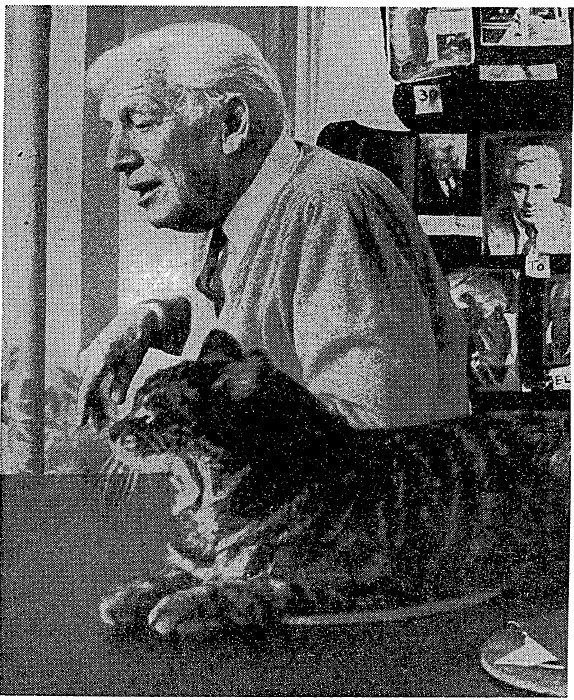
The article closes with a photo from
The New York Times (by Michael Evans)
Max Eastman, with his tabby Twiggy, during the interview at his home on West 13th Street.
>

S. E. Parker, “Anarchism versus Socialism” (1966)

This essay, by Sidney Parker, first appeared in Minus One, No. 14 (July-August 1966). It has since been reprinted in Enemies of Society (Ardent Press), pp. 150-3, and in The Sovereign Self No. 4 (Jan 2012) pp. 6-8.

Anarchism versus Socialism

S.E. Parker

The trouble with discussing socialism is that the word is such a vague one. Anarchism, in comparison, is clear and precise. An anarchist is someone who is without belief in authority--an individual who wants to live his life without having to submit to a will external to him. Anarchism is therefore the philosophy of living without authority, as its etymology suggests.

But what is socialism?

The Little Oxford Dictionary is blunt: "Socialism: the principle that individual liberty should be completely subordinated to the community." Professed socialists themselves, however, have eschewed such bluntness and the most contradictory doctrines have been labeled "socialist". There have been and are, national socialists, Christian socialists, libertarian socialists, state socialists, Marxist socialists, spiritual socialists, idealist socialists and so forth and so on. The only way one can get any sense out of the bewildering confusion of "true interpretations" is to find some belief or principle common to all socialists which distinguishes them from other people.

Since, for socialists in general, the economic question is paramount--every problem tending to be reduced to the abolition of capitalism and the establishment of socialism--there is one belief which all socialists, from Statists to libertarian communists, share, and that is the belief in the need to put the ownership or control of the means of production into the hands of some collective body, be it the government or "society". Socialism above all is, as Auguste Hamon has said, a "social system in which -- a social doctrine by which -- the means of production are socialized". It is my argument that this wish to make society the owner and provider of the means of life is to put new authority over the individual in place of the old and is therefore not anarchism. Anarchism stands for leaving each individual free to provide for himself what he needs and is therefore not a complement of socialism but its opposite. It follows that those anarchists who think that anarchism is a form of socialism are deluding themselves and sooner or later will have to choose between them, for they cannot logically be both.

Undoubtedly there are some socialists who are genuinely concerned for the freedom of the individual and believe that by taking the means of production away from the capitalists and giving them to society, or the State as representative of society, they will abolish the subjection of the many to the privileged few and so secure the liberty of each individual. But how would this alter the position of the individual producer? Under capitalism he has to submit to the will of a handful of monopolists. Under socialism he would have to submit to the will of the collective. He would have no freedom to produce and exchange as he wishes and without this his individual freedom cannot exist.

The socialist might reply that when the means of production belong to all then everyone will be an owner. But of what use is it to me to be an owner of something in common with, say, 1,000,000 people? To own one millionth of something is in effect to own nothing. Under socialism, therefore, the individual would be a proletarian--that is, a property-less person--and control of the means of production would be in the hands of an abstraction called "society", and the interests of this abstraction would be superior to the interests of the individual. Everything would be for the "common good".

It is not enough to say that the individual would still own his clothing or his toothbrush, and that only the means of producing these things would be owned in common. As Benjamin Tucker pointed out this means "the liberty to eat, but not to cook; to drink, but not to brew; to wear, but not to spin; to dwell, but not to build; to give, but not to sell or buy; to think, but not to print; to speak, but not to hire a hall; to dance, but not to pay the fiddler."

Socialism, being a species of humanism, is a doctrine of indiscriminate solidarity. It suppresses direct exchange between the producer and the consumer and has for its ethic the obligation of each to work for the benefit of all. It assumes that since each individual will have the right to a guaranteed living, he must all have the duty to put all he produces at the disposal of the collectivity. The producer cannot choose who will benefit from this production; the consumer cannot choose who will be his producer. Socialism is thus a herd-philosophy, the practice of the bee-hive. Its consistent application would deny all freedom of choice and it is therefore a totalitarian system. Even if in theory there would be no laws in a socialist society to enforce the subordination of the individual to the mass, there would be a socially sanctioned system of moral coercion to achieve the same end.

Economic freedom -- any kind of freedom -- for the individual can only exist where there is a choice of alternatives. Anarchism can only be pluralist, allowing any kind of economic relationship that will satisfy the individuals involved. To tie the individual to collective ownership is not anarchism, for anarchism can only exist where there is the possibility for infinite change and variety.

The fundamental issue between anarchism and socialism was well put some time ago by Francis Ellingham when writing of the difference between individualist anarchism and libertarian communism. He wrote that this difference concerned:

... who is to be the subject of the process of production, consumption and accumulation?

Is it to be the individual, working as an independent economic unit--either alone or, if he chooses, in association with other individuals? Or is it to be the community as a whole, working as a sort of super-family, and necessarily incorporating the individual, who thus becomes a cell in a larger economic organism?

Either the economy could be of such a nature that it necessitated association (and let us never forget that economic necessity can be at least as tyrannical as any government), or it could be based on the individual unit, leaving each individual free to associate, but never submerging him in any group from which he could not withdraw without economic ruin.

The libertarian communist ideal is, he continues,

... only a variation on the Marxist ideal that the State will 'wither away'. there are no rulers in the Marxist paradise, which, in that sense, is an anarchist world. But the supposedly 'free' individual is merely a cog in a gigantic social machine, held together by sheer force of economic necessity.

Where socialists go wrong in this matter is in their assumption that the individual can only be free--i.e. self-governing, self-owning--when his interests are combined with those of all other individuals. They believe in the collectivization of interests. But I am not free if my interests are inseparable from yours. My freedom lies in my opportunity to differ, in dis-unity, dis-connection, dis-sent. I am freest when interests are individualized, when I can be sole sovereign over my person and can dispose of the things I produce, or the services I can offer, as I see fit.

Anarchism lies in the direction of the individualization of interests, economic or any other, not their socialization.

Socialism is a religion of Society--it is the sacrifice of the individual to the Collective.

Anarchism is the philosophy of the individual--it is the affirmation of individuality, the proud denial of legitimacy to any institution, group or idea that claims authority over the ego.

--From Minus One, No. 14 (July-August 1966).

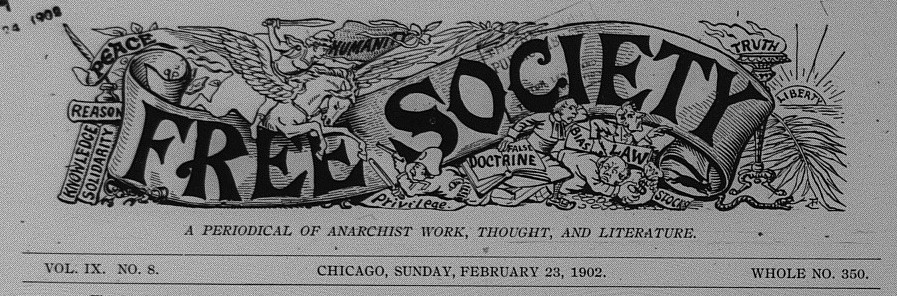
“Social Organism Again,” by Mary Hansen in FREE SOCIETY (February 23, 1902)

Here's a short article from Mary Hansen on socialism and the idea of social organism. This is from the issue for Sunday, February 23, 1902 (Vol. IX, No. 8, Whole No. 350), right-hand column of p. 3.

Social Organism Again.

That he who uses the social organism analogy does not see clearly, seems plain to me at least. A few weeks ago a prominent Socialist stood before an audience, and by way of proving social interdependence asked: Now if I were to cut off or injure these fingers would not my whole body suffer?" Yes! and following the same line of reasoning, if you injure half your organism the rest would suffer, and this under any circumstances. Now, if society were an organism, the same would be true of it, yet we do not find it so, since the injury done at present to the greater half of society only serves to increase the luxury of the other.

The more workers there are willing to starve on small wages and accept any injury, peaceably, that is caused by the avarice of their employers, the greater the profit and comfort of said employers, and the government officials, who could grow fat at leasure. Surely it would be difficult to show where the injury to society touches them.

Mary Hansen

Hansen was a Danish-American Anarchist who was (along with Voltairine de Cleyre, Natasha Notkin, and others) a regular participant in the Philadelphia Social Science Club and the principal author of the Club's classic pamphlet A Catechism of Anarchy. Free Society was published in Chicago but became a major venue for many of the Philadelphia Anarchists.

“Anarchism Exploded”

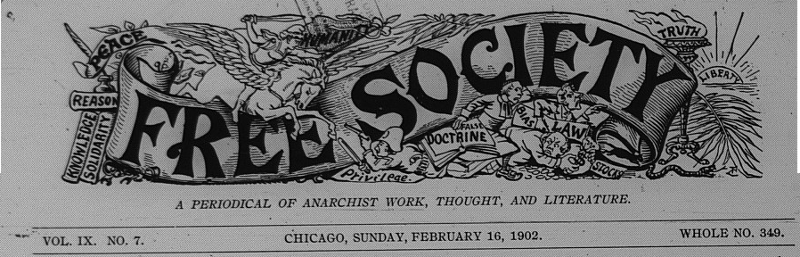
Here's an exchange from Free Society on liberty, trusts, and state socialism, from February 1902, between G. E. Lind and R. W. (presumably Ross Winn). The exchange appears in Free Society Vol. IX, No. 7, p. 3.

Anarchism Exploded.

When the economic development had transformed the social relations of the past into a state of society in which the material interests of one class of individuals became diametrically opposed to the material interests of the other class or classes of individuals, there naturally appeared various economic classes which in order to preserve themselves they were compelled to avail themselves of every opportunity in the struggle for supremacy which ensued. Therefore it was but natural that the class which had secured economic supremacy should make some claim to divine authority and the right to govern the economically inferior, while at the same time claiming to protect society. All this was done in order that the class which had attained economic supremacy might perpetuate its existence as rulers and exploit the economically inferior more successfully, hence the appearance of the State or government, which the Anarchists talk so much about, but understand so little.(1) Then the State is simply an effect instead of a cause, hence the absurdity of advocating the “abolition of the State without abolishing the class struggle which is the cause of the State.(2) Anarchism declares war on the State, which is just as nonsensical as the Democrats smashing the trusts, etc. Socialism would not smash the trusts or declare war on the State, but will absorb the State, and by so doing will absorb the trusts(3) and all the instruments of production and distribution, the result of which would be the abolition of economic classes and consequently the abolition of the oppressive capitalistic State, and the inauguration of the cooperative commonwealth.

G. E. Lind.

>

Comment

  1. But it was the Anarchists who first traced the origin of the State to the existence of a privileged class, and demonstrated that the perpetuation of the privileged class is the inevitable result of the State--its raison d'etre. We prove that privilege is only possible thru the support of the State, and that the abolition of the State is necessary to eliminate privilege.

  2. If, as you contend, the class struggle is the cause of the State's existence, and you wish to abolish the class struggle, you are simply taking another line of reasoning to reach the same objective point--viz., the abolition of the State, which you say is impossible. You appear to be slightly mixed--not an uncommon phenomenon with State Socialists.

  3. By establishing the most gigantic trust conceivable--a State monopoly. It is not the forms of monopoly that are evil; but its essence--the principle that abrogates liberty--that sets bounds upon the play of social activity.

  4. But your cooperative commonwealth, administered by State officials, will have society divided into two classes--the workers and the governmental directors of industries. The State boss with unlimited power, will constitute a class, and consequently the cooperative commonwealth will not abolish the class struggle. You seem to be in a fair way to explode the fallacies of your own philosophy.

R.W.

>

--Free Society: A Periodical of Anarchist Work, Thought, and Literature, Vol. IX, No. 7, Whole No. 349 (February 16, 1902). Chicago: A. Isaak, publisher. 3.

Letter from Eugene V. Debs to Joseph Labadie, May 5, 1908

This is a letter from the labor organizer and Socialist Party of America leader Eugene V. Debs to his fellow organizer, the individualist anarchist Joseph A. Labadie, in reply to an earlier letter from Labadie about misrepresentations of Anarchism coming in from Socialist Party members. The letter also refers to Debs's correspondence with Voltairine de Cleyre. At the time, Debs was running for President of the United States on the SP ticket.

May 5, 1908
Girard, Kansas

My dear Joe:--

Some days ago a letter came from you which I had but time to glance at and meant to answer later, but to my regret I am now unable to find it. In the thousand or more letters which pour in here daily yours seems to have gone astray. I remember, I think, the substance of your letter and regret you felt that ytou had cause for writing it. It is quite probable that there is good ground for your complaint. I do not justify nor attempt to justify any misrepresentation of anarchism or anarchists. But this sort of thing has been engaged in on both sides. At Chicago and some other places there are those who call themselves anarchists who are to be found in every election with the money of capitalist politicians in their pockets and doing the service of ward-heeling politicians, denouncing Socialists and visiting their wrath on the Appeal to Reason and other Socialist papers. Between elections of course, they have no use for politics and denounce all politics as corrupt but when there is an opening to make a few dirty dollars they are in the thick of the vilest kind of politics. But I know you do not defend this and I am simply mentioning it to show that there are those on both sides who are engaged in the reprehensible work which you and I both condemn.

I have a letter from Voltairine de Cleyre on the same subject and have just answered her. Of course you know that I am not an anarchist and do not agree to the anarchist philosophy, but I can none the less admire such a comrade as Voltairine de Cleyre, in whose letter which lies before me there is everything that is commendable and not one word to which any fair and decent person could take exception.

I have often defended anarchists and I think no one more fully appreciates the moral heroism of the Chicago anarchists who were legally murdered than I. Certain anarchists have at times treated me unfairly but I have rarely paid any attention to them for the very reason that I do not wish any personal controversy with those who are opposed to capitalism. So far as we can work together well and good. Where we cannot do this we can each pursue his own course with all due respect for the other. I number some anarchists among my warmest personal friends and the only change I could wish in them is that they were Socialists.

I appreciate the kindly spirit in which you have written me and you may rely upon me to do what I can to prevent any misrepresentation of anarchism on the part of Socialists.

I am glad your mail has been held up by the government. This gives you fresh credentials and increases, if possible, my personal regard for you. In any such fight, if it became serious, I need not assure you that you could count on me without fear of disappointment.

I hope you are well and cheerful, and with all good wishes, remain as ever,

Yours faithfully,

E. V. Debs

The letter is printed in Letters of Eugene V. Debs, Vol. 1, ed. J. Robert Constantine (University of Illinois Press, 1990), pp. 264-266. It is preserved in the Labadie Collection at the University of Michigan.

Pierre Leroux, "Individualism and Socialism" (part 2)

Now available thanks to Shawn P. Wilbur at Out of the Libertarian Labyrinth:


INDIVIDUALISM AND SOCIALISM.

By Pierre Leroux


[continued from previous post...]

III.

One can paint a portrait equally hideous and true of man in the state of absolute individuality and of man in the state of absolute obedience. The principle of authority, even disguised under the good name of devotion, is no better than the principle of egoism, hiding itself under the good name of liberty.

We also reject with all the forces of our soul Catholicism under all its disguises and in all its forms, whether it attaches itself again, by I know not what puerile hopes, to the old debris which are at Rome with the ruins of so many centuries, or whether, by who knows what jesuitism [escobarderie], it pretends to incarnate itself anew in Robespierre, become the legitimate successor of Gregory VII and the inquisition. And at the same time we regard as a scourge, no less fatal than papistry, the present form of individualism, the individualism of English political economy, which, in the name of liberty, makes men rapacious wolves among themselves, and reduces society to atoms, leaving moreover everything to arrange itself at random, as Epicurus said the world is arranged. For us, the papal theories of every sort and the individualist theories of every species are equally false. They could be fatal, if they were not equally powerless; but papistry, dead for some many centuries, will not prevail against the entire modern era, and the modern era, as we have demonstrated elsewhere, carries in itself the promise and the seed of a society, and is not the destruction and negation of every society.

Liberty and Society are the two equal poles of social science. Do not say that society is only the result, the ensemble, the aggregation of individuals; for we will arrive at what we have today, a dreadful pell-mell with poverty for the greatest number. Theoretically you would have still worse; for, society no longer existing, the individuality of each has no limits, and the reason of each has no rule: you would arrive at moral skepticism, at general, absolute doubt, and in politics at the exploitation of the good by the malicious, and of the people by some rascals and some tyrants.

But do not say any more that society is everything and that the individual is nothing, or that society comes before the individuals, or that the citizens are not anything but some devoted subjects of society, functionaries of society who must find, for good or ill, their satisfaction in all that which contributes to the social aim; do not make of society a sort of large animal of which we would be the molecules, the parts, or the members, of which some would be the head, the others the stomach, the others the feet, the hands, the nails or the hair. Instead of society being the result of a free and spontaneous life for all those who compose it, will not want the life of each man to be a function of the social life that you would have imagined: for you will arrive by that path only at brutalization and despotism; you would arrest, you would immobilize the human spirit, all while pretending to lead it.

Do not attempt to bring back to us the government of the Church; for it is not in vain that the human spirit for six centuries against that government, and has abolished it.

Do not attempt to apply to our era that which was suitable in previous eras, the principle of authority and sacrifice; for the authority and self-sacrifice of the previous life of Humanity aimed precisely to arrive at individuality, at personality, at liberty. That was good in the past, but it was good precisely on the condition that it would lead to a goal, and that once Humanity arrived at that goal, it would cease to be, and that this government of the world would make place for another.

We are even today the prey of these two exclusive systems of individualism and socialism, pushed back as we are from liberty by that which claims to make it reign, and from association by that which preaches it.

Some have posited the principle that every government must one day disappear, and have concluded from it that every government must from now on be confined to the narrowest dimensions: they have made of government a simple gendarme charged with responding to the complaints of the citizens. Moreover, they have declared the law atheist in any case, and have limited it to ruling the disagreements of individuals with regard to material things and the distribution of goods according to the present constitution of property and inheritance. Property thus formed has become the basis of that which remains of society among men. Each, retired on his bit of land, became absolute and independent sovereign; and all social action is reduced to making each remain master of the plot of land that inheritance, labor, chance, or crime had obtained for him: Each by himself, each for himself. Sadly, the result of such a renunciation of all social providence is that each does not have his bit of land, and that the portion of some tends always to increase, and that of the others to diminish; the well-demonstrated result is the absurd and shameful slavery of twenty-five million men over thirty.

Others, on the contrary, seeing evil, have wanted to cure it by an entirely different process. Government, that imperceptible dwarf in the first system, becomes in this one a giant hydra which embraces in its coils the entire society. The individual, on the contrary, absolute sovereign and without control in the first, is no longer anything by a humble and submissive subject: he was once independent, he could think and live according to the inspirations of nature; he became a functionary, and only a functionary; he is regimented, he has an official doctrine to believe, and the inquisition at its door. Man is no longer a free and spontaneous being, he is an instrument who obeys in spite of himself, or who, fascinated, responds mechanically to the social action, as the shadow follows the body.

While the partisans of individualism rejoice or console themselves on the ruins of society, refugees that they are in their egoism, the partisans of socialism, (2) marching bravely to what they call an organic era, strive to discover how they will bury every liberty, all spontaneity under what they call organization.

The first, entirely in the present and without future, have come as well to have no tradition, no past. For them the previous life of Humanity is only a dream without consequence. The others, carrying in the study of the past their ideas of the future, have taken up with pride the line of the catholic orthodoxy of the Middle Ages, and they have said anathema to all of the modern era, to Protestantism and to Philosophy.

Ask the partisans of individualism what they think of the equality of men: certainly, they will keep themselves from denying it, but it is for them a chimera without importance; they have no means of realizing it. Their system, on the contrary, has for consequence only the most unspeakable inequality. From this point their liberty is a lie, for it is only the smallest number who enjoy it; and society becomes, as a result of inequality, a den of rascals and dupes, a sewer of vice, suffering, immorality and crime.

Ask the partisans of absolute socialism how they reconcile the liberty of men with authority, and what they make, for example, of the liberty to think and to write: they will respond to you that society is a grand being of which nothing can disturb the functions.

We are thus between Charybdis and Scylla, between the hypothesis of a government concentrating in itself all the lights and all human morality, and that of a government deprived by its very mandate of all light and all morality; between an infallible pope on ones side and and a vile gendarme on the other.

The first call liberty their individualism, they will gladly call it a fraternity: the others call their despotism a family. Preserve us from a fraternity so little charitable, and let us avoid a family so intrusive.

Never, it is necessary to avow it, have the very bases of society been more controversial. If one speaks of equality today, if one shows the misery and absurdity of the present mercantilism, let one blacken a society where the disassociated men are not only strangers among themselves, but necessarily rivals and enemies, and all those who have in their heart the love of men, the love of the people, all those who are children of Christianity, Philosophy and the Revolution, become inflamed and approve. But let the partisans of absolute socialism come to outline their tyrannical theories, let them speak of organizing us in regiments of scientists and regiments of industrials, let them go as far as declaring against the liberty of thought, at that same instant you feel yourself repulsed, your enthusiasm freeze, your feelings of individuality and liberty rebel, you start back sadly to the present from dread of that new papacy, weighty and absorbent, which will transform Humanity into a machine, where the true living natures, the individuals, will no longer be anything by a useful matter, instead of being themselves the arbiters of their destiny.

Thus one remains in perplexity and uncertainty, equally attracted and repulsed by two opposite attractors. Yes, the sympathies of our era are equally lively, equally energetic, whether it is a question of liberty or equality, of individuality or association. The faith in society is complete, but the faith in individuality individuality is equally complete. From this results an equal impulse towards these two desired ends and an equal increase of the exclusive exaggeration of one or the other, an equal horror of either individualism or of socialism.

That disposition, moreover, is not new; it already existed in the Revolution; the most progressive men felt it. Take the Declaration of Rights of Robespierre: you will find formulated there the most energetic and absolute manner the principle of society, with a view to the equality of all; but, two lines higher, you will find equally formulated in the most energetic and absolute manner the principle of the individuality of each. And nothing which would unite, which harmonizes these two principles, placed thus both on the altar; nothing which reconciles these two equally infinite and limitless rights, these two adversaries which threaten, these two absolute and sovereign powers which both [together] rise to heaven and which each [separately] overrun the whole earth. These two principles once named, you cannot prevent yourself from recognizing them, for you sense their legitimacy in your heart; but you sense at the same time that, both born from justice, the will make a dreadful war. So Robespierre and the Convention were only able to proclaim them both, and as a result the Revolution has been the bloody theater of their struggle: the two pistols charged one against the other have fired.

We are still at the same point, with two pistols charged and [pointed] in opposite directions. Our soul is the prey of two powers that are equal and, in appearance, contrary. Our perplexity will only cease when social science will manage to harmonize these two principles, when our two tendencies will be satisfied. Then an immense contentment will take the place of that anguish.

IV.

In waiting for that desired moment, if one asks us for our profession of faith, we have just made it, and we are ready to repeat it; here it is: we are neither individualists nor socialists, taking these words in their absolute sense. We believe in individuality, in personality, in liberty; but we also believe in society.

Society is not the result of a contract. For the sole reason that men exist, and have relations between themselves, society exists. A man does not make an act or a thought which does not concern more or less the lot of other men. Thus, there is necessarily and divinely communion between men.

Yes, society is a body, but it is a mystical body, and we are not its members, but we live in it. Yes, each man is a fruit on the tree of Humanity; but the fruit, in order to be the product of the tree, is no less complete and perfect in itself; he contains in germ the tree which has engendered him; he becomes himself the tree, when the other will fall from old age under the shock of the winds, and it will be him who will bring new blood to nature. Thus each man reflects in his breast all of society; each man is in a certain manner the manifestation of his century, of his people and of his generation; each man is Humanity; each man is a sovereignty; each man is a law, for whom the law is made, and against which no law can prevail.

Because I live bodily in the atmosphere, and I cannot live an instant without breathing, am I a portion of the atmosphere? Because I cannot live in any way without being in relation and in communion with the external world, an I a portion of that world? No; I live with this world and in this world: that is all.

And just so, because I live in the society of men and by that society, am I a portion, a dependency of that society? No, I am a liberty destined to live in a society.

Absolute individuality has been the belief of the majority of the philosophers of the Nineteenth Century. It was an axiom in metaphysics, that there existed only individuals, and that all the alleged collective or universal beings, such as Society, Homeland, Humanity, etc., were only abstractions of our mind. These philosophers were in a grave error. They did not understand what is tangible by the senses; they did not comprehend the invisible. Because after a certain amount of time has passed, the mother is separate from the fruit that she carried in her womb, and because the mother and her child form then two distinct and separate beings, do you deny the relation which exists between them; do you deny what nature shows you even by the testimony of your senses, to know that that mother and that child are without one another beings that are incomplete, sick, and threatened with death, and that the mutual need, as well as the love, make from them one being composed of two? It is the same for Society and Humanity. Far from being independent of all society and all tradition, man takes his life in tradition and in society. He only lives because he as at one in a certain present and in a certain past. Each man, like each generation of men, draws his sap and his life from Humanity. But each man draws his life there by virtue of the faculties that he has in him, by virtue of his own spontaneity. Thus, he remains free, though associated. He is divinely united to Humanity; but Humanity, instead of absorbing him, is revealed in him.

If there are still in the world so many miserable and vicious men, of we are all affected by vice and misery, that reveals to us the ignorance and immorality which still afflicts Humanity. If Humanity was less ignorant and more moral, there would no longer be so many miserable and vicious beings in the world.

We are all responsible to one another. We are united by an invisible link, it is true, but that link is more clear and more evident to the intelligence than matter is to the eyes of the body.

From which it follows that mutual charity is a duty.

From which it follows that the intervention of man for man is a duty.

From which follows finally a condemnation of individualism.

But from that follows as well, and with an equal force, the condemnation of absolute socialism.

If God had desire that men should be parts of Humanity, he would have enchained them to one another in one great body, as the members of our body are connected to one another. To desire to enchain men thus, would have been as if, having recognized the invisible link that unites the mother and child, and which makes only one being of the two, you would desire to deny, because of that, their personality and enchain them to one another. You would return them by this to the previous state where they made strictly only one being; and, by reason of what they are now, you would constitute a state that is monstrous and as abnormal the state of absolute separation where you would have first desired to hold them. They are two, but they are united; there is relation and communion between them, but not identity. The one being who reunites them is God, who lives at once in the one and the other; and if he has separated them, it is in order that they should each have their individual life, even though they are connected to one another, and that under the relation that unites them they make only one single being. What is more, it is clear that the common life which unites them will be as much more energetic, as their individual lives are more grand. If the mother is happy, the child will be happy; and if the soul of the child is opened to enthusiasm and to virtue, the love of the mother will be will be exalted in it. Thus the social body will be made more happy and more powerful by the individuality of all its members, than if all men had been enchained to one another.

We arrive thus at that law, as evident and as certain as the laws of gravitation: "The perfection of society is the result of the liberty of each and all."

At the end of the day, to adopt either individualism or socialism, is to not understand life. Life consists essentially in the divine and necessary relation of individual and free beings. Individualism does not comprehend life, for it denies that relation. Absolute socialism does not comprehend it better; for, by distorting that relation, it destroys it. To deny life or to destroy it, these are the alternatives of these two systems, of which one, consequently, is no better than the other.

----------

(2) It is clear that, in all of this writing, it is necessary to understand by socialism, socialism as we define it in this work itself, which is as the exaggeration of the idea of association, or of society. For a number of years, we have been accustomed to call socialists all the thinkers who who occupy themselves with social reforms, all those who critique and reprove individualism, all those who speak, in different terms, of social providence, and of the solidarity which units together not only the members of a State, but the entire Human Species; and, by this title, ourselves, who have always battled absolute socialism, we are today designated as socialist. We are undoubtedly socialist, but in this sense: we are socialist, if you mean by socialism the Doctrine which will sacrifice none of the terms of the formula: Liberty, Fraternity, Equality, Unity, but which reconciles them all. (1847.) — I can only repeat here, with regard to the use of the word Socialism in all of this extract, what I said previously (pages 121 and 160 of this Volume). When I invented the term Socialism in order to oppose it to the term Individualism, I did not expect that, ten years later, that term would be used to express, in a general fashion, religious Democracy. What I attacked under that name, were the false systems advanced by the alleged disciples of Saint-Simon and by the alleged disciples of Rousseau led astray following Robespierre and Babœuf, without speaking of those who amalgamated at once Saint-Simon and Robespierre with de Maistre and Bonald. I refer the reader to the Histoire du Socialisme (which they will find in one of the following volumes of this edition), contenting myself to protest against those who have taken occasion from this to find me in contradiction with myself. (1850.)

Read the whole thing at Out of the Libertarian Labyrinth.

Pierre Leroux, "Individualism and Socialism" (part 1)

Now available thanks to Shawn P. Wilbur at Out of the Libertarian Labyrinth:


INDIVIDUALISM AND SOCIALISM.

By Pierre Leroux

(1834.—After the massacres on the Rue Transnonain.)

At times, even the most resolute hearts, those most firmly fixed on the sacred belief of progress, come to lose courage and to feel full of disgust at the present. In the 16th century, when one murdered in our civil wars, it was in the name of God and with a crucifix in the hand; it was a question of the most sacred things, of things which, when once they have procured our conviction and our faith so legitimately dominate our nature that it has nothing to do but obey, and even its most beautiful appanage disappears thus voluntarily before the divine will. In the name of what principle does one today send off, by telegraph, pitiless orders, and transform proletarian soldiers into the executioners of their own class? Why has our epoch seen cruelties which recall St. Bartholemew? Why have men been fanaticized to the point of making them coldly slaughter the elderly, women, and children? Why has the Seine rolled with murders which recalls the arquebuscades of window of the Louvre? It is not in the name of God and eternal salvation that it is done. It is in the name of material interests.

Our century is, it seems, quite vile, and we have degenerated even from the crimes of our fathers. To kill in the manner of Charles IX or Torquemada, in the name of faith, in the name of the Church, because one believes that God desires it, because one has a fanatic spirit, exalted by the fear of hell and the hope of paradise, this is still to have in one's crime some grandeur and some generosity. But to be afraid, and by dint of cowardice, to become cruel; to be full of solicitude for material goods that after all death will carry away from you, and to become ferocious from avarice; to have no belief in eternal things, no certainty of the difference between the just and the unjust, and, in absolute doubt, to cling to one's lucre with an intensity rivaling the most heated fanaticism, and to gain from these petty sentiments energy sufficient to equal in a day the bloodiest days of our religious wars, this is what we have seen and what was never seen before.

What indeed is the principle conquerors of the day have put forward? In the name of what idea have they declared in advance that they would bequeath to posterity the example of a decimated generation? And what is the drive that they have made play to gain that victory? It is neither an idea nor a principle. Everyone knows it. It is not a secret for anyone that the great words order and justice today only conceal the interests of the shops. Business is bad, and it is the innovators, it is said, that stand in its way: war then against the innovators. The workers of Lyon associate in order in order to maintain the rate of their salary: war, then, and war to the death, against the works of Lyon. Always, at the bottom of all of this, are the interests of the shops. In the days of mourning, so often renewed these past three years, the people have been told: here is a holy, just, legitimate idea, by virtue of which you can kill men. It is not so. But on the eve of each riot one cries to the people: Tomorrow your profit will be diminished, your daily receipts will be less, your material satisfaction will be compromised And that has been enough, and we have seen the shopkeepers in hunting gear, armed with double-barreled rifles, to aim more accurately and to kill two instead of one, go merrily to hunt among the blocks. Is there in such a spectacle something to trouble our convictions, and to make us doubt progress; and, since we are condemned to civil war, must we long for civil war as our ancestors knew it, atrocious but religious, deliberately bathing itself in blood, but with eyes lifted towards heaven? In that fury which, according to Bonald, often sent the innocent and the guilty, pell-mell, before their eternal judge, because it deliberately sacrificed the earth to heaven, we must regret the presence of the monster egoism, which has nothing of God, which, like the harpies, has only the hunger of its belly!

In past times, there was the nobility, and there was the clergy: the nobility had a maxim not to occupy itself with lucre; the clergy condemned usury, and regarded as inferior the condition of merchants. There were certainly men then who knew no other morality than their own selfish interests, and no other reason for things than their calculating tables; but they had not set the tone and did not lay down the law for society; they were not the arbiters and legislators. If they wished to rise that far, and to apply their narrow rules to things in general, they were ridiculous, and the poets availed themselves gladly of the comedy and satire, where they came immediately below the lackeys. Today these men enjoy the leading role; the very same society has no other law, no other basis nor end, than the satisfaction of their affairs. Humanity has not lived and suffered to bring about the reign of the merchants. Jesus Christ once chased the merchants from the temple: there are today no other temples than those of the merchants. The palace of the Bourse has replaced Notre Dame; and we know no other blazon than the double-entry cash-books. One passes from a boutique to the Chamber of Deputies, and one carries in public affairs the spirit of the sales counter. Our ancestors made crusades: we, we wisely calculate that that cost the bourgeois the conquest of Algiers, and we will gladly abandon to the English the civilization of Africa, if it gets a little expensive. The zeal of St. Vincent de Paul appears stupid to the general councils: is it not a revolting iniquity to charge the rich for the upkeep of the children that the poor abandon! Since money is everything, and the order of the bourgeois has replaced nobles and priests, is it astonishing that the blood of one bourgeois does not appear to us overpaid by the blood of a thousand proletarians, and is it not completely natural put the interests of the shops on a level with the blood of men? I kill, says the merchant, because I have been disturbed in my affairs: it is a compensation that is due to me for the loss that I feel. By this account, Shylock was right to want to carve human flesh: had it not been purchased?

Seen in this way, our century could not be more base. Material interests, there is the great watchword of society; and many innovators have themselves ignominiously eliminated from their mottoes the moral and intellectual amelioration of the people, in order to preserve only their material betterment.

Is it the case that we will sink more and more in this way, and that the shame may be reserved for France that, having proclaimed to the world the brotherhood of man, it transforms itself into what Napoleon has called with scorn a nation of shopkeepers, supported in their avaricious domination by the facile courage of an army of stipendiaries?

We know of noble hearts, of high intelligences, which fear it. We fall back, they cry, into Roman corruption and into the moral of the barbarians: of what use to us are eighteen hundred years of Christianity, and the conquests of science and industry?

It is to these generous, but discouraged, hearts, that I intend to respond, in occupying myself with political economy, that is, with the material aspect of society. I will attempt first, today, to expose for them the sense of that greediness which shows itself, it is true, among all the classes, but which, among men of power, struts about so hideously, sheltered by the bayonets of our soldiers; and in the subsequent articles, I will attempt to demonstrate that if the social question presents itself in our time primarily as a question of material wealth, it is because the human sciences are very close to finding the solution.

II

We say, then, that that exclusive preoccupation with material things which reigns today, that species of domination by egoism and the material, is nothing which must surprise or discourage us. In all periods of renewal, the renovation of material things has been one of the forms of progress. Every great human evolution is at once material, moral, and intellectual, and cannot not have these three aspects. To imagine that Christianity, for example, or any other great religious revolution, has related solely in its principles what is called heaven and not to the things of the earth, to morals or ideas, and not to interests, would be an absurd illusion, conceivable only by those who know the foundation of Christianity only by the sermons of their priest, but impossible for whoever has glanced at history. Christianity has been able to say: "My kingdom is not of this world; but by doing so it has powerfully altered the material constitution of that world, out of which it would direct the contemplation of men, towards a mysterious future. In the presence of pagan society, founded on individualism and slavery, Christianity posed the Essene way of life and the community of good; and from that new form given to material life resulted the dissolution of pagan society, the overthrow of the Roman world, and, as a result, the uselessness of slavery and its abolition. In the Protestant era, wasn't something analogous seen? Didn't we then see Christianity, attempting to regenerate itself, struggle for earthly goods against the Church, holder of those goods? Material interests played a huge role in the Reformation. The Reformation began in the 14th century with a violent and general struggle in Europe against the religious orders. It was the religious orders, that society in community without women and children, which, consequently, was only an exception and allowed to subsist outside of it the great, the true society, had however amassed such an enormous portion of the property, that the other society could no longer live; it was necessary then to recapture from it the land and all the instruments of labor that it had monopolized. Thus in the greatest and most exalted epochs, one finds again the question of material life.


But today it is evident that that which was only a secondary characteristic of previous revolutions must become a principle characteristic. Indeed, what do we want and where do we tend, on the faith of all the prophecies? The one who truly follows Jesus Christ with an intelligent heart, and not as a copyist without intelligence, does not say so absolutely that the kingdom of God is not on earth.(1) He understands that the epoch of realization approaches more and more. The stoicism of Zeno and the Christian stoicism are with reason relegated to their place in history. These two doctrines, or rather that doctrine, is today without social value. That was the debut of an immense career that Humanity has had to follow up to us. But where we have arrived today, heaven and earth begin to be without connection and without relation; and, instead of returning us toward the point of departure, towards the detachment and the retreat into ourselves of Jesus Christ and of Zeno, we must, by the efforts of our thought and the energy of our soul, transform the earth in such a way that the justice of heaven reigns there, in order one day to find that heaven so promised to our wishes.

The idea has been elaborated and preached by Christianity to all men, of a better world than the one which existed, of a world of equality and fraternity, of a world without despots and without slaves. Christianity has raised up humanity by hope; it has mystically announced its destiny; it has connected to the memories of its cradle, to its primitive and natural liberty, to its traditions of a past golden age, of Eden and of the native parade, the firm and assured sentiment of a golden age to come, of a paradise on earth, where the good will reign after the defeat of evil, and where man, redeemed by the divine word, will again find happiness, and enjoy an unalterable felicity. And, at that prophecy, one sees human society divide itself in two: the religious society, indifferent to the present enjoyments of the earth, or only using them in order to practice complete equality, community, individual non-property, as symbol of what will one day be the justice of heaven; and the secular society, which continua, under the teachings of the other and under its spiritual government, human life such as one had known it previously. Now, by Protestantism and by Philosophy, the religious society has been destroyed, and there is today only one society. The consequence, I repeat, isn't it clear and evident? Isn't it obvious that the principles of the world prophesied and awaited for so many centuries by the religious society must be realized more and more in the only society that exists today? Or else Humanity would have declined and degenerated, Christianity would have been an imposture and a chimera, and everything, in the eighteen hundred years which have passed, would only be comedy and deception. The earth, then, is promised to justice and equality.

Christianity, Reform, Philosophy, follow one another like the acts of a drama which approaches its dénouement. Those who consider history on in a casual manner, and page by page, must often find contradictory and incoherent that which is harmonic and continuous. Seeing the Reformation succeed Catholicism, and Philosophy succeed the Reformation, how many people are shocked, and see there only negation, discord and uncertainty! It is because they do not understand the series and the generation of things. So for them, there is death, there is nothingness, in these alternations and these contrasts, while for us, it is life. Their eyes offended by deep darkness, there where a dazzling light shines in ours. For what contradiction is there between the successive of a single drama, between the connected and coherent phases of a single evolution? It is only necessary to rise up enough to grasp and contemplate all at once the spirit of evolution in its entirety; and for anyone who is enlightened, that effort is not difficult. That alleged anarchy of Catholic Christianity, of the Reformation, and of Philosophy, succeeding and combating each other by turns, is not a very obscure enigma, the sense of which would be difficult to discover. We see Christianity first raise above the world its mystical paradise, like the seed which begins to form in the air, and which then waits until the winds spill it on the ground. The Reformation came after, which spread the promise to all of society, and, by laying waste to all pious retreats where the spiritual life had been concentrated, made only one single people, that it raises to spiritual dignity. Then in its turn comes Philosophy, which further extends this level, and which finally, explaining the prophecy, interprets the reign of God on earth as perfectibility. Christianity, Protestantism, and Philosophy, have thus driven towards the same end, and accomplished by various phases one single work. We are the last wave that the hand of God has pushed up to here on the shore of time: but the consequence of all the previous progress has not escaped us, and that obvious competition of three great phases which divided the centuries which preceded us is the token of all the progress to come.

Thus the earth, I repeat, is promised to justice and equality. Material goods are in themselves neither good nor bad. All the metaphysicians have come to see in matter and in body the limit of forces, the place where finite intelligences meet and are mutually revealed. Bodies and matter are the field of our faculties, the necessary means of their exercise, the milieu in which they are manifested. That there is in us, and in each of us, a force, created or uncreated, which animates us, constitutes us, and survives the destruction of what we call our body, is for me an obvious truth; but it is always the case that the force, either in this life, or in our previous or future lives, exerts itself only through the intermediary of bodies, precisely because it has limits and it is finite. The Christians, in the good days of Christianity, and even during the history of Christianity, have never understood the activity of the soul at the end of time without the resurrection of the body; and it has always been of the belief that man is, according to the expression of Bossuet, a soul and a body united together, an intelligence destined to live in a body. The Manicheans alone, exaggerating and distorting spiritualism, have entered into the error of regarding matter as absolute evil; and, by that same error, they fell inevitably under the empire of evil, in wanting to escape it.

Thus, whether we appeal to religious traditions and to the previous life of Humanity, or whether we consult only modern reason and the general agreement of the men of our era; far from condemning the use of material goods, we must see that none of our most noble faculties can be exercised without the mediation of these goods.

From this is follows that, all having been called to the spiritual life and to the dignity of men by the words of the philosophers, all must soar, and that legitimately, towards the conquest of material goods.

It is his dignity, it is his capacity as a man, it is his liberty, it is his independence, that the proletarian demands, when he aspires to possess material goods; for he knows that without these goods he is only an inferior, and that engaged, as he is, in the labors of the body, he partakes more of the condition of the domestic animals than that of man.

It is the same sentiment which pushes those who these goods to preserve them. Of course, we are not the apologists of the wealthy classes, we are with the people, and we will always be for the poor against the privileges of the wealthy; but we know that, whatever the softness and the egoism which reign in these classes, men absolutely corrupted and bad are the exception. In the present struggle of the proletariat against the bourgeoisie, that is of those who do not possess the instruments of labor against those who possess them, the bourgeoisie represents even, at first glance, more obviously than the proletarians, the sentiment of individuality and liberty. The wealthy possess that liberty, and they defend it, while the proletarians are so unhappy and so deprived of it, that a tyrant who promised to free them by enriching them could perhaps, in their ignorance, make of them for some time his slaves.

We find then good and legitimate that tendency of those who possess liberty and individuality to preserve it; but couldn't they find equally just and legitimate the demands of those who do not possess them, and want to?

There is, we say, the sense and the justification of that struggle for material goods, which seems, at first glance, the dominant character of our era, and which would dishonor it if one did not consider what it reveals, and if one had not studied the religious necessity scope of it. That demand for material goods is not at all immoral: very far from that, it is the result and the consequence of all the previous progress of Humanity.

Certainly, the philosophers who only hold as good, in human nature, the side of devotion, must find our era deplorable in all regards. For pure devotion, where will they find it? In their hearts, doubtless, and in the hearts of a certain number of generous men who take up the cause of the people. But society, viewed en masse, and in its truest aspect, did not meet their expectations. Devotion, as they sanctify it, they will find it neither in the wealthy classes nor among the poor, neither in the bourgeoisie nor among the proletarians. The first want to preserve, and the others to acquire: where is the devotion?

It is that pure devotion, however noble it may be, is only an individual passion, or, if you wish, a particular virtue of human nature, but is not human nature in its entirety. A man who, in all his life, will be posed from the standpoint of devotion, would be an insane being; and a society of men for whom the single rule would be devotion, and who would regard as bad every individual act, would be an absurd society. Thus, every theory which would found itself on devotion as on the most general formula of society, and who would deduce then from that expression some laws and institutions that is would have a hope of applying with force to society, would be false and dangerous.

But, on the contrary, a general principle which represents and expresses complete human nature, is the principle of liberty and individuality.

Our fathers put on their flag: Liberty, Equality, Fraternity. Let their motto still be our own. They did not conclude from I know not what social system to the individual; they did not say: Society must inevitably be organized in such and such a manner, and we are going to chain the citizen to that organization. They said: Society owes satisfaction to the individuality of all, it is the means of liberty for all.

The sentiment of liberty, as the Eighteenth Century and the French Revolution have felt and promulgated them, is an immense progress over the devotion or devoutness of Christianity, and it would be a regression to desire today to despotically organize society according to the particular views that one may have, instead of founding it on the principles of individuality and liberty.

Proclaim the system that will best satisfy the individuality and liberty of all, and do not fear that the devotion of the people would be lacking for you; for such an aim will be felt by all, and it is the only one which could excite devotion today. But devotion for its own sake would be as absurd a theory as the art for art's sake of certain litterateurs.

---------

(1) Jesus, in the Gospel, did not say, "My kingdom is not of this world; that was the bad translators who, by suppressing three words in one phrase of St. John, have made it say this. Jesus said literally, "My kingdom is not yet of these times." And as his kingdom, as it is explained in the same passage, is the reign of justice and truth, and as it adds that this kingdom will come on the earth, it follows that, very far from have prophesied that the principles of equality will never be realized on earth, Jesus on the contrary prophesied their realization, their reign, their arrival.

[continued in next post...]

Note: Thanks to buermann for the proofreading assist.
Read the whole thing at Out of the Libertarian Labyrinth.

[Uncategorized]

Edualc Reitellep defines "Quarry"

Now available thanks to Shawn P. Wilbur at Out of the Libertarian Labyrinth:

New York, 1874: Claude Pelletier, who liked to sign his books backwards, was developing his system of Atercratie—anarchy by a name with none of the baggage of the original—in a series of French-language texts, drawing heavily on familiar figures like Proudhon and Pierre Leroux. His Socialist Soirees of New York lays out the basics of atercratie, but he also wrote a long play about the Hussites which included quite a bit of commentary on 19th century socialists. And he compiled one of the various socialist dictionaries which were produced in the period. The project of producing a political program by defining keywords is one with a long history. Daniel Colson's Petit lexique philosophique de l'anarchisme: de Proudhon à Deleuze is a modern example. The Belgian "rational socialists" produced a fascinating dictionary in which many of their critiques of Proudhon were incorporated into the definitions. There is something illuminating, and frequently delightful, in dipping into some potentially innocuous entry, and finding what deep political implications it raised for the compilers. This entry, from the single volume (Vol. 2) of Pelletier's dictionary that I have been able to track down, is fairly pedestrian stuff, compared to some entries, but is probably useful to those who have yet to encounter this particular form of political tome. Here, for you edification, is the definition of "quarry:"
QUARRY. Location dug in the ground, where on extracts by means of shafts and galleries, or even from a single level, stone, coal and other minerals, such as lead, copper, gold, silver, etc...

Today the quarries which should belong to the nation, are abandoned to capitalists who exploit them for their own personal interests; and their private interest drives them to convert them into a monopoly in order to reap enormous profits, by augmenting, as it says in the entry for MONOPOLIZATION, the sale price of their product, and reducing the wages of their workers. It follows that they become millionaires in a few years and that against the discomfort and misery into which they cast the laborers gives rise to strikes, jealousies, hatred, and recriminations which sooner or later lead to hateful disputes and bloody conflicts: witness the coal miners’ societies of Pennsylvania and the vengeances of the Molly-Maguires.

All this would not occur if we were willing to recognize that what nature has produced and given freely to all, should not be the exclusive property of a man or of a small society of capitalists.

It is said that many of the things have been discovered only because private interests were in play and that many quarries, shafts and mines would not have been exploited, if the companies had not obtained some advantages which come to reassure them a bit about the random threats to their capital.

This is true; but it is true only because industry and its transactions rest on private credit instead of revolving on a social credit, as described in the entries BANK, CAPITAL, CREDIT and others in this Dictionary.

As long as Societies do not furnish the instruments of labor and the substratum of the products to the citizens whose industrial function will be to extract or transform them, the natural riches of the globe, which are the patrimony of all, will belong to a few of the rich and will serve to separate the people into different classes. This is obvious.

The people will be happy and free only when the oligarchs of capital, the idlers, soldiers, priests, spies and other parasites have disappeared from our midst, not as a result of a violent revolution; but by that of a new economic arrangement of the productive forces of society.

Read the whole thing at Out of the Libertarian Labyrinth.

Instead of a Book is now available in full online

I am happy to announce that the full content of Benjamin Tucker's Instead Of A Book, By A Man Too Busy To Write One is now available, online, through the Fair Use Repository!

The completion of the online edition adds the following new essays:

  1. Part V. Communism.

    1. General Walker and the Anarchists.
    2. Herr Most on Libertas.
    3. Still Avoiding the Issue
    4. Herr Most Distilled and Consumed.
    5. Should Labor be Paid or Not?
    6. Does Competition Mean War?
    7. Competition and Monopoly Confounded.
    8. On Picket Duty.
  2. Part VI. Methods.

    1. The Power of Passive Resistance.
    2. The Irish Situation in 1881.
    3. The Method of Anarchy.
    4. Theoretical Methods.
    5. A Seed Planted.
    6. The Home Guard Heard From.
    7. Colonization.
    8. Labor’s New Fetich.
    9. Mr. Pentecost’s Belief in the Ballot.
    10. A Principle of Social Therapeutics.
    11. The Morality of Terrorism.
    12. The Beast of Communism.
    13. Time Will Tell.
    14. The Facts Coming to Light.
    15. Liberty and Violence.
    16. Convicted by a Packed Jury.
    17. Why Expect Justice from the State?
    18. The Lesson of the Hour
    19. Convicted for their Opinions.
    20. To the Breach, Comrades!
    21. On Picket Duty.
  3. Part VII. Miscellaneous.

    1. The Lesson of Homestead.
    2. Save Labor from its Friends
    3. Is Frick a Soldier of Liberty?
    4. Shall Strikers be Court-Martialled?
    5. Census-Taking Fatal to Monopoly.
    6. Anarchy Necessarily Atheistic.
    7. A Fable for Malthusians
    8. Auberon Herbert and his Work.
    9. Solutions of the Labor Problem.
    10. Karl Marx as Friend and Foe.
    11. Do the Knights of Labor Love Liberty?
    12. Play-House Philanthropy.
    13. Beware of Batterson!
    14. A Gratifying Discovery.
    15. Cases of Lamentable Longevity.
    16. Spooner Memorial Resolutions.
    17. On Picket Duty.

There are still the usual finishing touches (internal links, details of the front matter, minor points of formatting, etc.) to apply. But this book is basically done, and all 497 pages worth of content are, in any case, available for you to read, cite, and enjoy!

Part IV of Benjamin Tucker’s Instead of a Book (on Socialism) is now online

Part IV of Benjamin Tucker's Instead of a Book, by a Man Too Busy To Write One, on Socialism, is now available in full in the Fair Use Repository's online edition of the work. This adds several newly transcribed essays focusing on the meaning of socialism, arguing that Anarchistic Socialism is the most consistent form of socialism and arguing against the common assumption that socialism is synonymous with State monopoly over production. The essays newly available are:

  • Socialism: What It Is, which argues that the word Socialism should be proudly claimed, or reclaimed, by Anarchists, in spite of the appropriation of the word by State Socialists. Tucker argues that Anarchistic Socialism is the most consistent form of socialism.
  • Armies That Overlap, in which Tucker claims (against the claims of the paper Twentieth Century) that Anarchism and Socialism, properly defined, are neither coextensive nor exclusive; they are two overlapping struggles.
  • Socialism and the Lexicographers, which compiles a large list of dictionary and encyclopaedia definitions of the word Socialism in response to State Socialists' recent attempts to use a dictionary definition to read Anarchists out of the socialist movement.
  • The Sin of Herbert Spencer, discussing the apparent class bias in Spencer's later work, which Tucker interprets as attacking only government privilege for the poor, while remaining silent about government privilege for the rich. Tucker also praises the work of Spencer's English followers, especially Auberon Herbert, as more consistent.
  • Will Professor Sumner Choose? addresses remarks by the liberal political economist William Graham Sumner, arguing that while his arguments against State Socialism are quite telling, consistency demands that he should endorse the radical laissez-faire position of Anarchistic Socialism.
  • After Freiheit, Der Sozialist responds to a polemical attack on the German edition of Liberty by a State Socialist newspaper.
  • State Socialism and Liberty argues that State monopoly over the means of production necessarily involves tyranny, and that free individual people must be able to withdraw and form their own arrangements at will.
  • On Picket Duty discusses arguments from the English Marxist Edward Aveling on the tyranny of State Socialism, the relationship between individualist anarchism and communist anarchism, the relationship between individualist anarchism and laissez-faire classical liberalism, gradualists who see State Socialism as part of a transition to Anarchism, and Terence Powderly's attacks on Oscar Wilde.