Fair Use Blog

“Practically, The Question of Slavery in the Territories” (Boston Daily Courier, December 11, 1860)

169. Practically, The Question of Slavery in the Territories

(Boston Daily Courier [Bell], December 11, 1860)

It does not lie in the power of Congress and the President to plant slavery in a single square mile of those Territories. Grant the right to do so, constitutionally, by unanimous act of both branches of Congress, with the consent of all the people,--give slavery every possible guaranty there for its protection and perpetuation--and yet not a slave would go there. It would require the act of a higher power--by change of climate--to make the conditions by which alone slaves can be taken and kept there. The reason simply is, because "it would not pay." What will not pay will not be done.

There are more than 30 million acres of good fertile land, in a state of nature, unimproved and untouched by labor, within the bounds of the Cotton growing slave States--capable of producing twenty million bales of cotton, or about four times the present crop of that staple, or reservation of land enough to supply food for all the laboring force required for its cultivation and its employers. The labor for such a production would require three or four times the present number of field slaves now employed in these crops in all the United States. With the world at peace, trade and manufactures prosperous, and the markets for these productions extending in a ratio like that of the last twenty years, the value of labor--that is, the price of slaves,--must increase in all that region. They have lately been profitably worked at a value of $1500 or $1800 for each able-bodied "field hand." Calculate the time required to supply this labor, and occupy this land with slaves, under the powerful stimulus of great profits. Not even the reopening of the slave trade under protection of the United States flag, aiding the natural increase of this class of labor, could supply it fast enough to prevent the five-fold greater stream of free labor pouring down from the Northwest, overflowing and possessing the country down to central Texas.

To talk of removing them from locations of such profitable use as this, and the still greater prospective profits, to a locality where they cannot be profitably used at any price--where they would be a tax and burthen to their owners to feed and clothe them, in comparison with the cost of hired labor, for any crops to which the soil and climate of the Territories are suited--is as absurd as to propose the reversal of the laws of matter, or the laws of trade. Slave labor, like all other [433] purchasable values, must follow economical laws.[1] Its prolonged stay after it has ceased to be profitable, in localities where it has long been established, is exceptional in appearance, because feeling and habit and domestic ties made the change difficult and slow, but not the less sure.

Look at Missouri. Slavery is there established by law, and amply protected by the irritation of opposition, by prejudice, by alliance with other slave States. Yet it has wasted and faded with an accelerating rate before free labor--because slave labor was more profitable elsewhere, hired labor cheaper and more profitable in Missouri. It is now virtually and to all intents and purposes a free State. How futile then the attempt to plant slavery in any Territory of the same latitude and climate.

Look at Texas, a slave state with rights guarantied of subdividing it into three more States. Southern Texas has soil and climate admirably adapted for slave labor, suitable for the slave grown crops. Land is cheap, immigration invited and urged. Yet such is the demand for the value of this labor in other cotton States, that it is doubtful if Southern Texas will have population enough for two States, before Northern Texas will be occupied by a non-slaveholding population.

Practically, then, there is no earthly power can plant any more slave States, and the North and the south are guilty alike of the supremest folly. The one is denying what she cannot give if she would, the other demanding what she cannot accept, and each is ready to rush upon the destruction of itself and the other, for this empty privilege of being insanely obstinate, the victims of the political demagogues who play upon these jarring chords to work their own selfish ends.

Howard Cecil Perkins, ed. Northern Editorials on Secession, Volume I (Gloucester, Mass.: Peter Smith, 1964), 432-433.
  1. [1]In the original the comma follows rather than precedes "like."↩

“Chivalry” (Columbus Daily Ohio State Journal, June 3, 1861)

215. Chivalry

(Columbus Daily Ohio State Journal [Lincoln], June 3, 1861)

Some of the best words in our language have been prostituted to the basest uses. What term is in such bad odor as "affinity," for instance, since its adoption into the vocabulary of the pestilent Free Lovers. Yet no more corrupt office does it perform than the word written above. "Chivalry" once had a noble meaning. We naturally associate with it the high tone of the ancient warriors, who disdained to strike an unarmed antagonist, and who would defend to the last even a foe who had eaten salt with them. But in the progress of time, with its changes, [536] we find the import of words accommodating itself to the habits, the thoughts and vices of men even. The civilization of slavery, which gilds treason into "peaceful separation," humiliating concessions into "compromises," and theft and robbery into an "accumulation of means," readily transforms cowardly ruffianism, simply, into "chivalry."

From the time Virginia first made negro-breeding her forte, South Carolina furnished a fine crop of poltroon tories for Marion's bullets, and Louisiana opened her arms to receive the harlots and cut-throats of France--our Southern brethren have monopolized all the chivalry of the entire Western Continent. They couldn't hear to the possession of a lingering spark of this element in the pleb[e]ian masses of the North, who work for a living, build churches and school-houses, construct railroads, pay their debts and fear God. These base Puritans never swagger. They have no servile population to bully. They consume a less amount of coarse tobacco and poor whisky, and have failed to reach the apex in brutal profanity and general beastliness. Hence their want of chivalry. Could these pitiable creatures be induced to embrace the saving grace of African slavery, repudiate their just debts, conspire against the Government, steal its property, the merchants turn their trading vessels into pirate ships, abolish the free school systems, devote themselves to dissipation, not forgetting the amusement, when maddened with "tangle-foot," to stab or shoot some unoffending, unarmed neighbor in the back, they might yet possibly redeem themselves.

This Southern chivalry takes on many shapes. It is as various as the different degrees of ignorance and brutality of its champions. To cudgel a United States Senator in his seat, of his guard and with no means of defence, beating him with a bludgeon within an inch of his life, while other armed ruffians stand near to see that the job is thoroughly executed, is the height of South Carolina chivalry and daring. It made no hero of the perpetrator of such a deed, and had not Providence so signally shown his hand, this same drunken bully would now doubtless be occupying a high seat in the rebel synagogue of the South.

The chivalry of Missouri assumed a form in Kansas which is yet fresh in the public mind. There Clark and Gardner, vieing [sic] with each other in the display of valor, stole behind one Barber, guilty of entertaining Free State notions, and fired their rifles at his back. He fell dead, but it was impossible to determine which hero had taken him off. A pro-slavery President got along with the matter, however, by appointing one Post Master and the other Purser in the Navy. In Kansas, too, was where Hopps, another Free State agitator, was scalped by Murphy, who was rewarded with an Indian Agency; where a Free State town was [537] battered down and pillaged, everything portable being carried off; where a son of the old martyr Brown, a prisoner and unarmed, was hacked to pieces by a hatchet in the hands of one Gibson--where, in short, butchering Free State men and laying waste their property was the chief employment of the Missouri braves for two or three years.

Later we find the chivalry of Texas--after that State has committed the most disgraceful treason, and resorted to the most dishonorable means to capture the loyal soldiers of the Federal Government--cropping out in the paying of respects to a Massachusetts woman. It was discovered by the chivalric citizens of San Antonio that this unprotected female was guilty of the heinous offense of having been born in Boston. It was inferrable from this, of course, that she did not regard the system of African slavery as a little ahead of the atonement in the regeneration of a fallen world, and she was surrounded by the daring sons of the South, who led her into the public streets, stripped her bare, applied a soothing, unctuous plaster of tar to her naked person, set off with an outer covering of down, rode her in state around the public square on an unpolished rail, with a secession flag on either side, the march accompanied by the musical yells of an excited mob. It is not uncommon for slave women to be stripped and lashed, in the South; and the above incident but shows that Southern character is progressing in the natural direction. We are constrained to believe there is yet some show for Sodom and Gamorrah in the last day.

After this chivalry has thieved and robbed until there was nothing else to lay its hands on, and plotted the most damnable treason, setting up its vileness against the Federal Government, it asks to be recognized as an independent power, and intimates a desire to carry on war after the civilized programme. It commences this war, however, by setting seven or eight thousands of its bullies on a starving garrison of seventy soldiers, and when discovered that the post the latter held was wrapped in flames, the braves plied the red-hot shot the more furiously. The Southern chivalric plan of warfare continues as it began, and is, in fact, but an expansion of its ruffianism and assassinations in time of peace. Bribes have been offered our faithful soldiers, who were guarding entrances to forts, and sentinels have been shot down at their posts by concealed foes. The lives of entire regiments have been attempted through poisoned liquors, dealt out as if from friendly hands.--The slaveholding Indians of Arkansas and North Carolina have been instigated to visit their savage atrocities upon the loyal citizens of the United States when fitting opportunity should offer.

The assassin's dagger and bullet, the savage's tomahawk and scalping [538]knife, arsenic, prus[s]ic acid and strychnine are to be the weapons of chivalry in this war. Oh Dahomey! Ye cannibal realms of the South Pacific! hold up your heads!

Howard Cecil Perkins, ed. Northern Editorials on Secession, Volume I (Gloucester, Mass.: Peter Smith, 1964), 535-538.

“Without exception, every Mexican in the county was implicated…” (Scraps of Newspaper, Olmsted)

Contemplated Servile Rising in Texas.

The Galveston News publishes the following in relation to the late contemplated negro insurrection in Colorado county:

Columbus, Colorado Co., Sept. 9, 1856

The object of this communication is to state to you all the facts of any importance connected with a recent intended insurrection.

Our suspicions were aroused about two weeks ago, when a meeting of the citizens of the county was called, and a committee of investigation appointed to ferret out the whole matter, and lay the facts before the people of the county for their consideration. The committee entered upon their duties, and in a short time, they were in full possession of the facts of a well-organized and systematized plan for the murder of our entire white population, with the exception of the young ladies, who were to be taken captives, and made the wives of the diabolical murderers of their parents and friends. The committee found in their possession a number of pistols, bowie-knives, guns, and ammunition. Their passwords of organization were adopted, and their motto, “Leave not a shadow behind.”

Last Saturday, the 6th inst., was the time agreed upon for the execution of their damning designs. At a late hour at night, all were to make one simultaneous, desperate effort, with from two to ten apportioned to nearly every house in the county, kill all the whites, save the above exception, plunder their homes, take their horses and arms, and fight their way on to a “free State” (Mexico).

[504] Notwithstanding the intense excitement which moved every member of our community, and the desperate measures to which men are liable to be led on by such impending danger to which we have been exposed by our indulgence and lenity to our slaves, we must say the people acted with more caution and deliberation than ever before characterized the action of any people under similar circumstances.

More than two hundred negroes had violated the law, the penalty of which is death. But, by unanimous consent, the law was withheld, and their lives spared, with the exception of three of the ringleaders, who were, on last Friday, the 5th inst., at 2 o’clock P.M., hung, in compliance with the unanimous voice of the citizens of the county.

Without exception, every Mexican in the county was implicated. They were arrested, and ordered to leave the county within five days, and never again to return, under the penalty of death. There is one, however, by the name of Frank, who is proven to be one of the prime movers of the affair, that was not arrested; but we hope that he may yet be, and have meted out to him such reward as his black deed demands.

We are satisfied that the lower class of the Mexican population are incendiaries in any country where slaves are held, and should be dealt with accordingly. And for the benefit of the Mexican population, we would here state, that a resolution was passed by the unanimous voice of the county, forever forbidding any Mexican from coming within the limits of the county.

Peace, quiet, and good order are again restored, and, by the watchful care of our Vigilance Committee, a well-organized patrol, and good discipline among our planters, we are persuaded that there will never again occur the necessity of a communication of the character of this.

Yours respectfully,

John H. Robson,
H.A. Tatum,
J.H. Hicks.
} Cor. Com.

The Galveston News, of the 11th nst. has also the following paragraph:

“We learn, from the Columbian Planter, of the 9th, that two of the negroes engaged in the insurrection at Columbus were whipped to death; three more were hung last Friday, and the Mexicans who were implicated were ordered to leave the country. There was no proof against these last beyond surmises. The band had a deposit of arms and ammunition in the bottom. They had quite a number of guns, and a large lot of knives, manufactured by one of their number. It was their intention to fight their way to Mexico.”

[From the True Issue, Sept. 5]

We noticed last week the rumor that a large number of slaves, of Colorado county, had combined and armed themselves for the purpose of fighting their way into Mexico. Developments have since been made of a much more serious nature than our information then indicated. It is ascertained that a secret combination had been formed, embracing most of the negroes of the county, for the purpose of not fleeing to Mexico, but of murdering the inhabitants–men, women, and children promiscuously. To carry out their hellish purposes, they had organized into companies of various sizes, had adopted secret signs and passwords, sworn never to divulge the plot under the penalty of death, and had elected captains and subordinate officers to command the respective companies. They had provided themselves with some fire-arms and home-made bowie-knives, and had appointed the time for a simultaneous movement. Some two hundred, we learn, have been severely punished under the lash, and several are now in jail awaiting the more serious punishment of death, which is to be inflicted to-day. One of the principal instigators of the movement is a free negro, or one who had been permitted to control his own time as a free man.

Frederick Law Olmsted, A Journey Through Texas; or, a Saddle-Trip on the Southwestern Frontier (New York: Dix, Edwards & Co, 1857), 503-504.


“the lower class or ‘Peon’ Mexicans… taking the likeliest negro girls for wives” and “a greaser” (Scraps of Newspaper, Olmsted)

“the lower class or ‘Peon’ Mexicans… taking the likeliest negro girls for wives” (Matagorda Co.) ‘a greaser’ / JTT p. 502

MATAGORDA.–The people of Matagorda county have held a meeting and ordered every Mexican to leave the county. To strangers this may seem wrong, but we hold it to be perfectly right and highly necessary; but a word of explanation should be given. In the first place, then, there are none but the lower class or “Peon” Mexicans in the county; secondly, they have no fixed domicile but hang around the plantations, taking the likeliest negro girls for wives; and, thirdly, they often steal horses, and these girls, too, and endeavor to run them to Mexico. We should rather have anticipated Lynch law, than the mild course which has been adopted.


A VOTER.–As an evidence of the capacity of the Mexican population to discriminate in matters of State importance, it may be mentioned that at one of the polls held in this city, a greaser, who was challenged, was asked incidentally by a bystander, “who he voted for, for Governor?”

“Sublett,” was the reply.

“Who for Lieutenant-Governor?”

“Sublett,” rejoined the Mexican.

“Who for Representative?”

“Sublett,” again muttered this bombshell freeman.

Voters like that swelled the Anti American majority in Bexar. Boast of your triumphs, gentleman Bombshells.

Frederick Law Olmsted, A Journey Through Texas; or, a Saddle-Trip on the Southwestern Frontier (New York: Dix, Edwards & Co, 1857), 502.

From John V. Denson, “Slavery Laws in Alabama” (1908), Part II: Runaways

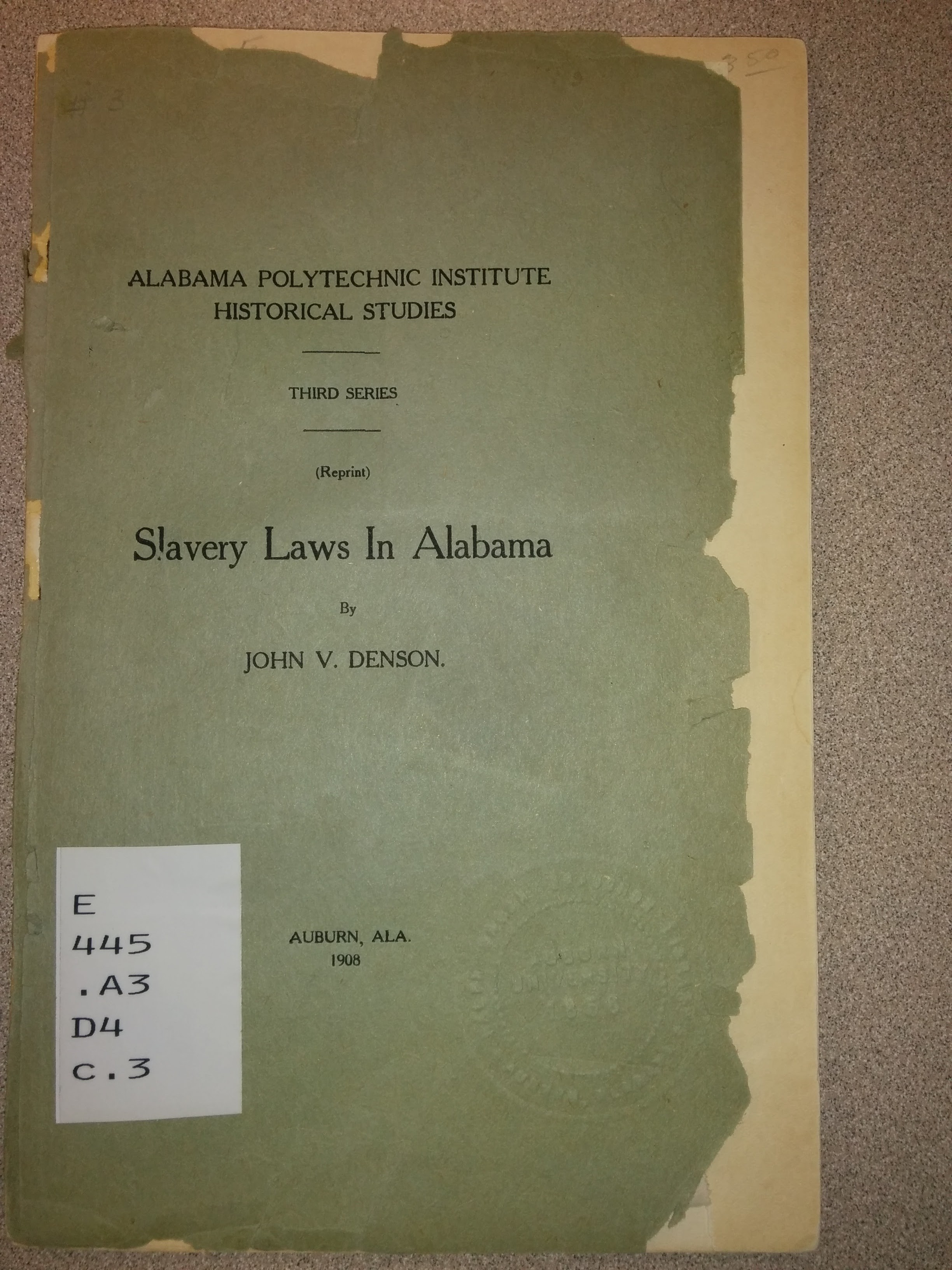
This text is transcribed from John V. Denson's 1908 pamphlet, Slavery Laws in Alabama. The booklet was originally published as part of the Alabama Polytechnic Institute Historical Studies series. John V. Denson was a student and later GTA instructor at Alabama Polytechnic for History and Latin, later a prominent lawyer in the Auburn-Opelika area. Like most of the historical studies from Alabama Polytechnic (now Auburn University) from the first decade of the 1900s, the pamphlet apologizes for Southern slavery, and adopts a point of view that is at times frankly white supremacist. The pamphlet begins with a discussion of the law of manumission; here is the next section, on the law concerning fugitive slaves.

[7] RUNAWAYS: The laws of Alabama relating to runaways were never cruel and never overstepped the bounds of conservative measures for the recovery of property. The act of 1805, in Secs. 12 and 13, provided that runaway slaves[9] might be apprehended by any person and carried before the next justice of the peace, who should commit such runaway to jail or send to his master, who was to pay a fee of six dollars and reasonable costs and charges, and further, that all slaves lying out hid, killing hogs, etc., were to be taken by force by the patrol, at the direction of the justice of the peace, and committed to jail, the provost's remuneration being thirty dollars paid by the state, three-fourths of which were to be repaid by the master in addition to his taxes. By the act of 1809[10] it was provided that [8] when a runaway slave was committed to jail and was not claimed by the owner within six months after the first publication of commitment, the sheriff should sell such slave, the proceeds going to the county; but if the owner should afterwards assert and prove his title, he could recover the amount paid to the county for the slave, but could not divest the title of the purchaser of such runaway, the time for such claim being limited in 1848 to five years after first publication.[11]

A slave found at a distance of eight miles from his master's plantation without a pass from his master, or one who had lain out more than two days without leave of his master, was considered a runaway.

The penalty visited upon any person who knowingly aided any negro or any other slave to runaway or depart from his master's service was imprisonment in the penitentiary [9] for a term of not less than two nor more than five years.[12]

So far as I have been able to discover there never existed in Alabama any statute, as there did in other states, providing for the outlawing of runaway slaves. In 1741 there was such a statute in North Carolina, providing that, Any person may lawfully kill a slave who has been outlawed for running away and lurking in swamps, etc.,[13] and a similar statute existed earlier in Virginia. In Maryland and the District of Columbia a similar law existed providing that when a slave should runaway from his master's service into the woods and remain there, killing hogs, etc., and should refuse to surrender, and offer resistance to persons legally empowered to pursue and capture, it should be lawful for such pursuers to shoot, kill, and destroy such slave.[14] The Alabama law, it seems to me, gave very little more authority to legal pursuers of fugitive slaves than is now given to officers when engaged in the pursuit of fugitives.

In North Carolina a proclamation of outlawry against a slave was authorized whenever he should runaway from his master and conceal himself in some obscure retreat, and to sustain life, should kill hogs, etc., and any person might lawfully kill such outlawed slave.[15] Also in Virginia two justices of the peace were authorized to outlaw runaways, whom any person might kill, without accusation of crime for so doing, but this act was repealed in 1792.[16]

This authority to outlaw slaves never existed in Alabama, and a person neverp possessed authority to kill a slave without possibility of accusation of crime, the law in Alabama [10] most resembling this being as follows: Any justice of the peace receiving information that three or more runaway slaves are lurking in swamps and other obscure places, may by warrant, reciting the names of the slaves and their owners, if known, direct a leader of the patrol of the district, and if there be none, then any other suitable person, to summon and take with him such power as may be necessary to apprehend such runaways, and, if taken to deliver them to the owner or to commit them to the jail of his proper county.[17]

Even after 1860, when it would be natural to expect more rigorous laws, the only new laws as to runaways were acts providing for increased compensation for taking up runaway slaves.[18]

  1. [9] Sec. 12. All runaway slaves may be apprehended by any person and carried before the next justice of the peace, who shall commit such slave to jail or send him to his owner, who shall pay six dollars for the slave so taken, and costs and charges.

    Sec. 13. In cases of slaves lying out hid, killing hogs, etc., the justice of the peace must direct the provost of patrols to take the slaves by force and commit them to jail, the provost receiving thirty dollars from the Territory, three-fourths of which was to be repaid by the master in addition to his taxes.

    See also Ala. Justice, p. 425.

    Toulmin's Dig. of 1807, p. 378.↩

  2. [10] Sec. 20. When any slave shall be committed to the jail of any county as a runaway, and such runaway shall not be claimed and proved by the owner thereof within six months of the first publication of the commitment of such slave in some newspaper published in this state, it shall be lawful for the sheriff of said county to sell said slave at public auction, at the court house of his proper county, upon giving at least thirty days' previous notice of such sale, by advertisement published in some newspaper in this state at the court house of the proper county, and at least two other public places in the same; and out of the proceeds arising from the sale of any runaway slave as aforesaid, the sheriff shall be entitled to the same commissions and fees as are allowed in execution, and the balance, after paying all prison fees and maintenance of said runaway slave while in jail, shall be for the use of the proper county: Provided, that if the owner of such runaway slave shall, after such sale prove his property in any such slave, the proper county shall pay to him the amount that shall have gone into the treasury, on account of the sale of such slave, but the right to any slave, sold as aforesaid, shall be and remain vested in the purchaser under the sale made by the sheriff as aforesaid.

    Clay's Ala. Dig., p. 542, sec. 20.

    Almost word for word in Ala. Justice, p. 432, and referred to Dig. p. 373.↩

  3. [11] There may arise in some minds this question: When a negro committed to jail as a runaway, is not claimed by any man as a slave, why is it not presumed that he is a free negro and discharged? Free negroes did live in Alabama, for there are laws which are specially applicable to them, and before 1834 emancipated slaves might remain in Alabama as free negroes, and therefore there might arise some question as to whether such free negro was free or slave, but the Supreme Court of Alabama, in the case of Field v. Milly Walker, Ala. Rep. vol. 17, p. 81, has held that a person of color in this state is presumed to be a slave and the burden of proof is on such person of color.↩
  4. [12] Acts of '40-'41, p. 129, sec. 15.

    Every person, who shall knowingly aid any negro or any other slave to run away, or depart from his master's service, such person, so offtending, on conviction, shall suffer imprisonment in the penitentiary not less than two, and not exceeding five years.

    See also Clay's Dig. of 1843, p. 419, sec. 15.↩

  5. [13] Stroud, p. 103; Haywood's Manual, pp. 521-522.↩
  6. [14] Goodell's American Slave Code, p. 231, Laws of Maryland, 1723, chap. 15, sec. 7.↩
  7. [15] Stroud, p. 38.↩
  8. [16] Goodell's American Slave Code, p. 231; Stroud, p. 103.↩
  9. [17] Ala. Code of 1852, sec. 1024; Clay's Dig., p. 541, sec. 15. This law was enacted in 1805, by the Miss. Territory.↩
  10. [18] Acts of '61, p. 15.

    AN ACT. To amend section 1023 of the Code in relation to runaway slaves.

    Sec. 1. Be it enacted by the Senate and the House of Representatives of the State of Alabama, in General Assembly convened, That hereafter it shall be the duty of justices of the peace before whom runaway slaves are brought, instead of committing them to jail, to order and direct such slaves to be delivered to their owner, overseer or agent, in all cases where the justice is satisfied that the name of the true owner is made known, and where the residence of such owner, his overseer or agent, is nearer than the county jail: Provided, that the owner, his overseer or agent, shall on delivery of the slave pay the fee now allowed by law for arresting, and the compensation hereinafter provided to the taker-up, or such other person as may have the custody of the slave, and in case of the refusal of the owner, his overseer or agent, to pay such fees and compensation promptly on delivery, then it shall be the duty of the person having charge of the slave, and the justice shall so instruct him, to carry the slave back to the office of the justice, who shall forthwith commit him to the county jail.

    Sec. 2. And be it further enacted, That where runaway slaves are committed to jail, it shall be the duty of the justice in such cases to endorse on the back of his warrant to the sheriff, the cost and charges for apprehending and bringing to jail, and to certify the same to the owner, when delivery is made to him, but in no case to exceed the amount allowed by law.

    Sec. 3. And be it further enacted, That for bringing a runaway slave to jail, the persons performing such service shall be entitled to the sum of ten cents a mile in coming to and returning from the jail, estimating the distance by the nearest route, and ferriages, and to the same compensation when the slave is carried to his master, or overseer, and the justice for his service shall be allowed the sum of seventy-five cents.

    Sec. 4. And be it further enacted, That any justice who allows and endorses on the warrant or certificate to the owner, larger or other fees and compensation, than is now allowed by law, and by the provisions of this act, shall be deemed guilty of a misdemeanor, and, on conviction, shall be fined not less than double the aggregate amount endorsed, or certified, to be recovered before any magistrate for the use of the owner. App'd. Dec. 7, 1861.

    Also in the Acts of '63, p. 63, appears this act.

    AN ACT, To increase the fees now allowed by law for apprehending and committing to jail runaway slaves.

    Sec. 1. Be it enacted by the Senate and House of Representatives of the State of Alabama, in General Assembly convened, That for apprehending and committing a runaway slave to jail, or for delivering him to his owner, the sum of ten dollars shall be allowed instead of six dollars as now provided by law; and for taking a runaway slave to jail the person performing such service shall be entitled to fifteen cents per mile, in giong to and returning from the jail, and to a like compensation when the slave is delivered to his master or overseer, instead of ten cents per mile as now provided, and the justice of the peace shall be allowed for his services one dollar and a half in lieu of seventy-five cents now allowed. App'd Dec. 7, 1863.

    Also in '64 this act was passed. Acts of '64, p. 78.

    AN ACT, To increase the compensation for taking up a runaway slave.

    Sec. 1. Be it enacted by the Senate and the House of Representatives of the State of Alabama, in General Assembly convened, That from and after the passage of this act the compensation for taking up a runaway slave shall be twenty-five dollars, instead of the amount now allowed by law. Provided, that this act shall terminate with the existing war. App'd Dec. 10, 1864.↩

Miss Meriwether Harvey, Class of 1907

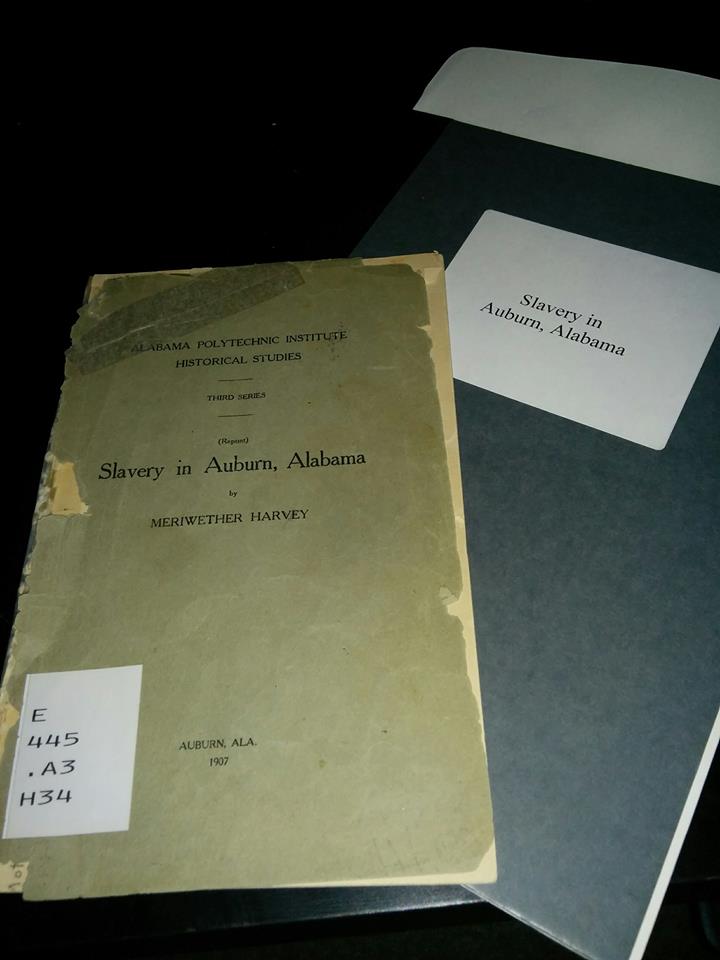
A few weeks ago I mentioned that we had added a 1907 short study on "Slavery in Auburn, Alabama" to the Fair Use Repository. The booklet was published as part of the Alabama Polytechnic Institute Historical Studies series. Meriwether Harvey is listed as the author of the booklet; it is evident from the text that Harvey based the study on some fairly extensive first-hand interviews with family or acquaintances in some of the prominent white families that had formerly owned slaves in the area of Auburn, and also at least some interviews with local African-Americans who had been born under slavery. If you wanted to find information about the author, though, what was available was fairly limited. Harvey was not a member of the Alabama Polytechnic faculty in 1907, and the booklet gives no further detail about its author.

John David Smith, the author of An Old Creed for the New South (2008), describes the the booklet and its author on pp. 173-4, 179:

Fortunately, a talented amateur historian and a number of graduate students went beyond such romanticized views of slavery on the state and local level. [...] Meriwether Harvey and James K. Turner conducted even more minute grass roots research on slavery in Auburn, Alabama and Edgecombe County, North Carolina, respectively. [...] The essays by Meriwether Harvey and James K. Turner remain important because they represent the type of micro research on slavery that still cries out to be written. Harvey, a student at Alabama Polytechnic Institute at Auburn, made the most detailed examination of the period of slavery in any one locale. He focused on slavery in Auburn, in 1860 a small cotton-producing community of one thousand whites and seven hundred blacks....

Smith helpfully, and correctly, identifies Meriwether Harvey as a student at Alabama Polytechnic (now known as Auburn University) -- but misidentifies Harvey as "he." After a bit of research with old copies of the Glomerata at the Auburn University Library Special Collections section, I can now introduce you to Miss Meriwether Harvey, a 19 year old Senior co-ed student at Alabama Polytechnic Institute, who graduated with honors as part of the Class of 1907. Alabama Polytechnic (formerly the Agricultural and Mechanical College of Alabama) had in fact admitted a small number of female students since 1892, -- including Miss Meriwether Harvey.

Miss Meriweather [sic] Harvey

Blockton, Ala.

"Merie." General.

A very congenial piece of curiosity.

Despises frivolity. "Isn't the Captain of Company K handsome!" Believes in maintaining her rights and doing the right. A natural-born mythologist. Always eager to talk about the Conway Cabal (?). Never sends post cards to the professors. Hardest boner of Co-eds. Pretends that she is going to "IV" but makes I's. "I'm shocked to think that Napoleon wrote L-O-V-E letters."

Honorary member of Websterian Literary Society; Distinction '05.

This is from p. 41 in the Senior Class section of the Glomerata, API's official yearbook, Vol. X for the school year ending in 1907.

Ms. Harvey was one of only eight women enrolled at Alabama Polytechnic in 1907. She graduated with honor as part of the Class of 1907; here is her listing in the 1907-1908 Alabama Polytechnic Institute catalogue:

Page 24. [...] GRADUATES WITH HONOR: John Bayard Clarke, Marion; John Cameron Dow, Barbour; Edwin Alexander Harriss, Georgia; Mary Meriwether Harvey, Bibb; [...]
Alabama Polytechnic Institute Catalogue, 1908, p. 24

Many thanks to the Auburn University Archives and Special Collections Department for their help in locating and identifying the author of this remarkable local study. More information about Meriwether Harvey is now available through Meriwether Harvey at ''Notes from the Margins''.

From John V. Denson, “Slavery Laws in Alabama” (1908), Part I: Emancipation

IMG_20160830_135830

This text is transcribed from John V. Denson's 1908 pamphlet, Slavery Laws in Alabama. The booklet was originally published as part of the Alabama Polytechnic Institute Historical Studies series (which had also previously published Meriwether Harvey's Slavery in Auburn, Alabama). John V. Denson was a member of the Board of Instruction for Alabama Polytechnic for History and Latin. Like most of the historical studies from Alabama Polytechnic (now Auburn University) from the 1900s, the viewpoint of the pamphlet is frankly white supremacist, and romanticizes and apologizes for Southern slavery. It is however an extensive and detailed study of the slave code in Alabama in particular. Here is the first section, on the law of manumission. More to follow.

Slavery Laws in Alabama

By

John V. Denson.

In this study of the laws of Alabama that related to slavery, it is not my intention to discuss at all the administration of the laws nor the conditions resulting from any maladministration of them, but merely the laws themselves in the abstract. To get the legal facts about their administration would be a matter of great difficulty, for the courts in which the great majority of slave cases were tried, that is, courts of a justice of the peace, were not courts of record, and the only facts accessible concerning them would be the personal statements of old citizens, and however interesting these might be, they would not be authoritative. The study, then, is a discussion of the statutes that have existed from time to time in Alabama relating to the slave and the free negro from 1819 to 1865. Where it was possible I have compared Alabama laws with the laws of other States. *EMANCIPATION:* Leaving aside any moral questions that may be incident to the emancipation of slaves, I shall discuss it solely from the legal standpoint. Slaves in Alabama were considered and dealt with as property, as chattels personal, and since the right of the owner of any property is absolute, it would seem, at first glance, that the owner of slaves should be allowed to deal with them without interference, and certainly to give them freedom if he saw fit. But slaves were a peculiar kind of property, and for the welfare of the public it was necessary that some restraints be placed upon the powers and rights of the master. A man may own a large quantity of gun-powder, and his property rights are absolute, but for the good of the public he is restrained in a degree, and is forbidden to store it in certain places. [2] And so the Legislature restrained the power of the slave master for various reasons. According to the law slaves were property, and creditors had a legal right to look upon them as security for their debts due from slave owners. The right of the creditor was valid and the master was bound to recognize it, the law providing that an emancipated slave was liable to be taken to satisfy a debt contracted before such emancipation. Again, it was necessary to prevent a freed slave from becoming a charge upon the public, and the master must give bond guaranteeing this. There was among slave-holders a very general impression that the influence of a free negro upon slaves was demoralizing, nor was this unreasonable. The slave might become restless under the taunts of his free brother, or encouraged to hope for freedom himself, and so might run away or incite an insurrection. Hence after 1834 the slave when freed was required to leave the State. also there was current in the South an idea that unrestrained emancipation would result in one of two conditions: either the emancipated negro must remain in the condition of the free negro in competition with the white man for his daily bread, or he must become lord of the soil, as he had in Hayti and Jamaica. Southerners, at least many of them, believed that the negro was incapable of providing sustenance for himself in competition with the whites, and they thought that a large percentage of negroes would be without work, almost starving, and the consequence would be plunder and pillage. The alternative of becoming owners of the soil was even more to be avoided, certainly if reports from Jamaica and Hayti were to be believed.[8] Unrestrained emancipation might turn loose upon Southern white men a horde of ignorant creatures, unchecked by wise leaders, and incapable of being controlled. All these things the South feared, and the laws checking emancipation were intended to prevent them. The Constitution of Alabama, formed in 1819, contained [3] the following statements about emancipation: The General Assembly shall have no power to pass laws for the emancipation of slaves, without the consent of their owners, or without paying their owners, previous to such emancipation, a full equivalent in money for the slaves so emancipated. They shall have the power to pass laws to permit the owners of slaves to emancipate them, saving the rights of creditors, and preventing them from becoming a public charge.[9] The early statute law in Alabama was the act of the Mississippi Territorial Legislature, passed in 1805, when Alabama was included in the Territory, and it remained the law until 1834. That statute provided: That from and after the passage of this act it shall not be lawful for any person or persons holding or owning slaves, to liberate them or any of them, unless they first prove to the satisfaction of the General Assembly, that such slave or slaves have done some meritorious act, either for the benefit of the said owner or for the benefit of this Territory; and in the said case the owner or owners of the said slave or slaves shall give bond or security to the Governor, for the time being, that the said slave or slaves shall not become chargeable to the public. Provided, nevertheless, that all slaves so emancipated shall be liable to be taken by execution to satisfy any debt contracted by the person emancipating them before such emancipation is made. Section 2 of this act provides: That any slave claiming freedom shall proceed by petition to the county or circuit court of his master's county; the master must enter into a bond approved by the governor, in a sum to be adjudged by the court, that such [4] slave will be subject to the order of the court and abide by the judgment of the court, the slave to remain in the service of the master till the determination of the suit.[10] It will be noticed that this statute contains no provision that the freed slave shall leave the state, and there was no such provision until 1834. Another noticeable feature is that there is nothing contained in the statute that would prevent a person's directing in his will that slaves be taken out of the state by his executors, to free territory, and there set free, and a provision of this kind did not occur until 1860. So far as I can find no will containing a bequest of this nature was ever declared null and void. In South Carolina the act of 1820[11] was the same as that quoted above, but in 1841 an act was passed which declared void all bequests, deeds, etc., which intended after the death of the owner to remove slaves from the state and liberate them.[11] Goodell, in his American Slave Code, published in 1853, makes the unqualified statement that, In South Carolina, Georgia, Mississippi, and Alabama, the legislature, only by express enactments, has authority to emancipate slaves, and cites as his authority Stroud, P. 147. Stroud's work was published in 1827.[12] Mrs. Stowe, in Uncle Tom's Cabin, published in 1851, makes the same statement, but cites no authority.[13] If these two persons had taken the trouble, they might have found that in 1834 the Legislature of Alabama enacted a law which provided that judges of the county court might, upon petition of the owner, emancipate slaves, in consideration of long, faithful, and meritorious services performed, and for other good causes, provided such slaves should leave the State within twelve months, never to return, and if such slaves should return, they were to be apprehended by the sheriff [5] and were liable to be sold for life as slaves. As in all provisions for emancipation, it was definitely set forth that nothing in the act should be so construed as to prejudice the rights of the creditors of the owner of the emancipated slaves.[14] This act remained in force until the act of 1860, which revoked and annulled all emancipation laws. The method of procedure under this act was simple. The master desiring to emancipate a slave made publication in his county newspaper for at least sixty days previous to making application, giving the name and description of the slave; at the appointed time the petition was filed and the cause tried. If there was proof that the slave had served his master with fidelity, or other good cause was shown, and no sufficient objection was offered, the judge of probate, acting upon authority conferred by the Legislature, declared the slave free.[14] [6] This act remained in force till 1860. At that time a stringent act prohibiting emancipation was passed, and it is natural to find it. Intensified by the sectional conflict in Kansas, and by the raid of John Brown, the antipathy between the South and the North was growing apace. In Alabama, one of the results of this was the sweeping act of 1860, which was as follows:

Sec. 1. Be it enacted by the Senate and House of Representatives of the State of Alabama, in General Assembly convened, That from and after the passage of this act, all clauses, items, words, or directions contained in any last will and testament, or other instrument, made for the purpose of emancipating any negro slave or slaves, either directly or indirectly, is hereby declared to be void and of no effect.

Sec. 2. Be it further enacted, That any and all clauses of any last will and testament or other instrument by which any executor, administrator, trustee, incorporation or society of persons, may be authorized or directed to remove any slave or slaves from the state of Alabama, for the purpose of emancipating such slave or slaves, is hereby declared to be void and of no effect.

Sec. 3. Be it further enacted, That all gifts and bequests by last will and testament, or other instrument, of any slave or slaves to any person or persons, or to any trustee, incorporation or society of persons, upon the trust or condition that such slave or slaves shall be removed beyond the limits of the state of Alabama, and to some state or territory, where African slavery does not exist, shall be utterly null and void.

Sec. 4. Be it further enacted, That all laws and parts of laws authorizing the emancipation of any slave or slaves, by any proceedings before any court in the state of Alabama, are hereby repealed.

Sec. 5. Be it further enacted, That the provisions of this act shall not apply to wills and testaments or other instruments which may have become effectual before its passage.[15]

  1. [8]Stearn's Notes on Uncle Tom's Cabin, Note 9.↩
  2. [9]Three clauses seem to have been taken almost verbatim from the constitution of Mississippi (1817), except that the latter forbade the emancipation of slaves without the consent of their owners unless where a slave shall have rendered to the State some distinguished service, in which case the owner shall be paid a full equivalent for the slaves so emancipated. See Poore's Charters and Constitutions.↩
  3. [10]Toulmin's Dig. of 1807, p. 259. Hitchcock's Ala. Justice, p. 421.↩
  4. [11]O'Neal's article on S. c. laws in DeBow's Industrial Resources of the South, vol. 2, p. 274.↩
  5. [12]Goodell's American Slave Code, p. 341.↩
  6. [13]Uncle Tom's Cabin and Key, vol. 2, p. 354.↩
  7. [14]

    Acts of the Legislature, '33-34, p. 29.

    Sec. 1. Be it enacted by the Senate and the House of Representatives of the State of Alabama, in General Assembly convened, That whenever the owner or owners of any slave or slaves, shall be desirous of emancipating such slave or slaves, such owner or owners shall make publication in some newspaper printed within the county where such slaves reside, (or if there be no paper printed in said county, then in the nearest paper thereto,) for at least sixty days previously to the making application in which shall be set forth the time and place that such application will be made, together with the names and description of the slave or slaves, sought to be emancipated; and at the time appointed the judge of the county court may upon petition filed, proceed to hear and determine upon the application so made, and if, in his opinion, the said slave should be emancipated, in consideration of long, faithful, and meritorious services performed, or for other good and sufficient cause shown, the said judge may proceed to emancipate and set free such slave or slaves; and the clerk of the court shall make record of the same in a book to be kept by him for that purpose: Provided, that such slave or slaves shall remove without the limits of this state, within twelve months after such emancipation, never more to return, and that such emancipation shall not take effect until after such removal.

    Sec. 2. And be it further enacted, That if the said slave or slaves shall return within the limits of this state after such removal and emancipation, he, she, or they, shall be subject to be apprehended by the sheriff of the county within which the same may be found and imprisoned, and after having advertised the same for at least thirty days, may be sold to the best bidder for cash as slaves for life; and the proceeds of such sale, after paying all expenses, shall be paid into the county treasury for the use of said county.

    Sec. 3. And be it further enacted, That it shall be the duty of all sheriffs, constables and patrols, to apprehend slaves who shall return after having been so emancipated and removed, and bring them before some justice of the peace who shall commit them; and the same compensation shall be allowed in such cases as is allowed for apprehending runaway slaves.

    Sec. 4. And be it further enacted, That nothing in this act contained shall be so construed as to prejudice the rights of the creditors of the owner of slaves so emancipated.

    App'd, Jan. 17, 1834.

    See also Clay's Ala Dig. of 1843, p. 545, secs. 37, 38, and 40. Also Ala. Code of 1852, secs. 2044-2048.

    ↩
  8. [15]Acts of 1859-60, p. 28. App'd Jan. 25, 1860.↩

Now available: full text of “Slavery in Auburn, Alabama” (1907)

Now available on the Fair Use Repository website: I have just made available the full, transcribed text of Slavery in Auburn, Alabama, a small 18pp booklet from the Alabama Polytechnic Institute Historical Studies (published by Auburn University, then known as Alabama Polytechnic Institute) written by Meriwether Harvey.

I found the booklet on the shelves at the Auburn University RBD Library, an aging, decaying reprint booklet carefully tucked into a protective grey cover, and decided that this document of local history deserved preserving. So I have spent the past couple days reading and transcribing the text into digital form.

The booklet was written in 1907, and its viewpoint very emphatically reflects the views common among wealthy white families and former slaveholders (like the Harveys) in and around Auburn, Alabama, a small college town in what was then rural East Alabama. It is romanticized, although concerned enough with points of detail and description that that only causes a problem in some parts of the booklet. At times, the text is oblivious, or frankly racist. It makes some blanket claims about the local slave trade that are almost certainly self-serving lies told by the author's sources. However, the booklet seems to have been based primarily on first-hand interviews with slaveholding white families and a few interviews with African-American residents who had been born under slavery, and whether intentionally or unintentionally provides fascinating points of detail, and anecdotes reflecting the reminiscences, the self-justifying fantasies, and also the anxieties of white slaveholders in East Alabama, as well as some of the range of experiences of slavery in east Alabama, and the operation of the slaves' economy, despite its frustrating limitations. Some excerpts:

Slavery in Auburn, Alabama (1907)

By Meriwether Harvey

[...] Corn shucking was another great occasion in the negro's life. The owner would have all his corn hauled up and thrown on the ground at the crib door in a big pile; then he would invite his neighbors' negroes to come to his house on a certain night to a corn shucking. Only the men were invited; as they came they could be heard in the distance singing corn songs. I have tried to record some of these songs, but I find they were a jargon; they had no real words, only a tune. Some disinterested man would lay a long pole in the middle of the pile; then two negro men would choose sides, as is done today in spelling matches, and the two sides would enter into a contest to see which could first finish their side of the pile. The leader, dressed in a stove pipe hat and feather, walked up and down on the pile and gave out the corn song. The whole crowd answered him in the chorus. As they shucked, they would throw the corn into the barn in front of them and the shucks behind. When they had finished about half of the pile, corn whiskey was passed; thus they worked till eleven o'clock, when [13] they had a big plain supper. After eating the put the shucks in pens made for the purpose. By twelve they had finished, and then the frolic began. They danced about the great bonfire that had been burning all the time behind them, so that they might have sufficient light to shuck the corn, the lights and shadows making a strange and ghostly scene. After the supper the owner of the plantation, the giver of the corn shucking, or sometimes the overseer, was seized and carried about on the shoulders of some of the negroes. The other negroes followed, all singing at the top of their voices. About two or three o'clock in the morning they all went home.

[...] The treatment of slaves was generally good because the negro was property and was cared for as such. [sic] I have interviewed only one man who ever saw a slave unmercifully beaten. [sic] A great many negroes would run away; some of them were chronic runaways, and were so seemingly without any cause whatever. A few of these chronic runaways were chained at night. Certain people all through the country kept fox hounds for tracking runaway negroes, who would go off into the swamps and woods. It was often impossible to catch them in any way except with dogs. They were seldom bitten by the dogs when over taken; they would climb a tree if one was near at hand, but if they were caught on the ground, the dogs were so trained that they circled around the negroes, without going close to them. Negroes always aided a runaway by slipping to him something to eat. Mr. H. never had a negro to lie out more than three days, and never offered more than ten dollars as a reward for his return. Mr. B., with the aid of another man, caught a negro who had been in the woods seven years. He advertised the negro, and in due time returned him to his master. The slave turned out to be the most faithful of a large number of slaves. Mrs. D. says of her whole [15] number of slaves, which was between one hundred and fifty and two hundred, there was never a runaway; Mr. B. knows several such cases. Uncle West would run from the plantation up to Mr. F. R.'s residence whenever the overseer told him to do what he did not wish to do, or threatened to whip him. None of the negroes ever did any other kind of running away.

The overseers were men selected for their practical farming ability, and their business was to oversee the negroes and look after the farm and the planting. Sometimes an overseer was discharged, or brought to trial, when he mistreated a negro. One of Mr. W. H.'s overseers whipped two of his negroes, who hid in the swamp. Some of the other negroes came from the plantation to Auburn to tell their master. He decided the whipping unjust and paid the overseer up and let him go.

When an overseer was hired it was understood that he was to ride the country as a patrol; also the young white slave-owners of the neighborhood patrolled on certain nights. A negro was not allowed to leave his master's plantation without a pass stating where he was going and when he was to return. This had to be signed, either by the overseer or the master. If the negro was caught away from home without a pass, he was whipped with a leather strap by these patrols. The usual punishment for being away from home without a pass was ten to twenty lashes, but in exceptional cases thirty-nine lashes might be given. These patrols went usually Saturday nights and Sunday afternoons and nights, but they also went out any night when they thought they might catch negroes roving about. They patrolled the roads, visited the plantations, and searched the cabins; if a negro was caught in a cabin away from home, he was taken off a good way from the negro quarters and whipped. Of course the whipping depended upon the offense, the mood of the patrol, and the negro whipped. Sometimes people who did not own negroes would catch a [16] negro without a pass and beat him badly, but the regular patrol did not do this.

The negroes were punished as a rule, by whipping; the whip was a leather strap so that it would not cut the skin. The foreman was the boss and did the whipping, but the owner, or overseer, was there to witness it. On some plantations the overseer did the whipping, but the master was usually present. Negroes were not whipped for small offenses; a foreman would sometimes dislike a certain negro and would beat that one unmercifully. As a rule, the overseer was more kind and merciful than the foreman. If there was a large number of hands, the foreman spent his whole time bossing; if the number was small, he would work awhile and then boss awhile. He lorded it over the other negroes. The worst whipping was often done by the negro parents.

[...] Slavery was not without its dark side. There were near Auburn several instances of cruel treatment to slaves. In one case they were not properly fed, in another, they were not sufficiently clothed. How far this was due to the lack of means of the masters is now hard to determine. In some cases they seem to have been overworked. In one or two they were treated roughly and punished severely. In one case a slave stabbed his master, but did not kill him. The slave was tried and hanged. Public opinion disapproved of cruelty on the part of masters. One man was indicted three times for ill treatment of his slaves, especially for failing to supply them with sufficient food and clothing. He was fined each time.

[18]There were some old negroes who did as they pleased and went where they pleased. These negroes were too old and infirm to be of any value. Mr. H. had four or five such, two of whom were blind women. They made money by making baskets and selling chickens and eggs. These negroes were not what were called free negroes. Uncle Burl Dillard was in reality a free negro, but he nominally belonged to the Dillards. He made ginger bread and persimmon beer, which he sold. He also had a wagon and mule, and went through the country buying old rags which he took to Columbus and there sold. His wife, Aunt Kitty Dillard, was a slave.

The negroes had the greatest contempt for poor white folks, that is people who owned no negroes. Every one speaks of their faithfulness. They would divide anything they had with their masters and would steal from their neighbor rather than their master. Only cribs and smoke houses were locked. They thought their folks the greatest in the world, and what belonged to the master was always spoken of as theirs. They were respectful to every one except poor white folks. Mr. R.'s negroes came from South Carolina and would not associate with other negroes because they thought South Carolina negroes far superior to any of the negroes in Auburn. In 1847 Aus Harvey went to Mexico with his master. When they left, the mother of Mr. Harvey made Aus promise to bring her son back if he should die. Mr. Harvey died with yellow fever, and true to his promise, Aus brought the body home. He paid his own fare and that of the corpse by cooking and doing various things. He told parties that the corpse was a piece of furniture he was bringing to Alabama. Finally, he got the body as far as Montgomery; then the family sent for it. There were many examples of faithfulness, too numerous to be told.

--Meriwether Harvey, Slavery in Auburn, Alabama (1907)

Bruce Levine, The Fall of the House of Dixie on Robert E. Lee and the whipping of the Norris slaves

This passage is from Bruce Levine's 2013 study, The Fall of the House of Dixie: The Civil War and the Social Revolution That Transformed the South (Random House, 2013). Levine's text includes an error of misreading the sources: in reading descriptions of the escape and whipping, he seems to have mistakenly parsed my sister Mary, a cousin of ours, and I determined to run away as my sister, Mary (a cousin of ours), and I determined to run away, thus mistaking Mary Norris for the unnamed cousin of ours in Norris's testimony (in fact, according to Pryor, inf., the cousin is George Parks).

Hundley was anxious to attribute such conduct to only the greediest and cruelest masters. In fact, however, cracking whips and piercing cries were heard throughout the South. Robert E. Lee liked to think of himself as a humane owner. But he could react as fiercely as any other when his power and authority were challenged. In 1859, three of Lee's slaves--Wesley Norris, his sister, and a cousin named Mary--attempted to escape from the Arlington plantation. Recaptured in Maryland, the unfortunate people were jailed there for two weeks and then delivered back into Lee's hands. Promising to teach them a lesson they would not soon forget, Lee had them taken to the barn, stripped to the waist, and whipped between twenty and fifty times each on their bare flesh by a local constable named Dick Williams. As the punishment proceeded, Wesley Norris later recalled, Lee stood by, and frequently enjoined Williams to lay it on well, which he did.44

44. Elizabeth Brown Pryor, Reading the Man: A Portrait of Robert E. Lee through His Private Letters (New York, 2007), 260-261.

--Bruce Levine, The Fall of the House of Dixie: The Civil War and the Social Revolution That Transformed the South (Random House, 2013). 11, 309n44.

Two more years of THE LIBERATOR now available! (Scanning Project, Week 1 update)

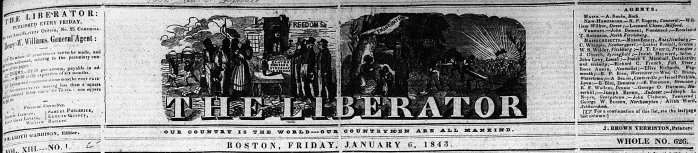
I'm happy to announce, as an update to the ongoing Liberator online archive project that two more volumes of The Liberator -- Vol. XII and Vol. XIII -- are now available, in full page-scan PDF facsimiles -- at the Liberator online archive:

<

p>The early 1840s were eventful and contentious years in the American Abolitionist movement, with much of the controversy centered on Garrison, Abby Kelly and their radical allies -- especially the ultras' strident opposition to electioneering and political parties, and their principled defense of women's freedom to participate equally in the Abolitionist movement. In May 1840, the American Anti-slavery Society underwent a schism in the conflict over both propositions; more conservative, politically-oriented and anti-feminist abolitionists attempted to purge Garrison from the AAS, and when they failed to run him out, they left to form a new, conervative American and Foreign Anti-Slavery Society. The pages of The Liberator in 1841-1842 were full not only of news about national events, slavery, war, but also internal debate within the movement over the AAS/AFAS split and the electoral campaigns of the recently-formed Liberty Party, as well as new reports and arguments over the Come-Outer religious movement, endorsed by Garrison, Abby Kelly, and others, which called on Christians to come out of mainline denominations that did not reflect their conscientious beliefs on spiritual practice or which refused to take a moral stand against slavery, alongside established features such as the Refuge of Oppression columns (in which Garrison quoted, verbatim, the words of defenders of slavery and racism, in order to demonstrate the inhumanity of their views), international updates on the Caribbean and on the speaking tours of British Abolitionists, reflections on religious and moral topics, and pages of bad moral reform poetry. To see it as it happened, you can now check out 104 more issues of The Liberator available online, in full, for free, from January 1841 to the end of December 1842.

If you enjoy this project or find the materials useful, you can help support the work and speed up the on-going progress with a contribution to the project, in any amount, through the Molinari Institute -- the not-for-profit sponsor of the Fair Use Repository. You can read more about the fundraiser and the archive project in the introductory post here at Fair Use Blog.

Read, cite, and enjoy!