Fair Use Blog

“His point was that the vast majority of El Paso Mexicans, who were not of the middle class, did not think of themselves as white and that El Paso blacks also did not regard Mexicans as white” (J. Hamilton Price, quoted and discussed in Foley)

J. Hamilton Price on Mexican protests of whiteness, non-coloredness. Followed Jim Crow patterns for colored, not white, people. / BB&W, p. 133.

Amidst all the protests that classifying Mexicans as “colored” insulted Mexicans on both sides of the border, little was heard from the African American community of El Paso, which, although small (less than two percent), could not have appreciated the Mexican community’s insistence that being classified in the same racial category as “negro” was the worst possible affront to Mexican racial pride. However, one El Pasoan, J. Hamilton Price, who was either African American or posing as one, wrote a long letter explaining how both blacks and whites in El Paso were roaring with laughter over the Mexicans’ exhibitions of wounded dignity.[29] Price wrote that local blacks did not consider Mexicans white, nor did they consider them to be superior to blacks. Furthermore, if Mexicans considered themselves superior to blacks, he wanted to know why Mexicans in El Paso ate, drank, and worked with people considered racially inferior. He went on to list the numerous ways in which Mexican behavior departed radically from Anglo-white behavior with respect to blacks. “One sees daily in this city,” he wrote, “Mexican boys shining the shoes of Negroes. If Mexicans are racially superior to Negroes,” he continued, “they shouldn’t be shining their shoes.”[30] It is worth listing all the behaviors Price described to indicate how ludicrous he found the Mexican claim to whiteness:

  • Some of the Mexican men had their hair made wavy to look more like the curly hair of Negroes.
  • In local stores Mexican clerks addressed Negro clients as “Sir” and “Ma’am.”
  • In local streetcars Mexicans occupied the seats reserved by law for Negroes.
  • Many Mexicans in El Paso preferred Negro doctors and dentists to those of their own race.
  • Many Mexicans were employed on ranches and in the homes and commercial establishments of Negroes.
  • Mexican boxers competed with Negroes in Juarez and would compete with them in El Paso, if it were permitted.
  • Mexican soccer players avidly played against Negroes, and many of the players on the Mexican teams were Negroes.
  • In some of the Mexican bars and small restaurants Negroes were as well received as Mexicans themselves.
  • Four out of five clients of Negro prostitutes were Mexicans.
  • In El Paso and Juarez many Mexican women were married to Negroes.

[134]Price wrote that the offspring of Mexican and black marriages were so numerous in El Paso that they were called “negro-burros,” literally, “black donkeys.” In Mexico, according to Price, many of these mixed-race persons were considered Mexican and occupied important positions in Mexican social circles. They often frequented the best theaters, restaurants, and Mexican hair salons, married Mexican women, and, if Democrats, were able to vote in the Democratic primaries in Texas, which otherwise barred blacks from voting. His point was that the vast majority of El Paso Mexicans, who were not of the middle class, did not think of themselves as white and that El Paso blacks also did not regard Mexicans as white. Price, angered by the manner in which Mexicans objected to being labeled as “colored,” ended his long leter with some racial invective of his own: “Though once pure Indians,” he wrote, “Mexicans had become more mixed than dog food–undoubtedly a conglomeration of Indian with all the races known to man, with the possible exception of the Eskimo.”[31]

Price’s letter brought a series of angry rebuttals from Mexicans who denounced Price as a coward for using a pseudonym–they could not find his name in the city directory. One writer, Abraham Arriola Giner, accused Negroes of deserving their inferior status for having tolerated oppressive conditions that no Mexican ever would. He boasted of the high level of culture attained by his Indian ancestors and belittled Negroes as descendants of “savage tribes” from Africa where they practiced cannibalism and did nothing to improve their lives. He reminded Price that American Negroes, as former slaves, did not have their own country or flag and that there was no honor for those who did not understand the meaning of liberty. In  afinal stroke of racial arrogance, Arriola Gina wrote that Mexicans would never tolerate any race claiming to be superior to Mexicans because “such superiority does not exist.”[32]

Neil Foley, "Partly Colored or Other White: Mexican Americans and Their Problem with the Color Line," in Beyond Black and White: Race, Ethnicity, and Gender in the U.S. South and Southwest, ed. Stephanie Cole and Alison M. Parker, 123-144 (College Station: Texas A&M University Press, 204), 133-134.
  1. [29]El Continental, Oct. 14, 1936, CCC. An editorial appearing opposite Hamilton’s letter stated that the letter appeared to be written “por un negro” and that although vulgar (“grosera”), the editor decided to publish the letter to express a different point of view.↩
  2. [30]El Continental, Oct. 14, 1936, CCC.↩
  3. [31]Ibid.↩
  4. [32]Ibid., Oct. 16, 1936.↩

Two more years of THE LIBERATOR now available! (Scanning Project, Week 1 update)

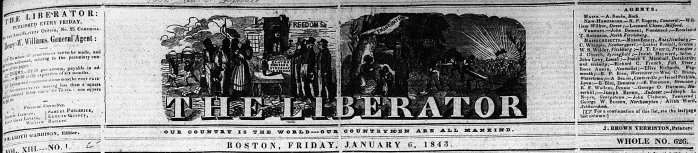
I'm happy to announce, as an update to the ongoing Liberator online archive project that two more volumes of The Liberator -- Vol. XII and Vol. XIII -- are now available, in full page-scan PDF facsimiles -- at the Liberator online archive:

<

p>The early 1840s were eventful and contentious years in the American Abolitionist movement, with much of the controversy centered on Garrison, Abby Kelly and their radical allies -- especially the ultras' strident opposition to electioneering and political parties, and their principled defense of women's freedom to participate equally in the Abolitionist movement. In May 1840, the American Anti-slavery Society underwent a schism in the conflict over both propositions; more conservative, politically-oriented and anti-feminist abolitionists attempted to purge Garrison from the AAS, and when they failed to run him out, they left to form a new, conervative American and Foreign Anti-Slavery Society. The pages of The Liberator in 1841-1842 were full not only of news about national events, slavery, war, but also internal debate within the movement over the AAS/AFAS split and the electoral campaigns of the recently-formed Liberty Party, as well as new reports and arguments over the Come-Outer religious movement, endorsed by Garrison, Abby Kelly, and others, which called on Christians to come out of mainline denominations that did not reflect their conscientious beliefs on spiritual practice or which refused to take a moral stand against slavery, alongside established features such as the Refuge of Oppression columns (in which Garrison quoted, verbatim, the words of defenders of slavery and racism, in order to demonstrate the inhumanity of their views), international updates on the Caribbean and on the speaking tours of British Abolitionists, reflections on religious and moral topics, and pages of bad moral reform poetry. To see it as it happened, you can now check out 104 more issues of The Liberator available online, in full, for free, from January 1841 to the end of December 1842.

If you enjoy this project or find the materials useful, you can help support the work and speed up the on-going progress with a contribution to the project, in any amount, through the Molinari Institute -- the not-for-profit sponsor of the Fair Use Repository. You can read more about the fundraiser and the archive project in the introductory post here at Fair Use Blog.

Read, cite, and enjoy!

The Liberator in Full Online for Free: Scanning Project, Week 1

From time to time I have mentioned my ongoing project of making full issues of William Lloyd Garrison's The Liberator available here at fair-use.org. The Liberator is big (52-53 issues every year, for 35 years!) and the project has progressed at a slow pace. But I'm happy to announce that, thanks to a break from other obligations, a sponsorship from the Molinari Institute, and generous contributions from supporters all over the Internet, the project will be able to proceed much more quickly and steadily from here on out -- hopefully with every issue of The Liberator available in full, online, for free, by the beginning of August 2014. But we need your support to make it happen!

Here's the deal. When the fundraiser project started, thanks to occasional scanning when I had the time to volunteer, fair-use.org had ten years' worth of The Liberator online: Volumes I.-IX. (1830-1839) and Volume XXI. (Jan.-Dec. 1851). In order to finish the remaining 25 years' worth of issues this summer -- instead of sometime around 2019 -- we're raising funds through our fiscal sponsor, the Molinari Institute -- in order to get the scans online and begin to prepare an extensive, open, free and researcher-friendly archive and index for anyone who wants to learn more about radical abolitionism and the history of American social movements. The fundraiser will cover the labor costs for the scanning and the increased web hosting costs for what's likely to become a very widely used web resource.

We started the fundraiser with a soft, quietly circulated launch last week. And I'm happy to announce to-day that, thanks to generous donations from 8 donors, we've already raised over 10% of our goal -- $246 out of the projected $2,000 budget. And also that thanks to the donations, we've already been able to add two new volumes -- Volume X. and Volume XI. of The Liberator (1840-1841) are now available online. We're on track to add the next two volumes (XII. and XIII.) by the end of this week.

About the project:

Our goal is to make every issue of The Liberator, from 1831-1865, available in full, online, for free, and to add free tools to aid students and researchers in searching through the archives of the paper.

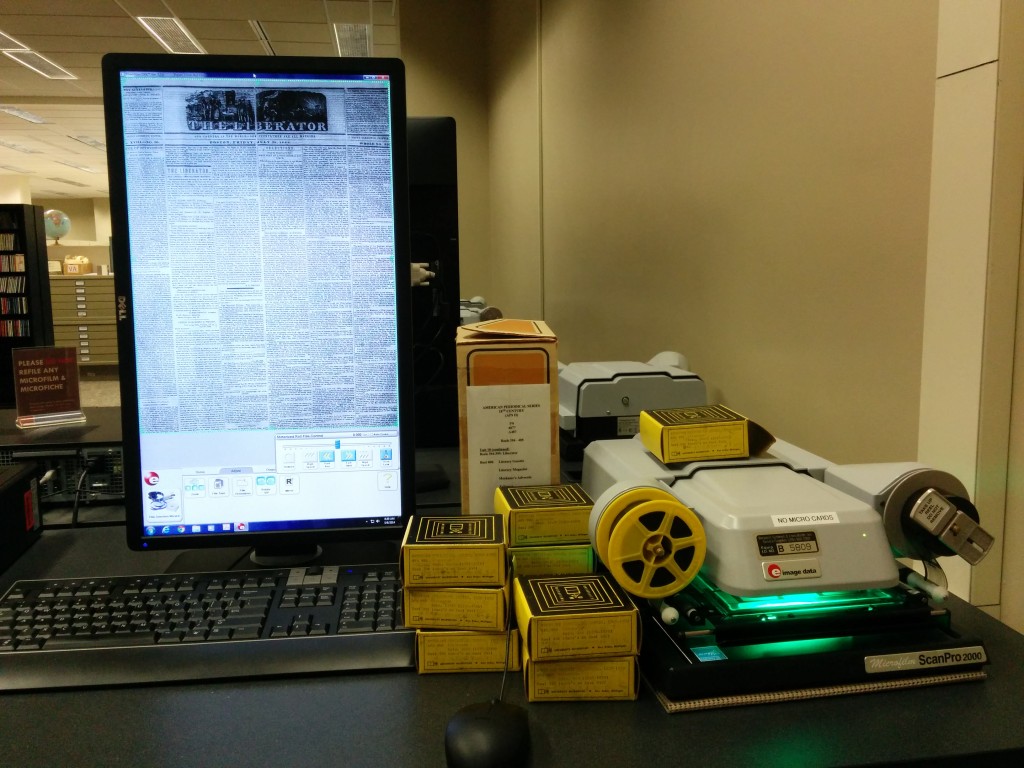
  • Phase I. is to scan every issue from every year of The Liberator from microfilm sources and to make facsimile PDFs available online for free at fair-use.org/the-liberator. If the fundraiser is fully funded, we should be able to add about two new volumes' worth of facsimile PDFs each week, and complete Phase I by August 2014.
  • Phase II. is to prepare a free, online hypertext index of The Liberator, similar to the Individuals and Titles and Periodicals sections of Wendy McElroy's indispensable Comprehensive Index to LIBERTY. The index will provide an easily searchable, easily browseable and interlinked complete table of contents for every issue of The Liberator and an index of names, book titles and periodical titles appearing in its pages. If we reach our stretch goals for the fundraiser, then the fundraiser will cover most of the labor cost for Phase II as well as for the scanning project. After Phase I is complete, I should be able to work out a plausible timeline for completing Phase II, but my guess at this point is that it could possibly be completed by the end of the year.
  • Phase III. would be to begin to transcribe individual articles and columns from the PDF facsimiles into lightweight, standards-based, linkable searchable HTML. This will be an immense amount of work and systematic effort to complete it will be a bit down the road. We'll do another round of fundraising to support the Phase III transcriptions once Phase I. is complete and Phase II. is in progress.

About The Liberator

Garrison's Liberator, running from 1831–1865, was the most prominent periodical of radical Abolition in the united states. Proclaiming, in the first issue, that:

. . . I am aware, that many object to the severity of my language; but is there not cause for severity? I will be as harsh as truth, and as uncompromising as justice. On this subject, I do not wish to think, or speak, or write, with moderation. No! no! Tell a man whose house is on fire, to give a moderate alarm; tell him to moderately rescue his wife from the hand of the ravisher; tell the mother to gradually extricate her babe from the fire into which it has fallen; -- but urge me not to use moderation in a cause like the present. I am in earnest -- I will not equivocate -- I will not excuse -- I will not retreat a single inch -- AND I WILL BE HEARD.

Together with the circle of black and white radicals that his paper attracted, Garrison's Liberator helped to organize, and offered a forum for, the Abolitionist movement that spent the next 35 years working for the immediate emancipation of all slaves, condemning racial prejudice and "American Colorphobia," and insisting that emancipation could only truly come about by inspiring a radical moral and social transformation. It urged a politics of radicalizing conscience, and denied that electoral gamesmanship, partisan politics, or political compromise would ever bring about liberation on their own. In the age of the Fugitive Slave Acts, the Garrisonians denounced the united states Constitution as a weapon of the slavers, "A Compromise with Death and an Agreement with Hell." Rejecting the use of either political or military power as a means of overcoming the slave system, they argued for Disunion ("No Union with Slaveholders, religiously or politically"), holding that the Northern free states should secede from the Union, thus peacefully withdrawing the Federal economic, political and military support that the Slave Power depended on, and (they argued) driving the slave system to collapse, by kicking out the Constitutional compromises that propped it up. Garrison and his circle, in the face of condemnation from more conservative anti-slavery activists, also constantly drew parallels and connections between the struggle against slavery and other struggles for social liberation, taking early and courageous stances in defense of women's rights and international peace.

What You Can Do To Help

If you enjoy this project or find the materials useful, you can help support the work and speed up the on-going progress with a contribution to the project, in any amount, through the Molinari Institute -- the not-for-profit sponsor of the Fair Use Repository. We can accept credit card donations through GoFundMe.com and we can also accept Bitcoin donations to bitcoin:18Bojnp2UG3iDpXT9CxjutjsXQjWgbmSCW. (If you send us a BTC contribution, please contact us to let us know who you are, what you donated and where we can reach you, so that we can send you a thank-you and, if you want, keep you up to date with the progress of the project!) Contributors have the option of having their names appear, with our thanks, on the archive page at fair-use.org/the-liberator/, or remaining anonymous if they'd prefer. You can also get periodic updates (no more than one e-mail a week) about both the progress of the fundraiser and the progress of the scanning project.

Please share this notice far and wide! We can finish this project on a small budget, but we need your help in getting the word out. A link here will work fine; or you can link directly to the GoFundMe.com fundraiser page at www.gofundme.com/8tb288

If you have access to microfilm and scanning equipment, you could also help the project immensely by contacting us at fair-use.org about hosting any alternative page-scans of some issues -- as with any 19th century periodical, many of the issues that we are scanning already had blemishes, tears or folds on the pages when they were preserved in microfilm, and if any parts of the text are illegible in our edition (the American Periodical Series microfilm collection, University Microfilms International, Ann Arbor, Mich., as found in the Auburn University Libraries in Auburn, Ala.) we'd love to have alternative page-scans of those issues from other sources.

Thanks for anything you can do. And as always, read, cite, and enjoy!