Fair Use Blog

Wanted–A Policy! (New-York Times, April 3, 1861)

Wanted--A Policy!

(New-York Times [Lincoln], April 3, 1861)

The Washington correspondent of one of our morning contemporaries says:

The point of embarrassment concerning Fort Sumpter, in the President's mind, as announced with entire candor, is, that if it be yielded, and the Federal authority thus withdrawn under real or supposed necessity, similar reasons may be urged as to Fort Pickens and other points, which are not considered in the same category.

We should be very sorry to think that the President's mind was embarrassed, or his action controlled, in any degree by such considerations at this late day. Undoubtedly in themselves they deserve serious and grave attention. But they should have been weighed and disposed of long ago. It is by no means a new discovery that much may be said on both sides of every question;--and persons who have nothing better to do may amuse themselves by such carefully balanced dialectics. But President Lincoln has duties and responsibilities on his hands which forbid his indulgence of such tastes. He is required to act,--and action requires decision. Certainly it is a momentous question whether Fort Sumpter should be evacuated or not:--there are many reasons to be urged for it and many against it. But Mr. Lincoln is under the necessity, after full consideration of both sides, to adopt one course or the other;--and when adopted he should act as if no objections had ever been urged against it. If he has decided to evacuate Fort Sumpter, he should do it, frankly,--not with apologies or useless "embarrassments." The effect of such a step should have been considered long ago.

It is idle to conceal the fact that the Administration thus far has not met public expectation. The country feels no more assurance as to the future--knows nothing more of the probable results of the secession movement,--than it did on the day Mr. Buchanan left Washington. It sees no indication of an administrative policy adequate to the emergency,--or, indeed, of any policy beyond that of listless waiting [661] to see what may "turn up." There are times when such a policy may be wise;--but not in presence of an active, resolute, and determined enemy. The new Confederacy is moving forward, towards the consummation of its plans, with a degree of vigor, intelligence, and success, of which, we are sorry to say, we see no indications on the part of the Government at Washington. In spite of the immense difficulties with which they have to content,--the poverty of the country, its utter lack of commerce, of an army and navy, and of credit,--the hostility of its fundamental principles to the sentiment of the Christian world, the utter hollowness of its reasons for revolution, and the universal distrust which it encounters everywhere,--in spite of all these obstacles and discouragements, we cannot conceal the fact that the new Government of which Jefferson Davis is at the head, has evinced a marvelous degree of energy, and is rapidly assuming the proportions of a solid and formidable Power. Within less than six months they have adopted a Constitution, organized a Government, put all its machinery into working order, established a commercial system and put it in operation, laid the basis of a financial department, organized an army, secured enormous stores and munitions of war, and put themselves in a position to offer a very formidable resistance to any attempted coercion on the part of the United States. And what has been done on our part against them? What single step has been taken by our Government, either to resist their movement from without, or to appeal with vigor and effect to the loyalty which still lives within their borders? Jefferson Davis will soon have an organized army of 30,000 men at his command:--suppose he decides to march into Mexico, or Virginia, or upon Washington,--what organized means have we to resist and defeat his schemes? They have adopted a revenue system for the express purpose of depleting and damaging our commerce:--what have we done to offset it? With a blindness and a stolidity without a parallel in the history of intelligent statesmanship, we have done everything in our power to aid their efforts, and crown their hostile endeavors with complete success.

The fact is, our Government has done absolute[ly] nothing, towards carrying the country through the tremendous crisis which is so rapidly and so steadily settling down upon us. It allows everything to drift,--to float along without guidance or impulse of any kind. This might do well enough, if the Southern States were pursuing the same policy. But while we are idle, they are active. While we leave everything at loose ends, they make everything tight and snug for the coming storm. Such a course can have but one result. The President must adopt some [662] clear and distinct policy in regard to secession, or the Union will not only be severed, but the country will be disgraced. No great community can drift into ruin, without losing character as well as prosperity. It must, at least, make an effort at self-preservation, if it would avoid the contempt inseparable from imbecility. A nation may be overcome by outward force, or destroyed by internal treachery;--but if it struggles nobly and gallantly against its enemies, whatever else it may lose, it preserves the respect of the world, as well as its own. We are in danger of losing everything--even honor. The public sentiment is already demoralized,--the heart of the people is deadened,--and the patriotism of the country is already paralyzed, to a degree which a year ago we should not have thought possible in any contingency. Rebellion in the popular judgment has ceased to be a crime. Treason has become respectable. Men throughout the North think and talk of the revolution which is crushing the best Constitution the world ever saw,--which is sweeping away a Government which has done more for popular rights and popular interests than any other the earth has ever known, as they would talk of a partisan canvass for control of a village corporation. Deeds of infamy, compared with which Arnold's treason shines bright as the sun at noonday, excite scarcely a passing remark, and the fate of the great Republic of the Western world--the great Republic of human history--excites scarcely as much interest as the fluctuations of the Stock market, or the ups and downs of a local canvass.

What is the reason of this sad--this fearful change in the temper and tone of the country? Is patriotism a fiction? Have we suddenly discovered that Governments are but playthings--that loyalty is a delusion--that to stab a nation is to commit no crime? Or does the event vindicate the old faith that Democracy is a delusion--that the people are incapable of self-government, and that bayonets and cannon are the only security for law and order?

Is it not rather than the people have no leaders,--no representatives in the posts of power,--no men filled with the conscious sense of duty, and omnipotent to do what is right through faith in the people whose interests and rights they guard, and whose power they wield? One of the highest and noblest functions of a Government in a free country is to lead the nation,--to go forward as the national honor and welfare may call, and summon the people to rally to the standard set up in their defence. The people look to their Government for guidance in every great emergency. They look to it for courage, for vigor, for indomitable energy, for all the great qualities which give [663] success to nations and glory to success. And when the Government fails them, they are powerless. They have no other leadership--no other means of union--no possibility of making their wishes known or their will felt, but through the action of the Government to which they have intrusted their welfare and delegated their power.

It is the high, the imperative duty of President Lincoln, in this solemn crisis of the nation's fate, to give the American people this guidance and leadership. He was perfectly right in saying at Springfield that upon his shoulders rests a responsibility more weighty than has ever fallen upon any one of his predecessors. That responsibility is not met by supervising the distribution of office. Mr. Lincoln should reserve his thoughts and his strength for nobler duties than presiding over the wranglings of hungry and selfish hunters for patronage and place. He wastes powers that belong to the nation,--he squanders opportunities which millions upon millions of gold will never bring back, for rescuing the nation from the most fearful perils. We shall not be suspected of any but the most friendly sentiments towards the President of the United States, when we tell him, what the courtiers who hang upon his favor will not dare to whisper,--that he must go up to a higher level than he has yet reached, before he can see and realize the high duties to which he has been called. He has spent time and strength in feeding rapacious and selfish partisans, which should have been bestowed upon saving the Union and maintaining the authority of the Constitution he has solemnly sworn to defend. He has not done what he was expected to do as soon as he should assume the reins of power--summon back, by word and act, the loyalty of the American people to the flag and the Government of their common country. The Union is weaker now than it was a month ago. Its foes have gained courage, and its friends have lost heart. Step by step the new Confederacy marches forward towards solid and secure foundations,--and day by day the bright hopes of the lovers of the Union fade and die away.

The Administration must have a policy of action,--clear and definite in the end it aims at, wise and resolute in the means employed, and proclaimed to the people as the standard around which they can rally. What it should be, it is not for us to say. That is a matter requiring wise and careful deliberation on the part of those who are responsible; but it should be decided upon promptly, and then carried into effect with steady and dauntless resolution.

The President has to decide whether he will enforce the law at the hazard of civil war,--or whether he will waive the exeuction of the law, and appeal to the people of the seceded States on behalf of the [664] Union. One or other of these courses he should lose no time in adopting,--simply because every day lost renders less possible the success of either. If he decides to enforce the laws, let him call Congress together and demand the means of doing it. If he decides upon Peace, let him proclaim his purpose,--and seek at once the confidence and favor of the people whom he desires to win. Let him first disarm the fears of War which now unite, by outward pressure, the Southern people,--and then let him proceed to organize a Union Party in every Southern State, and to strengthen and encourage it by all the legitimate means at his disposal. Why has Sam Houston, of Texas, been left to fight the battle of the Union alone,--without a word of encouragement, or promise of a man or a dollar from the Government at Washington? Why have the Union men in Louisiana been abandoned without an effort, to the despotism of the minority which has usurped control of their affairs? Why have the noble-hearted champions of the Union and the Constitution in Virginia and Tennessee and Kentucky, been ignored utterly in the use of the Executive patronage and in all the public action of the Federal Government? Simply, in our judgment, because the Administration has decided upon no means of meeting the secession movement,--because it has no Policy. It is going on blindly,--living from hand to mouth,--trusting in the chances of the future for deliverance from present and impending perils.

We trust this period of indecision, of inaction, of fatal indifference, will have a speedy end. Unless it does, we may bid farewell to all hope of saving the Union from destruction and the country from anarchy. A mariner might as well face the tempest without compass or helm, as an Administration put to sea amid such storms as now darken our skies, without a clear and definite plan of public conduct. The country looks eagerly to President Lincoln for the dispersion of the dark mystery that hangs over our public affairs. The people want something to be decided on--some standard raised--some policy put forward, which shall serve as a rallying point for the abundant but discouraged loyalty of the American heart. In a great crisis like this, there is no policy so fatal as that of having no policy at all.
Northern Editorials on Secession Volume II, 660-664.

Max Eastman Is ‘Sorry’ For Today’s Rebels (Alden Whitman, New York Times, Jan. 9, 1969)

Here is an article on Max Eastman and his reflections on the New Left in his old age. This article appeared in The New York Times of January 9, 1969 (p. 33).

Max Eastman Is 'Sorry' For Today's Rebels

By ALDEN WHITMAN.

One of the country's reigning radical writers and agitators of a half-century ago looked this week at today's young militants and found more to pity than to praise.

He is Max Eastman, editor of the Socialist periodical, The Masses, and its successor, The Liberator, in the years before and during World War I. Widely influential in left-wing and labor circles, these magazines printed articles by Mr. Eastman and by, among others, John Reed and Floyd Dell. Art Young and Robert Minor were among the cartoonists.

Twice Faced Trial

Because of antiwar articles in The Masses, Mr. Eastman was twice brought to trial amid nationwide publicity, charged with conspiracy to obstruct the draft. The charge was dropped after two Federal juries were unable to agree on a verdict.

I feel kind of sorry for these young rebels of today, he said in an interview last Saturday at his West 13th Street apartment that marked his 86th birthday. He was on his way from Martha's Vineyard, where he and his wife spend their summers, to a winter home in Barbados.

They have an emotion not unlike ours, he continued, running his fingers through a shock of fine, snow-white hair. They want to make a revolution but they have no ultimate purpose.

I have a certain emotional sympathy for them, but they are rather pathetic because they have no plan. They just seek a revolution for its ow sake.

By contrast, said Mr. Eastman, glancing from his padded chair around a room festooned with Christmas and birthday cards, We had a program and a purpose, which was to make over capitalism into Socialism, and it was based on an ideal and on an ideal and on an ideology.

With a vigor that belied his years, the ruddy-faced Mr. Eastman categorized the radicals of the New Left as the bohemian wing of the bourgeoisie, sons and daughters of the well-to-do, who have no real class affiliation and no alliances with the working class.

It is not possible, he said in slow, measured tones, to bring about a revolution--except on a class basis--unless by some sort of fluke.

Asked why today's rebels appeared to lack an ideology, he declared:

Socialism was once a plausible plan, but when Socialism failed completely and produced a totalitarian tyranny [in the Soviet Union under Stalin], it left social ideas without a theoretical basis.

Mr. Eastman stressed, though, that there were some similarities between rebels in 1969 and those of his era.

Mood Called the Same

The mood of militance is the same, he asserted, and so is the general rejection of convention. But many of today's restive youth are caught up in trivialities. Obscenity, for example.

Having broken with the Socialist movement (but I never considered myself a Marxist, not even in The Masses days in 1913) when his friend Leon Trotsky was read out of the Communist party by Stalin in 1926-27, Mr. Eastman made his own transition from radicalism to the Reader's Digest. He has been a roving editor for that publication since 1941.

The author and poet indicated hat his outlook for social change in the United States and the world was gloomy. He doubted, he said, that this country needs a revolution, or that one was possible either from the New Left or the Negro community. Negro militants, he said, are bound to raise hell, but they can't make a revolution.

We have to patch up the world as it is and accept it, although I don't feel very happy about it, Mr. Eastman said.

Like many writers, he has given no thought to retirement. Doubleday is to publish this spring a translation he made many years ago of Trotsky's account of Lenin's youth.

The manuscript, which Mr. Eastman had believed lost, turned up in the Harvard library a few years ago. It chronicles the Bolshevik leader's life up to when he joined the Russian revolutionary movement after becoming a lawyer in St. Petersburg, now Leningrad.

In addition, Mr. Eastman is collecting a number of essays and portraits of his contemporaries for publication soon. These, he remarked with a twinkle in his bluish eyes, are to be entitled Bull in the Afternoon and Other Essays.

The lead essay, a criticism of Ernest Hemingway's Death in the Afternoon, precipitated the famous set-to between the two authors.

Fresh in His Mind

That encounter, which took place in 1937 in the office of Max Perkins, an editor at Scribner's, was still fresh in Mr. Eastman's mind.

Hemingway shoved an open book against my nose, he recalled, and accused me of saying that he lacked virility. I grabbed him by the throat and threw him--or backed him up--over Perkins's desk and onto his back on the floor.

The two men's friendship, never thereafter the epitome of cordiality, is now largely a mellow memory for Mr. Eastman. In addition to the piece on Hemingway, Mr. Eastman plans to include his new book essays on H. L. Mencken, Bernard Berenson and Sherwood Anderson.

At 86, an author is still an author.

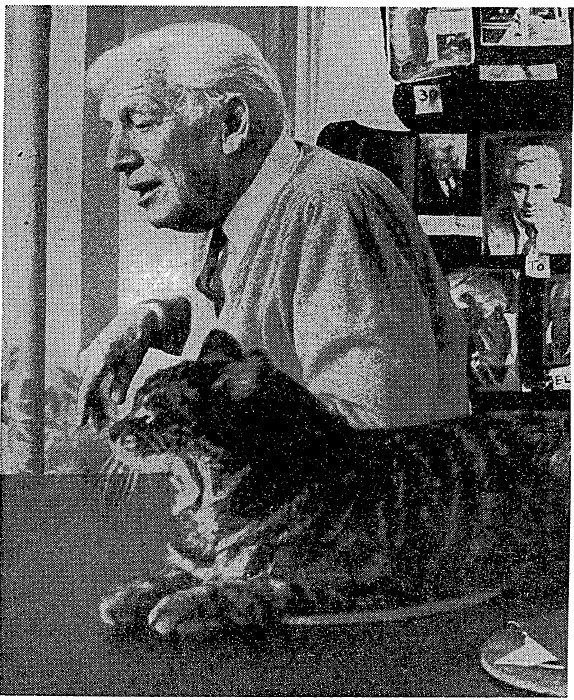
The article closes with a photo from
The New York Times (by Michael Evans)
Max Eastman, with his tabby Twiggy, during the interview at his home on West 13th Street.
>

“Defeat of the Communists,” in The New York Times (January 14, 1874)

Here's another account from the mainstream New York press -- this time, from the New York Times -- on the New York "Committee of Safety" and on the police attack on labor protesters in Tompkins Square. Like the previously posted stories from the Herald, the paper treated the protest as a project of "The Communists," in the midst of the United States' first great Red Scare. Also notable here is an early press appearance for Justus Schwab, here arrested with a red flag around his waist, later known and beloved by the Anarchist community in New York City as the owner of a "Beer-Hole" on First Street, which provided a meeting-place for radicals, political refugees, writers and artists that Emma Goldman remembered as "the most famous radical center in New York."

Here's the story, printed in the New York Times, on January 14, 1874.

>

DEFEAT OF THE COMMUNISTS

>

THE MASS-MEETING AND PARADE BROKEN UP.

>
ENCOUNTER BETWEEN THE MOB AND THE POLICE--ARREST OF RIOTERS.
>

>

The Police Commissioners wisely refused permission to the Communists to parade yesterday. There would have been no objection to an honest working men's parade, but the great majority of the working men, through their acknowledged representatives, disclaimed all connection with the projection display, and it was therefore considered unadvisable to permit a few malcontents to disturb the peace of the City. The events of yesterday sufficiently proved the wisdom of the prohibition, and the bad spirit that unfortunately is rife among the more worthless sections of the community. In spite of the refusal it was stated early in the day that the meeting would be held, and by 10 o'clock Tompkins square and vicinity were occupied by perhaps 3,000 persons of the lowest class, most of whom, however, were probably there out of idle curiosity. At 10:15 the Police, under Commissioner Duryee and Capts. Walsh, Murphy, Tynan, and Allaire, with platoons from their respective precincts, the Seventeenth, Eleveneth, Eighteenth, and Twenty-first, marched into and cleared the square, while a mounted squad scoured the streets in the vicinity. Capt. Walsh, with Sergts. Cass and Berghold and twenty-two men, made for the largest crowd, assembled round a banner inscribed The Tenth Ward Working Men's Organization, and here there was a fray, in which Sergt. Berghold had his head broken, and his assailants fared no better. They told their stories afterward at the Seventeenth Precinct Station-house, corner of Fifth street and Second avenue, where they were conveyed, and at which thenceforward the interest centered. Christian Meyer, who struck the Sergeant, confessed his misdeeds with much naivete, as he was sitting with head bandaged and a broken wrist in a sling in the officers' quarters. He said he was a painter by trade, belonging to an association with 3,000 members; that there were about 100 of them only present; that every one was armed in some way, his own weapon being a claw-hammer, with a thong to put his hand through; and that they had orders not to fight unless they were attacked. The Sergeant pushed him, so he obeyed orders and hit the Sergeant. Justus Schwab, another captive, who wore a red flag around his waist, said his father had served four years' imprisonment for riot at Frankfort, Germany: that he had been four years and eight months in the country, and fourteen weeks out of work. He thought every man should defend the State, and that the State should provide for every man. He thought the working men would triumph, and commenced to sing the Marseillaise, a performance which was checked. On Hofflicher, another leader, was found a somewhat elaborate Communistic badge. The vicinity of the station-house for several blocks was thronged until quite late in the afternoon, and in the Bowery as far down as Canal street, knots of men were gathered on the corners as late as 2 o'clock, waiting for the procession. In the vicinity of the Seventeenth Precinct Station-house the task of dispersing the multitude kept the officers well employed. There were incessant skirmishes in which clubs were judiciously applied with seasonable but not excessive severity, and prisoners were continually being brought in. The scrambles of the mob as the officers advanced were not unamusing; in fact, it seemed as if they rather enjoyed the exercise. The housetops and windows for blocks were crowded with patient spectators.

At 3:45 P. M. the prisoners were marched to Essex Market Police Court, and arraigned before Justice Flammer, who held them in default of $1,000 bail each. The schools soon after filled the streets with children and a more respectable class of citizens appeared. The trouble was evidently over. It was at no time beyond easy control. The forbearance and good humor of the Police were admirable. There were unpleasant incidents, however, which showed plainly that a neglected spark might have been fanned into a dangerous flame amid the unamiable passions abroad. Alderman Kehr, about noon, was passing through Fourth street, when he was recognized, and as the cry was raised, Here's an Alderman--go for him! he jumped on an Avenue A car, but was again recognized, the car boarded, and he had to jump off again and run for his life. Police Commissioners Charlick and Gardner visited the Seventeenth Precinct in a coupé at 4:30 P. M.

THE COMMITTEE OF SAFETY BEFORE THE MAYOR

>

The Mayor arrived at his office at noon. When he had taken his seat, his Secretary handed him a card containing the request, Mr. Leander Thompson would like to have an interview with his Honor. The Mayor recognized the name as that of a member of the Working Men's Committee of Safety, who had previously called upon him as a representative of the labor movement, and at whose request he had promised to address the laborers at Union square. The Mayor told his Secretary to admit Mr. Thompson, and the latter, accompanied by Messrs. John McMichael, George Buck, John Halbert, and Luceen Saniel, entered the office. Gen. Duryee, the Police Commissioner, was in an adjoining chamber, and, the moment Thompson entered, the Mayor called him to his side.

Well, gentlemen, said the Mayor, I am ready to hear what you have to say.

Mr. Thompson, in response, said the deputation represented the Committee of Safety, and they had called to escort his Honor to Tompkins square where, they hoped, he would address the people.

Mayor Havemeyer--I have heard what occurred this morning, and I do not desire to address crazy or excited people, who might be anxious to send brickbats flying.

Mr. Thompson--The people would like to hear your views. We will take you in a carriage. The working men are a peaceable and orderly class. They made an attempt to meet and express their views and were forcibly ejected by the Police, who clubbed and trampled upon them.

Mr. McMichael here stepped forward and said, Mr. Mayor, I hope you will come with us. We promised the people that you would speak to them, and they will be much disappointed if you do not. The meeting this morning was intended to be peaceable and orderly, but the Police interfered and clubbed every one they met. there were 20,000 persons in the square and its vicinity, and they were driven back without cause. I believe that it is absolutely necessary for you to come up and speak to the working men. They are very much excited about the treatment they have received from the Police, and consequences which we would wish to avert may follow if they are not spoken to.

Gen. Duryee interposed here. He said that all law-abiding citizens would act peaceably, and that he did not believe there would be any further trouble. But, resumed Mr. McMichael, the Police treated the meeting most mercilessly. Without a moment's warning they clubbed them off the ground.

Gen. [sic]Duryea[/sic], (warmly)--No, Sir; the Police did not act until a man came forward and struck a Sergeant on the head with a heavy hammer, which he had rigged so completely that it was taken from him with difficulty. Then an attack was made upon a Captain, so that it was time to disperse the crowd.

Mr. Thompson--The Park Commissioners gave us a permit to meet in Tompkins square, and they rescinded it last night, so that we had no time to tell the people to keep away.

Mr. McMichael--The meeting was intended to be peaceable: we promised the people that you would address them, and it is necessary for something to be done to allay the feeling that exists.

Mayor Havemeyer--I would have addressed the working men to-day if they carried out the programme they submitted to me. They agreed to march from Tompkins to Union square, and I told you that I would speak to them before they were dismissed at the latter place. Instead of doing what they agreed to do, they held a mass-meeting at Tompkins square without authority.

One of the deputation here remarked that the programme was changed on the previous night, so as to enable the working men to hear addresses.

Mr. Thompson--Our original intention was to march down to the City Hall, so as to see the authorities about getting employment.

Commissioner Duryee--But the Police Commissioners had to forbid that, because a large procession would interfere with business in the crowded thoroughfares below Canal street.

Mr. Halbert--This is a diversion. We desire to know if your Honor will come with us to address the working men.

Mayor Havemeyer--I must leave the matter to Commissioner Duryee.

Commissioner Duryee--I think it would be unadvisable for you to go. Let these gentlemen come again, and I am sure that all that can be done for the unemployed will be done by the City.

Mr. McMichael--We have been denounced by the press without cause. We have been called Communists, and our objects have been misrepresented. All we want is work.

Mayor Havemeyer--Well, there is one difficulty in the way. The market in this City is glutted with labor, and men will not work unless they can get the price they ask. I believe that there is work enough for everybody, but not at the wages demanded. (To Mr. McMichael.) What is your business?

Mr. McMichael--I am a painter.

Mayor Havemeyer--Well, many a man who can't, at the present rates, get his house painted for less than $300 would willingly give $200 to have it done. But, as he has got money, he can afford to wait until he can have the painting done at the sum he wishes to pay for it.

Mr. McMichael--It is necessary to get good prices to live now.

Mr. Thompson--The working men can't demand employment from private parties, so they must demand it from the Government.

Mayor Havemeyer--It is not the purpose or object of the City Government to furnish work to the industrious poor. That system belongs to other countries, not to ours. We can't tear down the City Hall so as to furnish work to the unemployed. We have to open streets and proceed with other works such as are rquired, and it takes time to authorize these according to law.

Mr. Thompson--But is it not the duty of the Government to furnish rations to starving men and their families?

Mayor Havemeyer--I agree with you that rations should be furnished to those who need them, and I am ready to advance a movement of that kind to the full extent of my power. The people of this City are too large-hearted to allow any person to suffer from starvation.

Mr. Thompson--Well, perhaps it's better for your Honor not to come with us to-day; so we shall not urge you. But we must see the people, lest they should blame us for not bringing you to Tompkins square. Will you (turning to Commissioner Duryee) give us a letter to the other Commissioners, so that we may procure a pass to enter Tompkins square. If we don't get a pass, we'll get clubbed by the Police.

Commissioner Duryee--There is no necessity for a note. See Commissioner Smith. You can easily see him.

The deputation then left. Immediately after they had retired, the Mayor said: I am in favor of raising subscriptions from merchants and others, so as to alleviate any suffering that may exist among working men and their families. Money would be soon forthcoming for the purpose, and a hall could be hierd and a clerk engaged to serve out rations of all kinds to the hungry. Money could also be advanced to those who were unable to pay their rent.

THE RIOTERS IN COURT.

>

Essex Market Police Court was particularly lively yesterday afternoon when Capt. Walsh, of the Seventeenth Precinct, assisted by twenty-five patrolmen marched in the prisoners whom they had arrested for riotous conduct around Tompkins square. The would-be Communists looked dogged and obstinate, evidently thinking that they would be at once discharged. They were considerably disappointed, however, when it was made known to them that the full penalty of the law would be meted out to them. They all expected friends would come forward and exert mysterious influence in their favor, but their expectations were all in vain. Some few of them, more impudent than others, said, Oh, the Judge dare not do anything to us; we are too powerful, and the people would tear down the prison. After the ordinary business had been disposed of, Justice Flammer directed the prisoners in charge of Capt. Walsh to be brought before him. The rioters were then all marched up to the desk, and formal complaints were entered against every one of them, charging them with assault and battery and riotous conduct. Justice Flammer, after the complaints of the officers were taken, committed all the prisoners, in default of $1,000 bail each, to stand their trial. They were all taken into the prison, and when there were visited by a Times reporter. They appeared only to be realizing the fact that they had committed very serious offenses against the law, and many of them regretted that they had ever been drawn into joining the demonstration.

Sources

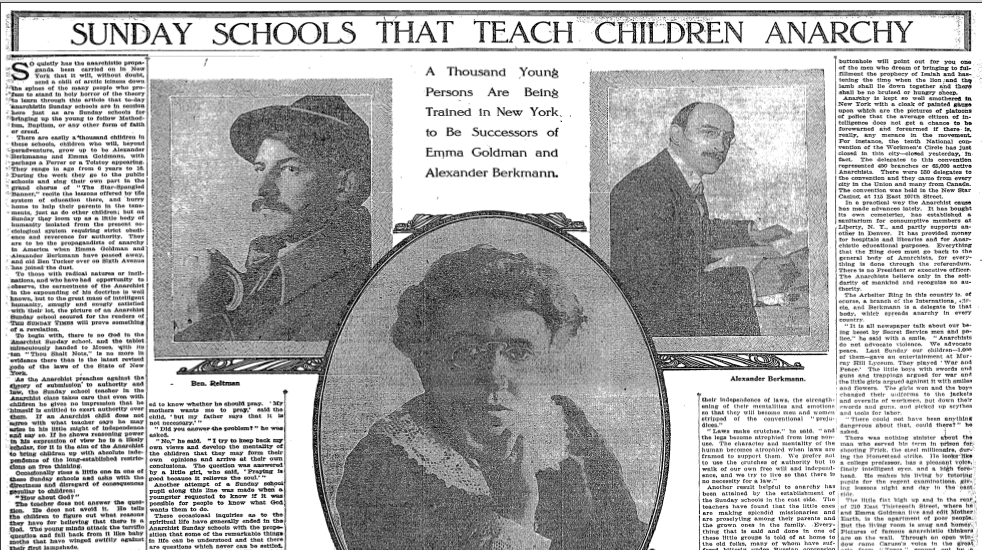
“Sunday Schools That Teach Children Anarchy,” from the New York Times (May 8, 1910)

Here's some more on mass-media reception of Anarchism during the early 20th century: a strange little piece from the Sunday New York Times magazine from May 8, 1910, on Anarchist Sunday schools in New York, focusing on the Ferrer Sunday School taught by Alexander Berkman. The Sunday schools were part of the large network of schools, cultural spaces and other institutions organized by Anarchists in large cities like New York during the early 20th century. (Like most Anarchistic educational projects, the Sundays were closely associated with the Modern School Movement and the thought of Francisco Ferrer). Either of the writer of the article, or his editor, couldn't quite seem to decide whether they wanted this story to be a straight interview of Berkman and a description of how the Sunday Schools were operated, or whether they wanted another cookie-cutter Anarchist-menace scare story.

SUNDAY SCHOOLS THAT TEACH CHILDREN ANARCHY

A Thousand Young Persons Are Being Trained in New York to Be Successors of Emma Goldman and Alexander Berkman.

So quietly has the anarchistic propaganda been carried on in New York that it will, without doubt, send a chill of arctic iciness down the spines of the many people who profess to stand in holy horror of the theory to learn through this article that to-day anarchistic Sunday schools are in session here just as are Sunday schools for bringing up the young to follow Methodism, Baptism, or any other form of faith or creed.

>

There are easily a thousand children in these schools, children who will, beyond peradventure, grow up to be Alexander Berkmanns and Emma Goldmans, with perhaps a Ferrer or a Tolstoy appearing. They range in age from 6 years to 16. During the week they go to the public schools and sing their own part in the grand chorus of "The Star-Spangled Banner," recite the lessons offered by the system of education there, and hurry home to help their parents in the tenements, just as do other children; but on Sunday they loom up as a little body of humanity isolated from the present sociological system requiring strict obedience and reverence for authority. They are to be the propagandists of anarchy in America when Emma Goldman and Alexander Berkmann have passed away, and old Ben Tucker over on Sixth Avenue has joined the dust.

To those with radical natures or inclinations, and who have had opportunity to observe, the earnestness of the Anarchist in the expounding of his doctrine is well known, but to the great mass of intelligent humanity, smugly and snugly satisfied with their lot, the picture of an Anarchist Sunday school secured for readers of The Sunday Times will prove something of a revelation.

To begin with, there is no God in the Anarchist Sunday school, and the tablet miraculously handed to Moses, with its ten Thou Shalt Nots, is no more in evidence there than is the latest revised code of the laws of the State of New York.

As the Anarchist preaches against the theory of submission to authority and law, the Sunday school teacher in the Anarchist class takes care that even with children he gives no impression that he himself is entitled to exert authority over them. If an Anarchist child does not agree with what teacher says he may arise in his little might of independence and say so. If he shows reasoning power in his expression of view he is a likely scholar, for it is the aim of the Anarchist to bring children up with absolute independence of the long-established restrictions on free thinking.

Occasionally rises a little one in one of these Sunday schools and asks with the directness and disregard of consequences peculiar to children:

How about God?

The teacher does not answer the question. He does not avoid it. He tells the children to figure out what reasons they have for believing that there is a God. The young minds attack the terrific question and fall back from it like baby moths that have winged swiftly against their first lampshade.

The largest of the Sunday schools is in Avenue A. It is called the Ferrer Sunday School, and was, until the killing of the Spanish philosopher, known as the Radical Sunday School. How the name was changed will prove a story that may stand out with striking novelty in the child life of New York to-day. It shall be told a little later in this article.

The Ferrer Sunday School is conducted by Alexander Berkmann. It has about eighty members and is in two classes. It meets on Sunday between 10 in the morning and noon. The youngest child is 7.

Berkmann has no laid-out system of teaching, depending on his comprehension of the psychology of the group at the time of the gathering. There are no rules. A song may be sung in chorus, a song dealing with freedom of mankind and hate for oppression. Some of the children may have learned by heart a poem or a fragment of an anarchistic argument and these provide recitations. The training of the mind anarchistically is then begun.

Berkmann, in a talk with a Times writer, in the office of Mother Earth, the Anarchist magazine, gave a sample of this teaching.

This was his talk to his Sunday school on Sabbath after the execution of Ferrer.

Once a single human being was swept from the sea to the shore of an island where there lived no human beings. There he found a great flock of sheep. He studied them and noticed that some of them were very powerfully built and finely fed. Some had even attained the strength and ferocity of wolves. But there were a great many of the sheep that were lean and worn. They were hungry and had been trampled down and hurt.

The man thought that he could so arrange it that these sheep, with little to eat and with bruises from being trampled, could be taught to care for themselves better and realize what the power of the strong and wolflike sheep had brought them to. He went among the sheep that suffered and began to point out to them what was the matter. The wolfish and strong ones heard of this and they turned upon the man and killed him.

When Berkmann finished this parable one of the children, a boy 18 years old, arose and said:

Why Mr. Berkmann, this story is just like the story of Ferrer's death.

The children were so impressed with the parable and the discussion which followed that the name of the school was then changed from the Radical Sunday School to the Ferrer Sunday School.

In the classes, said Berkmann, we generally use current events as subjects for discussion and study. For instance, one of our lessons was produced by the Hudson-Fulton Celebration in New York. The children of the east side saw a great deal of the sailors from the many men-of-war in the harbor. They saw the sailors of different nationalities entering and leaving the cafés, the best of friends, their arms about each other and acting like human brothers. The question naturally followed. Why should they be thus fond of each other and thus brotherly on land, and on sea be commanded to kill each other? They are brothers, and love each other, and there can be no fair reason for their slaying each other.

A man who had been raised in one of the old credal beliefs with care but who had come to be an agnostic in middle life once told the writer than when he realized that his religion had gone from him he felt that what he called reason had stepped into a nursery, and, like a willful bully, had gathered up the toys of a child sitting there and had destroyed them because he considered them useless. He considered the change from belief to agnosticism the tragedy of his life. The figure may be applied to thinking grown-ups easily, but it is hard to think of applying it to a child. And yet in the Anarchist Sunday school the tragedy of the destroyed toys is not infrequently enacted.

The pupil of the Anarchist Sunday school is taught to reason. The teacher only serves to direct their attention to a problem.

One child, said Berkmann, wanted to know whether he should pray. My mothers wants me to pray, said this child, but my father says that it is not necessary.

Did you answer the problem? he was asked.

No, he said. I try to keep back my own views and develop the mentality of the children that they may form their own opinions and arrive at their own conclusions. The question was answered by a little girl, who said, Praying is good because it relieves the soul.

Another attempt of a Sunday school pupil along this line was made when a youngster requested to know if it was possible for people to know what God wants them to do.

These occasional inquiries as to the spiritual life have generally ended in the Anarchist Sunday schools with the proposition that some of the remarkable things in life can be understood and that there are questions which never can be settled. The mental attitude of the children might be put in this way: We are not certain whether there are grounds for the belief that we should pray.

That, of course, leaves the question well in the field of agnosticism. The teacher of anarchy does not, with the children, declare that there is no God. Nor does he say that there is a God. The Sunday school class goes frequently to the Museum of Natural History, to Central Park, to the Zoological Gardens, and other places where, with the teacher, nature is studied.

The Ferrer Sunday school is only one of about fifteen similar schools in the greater city. Wherever the local groups of Anarchists can handle their own Sunday schools, carrying on the propaganda with literature, letters, lectures, &c., they do so without asking aid of others. When they cannot the State group helps. There is no central or superior group. Each has its own autonomy, although they all work to develop their principles of solidarity and mutual aid.

There are frequently conventions of the Sunday school teachers. Those who have classes get together and exchange experiences and ideas. In this city the Anarchists know that the fulfillment of their vision is afar, and they are already sowing their seed in the young and new fields that a generation of their kind may take hold of the propaganda when the present generation has withered and fallen.

These little Anarchists are being trained to believe in no authority. As Mr. Berkmann put it, everything is being done for them to aid them in the development of their independence of laws, the strengthening of their mentalities and emotions so that they will become men and women stripped of the conventional prejudices.

Laws make crutches, he said, and the legs become atrophied from long non-use. The character and mentality of human becomes atrophied when laws are framed to support them. We prefer not to use the crutches of authority but to walk of our own free will and independence, and we try to live so that there is no necessity for a law.

Another result helpful to anarchy has been attained by the establishment of the Sunday schools in the east side. The teachers have found that the little ones are making splendid missionaries and are proselyting among their parents and the grown ones in the family. Everything that is said and done in one of these little groups is told of at home to the old folks, many of whom have suffered bitterly under Russian oppression and who have revolution deep in their hearts. They write letters to the Anarchist teachers and get replies. They discuss the views expounded at home by their children and many of them become radicals and join the Anarchist groups.

The Anarchists also spread their propaganda by establishing little libraries which they make easily accessible to all who want to study the theory.

In the spreading of the propaganda among the children the littlest are not overlooked. There are some as young as six years of age who are getting kindergarten lessons in anarchy. One of these lessons is the lesson which preaches to a boy of health and strength at the age of six that he should not strike or abuse a boy who is not as strong as he is but should help him because he needs help. That is the very heart of the kindergarten lesson.

All of this work is done in what is called the Workmen's Circle. The Circle is the general group and is known as the Arbeiter Ring. A little white enamel badge with the letters A. R. in the buttonhole will point out for you one of the men who dream of bringing to fulfillment the prophecy of Isaiah and hastening the time when the lion and the lamb shall lie down together and there shall be no bruised or hungry sheep.

Anarchy is kept so well smothered in New York with a cloak of painted gauze upon which are the pictures of platoons of police that the average citizen of intelligence does not get a chance to be forewarned and forearmed if there is, really, any menace in the movement. For instance, the tenth National convention of the Workmen's Circle has just closed in this city--closed yesterday, in fact. The delegates to this convention represented 450 branches or 65,000 active Anarchists. There were 550 delegates to the convention and they came from every city in the Union and many from Canada. The convention was held in the New Star Casino, at 115 East 107th Street.

In a practical way the Anarchist cause has made advances lately. It has bought its own cemetaries, has established a sanitarium for consumptive members at Liberty, N. Y., and partly supports another in Denver. It has provided money for hospitals and libraries for Anarchistic educational purposes. Everything that the Ring does must go back to the general body of Anarchists, for everything is done through the referendum. There is no President or executive officer. The Anarchists believe only in the solidarity of mankind and recognize no authority.

The Arbeiter Ring in this country is, of course, a branch of the International Circle, and Berkmann is a delegate to that body, which spreads anarchy in every country.

It is all newspaper talk about our being beset by Secret Service men and police, he said with a smile. Anarchists do not advocate violence. We advocate peace. Last Sunday our children--1,000 of them--gave an entertainment at Murray Hill Lyceum. They played War and Peace. The little boys with swords and guns and trappings argued for war and the little girls argued against it with smiles and flowers. The girls won and the boys changed their uniforms to the jackets and overalls of workmen, put down their swords and guns, and picked up scythes and tools for labor.

There could not have been anything dangerous about that, could there? he asked.

There was nothing sinister about the man who served his term in prison for shooting Frick, the steel millionaire, during the Homestead strike. He looks like a college professor, has a pleasant voice, finely intelligent eyes, and a high forehead. He makes his living by tutoring pupils for the regent examinations, giving lessons night and day in the east side.

The little flat high up and in the rear of 210 East Thirteenth Street, where he and Emma Goldman live and edit Mother Earth, is the apartment of poor people. But the living room is snug and homey. Pictures of famous anarchistic thinkers are on the wall. Through an open window came Caruso's voice in the great aria from Tosca, ground out by a phonograph, as Berkmann talked with the Times man. It was a warm combination, but the night was warm, and we were glad for the breeze that swept the little place however burdened it might be.

We teach no ism, he said, harking back to the Sunday schools. Our aim is to develop character and mentality in the child. We try to make them think, criticise, and feel.

We want their emotional and intellectual natures developed. We want to make them men and women absolutely free of the old restrictions. We hope that they will grow up with the spirit of solidarity and co-operation in them. We try to teach them that in and out of school.

We try to teach them ethical right and reason. Our Radical Boys' Literary Club, boys about 13 or 14 years old, hold meetings after school, and they run their organization just as the grown people do. They have advanced to where they need no help from their elders.

Among the grown Anarchists the cause is kept warm by fervid preachings in their publications. These are the weekly paper Frei Arbiter Stimme, with a circulation of 12,000; Mother Earth, with a circulation of 6,000; Freiheit, with 5,000 circulation, and Voine Listy, a Bohemian paper, with a circulation of 4,500.

There are nine large groups of the grown Anarchists in New York. These have regular meetings, and conduct the propaganda with lectures, debates, &c.

In the district from Fourteenth Street to the Battery east of Broadway are 850,000 people living. Here beats the heart of anarchy. Nearly all of these people are foreign born, the native born element being insignificant in its percentage.

Forsyth Street, Chrystie, Cannon, Pitt, Columbia, Second Streets all have buildings in which are tiny halls that may be rented for a dollar or two for a wedding, a banquet, a lodge meeting, or a group meeting of Anarchists.

The man who lives awhile in this teeming corner of Manhattan does not take long to find out where he can go and hear all the anarchy he wants expounded. The writer once met in one of these little halls S. Yanofsky, the editor of the Frei Arbiter Stimme. A man with dreamy eyes, pointed beard, and nervous energy, he seemed to be looked up to as little short of a god by a clump of young men and women who were wating for him.

Yanofsky and Berkmann were both rounded up by the police after the Silverstein bomb explosion in Union Square in 1908, and as there was nothing against either of them nothing came of the call to Police Headquarters. Yanofsky, when asked by the writer what he thought of Silverstein's act, replied:

The man who commits a violent deed, if he is not mad, is desperate. Violence never did any good for anarchy. All government is a form of violence. Suppose Silverstein had suffered personally--and his act was that of an impatient and ignorant man--what did he accomplish? He only made himself dead and gave the chance to the enemies of anarchy to spread their calumnies. He only helped them to kill of the chances of gaining liberty.

Berkmann was a little clearer on the matter of violence and anarchy.

If a Republican or Democrat should throw a bomb or kill another, he said, the Republican Party or the Democratic Party would not be blamed for it. When an Anarchist does a thing like that we frankly say that anarchy did not inspire it, but that conditions of inequality and injustice caused the crime. To stop the crime, stop the cause. Anarchy is for justice and freedom. It cannot be blamed for individual acts of violence.

Among the favorite east side speakers for anarchy, besides Yanofsky and Berkmann, is Dr. Ben Reitman, whose method is to stir up the hearers with fiery sentences depicting the wrongs resulting from the present order of things. He with the others believes that anarchy is gathering strength, and will continue to gather it and will prove a living force in the slow movement of society through the ages.

Review of C. L. James’s The French Revolution, from the New York Times (April 25, 1903)

We've been spending some time lately gathering material on C. L. James (1846-1911), the prolific but reclusive Anarchist pamphleteer and song-writer of Eau Claire, Wisconsin. James was something of an intellectual heavy in his day, and maintained frequent correspondence with (among others) The Alarm, Liberty, Free Society and Mother Earth, but he has since been almost entirely forgotten. Well, if the Fair Use Repository is good for anything, hopefully it is providing a platform for some diligent un-forgetting.

Along with a steady stream of pamphlets and articles, James wrote a book-length History of the French Revolution; for to-day's post, we have a very mildly positive review of the book that ran in the New York Times, of all places, on April 25, 1903. Well, it's certainly a kinder review than some he got in the Anarchist press. In any case, here we are.

The French Revolution

New York Times, April 25, 1903

History of the French Revolution. By C. L. James. Pp. 343. Cloth 8vo. Chicago: Abe Isaac, Jr.

A sketch of the French Revolution by a theoretical Anarchist is likely to have whatever interest attaches to a peculiar point of view. Mr. James seems to be a theoretic Anarchist, and his book has the special interest that might be expected of such a work. It is, in fact, a readable essay, for the most part moderate in expression, usually distinguished by lucidity of style, and apparently based on wide reading. After that the book is a piece of special pleading. Mr. James's method is not to exult over the bloodshed and madness of the Revolution, rarely to defned, though often to excuse, the atrocities of the time.

The Reign of Terror he regards as a dreadful period, and the Government of that time one of the worst that the world has known, but one of the strongest. He thinks the idyllic time of the revolution was the period of a year or more before the execution of the King, when France bordered close upon true anarchy, being almost without government. This opinion, as might be expected of an Anarchist, Mr. James is fond of repeating. He also declares that the influential men of the Revolution were not Socialists or Communists. Even while he condemns the government of the Jacobins, and many of their tyrannical measures, as a consistent Anarchist must, he is anxious to find acts of theirs to praise, and he is not often struck with the absurdities of the time. But perhaps Mr. James with all his keenness is a little defective in the sense of humor.

The attitude of the author is best illustrated by concrete examples. He appreciates the virtues of Louis XVI., and thinks imprisonment would have been better than death in his case, but believing him to have been guilty of the crimes of which he was convicted, is not struck with the travesty of justice implied in a trial by Judges who were constantly under the eyes and influence of an outspoken populace bitterly hostile to the accused. The Queen he thinks to have been guilty also of treason, but he is moved to generous disgust at the revolting charges of Hébert. Nevertheless he hardly permits himself one expression of pity for her fate, though he thinks her death a political mistake. The September massacres, the atrocities of Lyons and of Nantes he does not defend, but impliedly excuses by citing parallels in the doings of settled governments. This last is his favorite method of excuse, and it is sometimes effective. He pities the Girondists, but thinks they brought upon themselves their hard fate. Of Danton's end he says: Thus died, in the noblest of causes, the best champion of freedom whom the crisis of his time produced. Robespierre he does not defend so earnestly as do some recent students of the period, possibly because he cannot forgive Robespierre's ambition to be dictator. Marat's demand for 200,000 heads, though repeated in open convention, Mr. James thinks hardly more than a piece of insincere bravado. He pronounces the terrible doctor of the sewers the most misrepresented man in the revolution.

This book is well worth reading, if only that one may see how hard it is for the historian, however intelligent, to do much more than make ex parte statement of his case. It is well, however, that we should have such a statement from the revolutionary side, for the larger part of what has been written on the subject in English deals with it from the very opposite point of view.

“To Drive Anarchists Out of the Country,” from the New York Times (March 4, 1908)

In line with some of our other recent material from the anti-immigrant and anti-Anarchist panic of the 19-aughts, here is a long front-page story from the New York Times in 1908, in which the Times declared that The United States has declared open war on Anarchists. The form that the war would take was a mass crackdown on immigrants -- one of the first major immigration enforcement actions in United States history -- in order to round up and deport Anarchists with radical political beliefs.

TO DRIVE ANARCHISTS OUT OF THE COUNTRY


Secretary Straus Orders Immigration Men to Co-operate with Police in Locating Criminals.


INDORSED BY ROOSEVELT


Added Precautions to be Taken in Excluding Aliens--Three Assassinations Were Plotted in Chicago.


Special to The New York Times.

WASHINGTON, March 3.--The United States has declared open war on Anarchists. As a result of the great increase in crime and the growing boldness of those who are enlisted under the red flag, Commissioners of Immigration and immigrant Inspectors have been instructed by Secretary Straus of the Department of Commerce and Labor to ally themselves with the police and detectives of the cities and aid in putting an end to terrorism. The order was issued to-day, and is said to have the hearty indorsement of President Roosevelt.

Secretary Straus orders that the immigration authorities shall take steps necessary to securing the co-operation of the police and detective forces in an effort to rid the country of alien Anarchists and criminals falling within the law relating to deportation.

Secretary Straus's Order.

The order of Secretary Straus follows:

To all Commissioners of Immigration and Immigrant Inspectors in charge: It is hereby directed that, with a view to promptly obtaining definite information with regard to alien Anarchists and criminals located in the Untied States, you shall confer fully with the Chief of Police or the Chief of the Secret Service of the city in which you are located, furnishing such official with detailed information with regard to the inhibition of that statute against aliens of the criminal classes, explaining the powers and limitations imposed by said statute upon the immigration officials with respect to such persons.

You should call to the attention of the Chief of Police or Chief of the Secret Service the definition of Anarchist contained in Sections 2 and 38 of the act of Feb. 20, 1907, and the provisions of Section 2 placing within the excluded classes persons who have been convicted of or admit having committed a felony or other crime or misdemeanor involving moral turpitude, pointing out that if any such person is found within the United States within three years after landing or entry therein he is amenable to deportation under the provisions of Section 21 of said act.

The co-operation of said officials should be requested, making it clear that in order that any particular Anarchist or criminal may be deported, evidence must be furnished showing (1) that the person in question is an alien subject to the immigration acts; (2) that he is an Anarchist or criminal as defined in the statute; (3) the date of his arrival in the United States, which must be within three years of the date of his arrest; (4) the name of the vessel or of the transportation line by which he came, if possible, and (5) the name of the country whence he came, the details with respect to the last three items being kept at the various ports of entry in such a manner as to be available if information is furnished with respect to the Anarchist's name, the date of his arrival, and the port of entry.

It is desired that the above indicated steps shall be taken at once and that no proper effort shall be spared to secure and retain the co-operation of the local police and detective forces in an effort to rid the country of alien Anarchists and criminals falling within the provisions of the statute relating to deportation.

Uneasy Over Anarchy's Spread.

The Administration has viewed with increasing uneasiness the spread of Anarchy and Socialistic teachings. The threats made against citizens of wealth and position are becoming more numerous with every month. The attempt to kill the Chief of Police of Chicago, the riot in Philadelphia following the dispersal of an Anarchistic meeting, and the threats made against clergymen have brought the Government to a realization that something must be done to make life and property more secure.

With the activity of the immigration authorities and the police in running down criminals in the United States, there will be taken added precautions against admitting to the country any more of the same class. The examination of the hordes of aliens that come yearly to these shores will be made so severe that it will in the future partake of the nature of an inquisition. The Government is beginning to realize that it has been employing too lax methods in the past.

A case in point, they say, is the presence in this country of Emma Goldman. This woman is declared to be a firebrand and an Anarchist of the most rabid type. She went abroad some months ago, and at that time it was openly stated that she would not be readmitted to the country. In spite of these declarations Miss Goldman is back again in the United States spreading the propaganda of revolutionary Socialism.

It is cases such as these, in the opinion of officials, that lend encouragement to the vicious element. The laws, in the first place, are held to be too lenient, and secondly, they are not administered with the severity the situation demands. More stringent laws, coupled with emphatic application of them, are said to be the crying need of the time.

As the law now stands, an Anarchist may go about unmolested by the police after he has spent three years in this country and has not been connected with the perpetration of a crime in that time. He is immune from deportation. It does not matter whether the criminal is a citizen or not, he can legally resist all efforts to return him to the country from whence he came.

Possible to Exclude Anarchists.

It is possible, however, under the existing law to exclude Anarchists. The law declares that, among others, there may be excluded from the country anarchists, or persons who believe in or advocate the overthrow by force or violence of the Government of the United States or of all government or of all forms of law, or the assassination of public officials.

Section 20 of the Immigration act, which covers the exclusion of aliens, provides: That any alien who shall enter the United States in violation of the law shall, upon the warrant of the Secretary of Commerce and Labor, be taken into custody and deported to the country whence he came at any time within three years after the date of his entry into the United States.

Section 21 provides that in case the Secretary of Commerce and Labor shall be satisfied that an alien has been found in the United States in violation of this act, or that an alien is subject to deportation under any law of the United States, he shall cause such alien within the period of three years after landing to be taken into custody and returned to the country whence he came.

This makes it mandatory upon the Secretary to deport any alien Anarchist whom he may discover who has not been in the country three years.

General Enemies of Society.

In addition to these provisions, which ordinarily would cover the case of an Anarchist, a separate section dealing with enemies of society generally was included in the act. Section 38 says:

That no person who believes in or who is opposed to all organized government, or who is a member of or affiliated with any organization entertaining and teaching such disbelief in or opposition to all organized government, or who advocates or teaches the duty, necessity, or propriety of the unlawful assaulting or killing of any officer or officers, whether of specific individuals or of officers generally, of the Government of the United States, or of any other organized government, because of his or their official character, shall be permitted to enter the United States or any territory or place subject to the jurisdiction thereof.

This section shall be enforced by the Secretary of Commerce and Labor under such rules and regulations as he shall prescribe. That any person who knowingly aids or assists any such person to enter the United States or any territory or place subject to the jurisdiction thereof, or who connives or conspires with any such person or persons to allow, procure, or permit any such person to enter therein, except pursuant to such rules and regulations made by the Secretary of Commerce and Labor shall be fined not more than $5,000, or imprisoned for not more than five years, or both.

--The New York Times, March 4, 1908, pp. 1-2.

Emma Goldman Now Alien (New York Times, April 9, 1909)

This is a side column from Page 2 of the New York Times on April 9, 1909, reporting the U.S. Attorney's success in convincing a federal court to strip Emma Goldman of her citizenship, which she had gained by marriage to a naturalized citizen in 1887.

EMMA GOLDMAN NOW ALIEN.

Deprived of Rights of Citizenship by Disenfranchisement of Her Husband.
Special to The New York Times.

Buffalo, N.Y., April 8.--Judge Hazel, in the United States Court this morning, granted an order canceling the citizenship papers of Jacob A. Kersner. Through this order all rights of citizenship also are taken from Kersner's wife, who is none other than Emma Goldman, the woman leader of the Anarchists in this country, whose fiery teachings, it was charged by many, incited Leon Czolgosz to the assassination of President McKinley.

The order was granted upon motion of Special United States Attorney P. S. Chambers of Pittsburg, and the evidence upon which it was based was presented principally by Kersner's own father, who was subpoenaed from his home at Rochester.

Kersner obtained his citizenship documents in 1884, when the statutes governing such procedure were quite lax compared with the present laws. He was two years under age at the time. Three years later he married Emma Goldman. She was a foreigner herself, but by virtue of her marriage to a citizen she was clothed with the rights of citizenship. Emma was only a girl, then, and had barely begun the career that later connected her so closely with the Reds in the public eye.

--The New York Times (April 9, 1909), Page 2.