Fair Use Blog

Max Eastman Is ‘Sorry’ For Today’s Rebels (Alden Whitman, New York Times, Jan. 9, 1969)

Here is an article on Max Eastman and his reflections on the New Left in his old age. This article appeared in The New York Times of January 9, 1969 (p. 33).

Max Eastman Is 'Sorry' For Today's Rebels

By ALDEN WHITMAN.

One of the country's reigning radical writers and agitators of a half-century ago looked this week at today's young militants and found more to pity than to praise.

He is Max Eastman, editor of the Socialist periodical, The Masses, and its successor, The Liberator, in the years before and during World War I. Widely influential in left-wing and labor circles, these magazines printed articles by Mr. Eastman and by, among others, John Reed and Floyd Dell. Art Young and Robert Minor were among the cartoonists.

Twice Faced Trial

Because of antiwar articles in The Masses, Mr. Eastman was twice brought to trial amid nationwide publicity, charged with conspiracy to obstruct the draft. The charge was dropped after two Federal juries were unable to agree on a verdict.

I feel kind of sorry for these young rebels of today, he said in an interview last Saturday at his West 13th Street apartment that marked his 86th birthday. He was on his way from Martha's Vineyard, where he and his wife spend their summers, to a winter home in Barbados.

They have an emotion not unlike ours, he continued, running his fingers through a shock of fine, snow-white hair. They want to make a revolution but they have no ultimate purpose.

I have a certain emotional sympathy for them, but they are rather pathetic because they have no plan. They just seek a revolution for its ow sake.

By contrast, said Mr. Eastman, glancing from his padded chair around a room festooned with Christmas and birthday cards, We had a program and a purpose, which was to make over capitalism into Socialism, and it was based on an ideal and on an ideal and on an ideology.

With a vigor that belied his years, the ruddy-faced Mr. Eastman categorized the radicals of the New Left as the bohemian wing of the bourgeoisie, sons and daughters of the well-to-do, who have no real class affiliation and no alliances with the working class.

It is not possible, he said in slow, measured tones, to bring about a revolution--except on a class basis--unless by some sort of fluke.

Asked why today's rebels appeared to lack an ideology, he declared:

Socialism was once a plausible plan, but when Socialism failed completely and produced a totalitarian tyranny [in the Soviet Union under Stalin], it left social ideas without a theoretical basis.

Mr. Eastman stressed, though, that there were some similarities between rebels in 1969 and those of his era.

Mood Called the Same

The mood of militance is the same, he asserted, and so is the general rejection of convention. But many of today's restive youth are caught up in trivialities. Obscenity, for example.

Having broken with the Socialist movement (but I never considered myself a Marxist, not even in The Masses days in 1913) when his friend Leon Trotsky was read out of the Communist party by Stalin in 1926-27, Mr. Eastman made his own transition from radicalism to the Reader's Digest. He has been a roving editor for that publication since 1941.

The author and poet indicated hat his outlook for social change in the United States and the world was gloomy. He doubted, he said, that this country needs a revolution, or that one was possible either from the New Left or the Negro community. Negro militants, he said, are bound to raise hell, but they can't make a revolution.

We have to patch up the world as it is and accept it, although I don't feel very happy about it, Mr. Eastman said.

Like many writers, he has given no thought to retirement. Doubleday is to publish this spring a translation he made many years ago of Trotsky's account of Lenin's youth.

The manuscript, which Mr. Eastman had believed lost, turned up in the Harvard library a few years ago. It chronicles the Bolshevik leader's life up to when he joined the Russian revolutionary movement after becoming a lawyer in St. Petersburg, now Leningrad.

In addition, Mr. Eastman is collecting a number of essays and portraits of his contemporaries for publication soon. These, he remarked with a twinkle in his bluish eyes, are to be entitled Bull in the Afternoon and Other Essays.

The lead essay, a criticism of Ernest Hemingway's Death in the Afternoon, precipitated the famous set-to between the two authors.

Fresh in His Mind

That encounter, which took place in 1937 in the office of Max Perkins, an editor at Scribner's, was still fresh in Mr. Eastman's mind.

Hemingway shoved an open book against my nose, he recalled, and accused me of saying that he lacked virility. I grabbed him by the throat and threw him--or backed him up--over Perkins's desk and onto his back on the floor.

The two men's friendship, never thereafter the epitome of cordiality, is now largely a mellow memory for Mr. Eastman. In addition to the piece on Hemingway, Mr. Eastman plans to include his new book essays on H. L. Mencken, Bernard Berenson and Sherwood Anderson.

At 86, an author is still an author.

The article closes with a photo from
The New York Times (by Michael Evans)
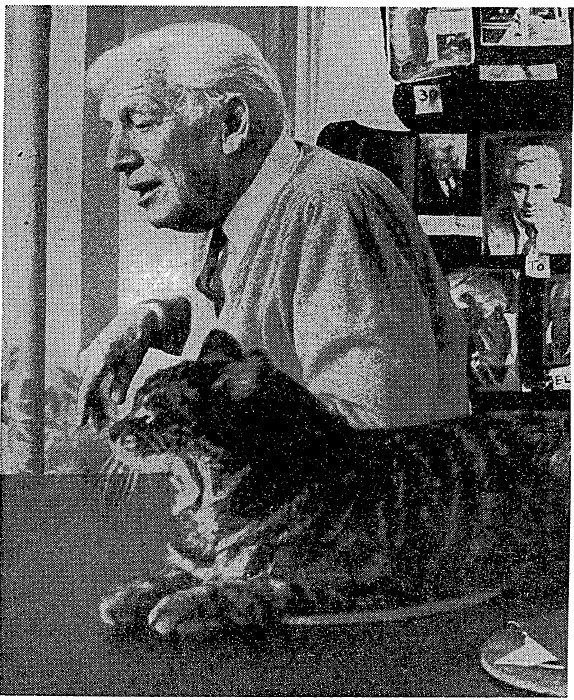
Max Eastman, with his tabby Twiggy, during the interview at his home on West 13th Street.
>

“Justus Schwab Mourned: Anarchists Forget Their Differences at His Funeral,” in the New York Times (December 21, 1900)

Yesterday's post mentioned Justus Schwab, a German-American radical and a fixture of the New York Anarchist milieu, who kept a radical "Beer-Hole" on First Street where Anarchists, socialists, writers, artists, and other radicals and misfits met to drink and talk into the night. Emma Goldman later described his saloon as "the most famous radical center in New York." Here is an item from the December 21, 1900 issue of the New York Times, on Schwab's death and his funeral, which brought together New York radicals across factional lines and putting aside schisms and personal breaks to celebrate his memory.

>

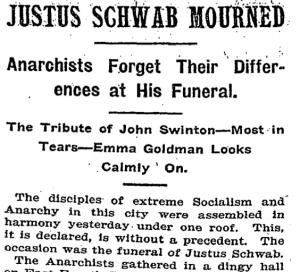
JUSTUS SCHWAB MOURNED

>

Anarchists Forget Their Differences at His Funeral.

>
The Tribute of John Swinton--Most in Tears--Emma Goldman Looks Calmly On.
>

>

The disciples of extreme Socialism and Anarchy in this city were assembled in harmony yesterday under one roof. This, it is declared, is without a precedent. The occasion was the funeral of Justus Schwab.

The Anarchists gathered in a dingy hall on East Fourth Street. All differences were forgotten, and there was not a single man or woman who gave evidence of any feeling other than sorrow at the loss of the dead disciple. At times during the speeches which were made over the body almost every one there broke down and wept. Dark, bearded faces that had worn a scowl of discontent for years were softened with grief, and men who had been bitter enemies of Justus Schwab while he was alive cried like children.

Emma Goldman, the woman Anarchist leader, who had been the dead man's closest friend, was the only one present who did not give some indication of emotion. She sat calmly throughout the ceremonies, although John Most, who had been opposed to Schwab for years, gave way completely to his grief several times.

The funeral services were held in the assembly room of the Labor Lyceum at 64 East Fourth Street. The body was taken from the room over the saloon at 50 First Street, where Schwab had lived, early in the day and placed on a bier in the middle of the assembly room. The coffin was open so that the face of the dead man could be seen, and coffin and bier were draped with flags. The emblem of Anarchy was wrapped around the coffin and thrown over the lower part of it, and flags from various labor unions hung below. There was a pile of flowers that brightened up the dark hall, arranged on a table at one end. There were wreaths from Cigar Makers' Union No. 90, from an Italian Anarchist society, and from the Social Science Club.

The funeral service was marked by the absolute absence of any religious ceremonial, and consisted of speeches by various friends of the dead man. The band of the Carl Sahm Club, which was stationed at one end of the hall, played a dirge that seemed to harmonize with the sombre surroundings, and the Lieber Tafel Singing Society, which the dead Anarchist had founded, sang Eventide. George Biederkapp, the author of a book of Socialist poems, recited an original poem eulogizing Schwab, entitled, The Storm Has Passed, and when he had taken his seat almost every one in the room was in tears. Alexander Jonas, a Socialist leader, made a short speech in German and was followed by John Swinton, who spoke in English.

I am entirely overcome, he said, when I attempt to speak of our dead brother. I have never known a man so self-sacrificing, so faithful, so noble.

John Most, who had been the leader of the Anarchist faction opposed to Schwab, was the next speaker. He spoke in German and in the most dramatic manner. When he had completed his speech he was evidently exhausted, and sank into a chair as the pall-bearers lifted the coffin and carried it out to the hearse, which was waiting for it.

As the hearse started slowly down Second Avenue, followed by a few carriages, nearly 2,000 people, many of them in tears, fell in line behind it. The procession passed by the little saloon where Schwab had lived and then proceeded slowly to the ferry at the foot of East Houston Street. All along the route the windows of the tenements were filled with people. At the ferry the carriages followed the hearse and the Anarchists on foot dispersed quietly. The body was taken to Fresh Pond, L. I., for cremation.

Source

“Defeat of the Communists,” in The New York Times (January 14, 1874)

Here's another account from the mainstream New York press -- this time, from the New York Times -- on the New York "Committee of Safety" and on the police attack on labor protesters in Tompkins Square. Like the previously posted stories from the Herald, the paper treated the protest as a project of "The Communists," in the midst of the United States' first great Red Scare. Also notable here is an early press appearance for Justus Schwab, here arrested with a red flag around his waist, later known and beloved by the Anarchist community in New York City as the owner of a "Beer-Hole" on First Street, which provided a meeting-place for radicals, political refugees, writers and artists that Emma Goldman remembered as "the most famous radical center in New York."

Here's the story, printed in the New York Times, on January 14, 1874.

>

DEFEAT OF THE COMMUNISTS

>

THE MASS-MEETING AND PARADE BROKEN UP.

>
ENCOUNTER BETWEEN THE MOB AND THE POLICE--ARREST OF RIOTERS.
>

>

The Police Commissioners wisely refused permission to the Communists to parade yesterday. There would have been no objection to an honest working men's parade, but the great majority of the working men, through their acknowledged representatives, disclaimed all connection with the projection display, and it was therefore considered unadvisable to permit a few malcontents to disturb the peace of the City. The events of yesterday sufficiently proved the wisdom of the prohibition, and the bad spirit that unfortunately is rife among the more worthless sections of the community. In spite of the refusal it was stated early in the day that the meeting would be held, and by 10 o'clock Tompkins square and vicinity were occupied by perhaps 3,000 persons of the lowest class, most of whom, however, were probably there out of idle curiosity. At 10:15 the Police, under Commissioner Duryee and Capts. Walsh, Murphy, Tynan, and Allaire, with platoons from their respective precincts, the Seventeenth, Eleveneth, Eighteenth, and Twenty-first, marched into and cleared the square, while a mounted squad scoured the streets in the vicinity. Capt. Walsh, with Sergts. Cass and Berghold and twenty-two men, made for the largest crowd, assembled round a banner inscribed The Tenth Ward Working Men's Organization, and here there was a fray, in which Sergt. Berghold had his head broken, and his assailants fared no better. They told their stories afterward at the Seventeenth Precinct Station-house, corner of Fifth street and Second avenue, where they were conveyed, and at which thenceforward the interest centered. Christian Meyer, who struck the Sergeant, confessed his misdeeds with much naivete, as he was sitting with head bandaged and a broken wrist in a sling in the officers' quarters. He said he was a painter by trade, belonging to an association with 3,000 members; that there were about 100 of them only present; that every one was armed in some way, his own weapon being a claw-hammer, with a thong to put his hand through; and that they had orders not to fight unless they were attacked. The Sergeant pushed him, so he obeyed orders and hit the Sergeant. Justus Schwab, another captive, who wore a red flag around his waist, said his father had served four years' imprisonment for riot at Frankfort, Germany: that he had been four years and eight months in the country, and fourteen weeks out of work. He thought every man should defend the State, and that the State should provide for every man. He thought the working men would triumph, and commenced to sing the Marseillaise, a performance which was checked. On Hofflicher, another leader, was found a somewhat elaborate Communistic badge. The vicinity of the station-house for several blocks was thronged until quite late in the afternoon, and in the Bowery as far down as Canal street, knots of men were gathered on the corners as late as 2 o'clock, waiting for the procession. In the vicinity of the Seventeenth Precinct Station-house the task of dispersing the multitude kept the officers well employed. There were incessant skirmishes in which clubs were judiciously applied with seasonable but not excessive severity, and prisoners were continually being brought in. The scrambles of the mob as the officers advanced were not unamusing; in fact, it seemed as if they rather enjoyed the exercise. The housetops and windows for blocks were crowded with patient spectators.

At 3:45 P. M. the prisoners were marched to Essex Market Police Court, and arraigned before Justice Flammer, who held them in default of $1,000 bail each. The schools soon after filled the streets with children and a more respectable class of citizens appeared. The trouble was evidently over. It was at no time beyond easy control. The forbearance and good humor of the Police were admirable. There were unpleasant incidents, however, which showed plainly that a neglected spark might have been fanned into a dangerous flame amid the unamiable passions abroad. Alderman Kehr, about noon, was passing through Fourth street, when he was recognized, and as the cry was raised, Here's an Alderman--go for him! he jumped on an Avenue A car, but was again recognized, the car boarded, and he had to jump off again and run for his life. Police Commissioners Charlick and Gardner visited the Seventeenth Precinct in a coupé at 4:30 P. M.

THE COMMITTEE OF SAFETY BEFORE THE MAYOR

>

The Mayor arrived at his office at noon. When he had taken his seat, his Secretary handed him a card containing the request, Mr. Leander Thompson would like to have an interview with his Honor. The Mayor recognized the name as that of a member of the Working Men's Committee of Safety, who had previously called upon him as a representative of the labor movement, and at whose request he had promised to address the laborers at Union square. The Mayor told his Secretary to admit Mr. Thompson, and the latter, accompanied by Messrs. John McMichael, George Buck, John Halbert, and Luceen Saniel, entered the office. Gen. Duryee, the Police Commissioner, was in an adjoining chamber, and, the moment Thompson entered, the Mayor called him to his side.

Well, gentlemen, said the Mayor, I am ready to hear what you have to say.

Mr. Thompson, in response, said the deputation represented the Committee of Safety, and they had called to escort his Honor to Tompkins square where, they hoped, he would address the people.

Mayor Havemeyer--I have heard what occurred this morning, and I do not desire to address crazy or excited people, who might be anxious to send brickbats flying.

Mr. Thompson--The people would like to hear your views. We will take you in a carriage. The working men are a peaceable and orderly class. They made an attempt to meet and express their views and were forcibly ejected by the Police, who clubbed and trampled upon them.

Mr. McMichael here stepped forward and said, Mr. Mayor, I hope you will come with us. We promised the people that you would speak to them, and they will be much disappointed if you do not. The meeting this morning was intended to be peaceable and orderly, but the Police interfered and clubbed every one they met. there were 20,000 persons in the square and its vicinity, and they were driven back without cause. I believe that it is absolutely necessary for you to come up and speak to the working men. They are very much excited about the treatment they have received from the Police, and consequences which we would wish to avert may follow if they are not spoken to.

Gen. Duryee interposed here. He said that all law-abiding citizens would act peaceably, and that he did not believe there would be any further trouble. But, resumed Mr. McMichael, the Police treated the meeting most mercilessly. Without a moment's warning they clubbed them off the ground.

Gen. [sic]Duryea[/sic], (warmly)--No, Sir; the Police did not act until a man came forward and struck a Sergeant on the head with a heavy hammer, which he had rigged so completely that it was taken from him with difficulty. Then an attack was made upon a Captain, so that it was time to disperse the crowd.

Mr. Thompson--The Park Commissioners gave us a permit to meet in Tompkins square, and they rescinded it last night, so that we had no time to tell the people to keep away.

Mr. McMichael--The meeting was intended to be peaceable: we promised the people that you would address them, and it is necessary for something to be done to allay the feeling that exists.

Mayor Havemeyer--I would have addressed the working men to-day if they carried out the programme they submitted to me. They agreed to march from Tompkins to Union square, and I told you that I would speak to them before they were dismissed at the latter place. Instead of doing what they agreed to do, they held a mass-meeting at Tompkins square without authority.

One of the deputation here remarked that the programme was changed on the previous night, so as to enable the working men to hear addresses.

Mr. Thompson--Our original intention was to march down to the City Hall, so as to see the authorities about getting employment.

Commissioner Duryee--But the Police Commissioners had to forbid that, because a large procession would interfere with business in the crowded thoroughfares below Canal street.

Mr. Halbert--This is a diversion. We desire to know if your Honor will come with us to address the working men.

Mayor Havemeyer--I must leave the matter to Commissioner Duryee.

Commissioner Duryee--I think it would be unadvisable for you to go. Let these gentlemen come again, and I am sure that all that can be done for the unemployed will be done by the City.

Mr. McMichael--We have been denounced by the press without cause. We have been called Communists, and our objects have been misrepresented. All we want is work.

Mayor Havemeyer--Well, there is one difficulty in the way. The market in this City is glutted with labor, and men will not work unless they can get the price they ask. I believe that there is work enough for everybody, but not at the wages demanded. (To Mr. McMichael.) What is your business?

Mr. McMichael--I am a painter.

Mayor Havemeyer--Well, many a man who can't, at the present rates, get his house painted for less than $300 would willingly give $200 to have it done. But, as he has got money, he can afford to wait until he can have the painting done at the sum he wishes to pay for it.

Mr. McMichael--It is necessary to get good prices to live now.

Mr. Thompson--The working men can't demand employment from private parties, so they must demand it from the Government.

Mayor Havemeyer--It is not the purpose or object of the City Government to furnish work to the industrious poor. That system belongs to other countries, not to ours. We can't tear down the City Hall so as to furnish work to the unemployed. We have to open streets and proceed with other works such as are rquired, and it takes time to authorize these according to law.

Mr. Thompson--But is it not the duty of the Government to furnish rations to starving men and their families?

Mayor Havemeyer--I agree with you that rations should be furnished to those who need them, and I am ready to advance a movement of that kind to the full extent of my power. The people of this City are too large-hearted to allow any person to suffer from starvation.

Mr. Thompson--Well, perhaps it's better for your Honor not to come with us to-day; so we shall not urge you. But we must see the people, lest they should blame us for not bringing you to Tompkins square. Will you (turning to Commissioner Duryee) give us a letter to the other Commissioners, so that we may procure a pass to enter Tompkins square. If we don't get a pass, we'll get clubbed by the Police.

Commissioner Duryee--There is no necessity for a note. See Commissioner Smith. You can easily see him.

The deputation then left. Immediately after they had retired, the Mayor said: I am in favor of raising subscriptions from merchants and others, so as to alleviate any suffering that may exist among working men and their families. Money would be soon forthcoming for the purpose, and a hall could be hierd and a clerk engaged to serve out rations of all kinds to the hungry. Money could also be advanced to those who were unable to pay their rent.

THE RIOTERS IN COURT.

>

Essex Market Police Court was particularly lively yesterday afternoon when Capt. Walsh, of the Seventeenth Precinct, assisted by twenty-five patrolmen marched in the prisoners whom they had arrested for riotous conduct around Tompkins square. The would-be Communists looked dogged and obstinate, evidently thinking that they would be at once discharged. They were considerably disappointed, however, when it was made known to them that the full penalty of the law would be meted out to them. They all expected friends would come forward and exert mysterious influence in their favor, but their expectations were all in vain. Some few of them, more impudent than others, said, Oh, the Judge dare not do anything to us; we are too powerful, and the people would tear down the prison. After the ordinary business had been disposed of, Justice Flammer directed the prisoners in charge of Capt. Walsh to be brought before him. The rioters were then all marched up to the desk, and formal complaints were entered against every one of them, charging them with assault and battery and riotous conduct. Justice Flammer, after the complaints of the officers were taken, committed all the prisoners, in default of $1,000 bail each, to stand their trial. They were all taken into the prison, and when there were visited by a Times reporter. They appeared only to be realizing the fact that they had committed very serious offenses against the law, and many of them regretted that they had ever been drawn into joining the demonstration.

Sources

New York Herald, 18 January 1874: “The Communists of New York–Their Secret Meetings and Movements,” and “The Communists: Meeting to Arouse the Second Assembly District”

Here are a pair of stories from the New York Herald in 1874, on "The Communists" and their meetings. The stories are typical examples of mainstream journalism reporting on radical movements in the wake of the United States' first great Red Scare -- the reaction to the Red uprisings in France in 1871 and the proclamation of the Paris Commune. Although the communards had been conquered, massacred and exiled by the Versailles government years before in 1871, the economic depression following the Panic of 1873, and an upsurge in worker protests and labor organizing, left many mainstream papers panicked about the prospects for conspiracy and insurgency in the United States.

Many thanks to Jesse Walker for pointing me to this issue of the Herald.

These stories appeared on Sunday, January 18, 1874. First, on p. 6, the column advertising "To-Day's Contents of the Herald" includes the following item:

THE COMMUNIST SNAKE "SCOTCHED" NOT KILLED: AN ALARMING PRONOUNCEMENT! THEY "WILL HAVE BREAD!" -- Tenth Page.

More on that in a minute. But first, in another column on p. 6:

The Communists of New York--Their Secret Meetings and Movements.

That there exists in the city of New York a disturbing element known as the "Communists" was demonstrated on Tuesday last in Tompkins square, and again last night in Cosmopolitan Hall. Although frustrated in Tuesday's open attempt to defy the lawful authorities which forbade their assembling, or at least their parading the streets in procession, there is no knowing at what hour or by what preconcerted and secret action they may commit some overt act and cause widespread consternation among the community.

These dangerous conspirators against society are not confined to New York nor to Paris; they are spread the world over. They declare, as one of the prisoners arrested on Tuesday last did, that the red flag is their only flag; that they spit upon all other flags; that they demand equal rights in all things, the equalization of property, the apportionment of "good things," and "free love," as it is commonly known, in its broadest sense. They have no religion and no respect for person or station. In New York the body is controlled in a mysterious manner by an unseen so-called "Committee of Safety," only a few of whom have appeared upon the surface. The movements of this committee are as secret and mystical as those of any known secret organization. Their leaders attempt to cover their own peculiar objects and schemes by advocating--nay, "demanding"--the employment of laborers upon the public works. These laborers, it is known, are mostly Irish Catholics, and if by their demands they succeed in securing employment for this class of people they take all the credit therefor, and hope thereby to win the Catholic laboring element to their side and obtain their assistance in their machinations. In these ridiculous demands, however, they have thus far failed. And when the Irish Catholic laborers are made to realize the hideous conduct of these Communists during their reign of carnage and terror in Paris, when the highest prelate in their Church in that unfortunate metropolis--the beloved Archbishop Darboy--together with other venerated and venerable magnates of the Church, was savagely butchered by these frenzied semi-barbarians, and the sacred shrines of their churches ruthlessly robbed of their precious jewels and treasures, they shun, as they would a pestilence, all affiliation with these foes of Christianity and civilization as well as of law and order. Evidence of this may be gleaned from the fact that of the large number of arrests at Tompkins square on Tuesday not a single Irish Catholic was found among the number. And another significant fact may be mentioned here--that of all those arrested, with only two or three exceptions, none were either native born or adopted citizens or foreigners who had declared their intentions of becoming citizens; in short, the great majority were men who recognized only the "red flag" as the flag of their nationality, and who "spat upon all others." The Communists attempt to cajole the German laborers in the same way they have the Irish; but they to almost as great an extent have failed with them as with the Irish. It is even intimated that the Communists have threatened to burn schoolhouses in order to give employment in their reconstruction to both Irish and German laborers.

It may be asked, where does all the money come from to support the extraordinary operations of these men--men who work like machines, or as an engineer moves his locomotive, with people's passions for tramways? They must have money, though professedly poor and starving, for if allowed to appear in procession they are ready to make a gorgeous display of banners and legends, of regalia, gold shields and other paraphenalia that must have cost thousands of dollars. At their meetings, which are seldom held twice in the same place or at the same hour when the places are changed, they have a free lunch at which many a poor fellow, out of work and out of money, is glad to get the wherewith to appease the pangs of hunger. These cost money, and it is the best possible way for them to spend it. The leaders--the engineers of the "Committee of Safety"--do not seem to be very impecunious, one of them (if not of this, of some other similar, if not so radical an organization) exhibiting in his shirt bosom on a certain occasion a thousand dollar breastpin while shrieking for "bread or blood." The money to support all these things, we say, must come from some source, or may it not be here already? May not the booty of the plundered churches of Paris be now furnishing the material aid to carry on these nefarious projects--projects so menacing to the peace and safety of this whole community? It is known, as has been before intimated in this paper, that large amounts of precious stones, without setting, and concealed in balls of wax, together with numerous other treasures, the spoils of the Paris churches we refer to, were secretly conveyed to this country during the temporary but sanguinary régime of the Communists in Paris. Hence is it not reasonable to suppose that the product of these treasures of the sanctuaries is employed in the work of these incendiaries, conspirators and revolutionists?

We do not think that there is any immediate cause for serious alarm in regard to the operations of these desperate people; but it manifestly behooves the authorities to take such steps as will prevent their obtaining the upper hand in any single demonstrative movement they may undertake.

On the first column p. 10, the Herald carries its second story:

>

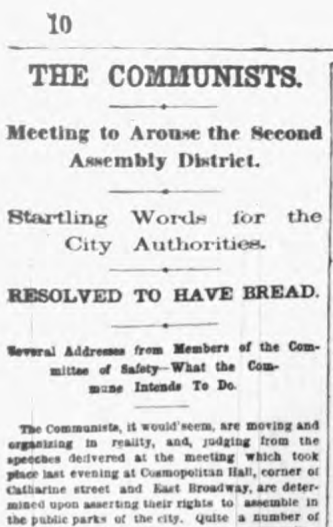
THE COMMUNISTS.

>

Meeting to Arouse the Second Assembly District.

>

Startling Words for the City Authorities

>

RESOLVED TO HAVE BREAD.

>
Several Addresses from Members of the Committee of Safety--What the Commune Intends To Do.
>

>

The Communists, it would seem, are moving and organizing in reality, and, judging from the speeches delivered at the meeting which took place last evening at Cosmopolitan Hall, corner of Catharine street and East Broadway, are determined upon asserting their rights to assemble in the public parks of the city. Quite a number of the organization were present, representing almost every nationality. Applause was freely given whenever any of the speakers alluded to the Police Commissioners or the police as tyrants and despots.

Citizen Banks

>

was on hand at an early hour, and as each newcomer made his appearance he would immediately rise and grasp him by the hand, and at the same time whisper to him in a subdued tone information of a secret character. About eight o'clock there were about sixty or seventy present. Citizen Banks then stepped up to the table at the further end of the room and called the meeting to order. He proposed that Mr. Roger Burke be requested to act as chariman. The motion was seconded and carried, and

Mr. Burke mounted the rostrum.

>

All eyes were now turned upon Citizen Burke, and as he prepared to deliver his address of thanks a faint applause greeted his ears. As soon as order was restored Citizen Burke delivered himself of hte following speech:--

Citizen Burke's Speech

>

Gentlemen--I am thankful to you for having elected me to this position. It is not the first time that I have held similar positions among workingmen. I am sorry to state that last evening one of our meetings was broken up by the police, and several of those present were "pulled." I am happy to be able to announce to you that every district in the city is undergoing a thorough organization. This district, however, is more behind than any other, and we must endeavor to protect our organization here also. The police have endeavored again to infringe upon our rights, for to-day, hearing of our proposed meeting this evening, they were sent around to dissuade the workingmen from putting in an appearance. I understand that at this very moment policement in citizens' clothes are placed around the building to watch us, and that detectives are also in our very midst prepared to note down every word we may give utterance to. The Committee of Safety desire, for the purpose of perfecting our organization, that every one present this evening step forward and transcribe his name upon the roll. At this juncture onf of the audience requested information of the speaker as to whether or not the police of New York city had been empowered to amend the constitution of the United States so as to prevent the right of free speech. This remark was received with applause by the entire assemblage.

Having concluded his remarks, Citizen Burke then introduced

Citizen Elliott.

>

Citizen Elliott announced the fact that the German wards were already thoroughly organized and that the only thing which remained to secure a thorough and effective organization was the enrolment of the English speaking wards. The proper manner of procedure, the speaker stated, for those in sympathy with the movement now on foot to redeem the workingmen was to perfect district and ward organizations throughout the entire city, the same as is done previous to the holding of the political elections. Rumors had gone abroad that the Committee of Safety had determined to resign their trust, but such was not the case. The

Committee of Safety

>

would always remain in active existence. The members of that committee had pledged themselves to remain true to the principles which led to their organization. They would never relax their efforts, but would work night and day to promote the great cause of the workingmen. Not one of them sought any office, and they were all pledged never to accept any. The Committee of Safety have, moreover, determined to carry the cases of the men now in custody who were arrested for participation in the meeting on Tuesday last before the State courts, and no labor nor expense would be spared to free them from bondage. On last Tuesday the country at large had seen a most dastardly outrage perpetrated upon the rights of the workingmen.

Commissioner Duryee

>

had charged his police upon inoffensive workingmen like so many "bulldogs" (Voice in the audience--"Shame! Shame!") When a demonstration is made again let the workingmen go out in large numbers so that the police or military will not dare to resist them. (Loud applause. I request that those who are present here this evening will, before they depart, come forward and sign the roll so that we can form a good nucleus to perfect a solid organization in this ward.

Citizen Banks

>

was then introduced. During the interval between the organization of the meeting and the conclusion of the speech of Citizen Elliot the audience was considerably increased by the entry of quite a number of prominent Communists.

Citizen Banks immediately opened his remarks by alluding to the outrage committed by the police on last Tuesday. He then continued in the following strain:--To-night, again, it appears to me that an attempt is being made to intimidate us from holding our meetings as citizens and workingmen, and a second outrage is being perpetrated upon us. We are denied the right of even meeting in peace and quietness in this hall. Police guard all the entrances, and detectives have been placed in our midst to watch our every movement. This I consider even a greater outrage than the one which was perpetrated on Tuesday last; for they have even busied themselves in warning the workingmen to keep away, telling them that if we met there would be trouble. The committee, however, have met here in defiance of the police. We are not to be terrified. We are not to be coerced into giving up our rights as citizens. Outrages such as these leave men no other remedy than military action and to be prepared militarily, in order that we can meet whenever we desire to exchange opinions and prepare for action. At Tompkins square they prepared an anbuscade for us, and without a word of warning began an indiscriminate clubbing. Those who were endeavoring to run in order to escape laceration were clubbed unmercifully--one workingman being killed outright and another now lies at the point of death. The time has come and we

must now prepare for the worst.

>

We must resist as workingmen, and as such we must endeavor to put down all monopolies. Under the present laws which govern society how much better off are we than the former slaves in the South? (Voice in the audience--"They were well fed.") Yes, they were well fed, and they were cared for and provided with work, which we are denied. We are not even as fortunate as were the negroes. Talk about free America and the Stars and Stripes! Why, the Stars and Stripes are in disgrace. We must prepare to

fight those opposed to us.

>

We are tired of political demagogues. We have had enough of them. They talk about the Communists. The Communists are the only ones who look after the rights of the workingmen. (Loud applause.) Nowadays the workingman who dares to say a word draws down upon his head the anger of the press. The competitive system in existence makes all the trouble. We want the system of universal co-operation, and to this opinion we must all incline. The man who does not labor robs the man who does. He hires you for his good only and robs you of the profit which belongs to your labor. Independent action on the part of the workingmen is the only way we can gain our ends, and if we cannot meet pacifically we must organize militarily. We must have no sympathy for anybody but our families, and if the police will not allow us to meet quietly we must go armed to our meetings.

Other Speakers.

>

Citizen Samuels, of the Committee of Safety, then addressed the meeting, and was followed by Citizen Leander Thompson, chairman of the Committee of Safety, and Citizen McGuire. Subsequent to the speech of Citizen McGuire, Citizen Elliot offered and read the following resolutions, which were unanimously adopted:--

Resolutions.

>

Whereas we are passing through a great financial crisis which has thrown us suddenly out of employment; and whereas there is no destruction of the real wealth of the country, but speculation in gold, stocks and the people's lands, sanctioned by the government, has been the sole cause of the panic; and whereas we are industrious, law-abiding citizens, who wish to avoid all outrage on person or property, and deprecate violence or injustice in any form; and whereas we desire only the means of obtaining the necessities of life, not as objects of charity, but as law-abiding citizens, whose right it is to demand work of the government which we have always protected and supported; therefore, we are

Resolved. That we will not eat the bread of idleness nor starve in the midst of plenty; but that we demand work, and pay for that work, now and without delay.

Resolved. That we demand the rigid enforcement of the eight-hour system on all private as well as public work, and the instant and entire abolition of the whole government contract system.

Resolved. That if the government will not furnish work for the unemployed, we, through our Committee of Safety, will in this our time of need supply ourselves and our families with proper food, shelter and clothing and will send all our bills for the same to the City Treasury to be liquidated, until such times as we shall obtain work and pay.

Resolved. That we demand an immediate and permanent reduction of twenty-five per cent on all house rents until the 1st of May to the unemployed of all classes.

Resolved. That, in the furtherance of the objects set down in the above resolutions, we will enroll our names and organize, not in the interest of any political party, but in the interest of all the people who are suffering from the present condition of affairs.

Resolved. That we will appoint from this mass meeting a committee of twelve workingmen, residents of the ward, to organize the working classes of the ward and co-operate with the German ward organizations.

Resolved. That we will support and sustain the Committee of Safety in its work of securing the above objects.

Adjourned.

>

After a somewhat lengthy address from Mr. McMicken, of the Committee of Safety, the meeting adjourned. Those who had not already signed the roll of membership were then again invited to do so. Some fears had been entertained that when the meeting was over some altercation, if not a serious disturbance, might occur between the police and the men who had attended the meeting, but nothing took place that could in any way be considered reprehensible. The men quietly dispersed to their homes, without even hovering around the building.

A little further down p. 10, in the column on court reports, there is the following report from the Court of Special Sessions:

Court of Special Sessions.

>

The Tompkins Square Rioters.

>

Before Judges Kilbreth, Flammer and Kasmire.

Benjamin Sugden, Peter Ackerman, Charles Green, Lorenzo Solestro, Jacob Eickhoff, Herman Zizachefsky, Thomas McGraw, Terence Donnelly, James Donohue and Joseph Hoefflicher were arraigned at the bar of Special Sessions yesterday, charged with assault and battery on several different officers and with aiding and inciting riot.

They were arrested last Tuesday, in and near Tompkins square, at the time of the workingmen's demonstration, and have been locked up in Essex Market Prison ever since. Counsellor Theodore E. Tomlinson appeared for all of them except Hoefflicher and demanded for his clients a trial by jury. Their cases were, therefore, sent to the Court of General Sessions. Counsellor Price appeared for Hoefflicher and asked that his case might be tried in the Court of Special Sessions. The trial was set down by the presiding magistrate for next Tuesday, when all the witnesses are expected to be present. The prisoners were then removed to the Tombs prison and are at present confined on the fourth tier of that institution. Some of them are accused of felonious assault and battery, while others have no complaint against them except meting and talking wildly in the streets.

Sources

“Sunday Schools That Teach Children Anarchy,” from the New York Times (May 8, 1910)

Here's some more on mass-media reception of Anarchism during the early 20th century: a strange little piece from the Sunday New York Times magazine from May 8, 1910, on Anarchist Sunday schools in New York, focusing on the Ferrer Sunday School taught by Alexander Berkman. The Sunday schools were part of the large network of schools, cultural spaces and other institutions organized by Anarchists in large cities like New York during the early 20th century. (Like most Anarchistic educational projects, the Sundays were closely associated with the Modern School Movement and the thought of Francisco Ferrer). Either of the writer of the article, or his editor, couldn't quite seem to decide whether they wanted this story to be a straight interview of Berkman and a description of how the Sunday Schools were operated, or whether they wanted another cookie-cutter Anarchist-menace scare story.

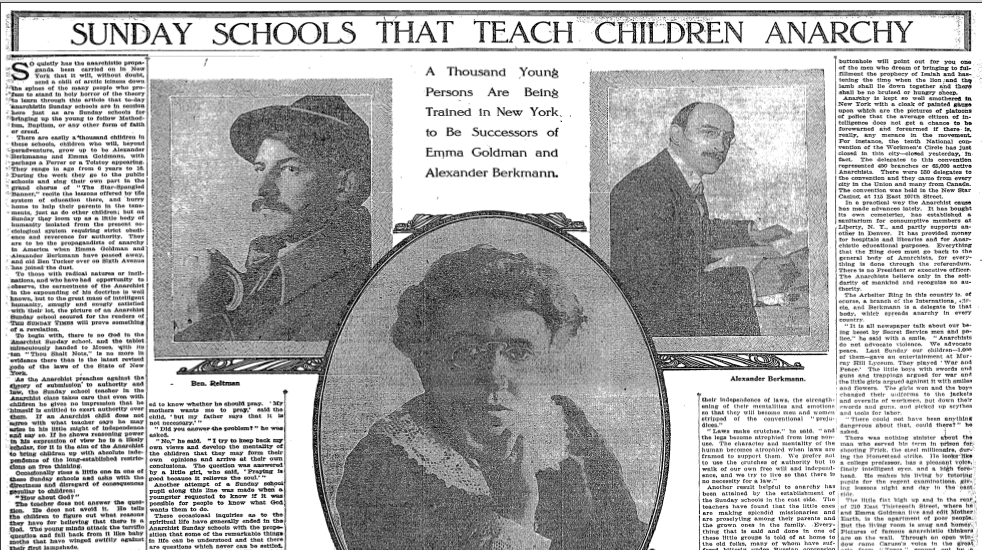
SUNDAY SCHOOLS THAT TEACH CHILDREN ANARCHY

A Thousand Young Persons Are Being Trained in New York to Be Successors of Emma Goldman and Alexander Berkman.

So quietly has the anarchistic propaganda been carried on in New York that it will, without doubt, send a chill of arctic iciness down the spines of the many people who profess to stand in holy horror of the theory to learn through this article that to-day anarchistic Sunday schools are in session here just as are Sunday schools for bringing up the young to follow Methodism, Baptism, or any other form of faith or creed.

>

There are easily a thousand children in these schools, children who will, beyond peradventure, grow up to be Alexander Berkmanns and Emma Goldmans, with perhaps a Ferrer or a Tolstoy appearing. They range in age from 6 years to 16. During the week they go to the public schools and sing their own part in the grand chorus of "The Star-Spangled Banner," recite the lessons offered by the system of education there, and hurry home to help their parents in the tenements, just as do other children; but on Sunday they loom up as a little body of humanity isolated from the present sociological system requiring strict obedience and reverence for authority. They are to be the propagandists of anarchy in America when Emma Goldman and Alexander Berkmann have passed away, and old Ben Tucker over on Sixth Avenue has joined the dust.

To those with radical natures or inclinations, and who have had opportunity to observe, the earnestness of the Anarchist in the expounding of his doctrine is well known, but to the great mass of intelligent humanity, smugly and snugly satisfied with their lot, the picture of an Anarchist Sunday school secured for readers of The Sunday Times will prove something of a revelation.

To begin with, there is no God in the Anarchist Sunday school, and the tablet miraculously handed to Moses, with its ten Thou Shalt Nots, is no more in evidence there than is the latest revised code of the laws of the State of New York.

As the Anarchist preaches against the theory of submission to authority and law, the Sunday school teacher in the Anarchist class takes care that even with children he gives no impression that he himself is entitled to exert authority over them. If an Anarchist child does not agree with what teacher says he may arise in his little might of independence and say so. If he shows reasoning power in his expression of view he is a likely scholar, for it is the aim of the Anarchist to bring children up with absolute independence of the long-established restrictions on free thinking.

Occasionally rises a little one in one of these Sunday schools and asks with the directness and disregard of consequences peculiar to children:

How about God?

The teacher does not answer the question. He does not avoid it. He tells the children to figure out what reasons they have for believing that there is a God. The young minds attack the terrific question and fall back from it like baby moths that have winged swiftly against their first lampshade.

The largest of the Sunday schools is in Avenue A. It is called the Ferrer Sunday School, and was, until the killing of the Spanish philosopher, known as the Radical Sunday School. How the name was changed will prove a story that may stand out with striking novelty in the child life of New York to-day. It shall be told a little later in this article.

The Ferrer Sunday School is conducted by Alexander Berkmann. It has about eighty members and is in two classes. It meets on Sunday between 10 in the morning and noon. The youngest child is 7.

Berkmann has no laid-out system of teaching, depending on his comprehension of the psychology of the group at the time of the gathering. There are no rules. A song may be sung in chorus, a song dealing with freedom of mankind and hate for oppression. Some of the children may have learned by heart a poem or a fragment of an anarchistic argument and these provide recitations. The training of the mind anarchistically is then begun.

Berkmann, in a talk with a Times writer, in the office of Mother Earth, the Anarchist magazine, gave a sample of this teaching.

This was his talk to his Sunday school on Sabbath after the execution of Ferrer.

Once a single human being was swept from the sea to the shore of an island where there lived no human beings. There he found a great flock of sheep. He studied them and noticed that some of them were very powerfully built and finely fed. Some had even attained the strength and ferocity of wolves. But there were a great many of the sheep that were lean and worn. They were hungry and had been trampled down and hurt.

The man thought that he could so arrange it that these sheep, with little to eat and with bruises from being trampled, could be taught to care for themselves better and realize what the power of the strong and wolflike sheep had brought them to. He went among the sheep that suffered and began to point out to them what was the matter. The wolfish and strong ones heard of this and they turned upon the man and killed him.

When Berkmann finished this parable one of the children, a boy 18 years old, arose and said:

Why Mr. Berkmann, this story is just like the story of Ferrer's death.

The children were so impressed with the parable and the discussion which followed that the name of the school was then changed from the Radical Sunday School to the Ferrer Sunday School.

In the classes, said Berkmann, we generally use current events as subjects for discussion and study. For instance, one of our lessons was produced by the Hudson-Fulton Celebration in New York. The children of the east side saw a great deal of the sailors from the many men-of-war in the harbor. They saw the sailors of different nationalities entering and leaving the cafés, the best of friends, their arms about each other and acting like human brothers. The question naturally followed. Why should they be thus fond of each other and thus brotherly on land, and on sea be commanded to kill each other? They are brothers, and love each other, and there can be no fair reason for their slaying each other.

A man who had been raised in one of the old credal beliefs with care but who had come to be an agnostic in middle life once told the writer than when he realized that his religion had gone from him he felt that what he called reason had stepped into a nursery, and, like a willful bully, had gathered up the toys of a child sitting there and had destroyed them because he considered them useless. He considered the change from belief to agnosticism the tragedy of his life. The figure may be applied to thinking grown-ups easily, but it is hard to think of applying it to a child. And yet in the Anarchist Sunday school the tragedy of the destroyed toys is not infrequently enacted.

The pupil of the Anarchist Sunday school is taught to reason. The teacher only serves to direct their attention to a problem.

One child, said Berkmann, wanted to know whether he should pray. My mothers wants me to pray, said this child, but my father says that it is not necessary.

Did you answer the problem? he was asked.

No, he said. I try to keep back my own views and develop the mentality of the children that they may form their own opinions and arrive at their own conclusions. The question was answered by a little girl, who said, Praying is good because it relieves the soul.

Another attempt of a Sunday school pupil along this line was made when a youngster requested to know if it was possible for people to know what God wants them to do.

These occasional inquiries as to the spiritual life have generally ended in the Anarchist Sunday schools with the proposition that some of the remarkable things in life can be understood and that there are questions which never can be settled. The mental attitude of the children might be put in this way: We are not certain whether there are grounds for the belief that we should pray.

That, of course, leaves the question well in the field of agnosticism. The teacher of anarchy does not, with the children, declare that there is no God. Nor does he say that there is a God. The Sunday school class goes frequently to the Museum of Natural History, to Central Park, to the Zoological Gardens, and other places where, with the teacher, nature is studied.

The Ferrer Sunday school is only one of about fifteen similar schools in the greater city. Wherever the local groups of Anarchists can handle their own Sunday schools, carrying on the propaganda with literature, letters, lectures, &c., they do so without asking aid of others. When they cannot the State group helps. There is no central or superior group. Each has its own autonomy, although they all work to develop their principles of solidarity and mutual aid.

There are frequently conventions of the Sunday school teachers. Those who have classes get together and exchange experiences and ideas. In this city the Anarchists know that the fulfillment of their vision is afar, and they are already sowing their seed in the young and new fields that a generation of their kind may take hold of the propaganda when the present generation has withered and fallen.

These little Anarchists are being trained to believe in no authority. As Mr. Berkmann put it, everything is being done for them to aid them in the development of their independence of laws, the strengthening of their mentalities and emotions so that they will become men and women stripped of the conventional prejudices.

Laws make crutches, he said, and the legs become atrophied from long non-use. The character and mentality of human becomes atrophied when laws are framed to support them. We prefer not to use the crutches of authority but to walk of our own free will and independence, and we try to live so that there is no necessity for a law.

Another result helpful to anarchy has been attained by the establishment of the Sunday schools in the east side. The teachers have found that the little ones are making splendid missionaries and are proselyting among their parents and the grown ones in the family. Everything that is said and done in one of these little groups is told of at home to the old folks, many of whom have suffered bitterly under Russian oppression and who have revolution deep in their hearts. They write letters to the Anarchist teachers and get replies. They discuss the views expounded at home by their children and many of them become radicals and join the Anarchist groups.

The Anarchists also spread their propaganda by establishing little libraries which they make easily accessible to all who want to study the theory.

In the spreading of the propaganda among the children the littlest are not overlooked. There are some as young as six years of age who are getting kindergarten lessons in anarchy. One of these lessons is the lesson which preaches to a boy of health and strength at the age of six that he should not strike or abuse a boy who is not as strong as he is but should help him because he needs help. That is the very heart of the kindergarten lesson.

All of this work is done in what is called the Workmen's Circle. The Circle is the general group and is known as the Arbeiter Ring. A little white enamel badge with the letters A. R. in the buttonhole will point out for you one of the men who dream of bringing to fulfillment the prophecy of Isaiah and hastening the time when the lion and the lamb shall lie down together and there shall be no bruised or hungry sheep.

Anarchy is kept so well smothered in New York with a cloak of painted gauze upon which are the pictures of platoons of police that the average citizen of intelligence does not get a chance to be forewarned and forearmed if there is, really, any menace in the movement. For instance, the tenth National convention of the Workmen's Circle has just closed in this city--closed yesterday, in fact. The delegates to this convention represented 450 branches or 65,000 active Anarchists. There were 550 delegates to the convention and they came from every city in the Union and many from Canada. The convention was held in the New Star Casino, at 115 East 107th Street.

In a practical way the Anarchist cause has made advances lately. It has bought its own cemetaries, has established a sanitarium for consumptive members at Liberty, N. Y., and partly supports another in Denver. It has provided money for hospitals and libraries for Anarchistic educational purposes. Everything that the Ring does must go back to the general body of Anarchists, for everything is done through the referendum. There is no President or executive officer. The Anarchists believe only in the solidarity of mankind and recognize no authority.

The Arbeiter Ring in this country is, of course, a branch of the International Circle, and Berkmann is a delegate to that body, which spreads anarchy in every country.

It is all newspaper talk about our being beset by Secret Service men and police, he said with a smile. Anarchists do not advocate violence. We advocate peace. Last Sunday our children--1,000 of them--gave an entertainment at Murray Hill Lyceum. They played War and Peace. The little boys with swords and guns and trappings argued for war and the little girls argued against it with smiles and flowers. The girls won and the boys changed their uniforms to the jackets and overalls of workmen, put down their swords and guns, and picked up scythes and tools for labor.

There could not have been anything dangerous about that, could there? he asked.

There was nothing sinister about the man who served his term in prison for shooting Frick, the steel millionaire, during the Homestead strike. He looks like a college professor, has a pleasant voice, finely intelligent eyes, and a high forehead. He makes his living by tutoring pupils for the regent examinations, giving lessons night and day in the east side.

The little flat high up and in the rear of 210 East Thirteenth Street, where he and Emma Goldman live and edit Mother Earth, is the apartment of poor people. But the living room is snug and homey. Pictures of famous anarchistic thinkers are on the wall. Through an open window came Caruso's voice in the great aria from Tosca, ground out by a phonograph, as Berkmann talked with the Times man. It was a warm combination, but the night was warm, and we were glad for the breeze that swept the little place however burdened it might be.

We teach no ism, he said, harking back to the Sunday schools. Our aim is to develop character and mentality in the child. We try to make them think, criticise, and feel.

We want their emotional and intellectual natures developed. We want to make them men and women absolutely free of the old restrictions. We hope that they will grow up with the spirit of solidarity and co-operation in them. We try to teach them that in and out of school.

We try to teach them ethical right and reason. Our Radical Boys' Literary Club, boys about 13 or 14 years old, hold meetings after school, and they run their organization just as the grown people do. They have advanced to where they need no help from their elders.

Among the grown Anarchists the cause is kept warm by fervid preachings in their publications. These are the weekly paper Frei Arbiter Stimme, with a circulation of 12,000; Mother Earth, with a circulation of 6,000; Freiheit, with 5,000 circulation, and Voine Listy, a Bohemian paper, with a circulation of 4,500.

There are nine large groups of the grown Anarchists in New York. These have regular meetings, and conduct the propaganda with lectures, debates, &c.

In the district from Fourteenth Street to the Battery east of Broadway are 850,000 people living. Here beats the heart of anarchy. Nearly all of these people are foreign born, the native born element being insignificant in its percentage.

Forsyth Street, Chrystie, Cannon, Pitt, Columbia, Second Streets all have buildings in which are tiny halls that may be rented for a dollar or two for a wedding, a banquet, a lodge meeting, or a group meeting of Anarchists.

The man who lives awhile in this teeming corner of Manhattan does not take long to find out where he can go and hear all the anarchy he wants expounded. The writer once met in one of these little halls S. Yanofsky, the editor of the Frei Arbiter Stimme. A man with dreamy eyes, pointed beard, and nervous energy, he seemed to be looked up to as little short of a god by a clump of young men and women who were wating for him.

Yanofsky and Berkmann were both rounded up by the police after the Silverstein bomb explosion in Union Square in 1908, and as there was nothing against either of them nothing came of the call to Police Headquarters. Yanofsky, when asked by the writer what he thought of Silverstein's act, replied:

The man who commits a violent deed, if he is not mad, is desperate. Violence never did any good for anarchy. All government is a form of violence. Suppose Silverstein had suffered personally--and his act was that of an impatient and ignorant man--what did he accomplish? He only made himself dead and gave the chance to the enemies of anarchy to spread their calumnies. He only helped them to kill of the chances of gaining liberty.

Berkmann was a little clearer on the matter of violence and anarchy.

If a Republican or Democrat should throw a bomb or kill another, he said, the Republican Party or the Democratic Party would not be blamed for it. When an Anarchist does a thing like that we frankly say that anarchy did not inspire it, but that conditions of inequality and injustice caused the crime. To stop the crime, stop the cause. Anarchy is for justice and freedom. It cannot be blamed for individual acts of violence.

Among the favorite east side speakers for anarchy, besides Yanofsky and Berkmann, is Dr. Ben Reitman, whose method is to stir up the hearers with fiery sentences depicting the wrongs resulting from the present order of things. He with the others believes that anarchy is gathering strength, and will continue to gather it and will prove a living force in the slow movement of society through the ages.
Have You A Country? (Revolt, January 15, 1916)

This is a letter published in Vol. I, No. 2 of Revolt (dated January 15th, 1916), an Anarchist newspaper edited by Hippolyte Havel and published by the Revolt Publishing Association, 63 East 107th Street, New York, N. Y. The copy came to us by way of a facsimile edition published by The Match!, a journal of Ethical Anarchism, published from Tucson, Arizona. The letter was contributed by Robert Minor, and appears on pp. 6-7 of the issue.

British Labor shows fight. The army poison hasnt twisted their brains as much as their bosses had hoped for. It gives a fellow's heart a quicker throb to know that even in the mob-crazy war country, Labor can hold up its head and be Labor still. In times of peace, workers know that capitalists are their enemies; in time of war they are often fools enough to go fight their friend workers of another country for the sake of the capitalist enemies that they have been fighting at all other times. They've got to learn better, and it looks as though the English are learning. Hurrah for the English! (That means English Labor, not the Greedy British Empire, their greatest enemy.)

They are not perfect by a long sight, but neither are we, nor any other labor. They are improving, that's the point. They have got their bosses so badly worried as to be afraid to make a daring stand for their crooked privileges. It is really amusing. Go to it, friends; you may weaken and be fooled later on, but even then, the little start you have made in defying conscription will not be forgotten, and the world will profit by the example.

May we do as well here in America. It's our turn now. Conscription is at the door, the back door, trying to sneak in. Stand up, American Labor! You ought to do even better, without the disadvantage of actual war upon you. You haven't any country. No labor, anywhere, has any country. So don't be patriotic. Be Labor. And fight to GET your country, not to help your bosses hold it.

HAVE you a country? Then, why do you pay rent?

Robert Minor.

“The Personal Is Political,” by Carol Hanish (1969)

One of the most influential slogans that radical feminists contributed to revolutionary politics in the late 1960s and 1970s was the slogan The personal is political! which profoundly challenged the narrow limits that Marxism, National Liberation movements, and other popular ideologies had set on what topics could be discussed as real political issues, which people's problems were or were not counted as serious problems to be addressed by organized movements, and what sorts of strategies might be seriously considered as means to liberation. The phrase quickly spread throughout the women's movement during the 1970s, and was soon being widely discussed without any reference back to the original source of the idea. But originally the phrase came about as the title of a 1969 position paper by Carol Hanish -- a radical feminist who played a founding role in the formation of New York Radical Women and later the Redstockings -- in which she defended the Women's Liberation movement's practice of small-group consciousness-raising meetings, against Left-wing criticisms that c.r. groups were doing therapy rather than politics, and complaints from movement politicos that feminist groups should spend less time talking about problems amongst themselves and more time taking public protest actions.

Hanisch's paper was printed as part of the movement anthology Notes from the Second Year. The text for this edition is taken from the reprinting of the paper in the Appendix to the Redstockings anthology, Feminist Revolution (1975/1978), pp. 204-205.

The Personal Is Political

For this paper I want to stick pretty close to an aspect of the Left debate commonly talked about--namely therapy vs. therapy and politics. Another name for it is personal vs. political and it has other names, I suspect, as it has developed across the country. I haven't gotten over to visit the New Orleans group yet, but I have been participating in groups in New York and Gainesville for more than a year. Both of these groups have been called therapy and personal groups by women who consider themselves more political. So I must speak about so-called therapy groups from my own experience.

The very word therapy is obviously a misnomer if carried to its logical conclusion. Therapy assumes that someone is sick and that there is a cure, e.g., a personal solution. I am greatly offended that I or any other woman is thought to need therapy in the first place. Women are messed over, not messed up! We need to change the objective conditions, not adjust to them. Therapy is adjusting to your bad personal alternative.

We have not done much trying to solve immediate personal problems of women in the group. We've mostly picked topics by two methods: in a small group it is possible for us to take turns bringing questions to the meeting (like, Which do/did you prefer, a girl or a boy baby or no children, and why? What happens to your relationship if your man makes more money than you? Less than you?). Then we go around the room answering the questions from our personal experiences. Everybody talks that way. At the end of the meeting we try to sum up and generalize from what's been said and make connections.

I believe at this point, and maybe for a long time to come, that these analytical sessions are a form of political action. I do not go to these sessions because I need or want to talk about my personal problems. In fact, I would rather not. As a movement woman, I've been pressured to be strong, selfless, other-oriented, sacrificing, and in general pretty much in control of my own life. To admit to the problems in my life is to be deemed weak. So I want to be a strong woman, in movement terms, and not admit I have any real problems that I can't find a personal solution to (except those directly related to the capitalist system). It is at this point a political action to tell it like it is, to say what I really believe about my life instead of what I've always been told to say.

So the reason I participate in these meetings is not to solve any personal problem. One of the first things we discover in these groups is that personal problems are political problems. There are no personal solutions at this time. There is only collective action for a collective solution. I went, and I continue to go to these meetings because I have gotten a political understanding which all my reading, all my political discussions, all my political action, all my four-odd years in the movement never gave me. I've been forced to take off the rose-colored glasses and face the awful truth about how grim my life really is as a woman. I am getting a gut understanding of everything as opposed to the esoteric, intellectual understandings and noblesse oblige feelings I had in other people's struggles.

This is not to deny that these sessions have at least two aspects that are therapeutic. I prefer to call even this aspect political therapy as opposed to personal therapy. The most important is getting rid of self-blame. Can you imagine what would happen if women, blacks, and workers (my definition of worker is anyone who has to work for a living as opposed to those who don't. All women are workers) would stop blaming ourselves for our sad situations? It seems to me the whole country needs that kind of political therapy. That is what the black movement is doing in its own way. We shall do it in ours. We are only starting to stop blaming ourselves.

We also feel like we are thinking for ourselves for the first time in our lives. As the cartoon in Lilith puts it, I'm changing. My mind is growing muscles. Those who believe that Marxd, Lenin, Engels, Mao, and Ho have the only and last good word on the subject and that women have nothing more to add will, of course, find these groups a waste of time.

The groups that I have been in have also not gotten into alternative life-styles or what it means to be a liberated woman. We came early to the conclusion that all alternatives are bad under present conditions. Whether we live with or without a man, communally or in couples or alone, are married or unmarried, live with other women, go for free love, celibacy, or lesbianism, or any combination, there are only good and bad things about each bad situation. There is no more liberated way; there are only bad alternatives.

This is part of one of the most important theories we are beginning to articulate. We call it the pro-woman line. What it says basically is that women are really neat people. The bad things that are said about us as women are either myths (women are stupid), tactics women use to struggle individually (women are bitches), or are actually things we want to carry into the new society and want men to share too (women are sensitive, emotional). Women as oppressed people act out of necessity (act dumb in the presence of men), not out of choice. Women have developed great shuffling techniques for their own survival (look pretty and giggle to get or keep a job or man) which should be used when necessary until such time as the power of unity can take its place. Women are smart not to struggle alone (as are blacks and workers). It is no worse to be in the home than in the rat race of the job world. They are both bad. Women, like blacks, workers, must stop blaming ourselves for our failures.

It took us some ten months to get to the point where we could articulate these things from the standpoint of what kind of action we are going to do. When our group first started, going by majority opinion, we would have been out in the streets demonstrating against marriage, against having babies, for free love, against women who wore makeup, against housewives, for equality without recognition of biological differences, and god knows what else. Now we see all these things as what we call personal solutionary. Many of the actions taken by action groups have been along these lines. The women who did the anti-woman stuff at the Miss America Pageant were the ones who were screaming for action without theory. The members of one group want to set up a private day-care center without any real analysis of what could be done to make it better for little girls, much less any analysis of how that center hastens the revolution.

That is not to say, of course, that we shouldn't do action. There may be some very good reasons why women in the group don't want to do anything at the moment. One reason that I often have is that this thing is so important to me that I want to be very sure that we're doing it the best way we know how, and that it is a right action that I feel sure about. I refuse to go out and produce for the movement. We had a lot of conflict in our New York group about whether or not to do action. When the Miss America Protest was proposed there was no question but that we wanted to do it. I think it was because we all saw how it related to our lives. We felt it was a good action. There were things wrong with the action, but the basic idea was there.

This has been my experience in groups that are accused of being therapy or personal. Perhaps certain groups may well be attempting to do therapy. Maybe the answer is not to put down the method of analyzing from personal experiences in favor of immediate action, but to figure out what can be done to make it work. Some of us started to write a handbook about this at one time and never got past the outline. We are working on it again.

It's true we all need to learn how to better draw conclusions from the experiences and feelings we talk about and how to draw all kinds of connections. Some of us haven't done a very good job of communicating them to others.

One more thing: I think we must listen to what so-called apolitical women have to say--not so we can do a better job of organizing them but because together we are a mass movement. I think we who work full-time in the movement tend to become very narrow. What is happening now is that when nonmovement women disagree with us, we assume it's because they are apolitical, not because there might be something wrong with our thinking. Women have left the movement in droves. The obvious reasons are that we are tired of being sex slaves and doing shitwork for men whose hypocrisy is so blatant in their political stance of liberation for everybody (else). But there is really a lot more to it than that. I can't quite articulate it yet. I think apolitical women are not in the movement for very good reasons, and as long as we say, You have to think like us and live like us to join the charmed circle, we will fail. What I am trying to say is that there are things in the consciousness of apolitical women (I find them very political) that are as valid as any political consciousness we think we have We should figure out why many women don't want to do action. Maybe there is something wrong with the action or something wrong with why we are doing the action or maybe the analysis of why the action is necessary is not clear enough in our minds.

Carol Hanish (March, 1969)

The themes that Hanisch develops in this position paper are very similar to, but apparently were not directly influenced by, ideas developed in the earlier work of Claudia Jones, an black American Communist, whose 1949 essay "An End to the Neglect of the Problems of the Negro Woman!" similarly challenged the male Left's attempt to exclude personal issues like marriage, social life, and family relationships from political organizing. Although the title of Hanisch's paper is the original source of the slogan, and the discussion in the paper is an early major source for the analysis that the slogan represented, Hanisch does not take credit for coining the slogan itself; she made clear in later interviews that the title The Personal Is Political was given to the paper by Shulamith Firestone and Anne Koedt, as editors of Notes from the Second Year.

Over My Shoulder #45: How Empire comes home in sado-statism and police brutality. From Fred Woodworth, “Evil Empire Notes,” in The Match! # 107 (Summer, 2009)

Here’s the new rules:

  1. At the top of the post, make a list of the books you’ve read all or part of, in print, over the course of the past week, at least as far as you can remember them. (These should be books that you’ve actually read as a part of your normal life, and not just something that you picked up to read a page of just in order to be able to post your favorite quote.)

  2. Pick one of those books from the list, and pick out a quote of one or more paragraphs, to post underneath the list.

  3. Avoid commentary above and beyond a couple sentences, which should be more a matter of context-setting or a sort of caption for the text than they are a matter of discussing the material.

  4. Quoting a passage absolutely does not entail endorsement of what’s said in it. You may agree or you may not. Whether you do isn’t really the point of the exercise anyway.

Here’s the books:

  • Sonia Johnson (1989). Wildfire: Igniting the She/Volution. (Albuquerque: Wildfire Books. I picked it up some time ago through BookMooch.)
  • Richard Gombin (1975), The Origins of Modern Leftism. Translated from the French by Michael K. Perl. (Baltimore: Penguin. Picked up this very week for 49¢ from the Shaman Drum used books sale rack!)
  • Fred Woodworth, The Match! Issue No. 107 (Summer, 2009). (Tucson: Fred Woodworth. PO Box 3012, Tucson, Arizona 85702. I picked my copy up last week from May Day Books in Minneapolis.)

And here’s the quote. This is taken from Fred Woodworth’s Evil Empire Notes, Issue No. 107 of The Match! (Summer 2009; also, incidentally, the 40th anniversary issue of The Match!). This was airplane reading, taken in somewhere in the sky between Minneapolis and Las Vegas.

GIVEN all the millions of horrifying stories in the naked country, now and then it’s good to pluck out one to hear an authentic voice rather than a statistic. Amnesty International printed up this one, by Donald Boyd of Chicago:

I have been a victim of racial profiling since I was 17 years old. Once when I was walking to the cleaners, I stopped to talk with some young men…. When I walked away, the police just automatically accused me of purchasing drugs. Two officers jumped out of a car and kept asking What did they sell you? I repeatedly replied no one sold me anything. … They cuffed me and drove me to a police substation.

… The next morning they loaded 45 people into a van made for 32. The men were almost all black and Latino. When we arrived at the jail, sheriff’s deputies, dressed in riot gear, met us. They shouted obscenities and threats. The deputies assaulted several people, including me, for supposedly not complying with their every word.

At each step in the process—arrest, detention and bond hearing—we were lined up, and numbers were scribbled on our arms with black marking pens…. In court, you appear before a judge, but via a television screen. You don’t get to speak, and the judge never even looks you in the face…. They treat our communities with disdain and contempt. I had to hire a lawyer and spend thousands of dollars to get the charges dismissed….


AS Law becomes increasingly complex, with hundreds of thousands and even millions of laws stacked on top of each other, almost no one can confront officialdom in any way without a lawyer. But what happens when your lawyer takes your money and does no work, don’t file basic motions or writs, and essentially shafts you? Not much. Bar associations have a cap of compensatory payments they sometimes make to incompetent or dishonest lawyers’ clients, but the amouts are often based on century-old, or even older, stated maximums. And it’s next to impossible to go after such a lawyer legally, because to do so you need… another lawyer.


. . .

EIGHT COPS raided a home in Minneapolis in ‘08. They shot up the place, accidentally not killing anyone. Well, it was the wrong house (there is no right house for something like this). This is completely comparable to a surgeon amputating the wrong leg, but if the doctor who did this to you then got a commendation from the medical association, wouldn’t you feel absolutely floored? So did the family whose home was raided and shot up. All eight cops received medals.

Undoubtedly this sounds like hyperbole or mere rhetoric, but the simple fact is that there is no conceivable way anyone can interpret this but as an official statement of Good Work, Men to stupid, negligent, incompetent thugs for terrorizing and injuring innocent people.


NOT SURPRISINGLY, when humanitarian spirit is dead in officialdom it’s not partly alive; it really is extinct and defunct. Also in Minnesota, a poor wild bear somehow got a plstic jar or bucket stuck on its head. Official solution: shoot the bear. No sympathy for an unfortunate creature; no imaginative or bold remedy. Just kill.


AS REPORTED by the Washington Post, prison guards at Prince George’s County Jail in Maryland are apt to be the kind of guys the average person expects to hear of as BEHIND bars. An investigation by the paper found guards who’ve been charged with assault, theft, beating and threatening their wives with death, having sex with prisoners, robbery at gunpoint, and other crimes.

Among the nine officers was Mark R. Bradley, whose then-wife asked for a protective order in 1998, claiming he had threatened, taunted, punched and slapped her… When she reached for the phone, Bradley who had been on the force for almost four years, yanked it away… His wife recalled him saying: Call the police… Make me lose my job. I’ll kill you. Almost a decade later, he was still on the payroll at the jail, despite three protective orders issued against him in the late 1990s. In 2004, he pleaded guilty to assaulting another woman, whose rib was broken. The woman, who had been pregnant with his child, told police that after a beating days earlier, she had a miscarriage. A judge put Bradley on probation and ordered him to take an anger management class.


AIRPORT FASCISM is being extended to railroads. Amtrak, the railroad passenger company, has brought in a SWAT-style phalanx of agents in full combat gear to sweep through train stations, randomly screening and searching passengers. The randomly chosen passengers will have to place their bags on a platform and be swabbed with chemicals that are claimed to react to traces of explosives. You can also be ratted out by dogs.


ONE OF THE factors that propelled the United States as far along into the police state that it now is, was the Vietnam War. There’s plenty of evidence that soldiers in ALL wars become brutalized, but something extraordinary seems to have taken place in Vietnam. Whatever it was, American men who went there (and survived) tended to come back in a vicious state of mind. Ordinary people were their enemy. They made up stories (essentially none has ever been verified) of people spitting on them when they arrived at stateside airports; and they formed cliques of us-versus-them. Looking for work, a high proportion of them went into law enforcement, and there they reinforced and amplified the already-existing us versus them mentality, ratcheting the propensity toward police brutality to amazing heights.

Now the same thing is happening with Iraq. Our guess is that the psychological corruption happens when soldiers fight amid a culture and a language that has few points of contact with the west and with Indo-European languages. It is one thing to fight, say, Germans or Italians, whose general culture is largely familiar (same religions, for instance) and whose languages have a large percentage of words that are the same or nearly enough so to be comprehensible even to the monolingual standard American youth. But in Vietnam—and now in Iraq—these military people are surrounded by words and behaviors utterly alien to them. Our own idle theory, therefore, is that this operate on their minds in such a way that the enemy becomes completely dehumanized. This creates the us-versus-them, and when they return to the USA, they still have it.

Then they go into law enforcement.

Already we are beginning to read about cases in which police—now Iraq war veterans—are opening fire on people merely running away from them. And already, too, the convoluted excuses are starting to evolve: Re-experiencing a war zone is one of several classic signs of combat stress reaction, says the Department of Veterans Affairs. If persistent and untreated, the Department goes on, this can result in post traumatic stress disorder.

Whatever verbal gimmickery you haul out to gloss over the facts, the truth is that these men (generally they are men) have been ruined, corrupted fatally and irretrievably, by being sent out to murder masses of people for no good reason in a country where they ought never to have gone. Mostly it’s their own fault, too, since ultimately it was their own volition that was compliant in their going there.

The bottom line is that Bush’s freudian effort to surpass his father’s Panama coup by similarly taking Saddam Hussein, unresisted by the press and the American people at the outset, is now going to result in thirty or forty more years of ever-worsening police violence against the public here. With this on top of everything else—the overpopulation, insanely burgeoning law-pollution, disastrous shift to digital culture, etc.—America is rapidly turning into an unliveable hell. Then add global warming.


IMMIGRATION PRISONS, where you’re sent for not having adequate proof of being a so-called citizen, are the new concentration camps of the Evil Empire. There are now a whole class of persons of various ethnicities who are afraid to travel outside of the towns or cities where they live, because of the possibility of being stopped by some profiling trick excused as a broken taillight, and then being sent sprawling into a cell at an immigration prison.

A recent well-publicized case in some of the larger newspapers (and excluded from the local dailies) concerned one Hiu Lui Ng, who’d come to the US from Hong Kong. Making the mistake of going to immigraiton headquarters in New York City to get a green card (legal authorization to live and work in this country), he was grabbed and put behind bars. There he developed cancer, was in severe pain, laughed at by the medical matrons, and eventually died from the rampaging and untreated disease.

. . . They denied him a wheelchair and refused pleas for an independent medical evaluation. Instead, … guards at the Donald W. Wyatt Detention Facility in Central Falls, Rhode Island, dragged him from his bed on July 30, craried him in shackles to a car, bruising his arms and legs, and drove him two hours to a federal lock-up in Hartford, where an immigration officer pressured him to withdraw all pending appeals of his case. (New York Times.)

One out of hundreds of thousands.

— Fred Woodworth, Evil Empire Notes, in The Match! Issue No. 107 (Summer, 2009). 19–21.

See also:

Susan Brownmiller on statistics, stranger rape and acquaintance rape. From Against Our Will (1975)

Trigger warning: This passage, from Susan Brownmiller's groundbreaking 1975 study Against Our Will: Men, Women and Rape, includes testimony from a rape survivor, describing her own experience of stranger rape.

Prior to the 1980s, most social science research on rape was concentrated on stranger rape -- in which a man assaults a woman who is unknown to him, who is targeted at random or opportunistically, in the midst of another crime (such as mugging or burglary). At the time, there little reliable research on date rape and other forms of acquaintance rape. Later research found that acquaintance rape was far more prevalent than previously realized, and far more common than stranger rape -- that 90% or more of all rapes were committed by a date, an intimate partner, or another man known to the victim. This passage, from New York radical feminist Susan Brownmiller's groundbreaking 1975 study Against Our Will: Men, Women and Rape, summarizes the data that was available in the mid-1970s, and the limitations of that data, which feminists were beginning to investigate and reveal.

According to the task force of the National Commission on the Causes and Prevention of Violence, half of all rape victims (53 percent) were total strangers to their attackers; another 30 percent were slightly acquainted. Seven percent had a family relationship to their rapists (daughter, sister, niece or cousin) and 3 percent were not related but had a previous close association. (As with most percentage distributions concerning crime, there is always a category called unknown or other.) The task force concluded, If a woman is attacked, then, considerable justification does appear to exist for the fear that the offender will be a stranger.

As I mentioned in Chapter 6, The Police-Blotter Rapist, the statistical profile of rape falls midway between the profiles for assault and robbery. In keeping with this pattern, when interpersonal relationships in these three crimes of violence are compared side by side, we find that strangers commit 21 percent of all assaults, 53 percent of all rapes and 79 percent of all robberies.

Testimony: About five years ago when I lived in Chicago I awoke one night gagged with my hands pinned down by someone who was wearing leather gloves and holding a razor to my throat. I wasn't quite sure I was awake. I thought I must be in the middle of a nightmare that seemed much more realistic than usual and I couldn't break it up. I was trying to establish if there really was a person there. And then I did get my wrist cut slightly, so I realized it was real and that I was risking my life and that I'd better hold still and let the man have intercourse with me. He was very fast. He wasn't wearing any clothes on the bottom half of his body and he ran out the window in that position, just like Romeo on the balcony, onto the fire escape and down.

I got up, turned on the lights and took a bath in alcohol. I was living alone. I had to get out of the apartment. I set off with my coat on and then I realized the man had gotten in my purse and left me without a penny. Apparently he had been in the apartment for some time before I woke up because I saw he had gagged me with my own dishtowel. It was then that I thought to call the police.

Stranger-rape has clearly been the preferred category from the point of view of the police precinct, the category most likely to win the determination of founded. When a woman is raped by a total stranger, her status as victim is clean and untranished in the station-house mentality. In Brenda Brown's 1973 Memphis study, 73 percent of all founded rapes were committed by strangers, and Brown reported, The closeness of the relationship was a frequently used reason for categorizing cases as unfounded. According to the Uniform Crime Reports, unfounded cases are frequently complicated by a prior relationship between victim and offender.

For this reason it remains difficult to assess the true percentage of rapes committed by strangers. As the women's movement continues to press a greater understanding of the crime of rape on the general public, women who have been assaulted by men they know will feel freer to report the crime and these reports will begin to be treated with the seriousness they deserve. At the present time, police precincts still operate from the assumption that a woman who has been raped by a man she knows is a woman who changed her mind afterwards.

Susan Brownmiller (1975), Against Our Will: Men, Women and Rape. 351–352.

“Goodbye to All That,” by Robin Morgan (1970)

In the late 1960s and early 1970s, Rat, was one of the leading counterculture / New Left newspapers in New York City. In January 1970, a group of women who worked at Rat, fed up with the increasingly aggressive sexism of the paper's content and internal hierarchies, took over the newspaper and, with the help of women from Women's Liberation groups in New York, converted it into a feminist newspaper. In the first issue, Robin Morgan (then a member of W.I.T.C.H.) contributed Goodbye to All That. The article has since been reprinted widely in anthologies of radical feminist writing; this copy is based on the reprint that appears in Dear Sisters: Dispatches from the Women's Liberation Movement. A slightly different version appears, together with a long introduction and explanatory footnotes, in Morgan's The Word of a Woman: Feminist Dispatches 1968–1992.

Goodbye to All That

So, Rat has been liberated, for this week, at least. Next week? If the men return to reinstate the porny photos, the sexist comic strips, the nude-chickie covers (along with their patronizing rhetoric about being in favor of women's liberation)--if this happens, our alternatives are clear. Rat must be taken over permanently by women--or Rat must be destroyed. (¶ 1)

Why Rat? Why not EVO or even the obvious new pornzines (Mafia-distributed alongside the human pornography of prostitution)? First, they'll get theirs--but it won't be by a takeover, which is reserved for something at least worth taking over. Nor should they be censored. They should just be helped not to exist--by any means necessary. But Rat, which has always tried to be a really radical cum lifestyle paper, that's another matter. It's the liberal cooptative masks on the face of sexist hate and fear, worn by real nice guys we all know and like, right? We have met the enemy and he's our friend. And dangerous. What the hell, let the chicks do an issue; maybe it'll satisfy 'em for a while, it's a good controversy, and it'll maybe sell papers runs an unoverheard conversation that I'm sure took place at some point last week. (¶ 2)

And that's what I wanted to write about--the friends, brothers, lovers in the counterfeit male-dominated Left. The good guys who think they know what Women's Lib, as they so chummily call it, is all about--who then proceed to degrade and destroy women by almost everything they say and do: The cover on the last issue of Rat (front and back). The token pussy power or clit militancy articles. The snide descriptions of women staffers on the masthead. The little jokes, the personal ads, the smile, the snarl. No more, brothers. No more well-meaning ignorance, no more cooptation, no more assuming that this thing we're all fighting for is the same; one revolution under man, with liberty and justice for all. No more. (¶ 3)

Let's run it down. White males are most responsible for the destruction of human life and environment on the planet today. Yet who is controlling the supposed revolution to change all that? White males (yes, yes, even with their pasty fingers back in black and brown pies again). It could just make one a bit uneasy. It seems obvious that a legitimate revolution must be led by, made by those who have been most oppressed: black, brown, yellow, red, and white women--with men relating to that the best they can. A genuine Left doesn't consider anyone's suffering irrelevant or titillating; nor does it function as a microcosm of capitalist economy, with men competing for power and status at the top, and women doing all the work at the bottom (and functioning as objectified prizes or coin as well). Goodbye to all that. (¶ 4)

Run it all the way down. (¶ 5)

Goodbye to the male-dominated peace movement, where sweet old Uncle Dave can say with impunity to a woman on the staff of Liberation magazine, The trouble with you is you're an aggressive woman. (¶ 6)

Goodbye to the straight male-dominated Left: to PL, who will allow that some workers are women, but won't see all women (say, housewives) as workers (blind as the System itself); to all the old Left-over parties who offer their Women's Liberation caucuses to us as if that were not a contradiction in terms; to the individual anti-leadership leaders who hand-pick certain women to be leaders and then relate only to them, either in the male Left or in Women's Liberation—bringing their hang-ups about power dominance and manipulation to everything they touch. (¶ 7)

Goodbye to the Weather Vain, with the Stanley Kowalski image and theory of free sexuality but practice of sex on demand for males. Left Out!—not Right On!—to the Weather Sisters who (and they know better—they know) reject their own radical feminism for that last desperate grab at male approval that we all know so well, for claiming that the machismo style and the gratuitous violence is their own style by free choice, and for believing that this is the way for a woman to make her revolution…all the while, oh my sister, not meeting my eyes because Weathermen chose Charles Manson as their—and your—hero. (Honest, at least, since Manson is only the logical extreme of the normal American male's fantasy, whether he is Dick Nixon or Mark Rudd: master of a harem, women to do all the shitwork, from raising babies and cooking and hustling to killing people on command.) Goodbye to all that shit that sets women apart from women; shit that covers the face of any Weatherwoman which is the face of any Manson Slave which is the face of Sharon Tate which is the face of Mary Jo Kopechne which is the face of Beulah Saunders, which is the face of me which is the face of Pat Nixon which is the face of Pat Swinton. In the dark we are all the same--and you better believe it: we're in the dark, baby. (Remember the old joke: Know what they call a black man with a Ph.D.? A nigger. Variations: Know what they call a Weatherwoman? A heavy cunt. Know what they call a hip revolutionary woman? A groovy cunt. Know what they call a radical militant feminist? A crazy cunt. Amerika is a land of free choice--take your pick of titles.) Left Out, my sister—don't you see? Goodbye to the illusion of strength when you run hand in hand with your oppressors; goodbye to the dream that being in the leadership collective will get you anything but gonorrhea. (¶ 8)

Goodbye to RYM II, as well, and all the other RYMs—not that the sisters there didn't pull a cool number by seizing control, but because they let the men back in after only a day or so of self-criticism on male chauvinism. (And goodbye to the inaccurate blanket use of that phrase, for that matter: male chauvinism is an attitude—male supremacy is the objective reality, the fact.) Goodbye to the Conspiracy, who, when lunching with fellow sexist bastards Norman Mailer and Terry Southern in a Bunny-type club in Chicago found Judge Hoffman at the neighboring table—no surprise: in the light they are all the same. (¶ 9)

Goodbye to Hip culture and the so-called Sexual Revolution, which has functioned toward women's freedom as did the Reconstruction toward former slaves—reinstituting oppression by another name. Goodbye to the assumption that Hugh Romney is safe in his cultural revolution, safe enough to refer to our women, who make all our clothes without somebody not forgiving that. Goodbye to the arrogance of power indeed that lets Czar Stan Freeman of the Electric Circus sleep without fear at night, or permits Tomi Ungerer to walk unafraid in the street after executing the drawings for the Circus advertising campaign against women. Goodbye to the idea that Hugh Hefner is groovy 'cause he lets Conspirators come to parties at the Playboy Mansion—goodbye to Hefner's dream of a ripe old age. Goodbye to Tuli and the Fugs and all the boys in the front room—who always knew they hated the women they loved. Goodbye to the notion that good ol' Abbie is any different from any other up-and-coming movie star who ditches the first wife and kids, good enough for the old days but awkward once you're Making It. Goodbye to his hypocritical double standard that reeks through the tattered charm. Goodbye to lovely pro-Women's Liberationist Paul Krassner, with all his astonished anger that women have lost their sense of humor on this issue and don't laugh any more at little funnies that degrade and hurt them: farewell to the memory of his Instant Pussy aerosol-can poster, to his column for the woman-hating men's magazine Cavalier, to his dream of a Rape-In against legislators' wives, to his Scapegoats and Realist Nuns and cute anecdotes about the little daughter he sees as often as any properly divorced Scarsdale middle-aged father; goodbye forever to the notion that a man is my brother who, like Paul, buys a prostitute for the night as a birthday gift for a male friend, or who, like Paul, reels off the names in alphabetical order of people in the women's movement he has fucked, reels off names in the best locker-room tradition--as proof that he's no sexist oppressor. (¶ 10)

Let it all hang out. Let it seem bitchy, catty, dykey, Solanisesque, frustrated, crazy, nutty, frigid, ridiculous, bitter, embarrassing, man-hating, libelous, pure, unfair, envious, intuitive, low-down, stupid, petty, liberating. We are the women that men have warned us about. (¶ 11)

And let's put one lie to rest for all time: the lie that men are oppressed, too, by sexism—the lie that there can be such a thing as men's liberation groups. Oppression is something that one group of people commits against another group specifically because of a threatening characteristic shared by the latter group—skin color or sex or age, etc. The oppressors are indeed fucked up by being masters (racism hurts whites, sexual stereotypes are harmful to men) but those masters are not oppressed. Any master has the alternative of divesting himself of sexism or racism; the oppressed have no alternative—for they have no power—but to fight. In the long run, Women's Liberation will of course free men—but in the short term it's going to cost men a lot of privilege, which no one gives up willingly or easily. Sexism is not the fault of women—kill your fathers, not your mothers. (¶ 12)

Run it down. Goodbye to a beautiful new ecology movement that could fight to save us all if it would stop tripping off women as earthmother types or frontier chicks, if it would right now cede leadership to those who have not polluted the planet because that action implies power and women haven't had any power in about 5,000 years, cede leadership to those whose brains are as tough and clear as any man's but whose bodies are also unavoidably aware of the locked-in relationship between humans and their biosphere—the earth, the tides, the atmosphere, the moon. Ecology is no big shtick if you're a woman—it's always been there. (¶ 13)

Goodbye to the complicity inherent in the Berkeley Tribesmen being part publishers of Trashman Comics; goodbye, for that matter, to the reasoning that finds whoremaster Trashman a fitting model, however comic-strip far-out, for a revolutionary man—somehow related to the same Super-male reasoning that permits the first statement on Women's Liberation and male chauvinism that came out of the Black Panther Party to be made by a man, talking a whole lot about how the sisters should speak up for themselves. Such ignorance and arrogance ill-befits a revolutionary. (¶ 14)

We know how racism is worked deep into the unconscious by the System--the same way sexism is, as it appears in the very name of The Young Lords. What are you if you're a macho woman—a female Lord? Or, god forbid, a Young Lady? Change it, change it to the Young Gentry if you must, or never assume that the name itself is innocent of pain, of oppression. (¶ 15)

Theory and practice—and the light-years between them. Do it! says Jerry Rubin in Rat's last issue—but he doesn't or every Rat reader would have known the pictured face next to his article as well as they know his own much-photographed face: it was Nancy Kurshan, his woman, the power behind the clown. (¶ 16)

Goodbye to the New Nation and Earth People's Park for that matter, conceived by men, announced by men, led by men—doomed before birth by the rotting seeds of male supremacy transplanted into fresh soil. Was it my brother who listed human beings among the objects that would be easily available after the Revolution: Free grass, free food, free women, free acid, free clothes, etc.? Was it my brother who wrote Fuck your women till they can't stand up and said that groupies were liberated chicks 'cause they dug a tit-shake instead of a handshake? The epitome of male exclusionism—men will make the Revolution—and make their chicks. Not my brother. No. Not my revolution. Not one breath of my support for the new counterfeit Christ—John Sinclair. Just one less to worry about for ten years. I do not choose my enemy for my brother. (¶ 17)

Goodbye, goodbye. To hell with the simplistic notion that automatic freedom for women--or nonwhite peoples--will come about zap! with the advent of a socialist revolution. Bullshit. Two evils pre-date capitalism and clearly have been able to survive and post-date socialism: sexism and racism. Women were the first property when the Primary Contradiction occurred: when one-half of the human species decided to subjugate the other half, because it was different, alien, the Other. From there it was an easy enough step to extend the concept of Other to someone of different skin shade, different height or weight or language—or strength to resist. Goodbye to those simple-minded optimistic dreams of socialist equality all our good socialist brothers want us to believe. How merely liberal a politics that is! How much further we will have to go to create those profound changes that would give birth to a genderless society. Profound, Sister. Beyond what is male or female. Beyond standards we all adhere to now without daring to examine them as male-created, male-dominated, male-fucked-up, and in male self-interest. Beyond all known standards, especially those easily articulated revolutionary ones we all rhetorically invoke. Beyond—to a species with a new name, that would not dare define itself as Man. (¶ 18)

I once said, I'm a revolutionary, not just a woman, and knew my own lie even as I said the words. The pity of that statement's eagerness to be acceptable to those whose revolutionary zeal no one would question, i.e., any male supremacist in the counterleft. But to become a true revolutionary one must first become one of the oppressed (not organize or educate or manipulate them, but become one of them)--or realize that you are one already. No woman wants that. Because that realization is humiliating, it hurts. It hurts to understand that at Woodstock or Altamont a woman could be declared uptight or a poor sport if she didn't want to be raped. It hurts to learn that the sisters still in male-Left captivity are putting down the crazy feminists to make themselves look unthreatening to our mutual oppressors. It hurts to be pawns in those games. It hurts to try and change each day of your life right now—not in talk, not in your head, and not only conveniently out there in the Third World (half of which are women) or the black or brown communities (half of which are women) but in your own home, kitchen, bed. No getting away, no matter how else you are oppressed, from the primary oppression of being female in a patriarchal world. It hurts to hear that the sisters in the Gay Liberation Front, too, have to struggle continuously against the male chauvinism of their gay brothers. It hurts that Jane Alpert was cheered when rapping about imperialism, racism, the Third World, and All Those Safe Topics but hissed and booed by a movement crowd of men who wanted none of it when she began to talk about Women's Liberation. The backlash is upon us. (¶ 19)

They tell us the alternative is to hang in there and struggle, to confront male domination in the counterleft, to fight beside or behind or beneath our brothers--to show 'em we're just as tough, just as revolushunerry, just as whatever‐image‐they‐now‐want‐of‐us‐as‐once‐they‐wanted‐us‐to‐be‐feminine‐and‐keep‐up‐the‐home‐fire‐burning. They will bestow titular leadership on our grateful shoulders, whether it's being a token woman on the Movement Speakers Bureau Advisory Board, or being a Conspiracy groupie or one of the respectable chain-swinging Motor City Nine. Sisters all, with only one real alternative: to seize our own power into our own hands, all women, separate and together, and make the Revolution the way it must be made—no priorities this time, no suffering group told to wait until after. (¶ 20)

It is the job of revolutionary feminists to build an ever stronger independent Women's Liberation Movement, so that the sisters in counterleft captivity will have somewhere to turn, to use their power and rage and beauty and coolness in their own behalf for once, on their own terms, on their own issues, in their own style—whatever that may be. Not for us in Women's Liberation to hassle them and confront them the way their men do, nor to blame them—or ourselves—for what any of us are: an oppressed people, but a people raising our consciousness toward something that is the other side of anger, something bright and smooth and cool, like action unlike anything yet contemplated or carried out. It is for us to survive (something the white male radical has the luxury of never really worrying about, what with all his options), to talk, to plan, to be patient, to welcome new fugitives from the counterfeit Left with no arrogance but only humility and delight, to push—to strike. (¶ 21)

There is something every woman wears around her neck on a thin chain of fear—an amulet of madness. For each of us, there exists somewhere a moment of insult so intense that she will reach up and rip the amulet off, even if the chain tears the flesh of her neck. And the last protection from seeing the truth will be gone. Do you think, tugging furtively every day at the chain and going nicely insane as I am, that I can be concerned with the peurile squabbles of a counterfeit Left that laughs at my pain? Do you think such a concern is noticeable when set alongside the suffering of more than half the human species for the past 5,000 years—due to a whim of the other half? No, no, no, goodbye to all that. (¶ 22)

Women are Something Else. This time, we're going to kick out all the jams, and the boys will just have to hustle to keep up, or else drop out and openly join the power structure of which they are already the illegitimate sons. Any man who claims he is serious about wanting to divest himself of cock privilege should trip on this: all male leadership out of the Left is the only way; and it's going to happen, whether through men stepping down or through women seizing the helm. It's up to the brothers—after all, sexism is their concern, not ours; we're too busy getting ourselves together to have to deal with their bigotry. So they'll have to make up their own minds as to whether they will be divested of just cock privilege or—what the hell, why not say it, say it!—divested of cocks. How deep the fear of that loss must be, that it can be suppressed only by the building of empires and the waging of genocidal wars! (¶ 23)

Goodbye, goodbye forever, counterfeit Left, counterleft, male-dominated cracked-glass mirror reflection of the Amerikan Nightmare. Women are the real Left. We are rising, powerful in our unclean bodies; bright glowing mad in our inferior brains; wild hair flying, wild eyes staring, wild voices keening; undaunted by blood we who hemorrhage every twenty-eight days; laughing at our own beauty we who have lost our sense of humor; mourning for all each precious one of us might have been in this one living time-place had she not been born a woman; stuffing fingers into our mouths to stop the screams of fear and hate and pity for men we have loved and love still; tears in our eyes and bitterness in our mouths for children we couldn't have, or couldn't not have, or didn't want, or didn't want yet, or wanted and had in this place and this time of horror. We are rising with a fury older and potentially greater than any force in history, and this time we will be free or no one will survive. Power to all the people or to none. All the way down, this time. (¶ 24)

Free Kathleen Cleaver!Free Kim Agnew!
Free Anita Hoffman!Free Holly Krassner!
Free Bernardine Dohrn!Free Lois Hart!
Free Donna Malone!Free Alice Embree!
Free Ruth Ann Miller!Free Nancy Kurshan!
Free Leni Sinclar!Free Dinky Forman!
Free Jane Alpert!Free Dinky Forman!
Free Gumbo!Free Sharon Krebs!
Free Bonnie Cohen!Free Iris Luciano!
Free Judy Lampe!Free Robin Morgan!
Free Valerie Solanis!
Free our sisters!Free ourselves!

--Robin Morgan (January 1970)