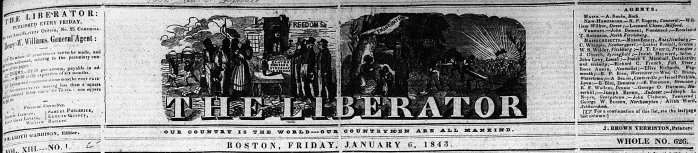
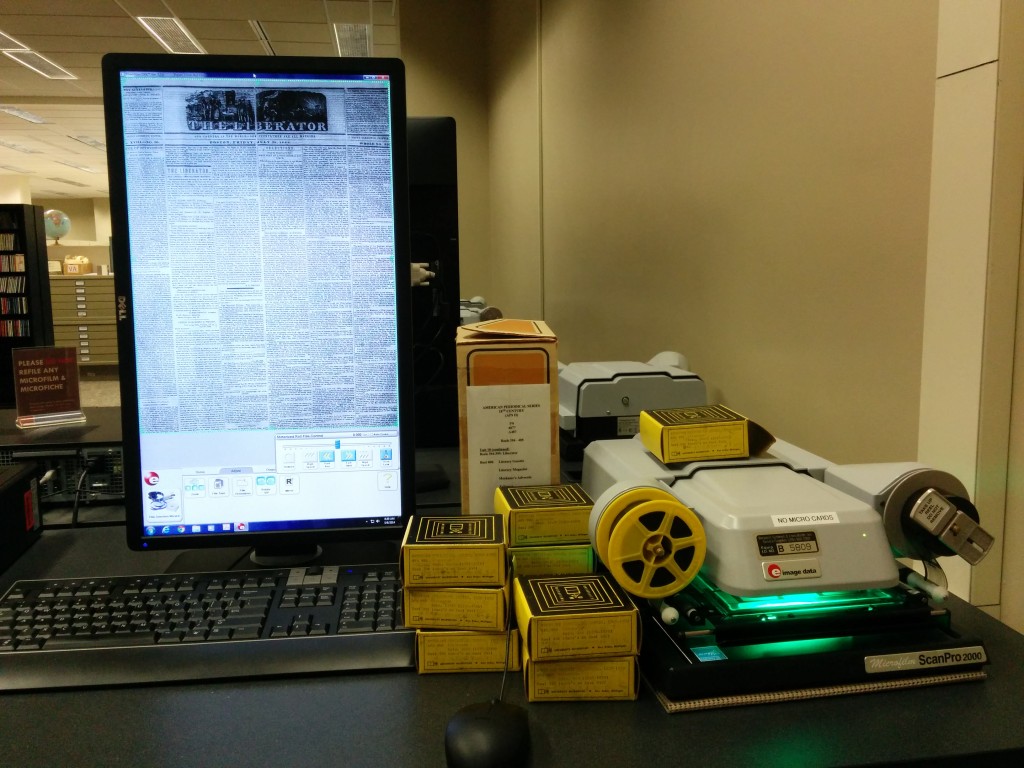
From time to time I have mentioned my ongoing project of making full issues of William Lloyd Garrison's The Liberator available here at fair-use.org. The Liberator is big (52-53 issues every year, for 35 years!) and the project has progressed at a slow pace. But I'm happy to announce that, thanks to a break from other obligations, a sponsorship from the Molinari Institute, and generous contributions from supporters all over the Internet, the project will be able to proceed much more quickly and steadily from here on out -- hopefully with every issue of The Liberator available in full, online, for free, by the beginning of August 2014. But we need your support to make it happen!
Here's the deal. When the fundraiser project started, thanks to occasional scanning when I had the time to volunteer, fair-use.org had ten years' worth of The Liberator online: Volumes I.-IX. (1830-1839) and Volume XXI. (Jan.-Dec. 1851). In order to finish the remaining 25 years' worth of issues this summer -- instead of sometime around 2019 -- we're raising funds through our fiscal sponsor, the Molinari Institute -- in order to get the scans online and begin to prepare an extensive, open, free and researcher-friendly archive and index for anyone who wants to learn more about radical abolitionism and the history of American social movements. The fundraiser will cover the labor costs for the scanning and the increased web hosting costs for what's likely to become a very widely used web resource.
We started the fundraiser with a soft, quietly circulated launch last week. And I'm happy to announce to-day that, thanks to generous donations from 8 donors, we've already raised over 10% of our goal -- $246 out of the projected $2,000 budget. And also that thanks to the donations, we've already been able to add two new volumes -- Volume X. and Volume XI. of The Liberator (1840-1841) are now available online. We're on track to add the next two volumes (XII. and XIII.) by the end of this week.
About the project:
Our goal is to make every issue of The Liberator, from 1831-1865, available in full, online, for free, and to add free tools to aid students and researchers in searching through the archives of the paper.
- Phase I. is to scan every issue from every year of The Liberator from microfilm sources and to make facsimile PDFs available online for free at fair-use.org/the-liberator. If the fundraiser is fully funded, we should be able to add about two new volumes' worth of facsimile PDFs each week, and complete Phase I by August 2014.
- Phase II. is to prepare a free, online hypertext index of The Liberator, similar to the Individuals and Titles and Periodicals sections of Wendy McElroy's indispensable Comprehensive Index to LIBERTY. The index will provide an easily searchable, easily browseable and interlinked complete table of contents for every issue of The Liberator and an index of names, book titles and periodical titles appearing in its pages. If we reach our stretch goals for the fundraiser, then the fundraiser will cover most of the labor cost for Phase II as well as for the scanning project. After Phase I is complete, I should be able to work out a plausible timeline for completing Phase II, but my guess at this point is that it could possibly be completed by the end of the year.
- Phase III. would be to begin to transcribe individual articles and columns from the PDF facsimiles into lightweight, standards-based, linkable searchable HTML. This will be an immense amount of work and systematic effort to complete it will be a bit down the road. We'll do another round of fundraising to support the Phase III transcriptions once Phase I. is complete and Phase II. is in progress.
About The Liberator
Garrison's Liberator, running from 1831–1865, was the most prominent periodical of radical Abolition in the united states. Proclaiming, in the first issue, that:
. . . I am aware, that many object to the severity of my language; but is there not cause for severity? I will be as harsh as truth, and as uncompromising as justice. On this subject, I do not wish to think, or speak, or write, with moderation. No! no! Tell a man whose house is on fire, to give a moderate alarm; tell him to moderately rescue his wife from the hand of the ravisher; tell the mother to gradually extricate her babe from the fire into which it has fallen; -- but urge me not to use moderation in a cause like the present. I am in earnest -- I will not equivocate -- I will not excuse -- I will not retreat a single inch -- AND I WILL BE HEARD.
Together with the circle of black and white radicals that his paper attracted, Garrison's Liberator helped to organize, and offered a forum for, the Abolitionist movement that spent the next 35 years working for the immediate emancipation of all slaves, condemning racial prejudice and "American Colorphobia," and insisting that emancipation could only truly come about by inspiring a radical moral and social transformation. It urged a politics of radicalizing conscience, and denied that electoral gamesmanship, partisan politics, or political compromise would ever bring about liberation on their own. In the age of the Fugitive Slave Acts, the Garrisonians denounced the united states Constitution as a weapon of the slavers, "A Compromise with Death and an Agreement with Hell." Rejecting the use of either political or military power as a means of overcoming the slave system, they argued for Disunion ("No Union with Slaveholders, religiously or politically"), holding that the Northern free states should secede from the Union, thus peacefully withdrawing the Federal economic, political and military support that the Slave Power depended on, and (they argued) driving the slave system to collapse, by kicking out the Constitutional compromises that propped it up. Garrison and his circle, in the face of condemnation from more conservative anti-slavery activists, also constantly drew parallels and connections between the struggle against slavery and other struggles for social liberation, taking early and courageous stances in defense of women's rights and international peace.
What You Can Do To Help
If you enjoy this project or find the materials useful, you can help support the work and speed up the on-going progress with a contribution to the project, in any amount, through the Molinari Institute -- the not-for-profit sponsor of the Fair Use Repository. We can accept credit card donations through GoFundMe.com and we can also accept Bitcoin donations to bitcoin:18Bojnp2UG3iDpXT9CxjutjsXQjWgbmSCW. (If you send us a BTC contribution, please contact us to let us know who you are, what you donated and where we can reach you, so that we can send you a thank-you and, if you want, keep you up to date with the progress of the project!) Contributors have the option of having their names appear, with our thanks, on the archive page at fair-use.org/the-liberator/, or remaining anonymous if they'd prefer. You can also get periodic updates (no more than one e-mail a week) about both the progress of the fundraiser and the progress of the scanning project.
Please share this notice far and wide! We can finish this project on a small budget, but we need your help in getting the word out. A link here will work fine; or you can link directly to the GoFundMe.com fundraiser page at www.gofundme.com/8tb288
If you have access to microfilm and scanning equipment, you could also help the project immensely by contacting us at fair-use.org about hosting any alternative page-scans of some issues -- as with any 19th century periodical, many of the issues that we are scanning already had blemishes, tears or folds on the pages when they were preserved in microfilm, and if any parts of the text are illegible in our edition (the American Periodical Series microfilm collection, University Microfilms International, Ann Arbor, Mich., as found in the Auburn University Libraries in Auburn, Ala.) we'd love to have alternative page-scans of those issues from other sources.
Thanks for anything you can do. And as always, read, cite, and enjoy!