Fair Use Blog

J.M. Clarke, “Who are the Philosophers?” from FREE SOCIETY IX.18 (May 4, 1902)

During the early 1900s, partly as a result of intense government scrutiny in the wake of the assassination of William McKinley, a number of anarchist journals featured heated debates over questions of methods, as well as the different meanings of "philosophic," "revolutionary," and other sorts of Anarchism. During 1902, some of that heat was concentrated in debates between writers in Free Society (a leading movement paper published in Chicago) and in Discontent (one of the anarchist papers published from the Home colony in northwest Washington). Here is a letter from that exchange, in which J. M. Clarke (in Free Society) calls J. F. Morton (of Discontent) to task for his articles claiming the title of "philosophic Anarchism." This letter appeared in Free Society, Volume IX, No. 18, Whole No. 360 (May 4, 1902), p. 3.

Who are the Philosophers?

I observe that there is no little friction just now among those designated under the general name Anarchists as to whom the designation properly applies. J. F. Morton, editor of Disconent, has defined the matter down to a very plain thing! Some of us more rudimentary ones have supposed that Anarchy was a social state in which there would be in all our social and personal conditions absolute individual liberty--at least as far as the possibilities of humanity would permit. We had supposed that all that stood in the way of this, law, Church, custom, or government, any restraint by any other person is contrary to Anarchist theory; that the means taken to attain this end, either the passive resistance methods of Tolstoy, the revolutionary theories of the "reds," as commonly called, the assassinatory violence of a Bresci or a Czolgosz, have nothing to do with the question of whether a person is an Anarchist or not. Some of us too had the temerity to suppose that as individuals, we were philosophic to a degree at least in maintaining our separate ideals, differing tho they might, each with the other. But now it seems we were all mistaken, we rudimentary ones: there is a cut-and-dried "philosophical" that just fits to real Anarchy and all other kinds are "no good." Love, taffy, goody-goody non-resistance, gentle cooing with our opponents as a whole, who are "obeying their convictions of duty," etc. Anarchism is also, we have found out, to "obey the law while it exists"! O wonderful philosophic Anarchy! This kind is doubtless simon pure, it out-Tuckers Tucker himself. It relegates "Instead of a Book" to a back seat, and in its stead places absolute, unquestioning obedience to law, for when it does not "exist" is the only time that we must not obey!

Seriously, is it not about time for us Anarchists to have done with such quibbling evasions? Let us manfully acknowledge there are Anarchists and Anarchists; that some do believe in assassinating tyrants, some in non-resistance, some in self-defense, some in collective effort, some in purely individual effort; but all in absolute individual liberty, believing that results will be the best guide to a normal use of the same. I am a believer in such action as shall in the light of my own reason, aided by my own instinctive expression, seem the truly advisable in the conditioning of the hour. One cannot say one method or another is best independently of circumstances of the case. Anarchists acknowledge no pronunciamento. We have certain ideas: we propose to live them each for himself. We do not propose to have anybody, not even a comrade, define us out of our individuality by allowing anybody to judge for us whether we are "philosophical" or not!
J. M. Clarke

“Social Organism Again,” by Mary Hansen in FREE SOCIETY (February 23, 1902)

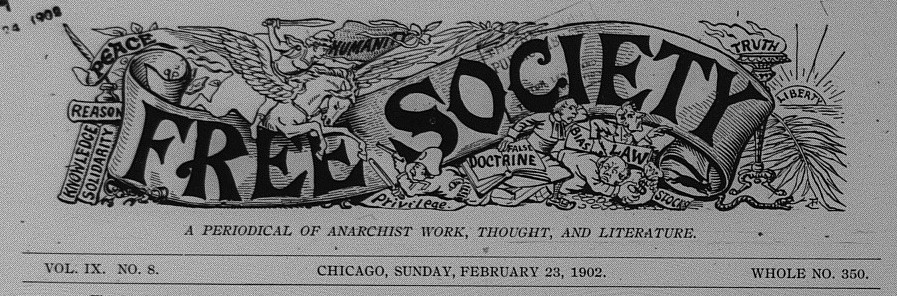
Here's a short article from Mary Hansen on socialism and the idea of social organism. This is from the issue for Sunday, February 23, 1902 (Vol. IX, No. 8, Whole No. 350), right-hand column of p. 3.

Social Organism Again.

That he who uses the social organism analogy does not see clearly, seems plain to me at least. A few weeks ago a prominent Socialist stood before an audience, and by way of proving social interdependence asked: Now if I were to cut off or injure these fingers would not my whole body suffer?" Yes! and following the same line of reasoning, if you injure half your organism the rest would suffer, and this under any circumstances. Now, if society were an organism, the same would be true of it, yet we do not find it so, since the injury done at present to the greater half of society only serves to increase the luxury of the other.

The more workers there are willing to starve on small wages and accept any injury, peaceably, that is caused by the avarice of their employers, the greater the profit and comfort of said employers, and the government officials, who could grow fat at leasure. Surely it would be difficult to show where the injury to society touches them.

Mary Hansen

Hansen was a Danish-American Anarchist who was (along with Voltairine de Cleyre, Natasha Notkin, and others) a regular participant in the Philadelphia Social Science Club and the principal author of the Club's classic pamphlet A Catechism of Anarchy. Free Society was published in Chicago but became a major venue for many of the Philadelphia Anarchists.

“Anarchism Exploded”

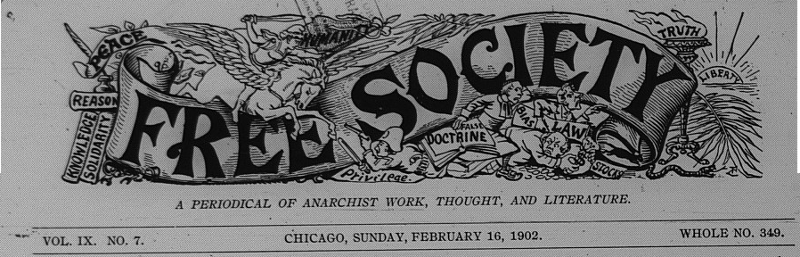
Here's an exchange from Free Society on liberty, trusts, and state socialism, from February 1902, between G. E. Lind and R. W. (presumably Ross Winn). The exchange appears in Free Society Vol. IX, No. 7, p. 3.

Anarchism Exploded.

When the economic development had transformed the social relations of the past into a state of society in which the material interests of one class of individuals became diametrically opposed to the material interests of the other class or classes of individuals, there naturally appeared various economic classes which in order to preserve themselves they were compelled to avail themselves of every opportunity in the struggle for supremacy which ensued. Therefore it was but natural that the class which had secured economic supremacy should make some claim to divine authority and the right to govern the economically inferior, while at the same time claiming to protect society. All this was done in order that the class which had attained economic supremacy might perpetuate its existence as rulers and exploit the economically inferior more successfully, hence the appearance of the State or government, which the Anarchists talk so much about, but understand so little.(1) Then the State is simply an effect instead of a cause, hence the absurdity of advocating the “abolition of the State without abolishing the class struggle which is the cause of the State.(2) Anarchism declares war on the State, which is just as nonsensical as the Democrats smashing the trusts, etc. Socialism would not smash the trusts or declare war on the State, but will absorb the State, and by so doing will absorb the trusts(3) and all the instruments of production and distribution, the result of which would be the abolition of economic classes and consequently the abolition of the oppressive capitalistic State, and the inauguration of the cooperative commonwealth.

G. E. Lind.

>

Comment

  1. But it was the Anarchists who first traced the origin of the State to the existence of a privileged class, and demonstrated that the perpetuation of the privileged class is the inevitable result of the State--its raison d'etre. We prove that privilege is only possible thru the support of the State, and that the abolition of the State is necessary to eliminate privilege.

  2. If, as you contend, the class struggle is the cause of the State's existence, and you wish to abolish the class struggle, you are simply taking another line of reasoning to reach the same objective point--viz., the abolition of the State, which you say is impossible. You appear to be slightly mixed--not an uncommon phenomenon with State Socialists.

  3. By establishing the most gigantic trust conceivable--a State monopoly. It is not the forms of monopoly that are evil; but its essence--the principle that abrogates liberty--that sets bounds upon the play of social activity.

  4. But your cooperative commonwealth, administered by State officials, will have society divided into two classes--the workers and the governmental directors of industries. The State boss with unlimited power, will constitute a class, and consequently the cooperative commonwealth will not abolish the class struggle. You seem to be in a fair way to explode the fallacies of your own philosophy.

R.W.

>

--Free Society: A Periodical of Anarchist Work, Thought, and Literature, Vol. IX, No. 7, Whole No. 349 (February 16, 1902). Chicago: A. Isaak, publisher. 3.