Fair Use Blog

1920s: “a jury indicted Bob Lemmons, an African American married to a Mexican woman, for violating the law forbidding miscegenation. He would not have been prosecuted were it not for the fact that he and his wife attempted to send their children to the white school instead of the black school.” (Foley, The White Scourge)

Miscegenation laws forbade the marriage of blacks with whites, but because Mexicans were often regarded as nonwhite, even if they were legally white, they were rarely, if ever, prosecuted.[13] In one particular case the law was applied for entirely different reasons than that of intermarriage. During the 1920s a jury indicted Bob Lemmons, an African American married to a Mexican woman, for violating the law forbidding miscegenation. He would not have been prosecuted were it not for the fact that he and his wife attempted to send their children to the white school instead of the black school. Mexican children in this township attended the white school in separate classrooms for the first two or three years; afterwards, only a token few, usually the ones Anglo teachers singled out as being “clean” and “not like the others,” were permitted to continue their education. A judge from Dimmit County, where the case was tried, told Paul Taylor: “The Negroes with Negro-Mexican children and the Mexicans wanted to send their children to the white school, so when that started… they just indicted and tried them for violating the law against intermarriage. Then they tipped off the women that if they had nigger blood they could not put the men in jail.”[14] Lemmon’s Mexican [209] wife confessed that she must be part black in order to have charges dropped against her husband for marrying a white person. This “proved that all the Mexicans were black,” reported one county resident, “so we put the Mexicans and Negroes together in school and employed a part Negro to teach them.”[15] The judge solved the problem of segregating Mexicans from whites in a town that had only two schools for three ethnic groups by changing the racial classification of Mexicans to black.

Neil Foley, The White Scourge: Mexicans, Blacks, and Poor Whites in Texas Cotton Culture (Berkeley: University of California Press, 1997), 208-209.


  1. [13]Interview with H. H. Schultz, U.S. Department of Agriculture, Austin, Texas, no. 192-363, folder “American Government Officials,” 74-187c, Taylor Papers. When whites married Mexicans, especially of the “peon” class (dark-skinned), they were said to have descended “to the level of the Mexicans” (interview with Mr. Martin, county agent, El Paso County, Texas, no. 85-90, folder “Along Rio Grande,” 74-187c, Taylor Papers). For a fine study of miscegenation law and racial ideology, see Pascoe, “Miscegenation Law,” 44-69.↩
  2. [14]Interview with Judge Wildenthal, no. 54-644, folder “Dimmit County,” 74-187c, Taylor Papers.↩
  3. [15]Interview with John Asker, no. 42-634, folder “Dimmit County,” 74-187c, Taylor Papers, and interview with Bob Lemmons, no. 246-417, folder “Dimmit County,” 74-187c, Taylor Papers. Asker told Taylor that he liked Mexicans but added, “You can’t make a rose out of an onion.”↩

1927: Spanish Language May Be Taught In Schools In Certain Counties

In a previous Act of the legislature passed a few years before, the Texas state legislature had passed a sweeping attack on bilingual education in the state of Texas in an act forbidding the use of languages other than English in Texas schools; by 1927, it became clear from community and teacher complaints that the text of the act effectively forbade even teaching foreign languages as courses in Texas schools. The Legislature passed a second act, amending the first Act to preserve the ban on languages other than English outside of foreign-language classes, but with an exception to allow for teaching foreign languages, including Spanish, German, and Bohemian (the original targets of the English-only law, which in the 19th century had been used in many community schools as a primary language of instruction).

Spanish Language May Be Taught in Schools in Certain Counties

[…]

Be it enacted by the Legislature of the State of Texas:

Section 1. That Article 288 of the Penal Code of the State of Texas adopted at the Regular Session of the Thirty-Ninth Legislature, 1925, be and the same is hereby amended so as to read as follows:

“Art. 288. Except as herein provided, each teacher, principal and superintendent employed in the public free schools of this State shall use the English language exclusively in the conduct of the work of the schools and recitations and exercises of the school shall be conducted in the English language, and the trustees shall not prescribe any texts for elementary grades not printed in English; provided, however, that it shall be lawful to provide text books for and to teach the Spanish language in elementary grades in the public free schools in counties bordering on the boundary line between the United States and the Republic of Mexico and having a city or cities of five thousand or more inhabitants according to the United States census for the year 1920. It is lawful to teach Latin, Greek, French, German, Spanish, Bohemian or other language as a branch of study in the high school grades as outlined in the state course of study. Any such teacher, principal, superintendent, trustee, or other school official having responsibility in the conduct of the work of such schools who fails to comply with the provisions of this article shall be fined not less than twenty-five nor more than one hundred dollars, cancellation of certificate or removal from office, or both fine and such cancellation or fine and removal from office.

Sec. 2. The fact that under the present law it is unlawful to teach Spanish in the elementary grades in the public free schools of this State and that in counties having cities of over five thousand population bordering on the boundary line between the United States and the Republic of Mexico, a knowledge of the Spanish language is of inestimable value to the citizens and inhabitants of such counties and cities, and the fact that in order to obtain a speaking knowledge and mastery of any foreign language, it is imperative that instruction in such language be begun at the earliest possible period and the crowded condition of the calendar creates an emergency and an imperative [268] public necessity that the constitutional rule requiring bills to be read on three several days in each House be suspended and that this Act take effect and be in force from and after its passage, and said rule is hereby suspended, and it is so enacted.

[…]

Approved March 28, 1927.

Effective (90) ninety days after adjournment.

H. P. N. Gammel, The Laws of Texas, 1927: Supplement Volume to the Original Ten Volumes, 1822-1897 (Austin, Texas: Gammel's Book Store, 1927), 283-284 (link).

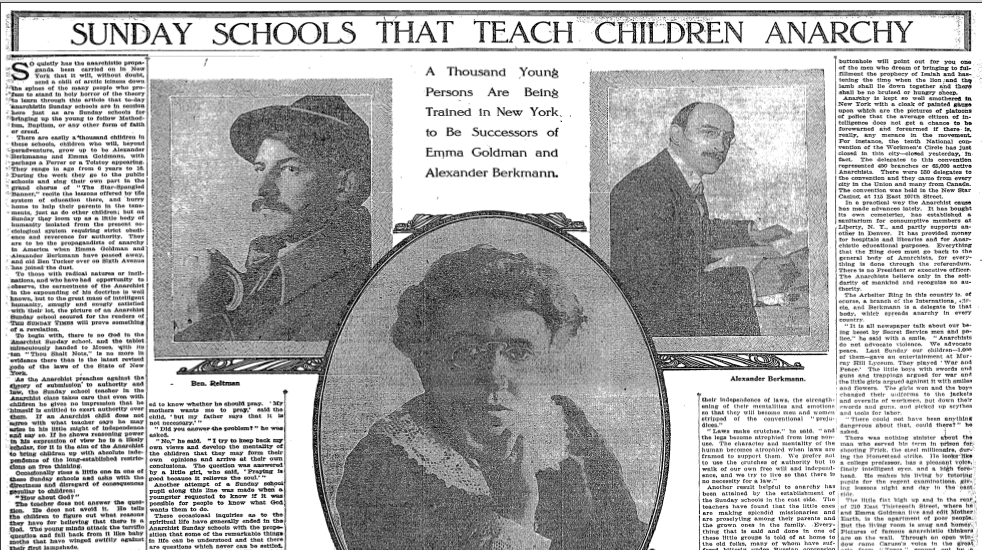
“Sunday Schools That Teach Children Anarchy,” from the New York Times (May 8, 1910)

Here's some more on mass-media reception of Anarchism during the early 20th century: a strange little piece from the Sunday New York Times magazine from May 8, 1910, on Anarchist Sunday schools in New York, focusing on the Ferrer Sunday School taught by Alexander Berkman. The Sunday schools were part of the large network of schools, cultural spaces and other institutions organized by Anarchists in large cities like New York during the early 20th century. (Like most Anarchistic educational projects, the Sundays were closely associated with the Modern School Movement and the thought of Francisco Ferrer). Either of the writer of the article, or his editor, couldn't quite seem to decide whether they wanted this story to be a straight interview of Berkman and a description of how the Sunday Schools were operated, or whether they wanted another cookie-cutter Anarchist-menace scare story.

SUNDAY SCHOOLS THAT TEACH CHILDREN ANARCHY

A Thousand Young Persons Are Being Trained in New York to Be Successors of Emma Goldman and Alexander Berkman.

So quietly has the anarchistic propaganda been carried on in New York that it will, without doubt, send a chill of arctic iciness down the spines of the many people who profess to stand in holy horror of the theory to learn through this article that to-day anarchistic Sunday schools are in session here just as are Sunday schools for bringing up the young to follow Methodism, Baptism, or any other form of faith or creed.

>

There are easily a thousand children in these schools, children who will, beyond peradventure, grow up to be Alexander Berkmanns and Emma Goldmans, with perhaps a Ferrer or a Tolstoy appearing. They range in age from 6 years to 16. During the week they go to the public schools and sing their own part in the grand chorus of "The Star-Spangled Banner," recite the lessons offered by the system of education there, and hurry home to help their parents in the tenements, just as do other children; but on Sunday they loom up as a little body of humanity isolated from the present sociological system requiring strict obedience and reverence for authority. They are to be the propagandists of anarchy in America when Emma Goldman and Alexander Berkmann have passed away, and old Ben Tucker over on Sixth Avenue has joined the dust.

To those with radical natures or inclinations, and who have had opportunity to observe, the earnestness of the Anarchist in the expounding of his doctrine is well known, but to the great mass of intelligent humanity, smugly and snugly satisfied with their lot, the picture of an Anarchist Sunday school secured for readers of The Sunday Times will prove something of a revelation.

To begin with, there is no God in the Anarchist Sunday school, and the tablet miraculously handed to Moses, with its ten Thou Shalt Nots, is no more in evidence there than is the latest revised code of the laws of the State of New York.

As the Anarchist preaches against the theory of submission to authority and law, the Sunday school teacher in the Anarchist class takes care that even with children he gives no impression that he himself is entitled to exert authority over them. If an Anarchist child does not agree with what teacher says he may arise in his little might of independence and say so. If he shows reasoning power in his expression of view he is a likely scholar, for it is the aim of the Anarchist to bring children up with absolute independence of the long-established restrictions on free thinking.

Occasionally rises a little one in one of these Sunday schools and asks with the directness and disregard of consequences peculiar to children:

How about God?

The teacher does not answer the question. He does not avoid it. He tells the children to figure out what reasons they have for believing that there is a God. The young minds attack the terrific question and fall back from it like baby moths that have winged swiftly against their first lampshade.

The largest of the Sunday schools is in Avenue A. It is called the Ferrer Sunday School, and was, until the killing of the Spanish philosopher, known as the Radical Sunday School. How the name was changed will prove a story that may stand out with striking novelty in the child life of New York to-day. It shall be told a little later in this article.

The Ferrer Sunday School is conducted by Alexander Berkmann. It has about eighty members and is in two classes. It meets on Sunday between 10 in the morning and noon. The youngest child is 7.

Berkmann has no laid-out system of teaching, depending on his comprehension of the psychology of the group at the time of the gathering. There are no rules. A song may be sung in chorus, a song dealing with freedom of mankind and hate for oppression. Some of the children may have learned by heart a poem or a fragment of an anarchistic argument and these provide recitations. The training of the mind anarchistically is then begun.

Berkmann, in a talk with a Times writer, in the office of Mother Earth, the Anarchist magazine, gave a sample of this teaching.

This was his talk to his Sunday school on Sabbath after the execution of Ferrer.

Once a single human being was swept from the sea to the shore of an island where there lived no human beings. There he found a great flock of sheep. He studied them and noticed that some of them were very powerfully built and finely fed. Some had even attained the strength and ferocity of wolves. But there were a great many of the sheep that were lean and worn. They were hungry and had been trampled down and hurt.

The man thought that he could so arrange it that these sheep, with little to eat and with bruises from being trampled, could be taught to care for themselves better and realize what the power of the strong and wolflike sheep had brought them to. He went among the sheep that suffered and began to point out to them what was the matter. The wolfish and strong ones heard of this and they turned upon the man and killed him.

When Berkmann finished this parable one of the children, a boy 18 years old, arose and said:

Why Mr. Berkmann, this story is just like the story of Ferrer's death.

The children were so impressed with the parable and the discussion which followed that the name of the school was then changed from the Radical Sunday School to the Ferrer Sunday School.

In the classes, said Berkmann, we generally use current events as subjects for discussion and study. For instance, one of our lessons was produced by the Hudson-Fulton Celebration in New York. The children of the east side saw a great deal of the sailors from the many men-of-war in the harbor. They saw the sailors of different nationalities entering and leaving the cafés, the best of friends, their arms about each other and acting like human brothers. The question naturally followed. Why should they be thus fond of each other and thus brotherly on land, and on sea be commanded to kill each other? They are brothers, and love each other, and there can be no fair reason for their slaying each other.

A man who had been raised in one of the old credal beliefs with care but who had come to be an agnostic in middle life once told the writer than when he realized that his religion had gone from him he felt that what he called reason had stepped into a nursery, and, like a willful bully, had gathered up the toys of a child sitting there and had destroyed them because he considered them useless. He considered the change from belief to agnosticism the tragedy of his life. The figure may be applied to thinking grown-ups easily, but it is hard to think of applying it to a child. And yet in the Anarchist Sunday school the tragedy of the destroyed toys is not infrequently enacted.

The pupil of the Anarchist Sunday school is taught to reason. The teacher only serves to direct their attention to a problem.

One child, said Berkmann, wanted to know whether he should pray. My mothers wants me to pray, said this child, but my father says that it is not necessary.

Did you answer the problem? he was asked.

No, he said. I try to keep back my own views and develop the mentality of the children that they may form their own opinions and arrive at their own conclusions. The question was answered by a little girl, who said, Praying is good because it relieves the soul.

Another attempt of a Sunday school pupil along this line was made when a youngster requested to know if it was possible for people to know what God wants them to do.

These occasional inquiries as to the spiritual life have generally ended in the Anarchist Sunday schools with the proposition that some of the remarkable things in life can be understood and that there are questions which never can be settled. The mental attitude of the children might be put in this way: We are not certain whether there are grounds for the belief that we should pray.

That, of course, leaves the question well in the field of agnosticism. The teacher of anarchy does not, with the children, declare that there is no God. Nor does he say that there is a God. The Sunday school class goes frequently to the Museum of Natural History, to Central Park, to the Zoological Gardens, and other places where, with the teacher, nature is studied.

The Ferrer Sunday school is only one of about fifteen similar schools in the greater city. Wherever the local groups of Anarchists can handle their own Sunday schools, carrying on the propaganda with literature, letters, lectures, &c., they do so without asking aid of others. When they cannot the State group helps. There is no central or superior group. Each has its own autonomy, although they all work to develop their principles of solidarity and mutual aid.

There are frequently conventions of the Sunday school teachers. Those who have classes get together and exchange experiences and ideas. In this city the Anarchists know that the fulfillment of their vision is afar, and they are already sowing their seed in the young and new fields that a generation of their kind may take hold of the propaganda when the present generation has withered and fallen.

These little Anarchists are being trained to believe in no authority. As Mr. Berkmann put it, everything is being done for them to aid them in the development of their independence of laws, the strengthening of their mentalities and emotions so that they will become men and women stripped of the conventional prejudices.

Laws make crutches, he said, and the legs become atrophied from long non-use. The character and mentality of human becomes atrophied when laws are framed to support them. We prefer not to use the crutches of authority but to walk of our own free will and independence, and we try to live so that there is no necessity for a law.

Another result helpful to anarchy has been attained by the establishment of the Sunday schools in the east side. The teachers have found that the little ones are making splendid missionaries and are proselyting among their parents and the grown ones in the family. Everything that is said and done in one of these little groups is told of at home to the old folks, many of whom have suffered bitterly under Russian oppression and who have revolution deep in their hearts. They write letters to the Anarchist teachers and get replies. They discuss the views expounded at home by their children and many of them become radicals and join the Anarchist groups.

The Anarchists also spread their propaganda by establishing little libraries which they make easily accessible to all who want to study the theory.

In the spreading of the propaganda among the children the littlest are not overlooked. There are some as young as six years of age who are getting kindergarten lessons in anarchy. One of these lessons is the lesson which preaches to a boy of health and strength at the age of six that he should not strike or abuse a boy who is not as strong as he is but should help him because he needs help. That is the very heart of the kindergarten lesson.

All of this work is done in what is called the Workmen's Circle. The Circle is the general group and is known as the Arbeiter Ring. A little white enamel badge with the letters A. R. in the buttonhole will point out for you one of the men who dream of bringing to fulfillment the prophecy of Isaiah and hastening the time when the lion and the lamb shall lie down together and there shall be no bruised or hungry sheep.

Anarchy is kept so well smothered in New York with a cloak of painted gauze upon which are the pictures of platoons of police that the average citizen of intelligence does not get a chance to be forewarned and forearmed if there is, really, any menace in the movement. For instance, the tenth National convention of the Workmen's Circle has just closed in this city--closed yesterday, in fact. The delegates to this convention represented 450 branches or 65,000 active Anarchists. There were 550 delegates to the convention and they came from every city in the Union and many from Canada. The convention was held in the New Star Casino, at 115 East 107th Street.

In a practical way the Anarchist cause has made advances lately. It has bought its own cemetaries, has established a sanitarium for consumptive members at Liberty, N. Y., and partly supports another in Denver. It has provided money for hospitals and libraries for Anarchistic educational purposes. Everything that the Ring does must go back to the general body of Anarchists, for everything is done through the referendum. There is no President or executive officer. The Anarchists believe only in the solidarity of mankind and recognize no authority.

The Arbeiter Ring in this country is, of course, a branch of the International Circle, and Berkmann is a delegate to that body, which spreads anarchy in every country.

It is all newspaper talk about our being beset by Secret Service men and police, he said with a smile. Anarchists do not advocate violence. We advocate peace. Last Sunday our children--1,000 of them--gave an entertainment at Murray Hill Lyceum. They played War and Peace. The little boys with swords and guns and trappings argued for war and the little girls argued against it with smiles and flowers. The girls won and the boys changed their uniforms to the jackets and overalls of workmen, put down their swords and guns, and picked up scythes and tools for labor.

There could not have been anything dangerous about that, could there? he asked.

There was nothing sinister about the man who served his term in prison for shooting Frick, the steel millionaire, during the Homestead strike. He looks like a college professor, has a pleasant voice, finely intelligent eyes, and a high forehead. He makes his living by tutoring pupils for the regent examinations, giving lessons night and day in the east side.

The little flat high up and in the rear of 210 East Thirteenth Street, where he and Emma Goldman live and edit Mother Earth, is the apartment of poor people. But the living room is snug and homey. Pictures of famous anarchistic thinkers are on the wall. Through an open window came Caruso's voice in the great aria from Tosca, ground out by a phonograph, as Berkmann talked with the Times man. It was a warm combination, but the night was warm, and we were glad for the breeze that swept the little place however burdened it might be.

We teach no ism, he said, harking back to the Sunday schools. Our aim is to develop character and mentality in the child. We try to make them think, criticise, and feel.

We want their emotional and intellectual natures developed. We want to make them men and women absolutely free of the old restrictions. We hope that they will grow up with the spirit of solidarity and co-operation in them. We try to teach them that in and out of school.

We try to teach them ethical right and reason. Our Radical Boys' Literary Club, boys about 13 or 14 years old, hold meetings after school, and they run their organization just as the grown people do. They have advanced to where they need no help from their elders.

Among the grown Anarchists the cause is kept warm by fervid preachings in their publications. These are the weekly paper Frei Arbiter Stimme, with a circulation of 12,000; Mother Earth, with a circulation of 6,000; Freiheit, with 5,000 circulation, and Voine Listy, a Bohemian paper, with a circulation of 4,500.

There are nine large groups of the grown Anarchists in New York. These have regular meetings, and conduct the propaganda with lectures, debates, &c.

In the district from Fourteenth Street to the Battery east of Broadway are 850,000 people living. Here beats the heart of anarchy. Nearly all of these people are foreign born, the native born element being insignificant in its percentage.

Forsyth Street, Chrystie, Cannon, Pitt, Columbia, Second Streets all have buildings in which are tiny halls that may be rented for a dollar or two for a wedding, a banquet, a lodge meeting, or a group meeting of Anarchists.

The man who lives awhile in this teeming corner of Manhattan does not take long to find out where he can go and hear all the anarchy he wants expounded. The writer once met in one of these little halls S. Yanofsky, the editor of the Frei Arbiter Stimme. A man with dreamy eyes, pointed beard, and nervous energy, he seemed to be looked up to as little short of a god by a clump of young men and women who were wating for him.

Yanofsky and Berkmann were both rounded up by the police after the Silverstein bomb explosion in Union Square in 1908, and as there was nothing against either of them nothing came of the call to Police Headquarters. Yanofsky, when asked by the writer what he thought of Silverstein's act, replied:

The man who commits a violent deed, if he is not mad, is desperate. Violence never did any good for anarchy. All government is a form of violence. Suppose Silverstein had suffered personally--and his act was that of an impatient and ignorant man--what did he accomplish? He only made himself dead and gave the chance to the enemies of anarchy to spread their calumnies. He only helped them to kill of the chances of gaining liberty.

Berkmann was a little clearer on the matter of violence and anarchy.

If a Republican or Democrat should throw a bomb or kill another, he said, the Republican Party or the Democratic Party would not be blamed for it. When an Anarchist does a thing like that we frankly say that anarchy did not inspire it, but that conditions of inequality and injustice caused the crime. To stop the crime, stop the cause. Anarchy is for justice and freedom. It cannot be blamed for individual acts of violence.

Among the favorite east side speakers for anarchy, besides Yanofsky and Berkmann, is Dr. Ben Reitman, whose method is to stir up the hearers with fiery sentences depicting the wrongs resulting from the present order of things. He with the others believes that anarchy is gathering strength, and will continue to gather it and will prove a living force in the slow movement of society through the ages.
Over My Shoulder #28: on women in Iran and the Islamic Revolution, from Azar Nafisi’s The Stuff that Dreams are Made Of, in My Sister, Guard Your Veil; My Brother Guard Your Eyes

Here’s the rules:

  1. Pick a quote of one or more paragraphs from something you’ve read, in print, over the course of the past week. (It should be something you’ve actually read, and not something that you’ve read a page of just in order to be able to post your favorite quote.)

  2. Avoid commentary above and beyond a couple sentences, more as context-setting or a sort of caption for the text than as a discussion.

  3. Quoting a passage doesn’t entail endorsement of what’s said in it. You may agree or you may not. Whether you do isn’t really the point of the exercise anyway.

Here’s the quote. This is from the opening essay of My Sister, Guard Your Veil; My Brother, Guard Your Eyes, a collection of essays by Iranian writers, artists, and intellectuals. The essay is The Stuff Dreams are Made Of, by Azar Nafisi (known to you, perhaps, as the author of Reading Lolita in Tehran). Here she talks about women’s struggle in Iran, before, during, and after the Islamic Revolution, including some things that even well-meaning folks in the United States (let alone the bellowing blowhard brigade) tend to forget:

In the fall of 1979, I was teaching Huckleberry Finn and The Great Gatsby in spacious classrooms on the second floor of the University of Tehran, without actually realizing the extraordinary irony of our situation: in the yard below, Islamist and leftist students were shouting Death to America, and a few streets away, the U.S. embassy was under siege by a group of students claiming to follow the path of the imam. Their imam was Khomeini, and he had waged a war on behalf of Islam against the heathen West and its myriad internal agents. This was not purely a religious war. The fundamentalism he preached was based on the radicla Western ideologies of communism and fascism as much as it was on religion. Nor were his targets merely political; with the support of leftist radicals he led a bloody crusade against Western imperialism: women’s and minorities’ rights, cultural and individual freedoms. This time, I realized, I had lost my connection to that other home, the America I had learned about in Henry James, Richard Wright, William Faulkner, and Eudora Welty.

In Tehran, the first step the new regime took before implementing a new constitution was to repeal the Family Protection Law which, since 1967, had helped women work outside the home and provided them with substantial rights in their marriage. In its place, the traditional Islamic law, the Sharia, would apply. In one swoop the new rulers had set Iran back nearly a century. Under the new system, the age of marital consent for girls was altered from eighteen to nine. Polygamy was made legal as well as temporary marriages, in which one man could marry as many women as he desired by contract, renting them from five minutes to ninety-nine years. What they named adultery and prostitution became punishable by stoning.

Ayatollah Khomeini justified these actions by claiming that he was in fact restoring women’s dignity and rescuing them from the degrading and diabolical ideas that had been thrust upon them by Western imperialists and their agents, who had conspired for decades to destroy Iranian culture and traditions.

In formulating this claim, the Islamic regime not only robbed the Iranian people of their rights, it robbed them of their history. For the true story of modernization in Iran is no that of an outside force imposing alien ideas or—as some opponents of the Islamic regime contend—that of a benevolent shah bestowing rights upon his citizens. From the middle of the nineteenth century, Iran had begun a process of self-questioning and transformation that shook the foundations of both political and religious despotism. In this movement for change, many sectors of the population—intellectuals, minorities, clerics, ordinary people, and enlightened women—actively participated, leading to what is known as the 1906 Constitutional Revolution and the effective implementation of a new constitution based on the Belgian model. Women’s courageous struggles for their rights in Iran became the most obvious manifestation of this transformation. Morgan Shuster, an American who had lived in Iran, even stated in his 1912 book, The Strangling of Persia: The Persian women since 1907 had become almost at a bound the most progressive, not to say the most radical, in the world. That this statement upsets the ideas of centuries makes no difference. It is the fact.

By 1979, at the time of the revolution, women were active in all areas of life in Iran. The number of girls attending schools was on the rise. The number of female candidates for universities had increased sevenfold during the first half of the 1970s. Women were encouraged to participate in areas previously closed to them through a quota system that offered preferential treatment to eligible girls. Women were scholars, police officers, judges, pilots, and engineers—present in every field except the clergy. In 1978, 333 out of 1,660 candidates for local councils were women. Twenty-two were elected to the Parliament, two to the Senate. There was one female Cabinet minister, three sub-Cabinet undersecretaries (including the second-highest ranking officials in both the Ministry of Labor and the Ministry of Industries), one governor, one ambassador, and five mayors.

After the demise of the shah, many women, in denouncing the previous regime, did so demanding more rights, not less. They were advanced enough to seek a more democratic form of governance with rights to political participation. From the very start, when Islamists attempted to impose their laws against women, there were massive demonstrations, with hundreds of thousands of women pouring into the streets of Tehran protesting against the new laws. When Khomeini announced the imposition of the veil, there were protests in wihch women took to the streets with the slogans: Freedom is neither Eastern nor Western; it is global and Down with the reactionaries! Tyranny in any form is condemned! Soon the protests spread, leading to a memorable demonstration in front of the Ministry of Justice, in which an eight-point manifesto was issued. Among other things, the manifesto called for gender equality in all domains of public and private life as well as for the guarantee of fundamental freedoms for both men and women. It also demanded that the decision over women’s clothing, which is determined by custom and the exigencies of geographical location, be left to women.

Women were attacked by the Islamic vigilantes with knives and scissors, and acid was thrown in their faces. Yet they did not surrender, and it was the regime that retreated for a short while. Later, of course, it made the veil mandatory, first in workplaces, then in shops, and finally in the entire public sphere. In order to implement its new laws, the regime devised special vice squads, called the Blood of God, which patrolled the streets of Tehran and other cities on the lookout for any citizen guilty of moral offense. The guards could raid shopping malls, various public spaces, and even private homes in search of music or videos, alcoholic drinks, sexually mixed parties, and unveiled or improperly veiled women.

The mandatory veil was an attempt to force social uniformity through an assault on individual and religious freedoms, not an act of respect for traditions and culture. By imposing one interpretation of religion upon all its citizens, the Islamic regime deprived them of the freedom to worship their God in the manner they deemed appropriate. Many women who wore the veil, like my own grandmother, had done so because of their religious beliefs; many who had chosen not to wear the veil but considered themselves Muslims, like my mother, were now branded as infidels. The veil no longer represented religion but the state: not only were atheists, Christians, Jews, Baha’is, and people of other faiths deprived of their rights, so were the Muslims, who now viewed the veil more as a political symbol than a religious expression of faith. Other freedoms were gradually curtailed: the assault on freedom of htep ress was accompanied by censorship of books—including the works of some of the most popular classical and modern Iranian poets and writers—a ban on dancing, female singers, most genres of music, films, and other artistic forms, and systematic attacks against the intellectuals and academics who protested the new means of oppression.

In a Russian adaptation of Hamlet distributed in Iran, Ophelia was cut out from most of her scenes; in Sir Laurence Olivier’s Othello, Desdemona was censored from the greater part of the film and Othello’s suicide was also deleted because, the censors reasoned, suicide would depress and demoralize the masses. Apparently, the masses in Iran were quite a strange lot, since they might be far more demoralized by witnessing the death of an imaginary character onscreen than being themselves flogged and stoned to death …. Female students were reprimanded in schools for laughing out loud or running on school grounds, wearing colored shoelaces or friendship bracelets; in the cartoon Popeye, Olive Oyl was edited out of nearly every scene because the relationship between the two characters was illicit.

The result was that ordinary Iranian citizens, both men and women, inevitably began to feel the presence and intervention of the state in their most private daily affairs. The state did not merely punish criminals who threatened the lives and safety of the populace; it was there to control the people, to flog and jail them for wearing nail polish, Reebok shoes, or lipstick; it was there to watch over young girls and boys appearing in public. In short, what was attacked and confiscated were the individual and civil rights of the Iranian people.

—Azar Nafisi, The Stuff that Dreams are Made Of, in My Sister, Guard Your Veil; My Brother, Guard Your Eyes: Uncensored Iranian Voices (2006; ISBN 0807004634), pp. 2–6.

Over My Shoulder #16: Michael Fellman (2002), The Making of Robert E. Lee

You know the rules. Here’s the quote. This is another passage from from Chapter 4 (Race and Slavery) of Michael Fellman’s The Making of Robert E. Lee (2000) (see also GT 2006-02-24: Over My Shoulder #12). Here’s some more on the Lees, slavery, and the slaves at Arlington. It’s mostly about Robert E. Lee’s wife Mary, but be sure to note Robert’s sanctimonious attempts to dissuade her from even taking the modest step of ransoming a slave from an especially cruel slave-driver. (In this matter is everything to be yielded to the servant, & nothing allowed to the master? Well…) It would be interesting to know whether the two white strangers were connected at all with the Norrises’ attempted escape the following year or the anonymous letters to the New York Tribune about their capture (which were, like most 19th century letters to the editor, published anonymously). In any case:

Lee’s views on slavery were considerably influenced by the opinions and activities of his wife and his mother-in-law, both of whom were deeply involved in the American Colonization Society, an early form of ambiguous antislavery activism, which sought to free the slaves by sending them back [sic] to Africa. As a young married woman, this project was a commitment of Mary’s heart and nost just her head. She wished to nurture, educate, and catechize the family slaves right away, in preparationfor eventual manumission and export. She wrote her mother in 1831, I hope that we may be able to do something in time for the spiritual benefit of those neglected slaves and for their eventual freedom. Because on these terms liberty meant expulsion of the entire inferior black race with whom whites could never imagine cohabiting on an equal footing, such colonizationism was racist antislavery doctrine.

In her diary for the 1850s, Mary frequently discussed the project. She joined her mother, she wrote, in the hope that one day all their slaves would be able to emigrate to Africa, so that they could carry light & Christianity to that dark heathen country. Nevertheless, admitting to a presentiment that she would not live long enough to carry out this grand scheme, she proposed to try it gradually. She picked her slave William and his family to act as pioneers, a kind of pilot project. And then she stated the larger purpose of the heart that lay behind her social project: What is life worth unless you can accomplish in it something for the benefit of others, especially of those so entirely dependent upon one’s will and pleasure.

Mary’s body servant, Eliza, was another pet project. I have always promised Eliza her freedom to emigrate to Africa in a few years. … If she will go to Africa she can have her freedom, Mary Lee wrote in her diary in 1853. She feared, however, that Eliza might marry here and be unwilling to go, especially if she should marry a free man. In the event, Mary Lee noted in 1860 that Eliza had her freedom and that she now lived in Newport with her husband. Somehow, Eliza had secured her freedom while avoiding being shipped back [sic] to Afirca. Such was the outcome favored by the vast majority of manumitted slaves, whatever the desires of their former masters.

As an interim measure on her slaves’ path to freedom and repatriation, Mary Lee, with the help of her daughters, set up a school for slaves, almost certainly a Sunday school, on the Arlington plantation. This was an unusual move, because the overwhelming majority of slave owners feared rightly that literacy would give slaves acces to seditious abolitionist materials, which would lead them to demand or seize their freedom. In 1819, this concern had led the Virginia legislature to outlaw education for blacks, but several of Virginia’s clergymen continued to encourage Sunday schools, arguing that the gentry class would answer to God, not to the legislature. It is not clear how many slaveholders in addition to the Lees followed this path of circumspect lawbreaking.

At least occasionally, Agnes Lee taught in this school for slaves in the mid-1850s. In her journal, she expressed her attitude and that of her father toward her students. I must put down my pen … & go teach my little scholars. We have a considerable number of ebony mites as Papa calls them & as no one knows as much as another it makes their instruction very tedious. Off to school she went, only to find an empty room. Well! I have gone down, I insist upon teaching them in classes & yet only one of my class ever arrived [in] time so I have employed this odd moment in writing.

Agnes’s pen dripped racial condescension even as she earnestly broke the law. Her view on her pupils’ tardiness reflected the Southern white contempt for slaves’ perceived lack of punctuality (although it must be noted that Northern factory managers had the same complaints about their workers, who also thus resisted discipline and set their own work schedules). The amused phrase ebony mites also demonstrated her father’s doubts about a project in which he disbelieved, although he did nothing to stop it, probably regarding it as harmless. While influenced by Mary’s colonizationist project, he was generally rather skeptical of its value, and sometimes he doubted whether Mary’s do-goodism was a very wise course. In one rather complex case in 1841, Robert attempted to dissuade Mary’s project of buying a slave off an unkind master in order to free him. In judging of results you must endeavour to lay aside your feelings & prejudices & examine the question as thus exposed. In this matter is everything to be yielded to the servant, & nothing allowed to the master? What will the effect of the precedent be on the rest [of the slaves and on] your father and his authority? Lee promised that he would comply with her wishes, but he urged her to consider well upon the matter & act for yourself.

After her father’s slaves became hers and Robert’s, Mary hardened her attitude toward them. On February 10, 1858, when Robert was trying to sort out the chaos on the other Custis plantations, Mary wrote an old friend about his efforts in trying to reduce these very complicated affairs into some order: It is very unsatisfactory work for the servants here have been so long accustomed to do little or nothing that they cannot be convinced of the necessity now of exerting themselves, in order to speed up the accomplishment of the promise of freedom in the will. Actually, Mary was being illogical, as the promise had been given unconditionally, albeit for five years down the line. Then Mary continued, unless there is a mighty change wrought in them I do not know what good they will do themselves, but at any rate we shall be relieved from the care of them which will be an immense burden taken from our shoulders. Actual experience in manumission was hardly proving to be the fulfillment of the colonizationist dreams of years past.

Over the next week, Mary continued to brood. On February 17, she wrote to W. G. Webster that two white men had been constantly lurking about with the servants & telling them that they had a right to their freedom immediately & that if they would unite & demand it they would obtain it. Only the merciful hand of a kind Providence … prevented an outbreak. Their freedom is a very questionable advantage to any but ourselves who will be relieved from a host of idle & their useless dependents. Of course, colonization had always promised masters relief from their slaves, but here Mary Lee dropped the charitable aspect of the project—the rationalization that it was intended for the good of blacks—and treated manumission as a racial safety valve for white masters.

Not colonization but her father’s will had freed these slaves, and Mary was retrospectively exasperated with him. My dear father in his usual entire ignorance of the state of his affairs has left provision in his will which it will be almost impossible to fulfill even in double 5 years. Just sending them out of the state, which Virginians freeing their slaves were required to do, would be prohibitively expensive, she believed. She then drew the sarcastic conclusion that we should be most deeply indebted to their kind friends the abolitionists if they would come forward [and purchase their] freedom at once.

It even gave Mary Lee a certain perverse satisfaction to note the virulent racism in Canada, that land of freedom to which thousands of slaves had fled, when she visited some hot springs there in 1860. There are a great number of runaways here, but I have not met with any acquaintances, Mary Lee wrote her daughter Annie. The white people say that before long they will be obliged to make laws to send them all out of Canada, so I see no place for them but Africa. I am told they suffer a great deal here in the long cold winters. After enticing them over here the white people will not let their children go to the same schools or treat them as equals in any way. Amalgamation—interracial marriage—is out of the question tho occasionally a very low white woman marries a black man. Either blacks had to be dominated by kind masters within slavery, or else they had to be returned to Africa. They could never live in equality with whites anywhere in North America, and freedom would bring them only into a condition worse than slavery. The Canadian racism she observed confirmed Mary’s beliefs in white supremacy and black degradation.

As the Civil War approached, given their experiences, both the Lees were disgusted with slavery. At the same time, they were prepared to defend it as the only viable safeguard of white control over blacks until that distant day when the South might be whitened through complete African repatriation [sic].

—Michael Fellman (2000), The Making of Robert E. Lee. New York: Random House, ISBN 0679456503. 67–72.