Fair Use Blog

Countereconomics on the shopfloor

So lately I’ve been reading through a cache of syndicalist and autonomist booklets that I picked up a couple years ago from a NEFACker friend of mine who was soon to move out of Vegas. Partly for my own edutainment, but also because I am doing some prep work for possibly introducing a sort of Little Libertarian Labor Library to the ALL Distro.[1] Anyway, here’s a really interest passage I ran across in a booklet edition of Shopfloor Struggles of American Workers — a talk by the Detroit auto-worker and autonomist Marxist Martin Glaberman — on the difference between asking workers to vote on an issue and asking them to strike over it, taking as an example the internal conflicts over the union bosses’ no-strike pledge during World War II.

One of the things I want to start with, because it does provide a framework, and is not simply an event from the past, is something I did some work on a number of years ago about auto workers in the United States during World War II, the kinds of struggles that went on on the shop floor, within the union, between the workers and the government, a complex reality. What it revolved around was the struggle against the no-strike pledge in the UAW When the United States entered World War II, virtually all of America’s labor leaders graciously granted in the name of their members a pledge not to strike at all during the war.

In the first months of the war, the first year, there was an actual drop off in strikes. The end of 1941 through 1942 was a period that put a finish to the late thirties, the massive organizational drives, the sit-down strikes, the violence, all the things that created the big industrial unions. The job hadn’t been entirely done. Ford wasn’t organized until early 1941. Little Steel wasn’t organized, unionized, until the war was well under way, and so on.

Gradually, however, as the war went on, the number of strikes, (by definition all of them were wildcats, all of them were illegal under union contracts and under union constitutions) began to escalate until by the end of the war, the number of workers on strike exceeded anything in past American labor history. What was distinct about the UAW wasn’t just that the wildcat strikes were larger in number and more militant, but the fact that something took place which made it possible to make a certain kind of record. It was the only union in which, because there were still two competing caucuses, leaving rank and file workers a certain amount of democratic leeway to press for their point of view, an actual formal debate and vote took place on the question of the no-strike pledge.

A small, so-called rank and file, caucus was organized late in 1943 and early 1944, to begin a campaign around a number of issues, but the central issue was the repeal of the no-strike pledge. … So[2] they proceeded to have a referendum. This referendum was in some respects the classic sociological survey. Everyone got a postcard ballot. Errors, cheating, etc. were really kept to a minimum. Everyone on the commission thought that it was as fair as you get in an organization of a million or more members. It took several months to do. When the vote was finally in, the membership of the UAW had voted about two to one to reaffirm the no-strike pledge.

The conclusion any decent sociologist would draw is that autoworkers on the whole thought that patriotism was a little bit more important than class interests, that they supported the war rather than class struggle and strikes, etc. There was a little problem, however, and this is why this is such a fascinating historical experience. The problem was that at the very same time that the vote was going on, in which workers voted two to one to reaffirm the no-strike pledge, a majority of autoworkers struck ….

To visualize it is fairly simple: you’re not voting on the shop floor; you get this postcard, you’re sitting at the kitchen table, you’re listening to the radio news with the casualty reports from Europe and the Pacific and you think, yes, we really should have a no-strike pledge, we’ve got to support our boys. Then you go to work the next day and your machine breaks down and the foreman says, Don’t stand around, grab a broom and sweep up, and you tell him to go to hell because it’s not your job and the foreman says he’s going to give you time off and the next thing you know, the department walks out. … The reality is that in a war which was probably the most popular war that America took part in, workers in fact, if not in their minds or in theory, said that given the choice between supporting the war or supporting our interests and class struggle, we take class struggle.

— Martin Glaberman, Shopfloor Struggles of American Workers (1993?)

Glaberman puts this out as a distinction between what workers say in their minds or in theory and what they say or do in fact. I’m not sure that’s right — doesn’t the story about the foreman involve the workers’ mind and beliefs just as much as the story about the kitchen table? — but I think the most important thing here is Glaberman’s attention to the context at the point of decision, and how that shapes what kind of decision a worker thinks of herself as making. Not just the outcome of the choice, but really the topic, whether the worker is asked to make some kind of political choice about what she ought, in some general and detached sense, she ought to value (isn’t Patriotism important?), or she finds herself making an engaged, personal choice about what’s happening — what’s being done — to her and her fellow workers right now, on the margin. There is a lesson here for counter-economists.

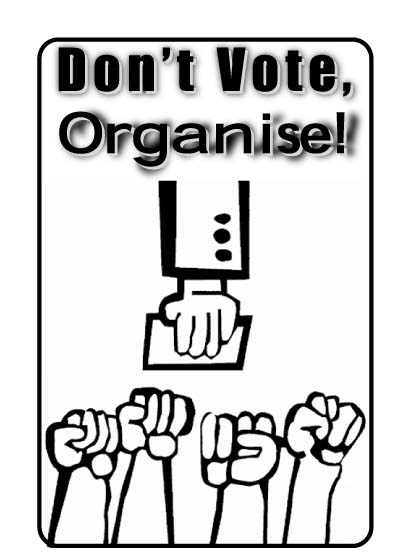
Freedom is not something you vote on. It’s something you struggle for. And what’s far more important than trying to figure out how to get people to endorse the right ideology, or, worse, the least-bad set of policies and candidates to each other across the kitchen table, is figuring out how you and your neighbors can best cooperate with each other, practice solidarity and withdraw from maintaining and collaborating with the state. People who would never respond to a smaller-government candidate or a libertarian ideological pitch often will act very differently when you open up opportunities to support grassroots alternatives and withdraw from the day-to-day inhumanities of war taxes, regulations, police, prisons, borders, and the state-supported and state-supporting corporate capitalist economy. Meanwhile, those who talk all day about changing votes, and building parties to more effectively capture a few more votes here and there, and have nothing else to offer, are wasting time, resources, and organizing energy on efforts that are not merely futile, but in fact actively lethal to any hope of motivating and coordinating effective practical action.

See also:

  1. [1] The basic idea: L4 would encompass some of the material we already have (Chaplin’s General Strike, Carson’s Ethics of Labor Struggle) and a lot of new and classic material, with new titles published at regular intervals, all with the basic underlying goal of (1) providing some decent labor-oriented materials for ALL locals, and (2) providing a decent source (mostly, currently, lacking) for IWW local organizing committees and other radical labor efforts to find some decently produced, low-cost booklet-style materials for lit drops and outreach tables, beyond just the IW, Anarcho-Syndicalist Review, and the relatively expensive books you can purchase through GHQ. ↩
  2. [2] [After an inconclusive floor debate in convention. —RG] ↩

The history of the Black Metropolis, the inner city, and the underground economy in Southside Chicago (from Sudhir Alladi Venkatesh, Off the Books)

This is from the first chapter, Living Underground, in Sudhir Alladi Venkatesh's Off the Books:

Though you wouldn't know it by looking at the dilapidated streets and empty lots, Maquis Park has a storied history. From the neighborhood's beginnings in the mid-nineteenth century until the early 1900s, working-class Irish immigrants populated the community. The region as a whole changed in the mid-twentieth century. African Americans pushed southward from areas near the central business district in search of cheaper rents and better neighborhood conditions. They moved into communities like Maquis Park that had been largely closed off due to segregation, real estate discrimination, and redlining by banks. Migrants also came from the sharecropping American South, and their arrival by the thousands in Chicago meant that the ghetto was always on the verge of bursting at its seams. Maquis Park's white homeowners had used restrictive covenants to prevent the sale of homes to blacks, but such resistance was futile in the face of overwhelming population growth and the expansion of the black community.

As their numbers grew, black Chicagoans built a Black Metropolis. Maquis Park became part of a broad area of black Southside settlement where migrants and native black Chicagoans could find comfort, opportunity, and a place of their own in the bustling city. But largely they were shunted off from much of that city due to the racism of their white neighbors and the ruling white machine. While they lobbied, protested, and struggled for their share, as a partial response they turned their energies inward. Maquis Park and its neighboring areas became a parallel urban world, integrated into Chicago yet set off because its inhabitants developed institutions that mirrored those of the larger metropolis but served mostly black Chicagoans. They forged what at the time was called a city within a city.

The Southside Black Metropolis would be alternatively celebrated and criticized. It held a thriving black press, prominent black businesses, healthy and active civic associations, and the kind of diversity and spontaneity one would expect to find in an urban milieu. It was known as Bronzeville, a term that honored the unrelenting spirit and commitment of black Americans to forge the good life. On the other hand, its residents were cut off from many political and economic resources, and they were largely unable to acquire homes or run businesses in white neighborhoods. Thus the Southside suffered overcrowding and inadequate housing, limited commercial development, high unemployment, and severe blight. A mansion might adjoin a transient hotel, and a row of shacks might sit opposite a thriving entertainment district. The most prosperous black Americans were reminded daily of the ceiling on social mobility that kept them segregated and that forced them to fend for themselves when the city's institutions failed them. For this, they shouted at both the ruling political elites and their own black political representatives who worked in the city machine.

In their drive to provide for themselves, black Chicagoans developed an alternate, underground economy--one interrelated to, but distinct from, the wider urban political economy. Even though black laborers were a significant part of the city's industrial and service sector labor force, there were not enough jobs available for black job seekers. So they worked for menial, off-the-books wages, often in their own community, as janitors and cleaners, waiters and entertainers, shoe shiners, tailors, house-painters, and general laborers. Whites would not hire black contractors for home repair, but they would turn to black women for domestic help, housecleaning, and child care, and they typically paid them under the table. Although black businesses flourished, there was inadequate financial assistance available from white-owned banks. So those starting businesses and those needing cash to survive a downturn went to unregulated creditors, loan sharks, and political bosses for a loan--for which they faced not only high interest rates but also physical harm if they were unable to repay. A significant share of this parallel economy involved criminal work, like numbers running and vice, in which not only were the earnings unreported but the activities themselves were illegal.

The outcome of all these practices was the emergence of a vibrant shady economy in Chicago's Southside. Well into the postwar era, the Black Metropolis boasted a vibrant alternative sphere of exchange and trading that supplanted the mainstream commercial sphere. It was not only a necessity, it was also a core part of the cultural life of the region. Politicians grew famous by dispensing patronage in the form of city contracts and off-the-books work--sometimes for a kickback and always for a vote on election day. In entertainment and gambling, unreported income was always available if one had connections to the ward boss, madam, or loan shark who controlled numbers, betting, local lotteries, brothels, and gambling parlors. Storied films like Uptown Saturday Night and Cotton Comes to Harlem spoke to the flattering view that many people, not just in black America but the country as a whole, held of the shady aspirant. For centuries, the outlaw, fighting both government and the entrenched powers to rise above the fray and accumulate wealth, has been an American hero, and in the mid-twentieth century this figure found an avatar in the black ghetto hustler.

After the civil rights era, Maquis Park suffered the fate of many American inner cities. Its wealthier classes left and moved into previously segregated areas, while its working and poor households remained. The area lost whatever mitigating effect on poverty the better-off households once contributed--to ensure that some streets were cleaned, that some parks were maintained, that some schools were kept in decent condition--and blight overwhelmed the physical landscape. Many of the beautiful brownstones reached a level of disrepair that required attention beyond the financial resources of their owners. Apartment buildings became abandoned due to neglectful landlords and the out-migration of the middle- and upper-class families. Sanitation services grew insufficient, and one saw litter and refuse everywhere. The homeless set up camp in the abandoned buildings but also in shanties alongside roads and in parks. People sat idle and out of work nearly everywhere.

But the alternate economy continued to thrive. Indeed, the underground economy was fast becoming a primary economy for black ghetto dwellers. Buying goods cheaply, whether on the street or in the alley, behind closed doors or outside of the neglectful state, was still part of their recipe for household survival. Off-the-books services, from tax preparation and general labor to security and entertainment, were plentiful.

Hustling was the word coined in popular discourse to refer to the indefatigable and creative attempts by the down-and-out to find work, make a buck, and make ends meet. But importantly, hustling included not only the labor to find illicit earnings, but also the work entailed in dealing with the consequences of living by shady means. Hustling meant insecurity, crime, and exploitative behavior, to which people had to respond. And in a time period when policing was inadequate and law enforcement relations with inner-city neighborhoods throughout black urban America were colored by neglect and distrust, it meant people sometimes had to take matters into their own hands. Thus, the hustle also involved a diverse set of strategies to make sure that the shady world did not completely ruin the social fabric. These strategies were often as creative as the illegal activities themselves. Whether they settled disputes or enforced underground contracts, people hustled not only to put food on the table, but also to maintain order in their streets and communities.

In time, the coexistence of despair and the outlaw lifestyle would draw the attention of those in the wider world. A wellspring of public scrutiny arrived at the doorstep of communities like Maquis Park in the eighties, after nearly two decades of poverty, unemployment, business failure, and high crime had swept through and ravaged the social and physical landscape. In academic and press reportage, critics and scholars tried to make sense of the apparently marked remove of the black ghetto from the mainstream. In The Truly Disadvantaged, sociologist William Julius Wilson diagnosed the presence of a subclass of black Americans living not only in conditions of extreme impoverishment, but also in relative remoteness from their surrounding city. More than their inability to find work marked their social isolation, Wilson argued. They suffered from inadequate integration into many urban institutions, from the police and schools to philanthropy and the press. And, he pointed out, unlike the mid-twentieth century there were no middle-class persons to serve as role models or provide social controls over unruly and delinquent behavior that was now growing out of control.

Following Wilson's essay, a flurry of critical assessment arose over the black ghetto. Scholars focused on the household as the root cause of isolation, deploying all kinds of statistical data--such as the alarming rate of teenage pregnancy, high rates of welfare dependency, absentee fathers and mother-led families--in an effort to isolate the role of black family formation in the reproduction of poverty. Detailed press reports, like Ken Auletta's The Underclass, spoke of the cultural pathologies, such as a lack of work ethic and a predilection for unruly behavior, that had been spawned in areas seemingly forgotten by time and morality. Human interest reportage, like Alex Kotlowitz's There Are No Children Here, pointed out the limited mental horizons of inner-city youth and young adults; few of these young people could envision a life for themselves beyond the ghetto, in marked contrast to the yuppies who were defining the renewed American spirit in the era of globalization. By the beginning of the eighties, when cities initiated revitalization programs to attract middle- and upper-class residents, the ghetto was pitied for what it lacked (normal families, good schools, working adults) and criticized for what it boasted (gangs, drugs, and crime).

In a way, this kind of attention to the urban underclass was nothing new. From the late nineteenth century onward, Chicago's black communities (and those in other major industrialized cities) were the repositories for public indignation and, eventually, some type of social reform. The clarion call of distress over a population living outside the social mainstream occurred every two or three decades. Depending on the political climate (conservative or progressive), policies like mass arrest and incarceration, urban renewal and housing construction, philanthropic investment and community development, would follow to integrate the disenfranchised. America's concern in the nineties for the dispossessed black inner city, seeing in it a form of existence that must be razed and then restored, is really part of a long history of inveighing against and expressing moral outrage at how the minority poor live.

In the midst of this public clamor and sometimes self-righteous inspection, Maquis Park and many other alienated and poor black communities perdure. Though not always in full measure and in comfort and security, households manage. Parents feed and clothe children, chaos does not rule, and people experience joy and see beauty. Residents deal with problems, like crime and delinquency, even if their ways of coping and maintaining social order do not receive much attention. And, as this book contends, an important dimension of their daily struggle to create a habitable place to live and work has occurred behind the scenes. Their labor takes place with resources amassed in the underground economy. Their work to restore order and keep Maquis Park safe and secure takes place often outside government agencies that can be, at varying times, neglectful and begrudging in allocating resources, yet spiteful in the drive to police and punish. Their collective labors have coalesced largely outside the watchful eye of media and scholars, for whom the tragedies of poverty have perhaps justifiably attracted more attention than the simple and remarkable ways in which people actually tend to their affairs in such environs. This book is about making visible these everyday shady efforts by Maquis Park residents to maintain their community.

--Sudhir Alladi Venkatesh, Off the Books: The Underground Economy of the Urban Poor (2006), pp. 14–20.