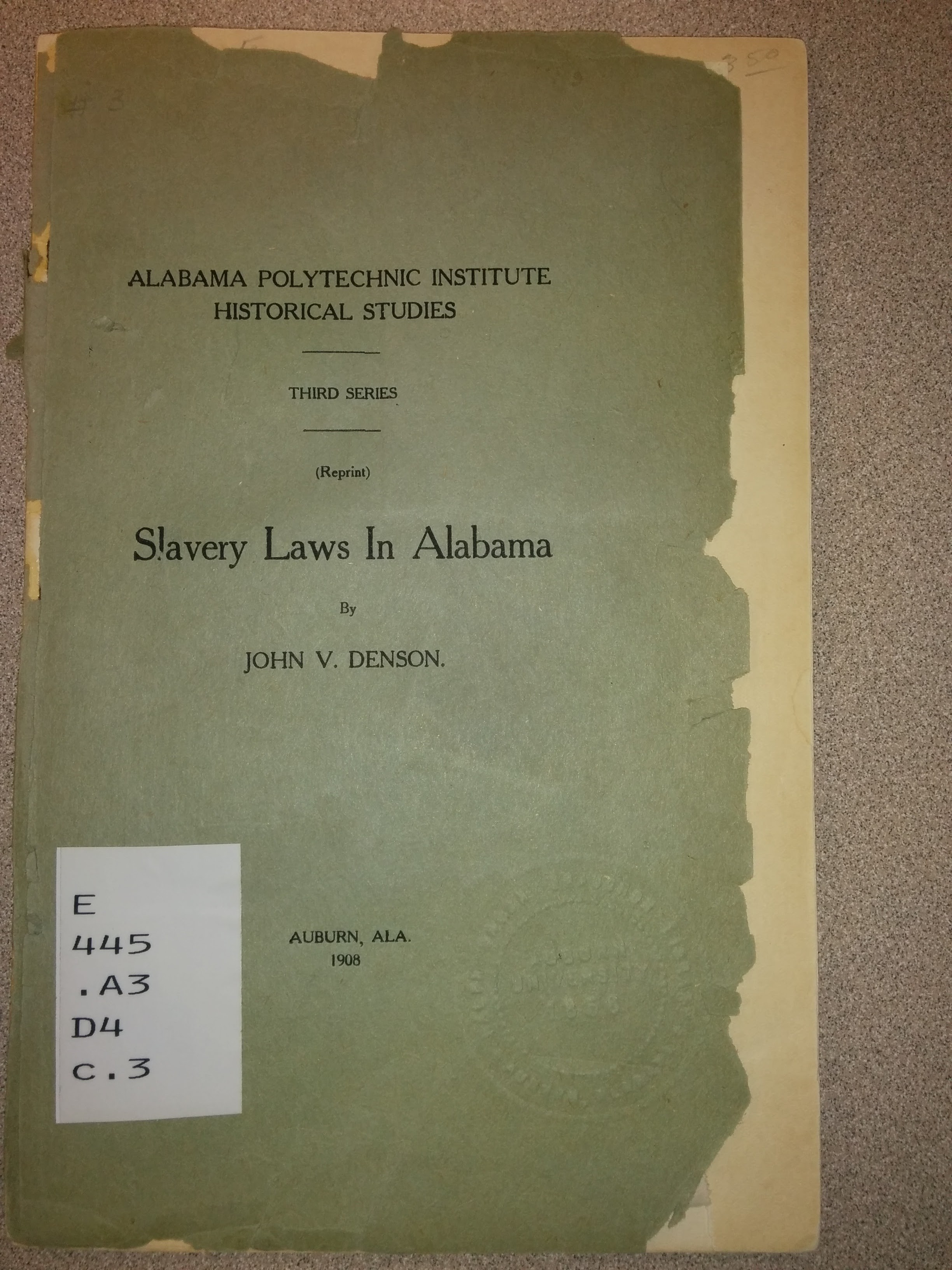
From John V. Denson, “Slavery Laws in Alabama†(1908), Parts III (Patrols) and IV (Mode of Trial of Slaves) posted by Rad Geek 17 Dec 2016 7:03 pm
Here is some more text transcribed from John V. Denson's 1908 monograph, Slavery Laws in Alabama, which we are in the process of serializing here at the blog in order to add the text to the Fair Use Repository. (For previous instalments, see Part I on the law of manumission and Part II on "Runaways".) The text was originally published in booklet form as part of the Alabama Polytechnic Institute Historical Studies series. The author, John V. Denson was a student and later GTA instructor at Alabama Polytechnic for History and Latin; he later became a prominent lawyer in the Auburn-Opelika area. Like most of the historical studies from Alabama Polytechnic (now Auburn University) from the first decade of the 1900s, the booklet takes the standpoint of "Lost Cause" apologia for Southern slavery, and adopts a point of view that is persistently racially insensitive, and at times frankly white supremacist. It is however an extensive and detailed study of the slave code in Alabama in particular, and essetial documentation for how Alabama historians and students of history wrote and thought about slavery at the turn of the 20th century. The next two sections of the text deal with the laws establishing and regulating Alabama slave patrols, and the laws governing the trials of slaves accused of criminal offenses (as well as the claims that could be made by the state against slaveholders, or by slaveholders against the state, in case the people that they claimed as their chattel property were punished or executed for crimes).
<
blockquote> [11] PATROLS: The patrol system was for the purpose of preserving order and peace, of preventing disturbances of any kind, and of serving as a special police system for slaves. In the system all white males between the ages of eighteen and sixty, who owned slaves, and other free white persons between the ages of eighteen and forty-five, who were subject to militia duty, were subject to perform patrol duty. Each patrol consisted of from four to six men under a leader, to serve not less than two nor more than three weeks, and to patrol such districts of their precinct as they thought necessary, at least once a week at night, and to be subject at all times, in addition to their prescribed duties, to the command of the justice of the peace [12] of the precinct.[19] I shall omit the patrol laws having to do with the making up of the patrol, eligibility, length of service, duties of leader, etc., and notice only those laws that related especially to slaves.
The general duties of the patrol were as follows: "It shall be the duty of each patrol detachment to visit all negro quarters, all places suspected of entertaining unlawful assemblies of slaves, or other disorderly persons unlawfully assembled; and upon finding such disorderly person or persons, to take him, her, or them, if free, before the nearest justice of the peace of such county, or make report thereof to said justice, so that he, she, or they, may be dealt with according to the law; and if any slave or slaves shall be found so assembled, or strolling without a pass, or some token from his or her owner or overseer, the said patrol may give such slave any number of lashes not exceeding fifteen; and if there be reason to suspect any such slave to be runaway from his or her owner they shall take such slave or slaves before the nearest justice of the peace for such county, to be dealt with according to the law; and to be allowed and paid by the owner, for all runaway slaves so taken up, the sum of ten dollars, and shall also be entitled to receive all other fines for which parties may be liable, which they may bring before any jurisdiction having cognizance thereof."[20]
Special acts with reference to patrol duties were few, and the following constitute those connected with slave matters:
In 1805 the Territorial Legislature passed an act providing that: "In cases of slaves lying out hid, killing hogs, etc., the justice of the peace must direct the provost of patrols to take the slaves by force and to commit them to jail, the provost getting thirty dollars, three-fourths of which was to be repaid by the master in addition to his taxes."[21] [13] In 1809 patrols were ordered to kill the dogs of slaves. In 1832 the Legislature passed this act: "It shall be an unlawful assembly for more than five male slaves, with or without passes, to assemble off their owner's plantation. The patrol must disperse such assembly, and may punish each slave with ten lashes, and for each subsequent offense with thirty-nine lashes."[22] This law, it will be noticed, was enacted in 1832, the year after the Nat Turner insurrection in Virginia, and it is very probable that the law is a result of the apprehension of the South caused by that insurrection.
The law of 1834 regulating emancipation had this clause:
It shall be the duty of all sheriffs, constables and patrols to apprehend slaves who shall return within the limits of this State after having been so emancipated and removed, (that is, according to the legal method prescribed) and bring them before some justice of the peace, who shall commit them, and the same compensation shall be allowed in such cases, as is allowed for apprehending runaway slaves.[23]
The patrol system and laws of South Carolina were similar to those of Alabama, except that in South Carolina much more authority and more duties were laid upon the patrol. For a sketch of the South Carolina patrol laws, see O'Neal's article in "DeBow's Industrial Resources of the South," vol. 2, p. 286.
[14] MODE OF TRIAL OF SLAVES: The laws of Alabama relating to the trial of slaves were explicit, and on the face of them seemed to guarantee justice to the criminal.
Before 1812, while Alabama was included in the Mississippi Territory, there were no juries in slave trials. By the act of 1807 it was provided that the justices of the quorum of every country were to be justices of oyer and terminer
in the trial of slaves charged with treason, felony or other crimes or misdemeanors. There were to be three justices of the quorum, who should have with them two justices of the peace, and the trial should be without a jury, but upon legal evidence, only. To convict a slave all the justices sitting must agree in the verdict, and the prisoner must have counsel to defend him.
No justice who had an interest in the slave was allowed to sit in the trial. Legal evidence was defined to be, the confession of the offender, the oath of one or more creditable witnesses, or such testimony of negroes or mulattoes, with pregnant circumstances, as to them shall seem convincing.
[24]
This act remained in force till 1812, when a superseding law was enacted, which made juries necessary in all slave trials. That law provided that for the trial of slaves charged with treason, felony or misdemeanors, a competent court should be any three justices of the quorum with one or more justices of the peace, excepting the justice who committed the prisoner to jail,[25] and a jury of men, no one of whom was the master of the slave or related to the master or to the prosecutor of the slave, and the court was to [15] proceed without indictment.[26] This law was in effect only two years, the act of 1814 providing that a slave charged with an offense not capital might be tried by a justice of the peace on warrant, and might be punished with not exceeding one hundred lashes, provided two slave-holders concurred with him in the propriety of the sentence, otherwise the punishment was to be not exceeding thirty-nine lashes.[27]
When Alabama became a State, she declared in her constitution, Art. 6, sec. 2, that, in the prosecution of slaves for crimes of a higher grade than petit larceny the General Assembly shall have no power to deprive them of an impartial trial by a petit jury.
For offences below petit larceny the trial was to be as it was under the Territorial act, except that not more than fifty lashes were to be administered by the justice.[28]
In accordance with the provision of the constitution, laws were passed as follows for trial by jury:
From and after the passage of this act, the justices of the inferior court of every county or corporation in this State, shall be justices of oyer and terminer, for trying slaves charged with treason, felony, or other crimes and misdemeanors of higher grade than petit larceny, which trial shall be before any three or more justices of the court aforesaid, and by a jury of twelve good and lawful men of the vicinage where such crimes shall have been committed.[29]
The procedure was as follows:
Whenever any slave shall be brought before a justice of the county court, or of the peace, for the commission of any offence against the penal laws of this state of a higher grade than petit larceny, if the justice after examination should think there are just or probable grounds of suspicion of the guilt or criminality of the offender, he shall immediately commit such slaves to jail, and he is hereby [16] empowered and directed to issue a summons to the sheriff of the county, to summons the justices of the county court, and a jury of twelve good and lawful men of the vicinage, to meet at the court house of said county, neither of whom shall be master of said slave or related to the master or prosecutor of such slave, in any degree, which would be a cause of challenge to a juryman in a trial of a free person; and such court and jury shall proceed in the trial of such slave without presentment or indictment; and no slave shall be condemned unless he be found guilty by a jury, after allowing him or her counsel in his or her defence, whose fee amounting to ten dollars shall be paid by the owner of the slave: Provided always, That when judgment of death shall be passed upon such offender, there shall be thirty days, at least, between the time of passing judgment and the day of execution, except in cases of conspiracy, insurrection, or rebellion.
Some minor changes were made in 1822 and in 1832, and finally in 1841 the law as to capital offenses was as follows:
The trial of all slaves for capital offences shall be by the circuit court of the proper county, in the mode now provided by law for the trial of white persons; but on such trial the slave shall be allowed but twelve peremptory challenges, and the State but four, and at least two-thirds of the jury shall be slave-holders; but if there be an actual or threatened rebellion, of the slaves of this State, it shall be the duty of any justice of the peace, before whom any slave or free person of color is brought, charged with a capital offence, if there be probable grounds for believing him or her guilty of the offence charged, to commit him or her to the county jail and appoint a time for the trial of the offence, not more than fifteen days from the commitment; it shall also, at the same time, be the duty of such justice to give notice of the time of such trial to the judge of the [17] county court, and some other justice of the peace, to attend the trial, which notice may be served by the sheriff or any constable; if there be no judge of the county court, one other justice shall be summoned in his stead to attend, and a majority of the persons thus summoned shall constitute a court for the trial of the offence, and if neither attend, any justice may summon two others forthwith to attend and try the cause.[30]
[18] It shall be the duty of the justice making such commitment, to require the sheriff, in writing, to summon a jury, to appear at the time appointed for the trial of the accused, and it shall be the duty of the sheriff to summon a jury, [19] possessing the qualifications prescribed by the chapter entitled, "Grand and Petit Jury", to consist of twenty-four persons, at least two-thirds of whom shall be slave-holders; and if the panel should be exhausted by challenges or otherwise, the deficiency shall be made up from the bystanders; but no one having an interest in such slave shall be a competent juror, or sit on the trial.[31]
In trials involving cases of insurrection, the only form of indictment necessary was a brief written statement of the nature of the crime, signed by the prosecuting attorney,[32] but in regular trials the indictment must be the same as in the prosecution of a white man, that is, it must have been found by a legally constituted grand jury, and a copy of the indictment must have been delivered to the prisoner at least two days before his trial, and his counsel, which was to be provided by the court, if necessary, was to have a list of the names of the jurors summoned.[33]
The law made it imperative that the accused slave in these trials have counsel, and if the master should neglect or refuse to employ such, it was the duty of the court to assign counsel for the defendant, who was authorized to demand a fee of ten dollars from the master. If the [20] dedefendant was a free negro and unable to employ counsel, the State was to pay the fee.[34]
It was the duty of the clerk of the court or the committing magistrate, to issue subpoenas for witnesses, and the duty of the sheriff to execute them, the same for the prisoner as for the State,[35] and the slave enjoyed the same privilege as the white man in having the State to force his witnesses to appear in court.[36]
<
p>If a slave was found guilty in such capital cases, the court was to pronounce the sentence and cause execution to be done in the same manner as that prescribed for white persons, except that on conviction of conspiracy, insurrection or rebellion, execution might be had immediately.[37]
Trials of capital cases as described above, were to be held in the court house of the county, and the clerk was to keep a record of the proceedings on the minutes of the court.[38]
Trials of slaves charged with petit larceny or lesser offences, as said above, were conducted according to the Territorial law, that is, For the offence of petit larceny, or any offence of a lesser grade, any slave may be tried by any justice of the peace on warrant, and may be sentenced to receive any number of stripes not exceeding fifty, which sentence shall be executed by the constable; but no justice of the peace shall be authorized to inflict more than thirty-nine lashes, unless he associates with him at least two respectable slaveholders, who concur with him in the propriety of the sentence.
[39]
All offences higher than petit larceny, not capitally punished, which if committed by a white person or a free negro would be punished by imprisonment in the penitentiary, were to be tried by the judge of the county court and two justices of the peace, with a jury, and the jury was to direct the punishment, not to exceed thirty-nine lashes,[40] or branding in the hand, or both.
By the act of 1849 all slaves were bailable before conviction except in capital cases where the proof was evident or the presumption great.[41]
[22] When a slave was convicted of an offence not capital, he was liable to be sold by the sheriff ten days after conviction to pay the costs of the prosecution, unless such costs should be paid by the owner;[42] and on conviction of a slave of a capital offence, the same jury was to assess the value of the slave, and upon execution of the slave the master was to receive one-half the amount assessed, paid out of a fund provided for that purpose.[43]
[23] The right of appeal in capital cases was certainly not denied to slaves, for though I find no special law providing for it, other than that in Clay's Dig., p. 473, sec., 10, that the mode of trial for slaves should be the same as for white persons, I do find in the reports of the Alabama Supreme Court a number of decisions in cases appealed by slaves convicted of capital offences. I did not find any instance of appeal in other than capital cases and presume that the slave had no appeal in such cases. This was the law in South Carolina.[44]
In the trial of slaves the testimony of slaves was legal. The Territorial act of 1805 provided that: No slave can be a witness against any person except in criminal cases, in which the evidence of one slave shall be admitted for or against another slave.
[45]
O'Neal, in his article in DeBow, vol. 2, p. 274, states that slaves as witnesses against slaves were to testify without oath, but such was certainly not the case in Alabama, for though I have failed to find a direct provision for it, certainly it will be inferred from the following act, the principle of which was never annulled: Whenever a slave shall be a witness in any cause, it shall be the duty of the presiding judge to explain to him or her the punishment for swearing falsely; and if the court before whom any slave is sworn, shall have reason to believe that he or she has sworn falsely, it shall be the duty of the court to direct him or her to be taken into custody, and, as soon as practicable, to cause a jury to be empanelled to try the fact, and if such slave be found guilty, the court shall, without delay, cause the proper punishment to be inflicted.
[46] Every slave who shall commit the crime of perjury shall be [24] punished with thirty-nine lashes, and branding in the hand with the letter P.
[47]
In the Territorial period, and possibly during the early years of Statehood, slaves did not take oath, and at every trial of a capital offence, where slaves were witnesses, the judge was to say to the witness: You are brought hither as a witness, and by the direction of the law, I am to tell you, before you give your evidence, that you are expected to tell the truth, the whole truth, and nothing but the truth; and if it be found hereafter that you tell a lie, and give false testimony, in this matter, you must, for so doing, have both your ears nailed to the pillory and cut off, and receive thirty-nine lashes on your bare back, well laid on, at the common post.
[49]
[48]
- [19] Ala. Code of 1852, Part 1, Title 13, Chap. 3.↩
- [20] Clay's Dig. of 1843, p. 392, sec. 2. This act was passed in 1819, and it has been impossible to get the Acts of 1819.↩
- [21] Toulmin's Dig. of 1807, p. 378.↩
- [22]
Acts of '32, p. 17.
Sec. 17. And be it further enacted, That hereafter it shall not be lawful for more than five male slaves, either with or without passes, to assemble together at any place off the proper plantation to which they belong; and if any slaves do so assemble together, the same shall be deemed and considered as an unlawful assembly.
App'd, Jan. 16, '32.
Also see section 18 of this act, quoted later.
Also Clay's Ala. Dig. p. 544, secs. 30-31. ↩
- [23]
Acts of '33-'34, p. 29. See sec. 3 of this act already quoted in footnotes.
See also Clay's Ala. Dig. p. 545, sec. 39.↩
- [24] Toulmin's Dig. of 1807, p. 328↩
- [25] The provision prohibiting the committing justice from sitting in the trial, was to insure impartial judges. Any justice might commit a slave for any reason on any charge, and it was to prevent such justice from sitting as a judge in the trial of a case in which he might be personally interested, and thus having beforehand a fixed opinion in the case.↩
- [26] Miss. Territorial Statutes, Dig. of 1816, p. 192.↩
- [27] Miss. Territorial Statutes, Dig. of 1816, p. 199.↩
- [28] Afterwards changed to 100 lashes. Code of 1852, sec. 3317.↩
- [29] Acts of 1819, p. 88.↩
- [30]
Acts of '40-'41, p. 189, sec. 10.
Also Clay's Ala. Dig. p. 473, sec. 10.
In 1822 an act was passed in which was this section:
Sec. 11. And be it further enacted, That in all prosecutions of slaves and free people of color punishable capitally, the circuit courts, and not the county courts, shall have jurisdiction; and that the trial shall be conducted in the same manner and under the same rules except as to evidence, as the trial of free white citizens.
Acts of '22-'23, p. 4. App'd Dec. 31, 1822.
In 1832 this act was passed:
AN ACT. To provide for the more speedy trial of slaves and free persons of color.
Sec. 1. Be it enacted by the Senate and the House of Representatives of the State of Alabama, in General Assembly convened, That from and after the passage of this act, the judge of the county court of each and every county in this state, together with two justices of the peace to be associated with him, or in case there should be no judge of the county court, then any three justices of the peace, shall constitute a court for the trial of all slaves and free persons of color, charged with any crime or misdemeanor of a higher grade than petit larceny.
Sec. 2. Be it further enacted, That whenever any slave or free person of color, shall be brought before any justice of the peace, charged with the commission of any crime or misdemeanor of a higher grade than petit larceny, if the justice, after examining the witnesses on the part of the prosecutor, shall believe there exists any reasonable or probable grounds of the guilt or criminality of such slave or free person of color, he shall immediately commit him or her to jail, and at the same time shall issue a notice to the judge of the county court of his county, and also to some justice of the peace, which notice shall be served by the sheriff or some constable of the county, informing them of such commitment, and state the time and place of the trial which shall not be less than ten nor more than fifteen days from the date of said notice; and the said justice who shall make the commitment as aforesaid, and the judge of the county court, or if there be no judge of the county court, two justices of the peace summoned as aforesaid, shall form a court to try and determine said offence; and it shall be the duty of the magistrate to order the sheriff or the coroner of his county to summon twenty-four jurors, to be and appear at the place and time appointed, for the trial of said offence, one-half of whom shall be slave-holders, and should the judge of the county court or any justice summoned to attend said trial fail to attend, any justice of the peace shall forthwith cause to be summoned two justices of the peace to be associated with him in forming said court, and may adjourn from day to day until the business before them is disposed of.
Sec. 3. And be it further enacted, That out of the number of jurors summoned by the sheriff, there shall be drawn twelve, who shall compose and be a jury for the trial of anyone prosecuted under this act: Provided always, that the accused shall have and enjoy the right of twelve peremptory challenges, and the state shall have the right of four peremptory challenges, and if the original panel should be exhausted by reason of challenge or otherwise, so that a sufficient number be not left to compose a jury, the court shall order the sheriff to summon a sufficient number of talesmen from the bystanders for that purpose.
Sec. 4. And be it further enacted, That in all trials had under this act, it shall be sufficient for the solicitor, or counsel appointed by the court to prosecute, to write out a brief statement of the nature of the crime charged against the defendant, and sign his name thereto, and no indictment or presentment shall be necessary.
Sec. 5. And be it further enacted, That if at any court held under this act, the solicitor of the circuit court should not be present, the court shall appoint counsel to prosecute, whose fee amounting to the sum of ten dollars, shall be paid by the state, and if the owner of any slave prosecuted under this act, shall not employ counsel to defend such slave, it shall be the duty of said court, to appoint counsel for that purpose, whose fee, amounting to the sum of ten dollars, shall be paid by the owner of said slave; and if any free person of color, prosecuted under this act, shall be unable to employ counsel to defend him or her, it shall be the duty of the court to appoint counsel for this purpose, whose fee, amounting to ten dollars, shall be paid out of the county treasury.
Sec. 6. And be it further enacted, That it shall be the duty of the clerk to issue all subpœnas or other legal process, as well for the defendant as for the state, all of which shall be executed by the sheriff; and the said clerk and sheriff shall receive the same fees therefor as now provided by law for similar services, and none other.
Sec. 7. And be it further enacted, That if any slave or free person of color shall be found guilty under this act, it shall be the duty of the court to pronounce sentence in the manner now prescribed by law, which sentence shall be carried into execution by the sheriff: Provided always, that if any slave or free person of color, shall be found guilty of any capital crime, there shall not be less than five nor more than ten days, between the day of passing sentence and the day of execution, except in cases of conspiracy, insurrection, or rebellion, when the sentence of the court may be executed forthwith.
Sec. 8. And be it further enacted, That all acts contrary to the provisions of this act be, and the same are, hereby repealed.
App'd, Jan. 7, 1832. Acts of '31-'32, p. 10.
↩ - [31]
Acts of '40-'41, p. 189, sec. 11.
Clay's Ala. Dig. p. 473, sec. 11.
↩ - [32]
Acts of '40-'41, p. 189, sec. 12.
In all trials thus to be had, it shall be sufficient for the solicitor or counsel, prosecuting for the state, to write out a brief statement of the nature of the crime, and sign his name thereto, to which the accused shall be required to plead; but if he or she refuse the court shall cause the plea of not guilty to be entered and proceed to the trial of the cause.
See also Clay's Ala. Dig. p. 473, sec. 12.
Also Code of 1852, sec. 3324.
↩ - [33]
Ala. Code of 1852, sec. 3576, and sec. 3319.
↩ - [34] ...↩
- [35] See sec. 6 of the act quoted in note 4 to page 10.↩
- [36]↩
- [37] Constitution of Ala., 1819, Art. 1, Sec. 10.↩
- [38]
Acts of '40-'41, p. 190, sec. 14, of chap. 15.
Trials to be had as aforesaid, (that is, as has been shown in the above,) shall be held in the court house of the county, where it shall be the duty of the sheriff and the clerk of the circuit court to attend, and the clerk shall keep a record of the procedings on the minutes of the court.
See also Clay's Ala. Dig. p. 473, sec. 14.
↩ - [39]
Clay's Ala. Dig. p. 474, sec. 17. This law was made a part of the statute law of Ala. in an act in connection with the penal code in 1841, in the same language, and may be found so in the Acts of '40-'41, p. 190, sec. 17 of chap. 15.
↩ - [40]
Acts of '40-'41, p. 190, sec. 18.
All offences committed by a slave, of a higher grade than petit larceny, and not capitally punished, which may be committed by slaves, and which, if committed by a white person or free negro, would, by the provisions of this code, be punished by imprisonment int he penitentiary, shall be tried by the judge of the county court and two justices of the peace, as provided for in this chapter, and the jury shall, by their verdict, direct the punishment to be inflicted, which shall not exceed thirty-nine lashes, or branding in the hand, or both, at the discretion of the jury.
↩ - [41]
Acts of '49-'50, p. 51.
AN ACT. Authorizing the bail of slaves in certain cases.
Sec. 1. Be it enacted by the Senate and the House of Representatives of the State of Alabama, in General Assembly convened, that all slaves shall, before conviction, be bailable, except for capital offences, where the proof is evident or the presumption great.
Sec. 2. Be it further enacted, that the owner of such slaves or overseer of the owner or his agent, or such person or persons as may be entitled to the possession of such slave or slaves shall be permitted to bail the same, in all cases deemed bailable, upon giving such bond and sureties as may be required by the judge or justice trying the same.
Sec. 3. Be it further enacted, That the justices of the peace in this state before commitment, shall have jurisdiction to jail, bail, or discharge any slave charged with any offence as the law and circumstances of the case may require.
Sec. 4. Be it further enacted, That the judges of the circuit and county courts in this state shall have jurisdiction on application to commit to jail, bail, or discharge any slave under the provisions of this act, notwithstanding any previous order made by any justice of the peace as the case may require.
App'd Jan. 12, 1850.
↩ - [42]
Acts of '43, p. 121.
Sec. 2. And be it further enacted, That in all convictions of slaves of any offence not capital, said slave shall be liable to be sold, within ten days after the conviction, by the sheriff, for the costs of prosecution, unless said costs shall be paid by the owners of said slaves. App'd Feb. 2, 1843.
See also Clay's Ala. Dig. p. 476, sec. 28.
↩ - [43]
Acts of '43, p. 9.
And be it further enacted, That whenever on the trial of any slave for a capital offence, the jury shall return a verdict of guilty, the presiding judge shall have the same jury sworn to assess the value of said slave, and the verdict of said jury shall be entered on the record of the court, and the master or owner of such slave producing to the Comptroller of Public Accounts a transcript of the record of the court, regularly certified by the clerk, the certificate of the sheriff, that any slave has been executed in pursuance of the sentence of the court, shall be entitled to receive a warrant on the treasurer for one half of the amount assessed by the jury to be paid out of the fund hereinafter provided for that purpose.
App'd Feb. 13, 1842.
In sec. 24 of this act, it was provided, that:
↩To raise a fund for the purpose aforesaid it shall be the duty of the assessor annually, to assess a tax of one cent on all slaves under ten years of age, and two cents on all slaves over ten and under fifty years of age, and it shall be the duty of the tax collector to collect and return the same, at the same time and in the same manner, they are compelled by law, to collect and return the state tax, and it shall be the duty of the treasurer to keep said fund separate and distinct from the revenue of the state.
- [44] DeBow's Industrial Resources of the South, vol. 2, p. 284.↩
- [45] Toulmin's Dig. of 1807, p. 378. Ala. Justice, p. 421.↩
- [46]
Acts of '40-'41, p. 188, sec. 9.
Clay's Dig. p. 473, sec. 9
↩ - [47] ↩
- [49]
Toulmin's Dig. of 1807, p. 328, sec. 61.
↩ - [48]
Ala. Justice, p. 431, sec. 49.
↩