Fair Use Blog

“In the name of racially regulating behavior, laws CREATED racial identities” — Tennessee use of “mulattoes, mestizos, and their descendants” (Haney Lopez)

Second, positive law has created the racial meanings that attach to physical features. In a sense, this is the heart of the prerequisite cases, which at root embody the efforts of the courts to inscribe on the bodies of individual applicants the term “White” or “non-White.” These cases established as legal precedent the racial identities of the various faces and nationalities entering the United States at the turn of the century. Again, however, the racial prerequisites to naturalization are not the only laws that explicitly defined racial identities. Almost every state with racially discriminatory legislation also established legal definitions of race. It is no accident that the first legal ban on interracial marriage, a 1705 Virginia act, also constituted the first statutory effort to define who was Black.[6] Regulating or criminalizing behavior in racial terms required legal definitions of race.[7] Thus, in the years leading up to Brown, most states that made racial distinctions in their laws provided statutory racial definitions, almost always focusing on the boundaries of Black identity. Alabama and Arkansas defined anyone with one drop of “Negro” blood as Black; Florida had a one-eighth rule; Georgia referred to “ascertainable” non-White blood; Indiana used a one-eighth rule; Kentucky relied on a combination of any “appreciable admixture” of Black ancestry and a one-sixteenth rule; Louisiana did not statutorily define Blackness but did adopt via its Supreme Court an “appreciable mixture of negro blood” standard; Maryland used a “person of negro descent to the third generation” test; Mississippi combined an “appreciable amount of Negro blood” and a one-eighth rule; Missouri used a one-eighth test, as did Nebraska, North Carolina, and North Dakota; Oklahoma referred to “all persons of African descent,” [119] adding that the “term ‘white race’ shall include all other persons”; Oregon promulgated a one-fourth rule; South Carolina had a one-eighth standard; Tennessee defined Blacks in terms of “mulattoes, mestizos, and their descendants, having any blood of the African race in their veins”; Texas used an “all persons of mixed blood descended from negro ancestry” standard; Utah law referred to mulattos, quadroons, or octoroons; and Virginia defined Blacks as those in whom there was “ascertainable any Negro blood” with not more than one-sixteenth Native American ancestry.[8]

The very practice of legally defining Black identity demonstrates the social, rather than the natural basis of race. Moreover, these competing definitions demonstrate that the many laws that discriminated on the basis of race more often than not defined, and thus helped to create, the categories they claimed only to elucidate. In defining Black and White, statutory and case law assisted in fashioning the racial significance that by themselves drops of blood, ascertainable amounts, and fractions never could have. In the name of racially regulating behavior, they created racial identities.

Ian F. Haney López, White By Law: The Legal Construction of Race (New York: New York University Press, 1996) Haney López, White By Law  , 118-119.
  1. [6]Finkelman, supra, at 2088. According to Finkelman, “This act also made the first stab at defining who was actually black. The law declared that anyone who was a child, grandchild, or great grandchild of a black was a mulatto under the statute. this meant that persons who were of one-eighth African ancestry were black for purposes of Virginia law.” See generally A. Leon Higginbotham, Jr., and Barbara K. Kopytoff, Racial Purity and Interracial Sex in the Law of Colonial and Antebellum Virginia, 77 GEO. L. J. 1967 (1989).↩
  2. [7]See Raymond T. Diamond and Robert J. Cottrol, Codifying Caste: Louisiana’s Racial Classification Scheme and the Fourteenth Amendment, 29 LOY. L. REV. 255, 265 (1983) They argue that “[s]tate supported or initiated discrimination required racial definitions. The law could not separate what it failed to categorize.”↩
  3. [8]Paul Finkelman, The Color of Law, 87 NW. U. L. REV. 937, 955 n. 96 (citing PAUL MURRAY, STATES’ LAWS ON RACE AND COLOR [1950]).↩

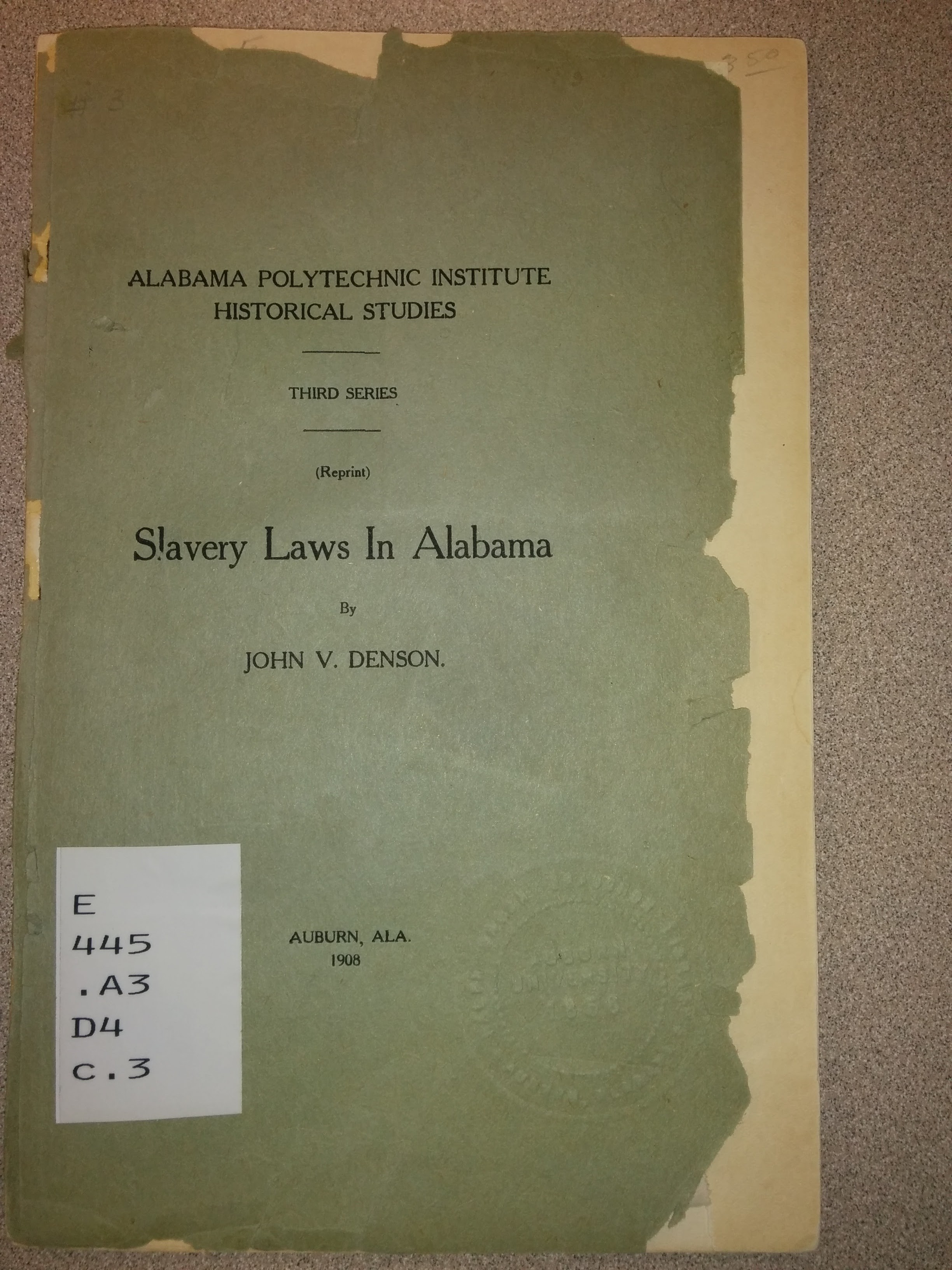
From John V. Denson, “Slavery Laws in Alabama” (1908), Parts III (Patrols) and IV (Mode of Trial of Slaves)

Here is some more text transcribed from John V. Denson's 1908 monograph, Slavery Laws in Alabama, which we are in the process of serializing here at the blog in order to add the text to the Fair Use Repository. (For previous instalments, see Part I on the law of manumission and Part II on "Runaways".) The text was originally published in booklet form as part of the Alabama Polytechnic Institute Historical Studies series. The author, John V. Denson was a student and later GTA instructor at Alabama Polytechnic for History and Latin; he later became a prominent lawyer in the Auburn-Opelika area. Like most of the historical studies from Alabama Polytechnic (now Auburn University) from the first decade of the 1900s, the booklet takes the standpoint of "Lost Cause" apologia for Southern slavery, and adopts a point of view that is persistently racially insensitive, and at times frankly white supremacist. It is however an extensive and detailed study of the slave code in Alabama in particular, and essetial documentation for how Alabama historians and students of history wrote and thought about slavery at the turn of the 20th century. The next two sections of the text deal with the laws establishing and regulating Alabama slave patrols, and the laws governing the trials of slaves accused of criminal offenses (as well as the claims that could be made by the state against slaveholders, or by slaveholders against the state, in case the people that they claimed as their chattel property were punished or executed for crimes).

<

blockquote> [11] PATROLS: The patrol system was for the purpose of preserving order and peace, of preventing disturbances of any kind, and of serving as a special police system for slaves. In the system all white males between the ages of eighteen and sixty, who owned slaves, and other free white persons between the ages of eighteen and forty-five, who were subject to militia duty, were subject to perform patrol duty. Each patrol consisted of from four to six men under a leader, to serve not less than two nor more than three weeks, and to patrol such districts of their precinct as they thought necessary, at least once a week at night, and to be subject at all times, in addition to their prescribed duties, to the command of the justice of the peace [12] of the precinct.[19] I shall omit the patrol laws having to do with the making up of the patrol, eligibility, length of service, duties of leader, etc., and notice only those laws that related especially to slaves.

The general duties of the patrol were as follows: "It shall be the duty of each patrol detachment to visit all negro quarters, all places suspected of entertaining unlawful assemblies of slaves, or other disorderly persons unlawfully assembled; and upon finding such disorderly person or persons, to take him, her, or them, if free, before the nearest justice of the peace of such county, or make report thereof to said justice, so that he, she, or they, may be dealt with according to the law; and if any slave or slaves shall be found so assembled, or strolling without a pass, or some token from his or her owner or overseer, the said patrol may give such slave any number of lashes not exceeding fifteen; and if there be reason to suspect any such slave to be runaway from his or her owner they shall take such slave or slaves before the nearest justice of the peace for such county, to be dealt with according to the law; and to be allowed and paid by the owner, for all runaway slaves so taken up, the sum of ten dollars, and shall also be entitled to receive all other fines for which parties may be liable, which they may bring before any jurisdiction having cognizance thereof."[20]

Special acts with reference to patrol duties were few, and the following constitute those connected with slave matters:

In 1805 the Territorial Legislature passed an act providing that: "In cases of slaves lying out hid, killing hogs, etc., the justice of the peace must direct the provost of patrols to take the slaves by force and to commit them to jail, the provost getting thirty dollars, three-fourths of which was to be repaid by the master in addition to his taxes."[21] [13] In 1809 patrols were ordered to kill the dogs of slaves. In 1832 the Legislature passed this act: "It shall be an unlawful assembly for more than five male slaves, with or without passes, to assemble off their owner's plantation. The patrol must disperse such assembly, and may punish each slave with ten lashes, and for each subsequent offense with thirty-nine lashes."[22] This law, it will be noticed, was enacted in 1832, the year after the Nat Turner insurrection in Virginia, and it is very probable that the law is a result of the apprehension of the South caused by that insurrection.

The law of 1834 regulating emancipation had this clause:

It shall be the duty of all sheriffs, constables and patrols to apprehend slaves who shall return within the limits of this State after having been so emancipated and removed, (that is, according to the legal method prescribed) and bring them before some justice of the peace, who shall commit them, and the same compensation shall be allowed in such cases, as is allowed for apprehending runaway slaves.[23]

The patrol system and laws of South Carolina were similar to those of Alabama, except that in South Carolina much more authority and more duties were laid upon the patrol. For a sketch of the South Carolina patrol laws, see O'Neal's article in "DeBow's Industrial Resources of the South," vol. 2, p. 286.

[14] MODE OF TRIAL OF SLAVES: The laws of Alabama relating to the trial of slaves were explicit, and on the face of them seemed to guarantee justice to the criminal.

Before 1812, while Alabama was included in the Mississippi Territory, there were no juries in slave trials. By the act of 1807 it was provided that the justices of the quorum of every country were to be justices of oyer and terminer in the trial of slaves charged with treason, felony or other crimes or misdemeanors. There were to be three justices of the quorum, who should have with them two justices of the peace, and the trial should be without a jury, but upon legal evidence, only. To convict a slave all the justices sitting must agree in the verdict, and the prisoner must have counsel to defend him.

No justice who had an interest in the slave was allowed to sit in the trial. Legal evidence was defined to be, the confession of the offender, the oath of one or more creditable witnesses, or such testimony of negroes or mulattoes, with pregnant circumstances, as to them shall seem convincing.[24]

This act remained in force till 1812, when a superseding law was enacted, which made juries necessary in all slave trials. That law provided that for the trial of slaves charged with treason, felony or misdemeanors, a competent court should be any three justices of the quorum with one or more justices of the peace, excepting the justice who committed the prisoner to jail,[25] and a jury of men, no one of whom was the master of the slave or related to the master or to the prosecutor of the slave, and the court was to [15] proceed without indictment.[26] This law was in effect only two years, the act of 1814 providing that a slave charged with an offense not capital might be tried by a justice of the peace on warrant, and might be punished with not exceeding one hundred lashes, provided two slave-holders concurred with him in the propriety of the sentence, otherwise the punishment was to be not exceeding thirty-nine lashes.[27]

When Alabama became a State, she declared in her constitution, Art. 6, sec. 2, that, in the prosecution of slaves for crimes of a higher grade than petit larceny the General Assembly shall have no power to deprive them of an impartial trial by a petit jury. For offences below petit larceny the trial was to be as it was under the Territorial act, except that not more than fifty lashes were to be administered by the justice.[28]

In accordance with the provision of the constitution, laws were passed as follows for trial by jury:

From and after the passage of this act, the justices of the inferior court of every county or corporation in this State, shall be justices of oyer and terminer, for trying slaves charged with treason, felony, or other crimes and misdemeanors of higher grade than petit larceny, which trial shall be before any three or more justices of the court aforesaid, and by a jury of twelve good and lawful men of the vicinage where such crimes shall have been committed.[29]

The procedure was as follows:

Whenever any slave shall be brought before a justice of the county court, or of the peace, for the commission of any offence against the penal laws of this state of a higher grade than petit larceny, if the justice after examination should think there are just or probable grounds of suspicion of the guilt or criminality of the offender, he shall immediately commit such slaves to jail, and he is hereby [16] empowered and directed to issue a summons to the sheriff of the county, to summons the justices of the county court, and a jury of twelve good and lawful men of the vicinage, to meet at the court house of said county, neither of whom shall be master of said slave or related to the master or prosecutor of such slave, in any degree, which would be a cause of challenge to a juryman in a trial of a free person; and such court and jury shall proceed in the trial of such slave without presentment or indictment; and no slave shall be condemned unless he be found guilty by a jury, after allowing him or her counsel in his or her defence, whose fee amounting to ten dollars shall be paid by the owner of the slave: Provided always, That when judgment of death shall be passed upon such offender, there shall be thirty days, at least, between the time of passing judgment and the day of execution, except in cases of conspiracy, insurrection, or rebellion.

Some minor changes were made in 1822 and in 1832, and finally in 1841 the law as to capital offenses was as follows:

The trial of all slaves for capital offences shall be by the circuit court of the proper county, in the mode now provided by law for the trial of white persons; but on such trial the slave shall be allowed but twelve peremptory challenges, and the State but four, and at least two-thirds of the jury shall be slave-holders; but if there be an actual or threatened rebellion, of the slaves of this State, it shall be the duty of any justice of the peace, before whom any slave or free person of color is brought, charged with a capital offence, if there be probable grounds for believing him or her guilty of the offence charged, to commit him or her to the county jail and appoint a time for the trial of the offence, not more than fifteen days from the commitment; it shall also, at the same time, be the duty of such justice to give notice of the time of such trial to the judge of the [17] county court, and some other justice of the peace, to attend the trial, which notice may be served by the sheriff or any constable; if there be no judge of the county court, one other justice shall be summoned in his stead to attend, and a majority of the persons thus summoned shall constitute a court for the trial of the offence, and if neither attend, any justice may summon two others forthwith to attend and try the cause.[30]

[18] It shall be the duty of the justice making such commitment, to require the sheriff, in writing, to summon a jury, to appear at the time appointed for the trial of the accused, and it shall be the duty of the sheriff to summon a jury, [19] possessing the qualifications prescribed by the chapter entitled, "Grand and Petit Jury", to consist of twenty-four persons, at least two-thirds of whom shall be slave-holders; and if the panel should be exhausted by challenges or otherwise, the deficiency shall be made up from the bystanders; but no one having an interest in such slave shall be a competent juror, or sit on the trial.[31]

In trials involving cases of insurrection, the only form of indictment necessary was a brief written statement of the nature of the crime, signed by the prosecuting attorney,[32] but in regular trials the indictment must be the same as in the prosecution of a white man, that is, it must have been found by a legally constituted grand jury, and a copy of the indictment must have been delivered to the prisoner at least two days before his trial, and his counsel, which was to be provided by the court, if necessary, was to have a list of the names of the jurors summoned.[33]

The law made it imperative that the accused slave in these trials have counsel, and if the master should neglect or refuse to employ such, it was the duty of the court to assign counsel for the defendant, who was authorized to demand a fee of ten dollars from the master. If the [20] dedefendant was a free negro and unable to employ counsel, the State was to pay the fee.[34]

It was the duty of the clerk of the court or the committing magistrate, to issue subpoenas for witnesses, and the duty of the sheriff to execute them, the same for the prisoner as for the State,[35] and the slave enjoyed the same privilege as the white man in having the State to force his witnesses to appear in court.[36]

<

p>If a slave was found guilty in such capital cases, the court was to pronounce the sentence and cause execution to be done in the same manner as that prescribed for white persons, except that on conviction of conspiracy, insurrection or rebellion, execution might be had immediately.[37]

Trials of capital cases as described above, were to be held in the court house of the county, and the clerk was to keep a record of the proceedings on the minutes of the court.[38]

Trials of slaves charged with petit larceny or lesser offences, as said above, were conducted according to the Territorial law, that is, For the offence of petit larceny, or any offence of a lesser grade, any slave may be tried by any justice of the peace on warrant, and may be sentenced to receive any number of stripes not exceeding fifty, which sentence shall be executed by the constable; but no justice of the peace shall be authorized to inflict more than thirty-nine lashes, unless he associates with him at least two respectable slaveholders, who concur with him in the propriety of the sentence.[39]

All offences higher than petit larceny, not capitally punished, which if committed by a white person or a free negro would be punished by imprisonment in the penitentiary, were to be tried by the judge of the county court and two justices of the peace, with a jury, and the jury was to direct the punishment, not to exceed thirty-nine lashes,[40] or branding in the hand, or both.

By the act of 1849 all slaves were bailable before conviction except in capital cases where the proof was evident or the presumption great.[41]

[22] When a slave was convicted of an offence not capital, he was liable to be sold by the sheriff ten days after conviction to pay the costs of the prosecution, unless such costs should be paid by the owner;[42] and on conviction of a slave of a capital offence, the same jury was to assess the value of the slave, and upon execution of the slave the master was to receive one-half the amount assessed, paid out of a fund provided for that purpose.[43]

[23] The right of appeal in capital cases was certainly not denied to slaves, for though I find no special law providing for it, other than that in Clay's Dig., p. 473, sec., 10, that the mode of trial for slaves should be the same as for white persons, I do find in the reports of the Alabama Supreme Court a number of decisions in cases appealed by slaves convicted of capital offences. I did not find any instance of appeal in other than capital cases and presume that the slave had no appeal in such cases. This was the law in South Carolina.[44]

In the trial of slaves the testimony of slaves was legal. The Territorial act of 1805 provided that: No slave can be a witness against any person except in criminal cases, in which the evidence of one slave shall be admitted for or against another slave.[45]

O'Neal, in his article in DeBow, vol. 2, p. 274, states that slaves as witnesses against slaves were to testify without oath, but such was certainly not the case in Alabama, for though I have failed to find a direct provision for it, certainly it will be inferred from the following act, the principle of which was never annulled: Whenever a slave shall be a witness in any cause, it shall be the duty of the presiding judge to explain to him or her the punishment for swearing falsely; and if the court before whom any slave is sworn, shall have reason to believe that he or she has sworn falsely, it shall be the duty of the court to direct him or her to be taken into custody, and, as soon as practicable, to cause a jury to be empanelled to try the fact, and if such slave be found guilty, the court shall, without delay, cause the proper punishment to be inflicted.[46] Every slave who shall commit the crime of perjury shall be [24] punished with thirty-nine lashes, and branding in the hand with the letter P.[47]

In the Territorial period, and possibly during the early years of Statehood, slaves did not take oath, and at every trial of a capital offence, where slaves were witnesses, the judge was to say to the witness: You are brought hither as a witness, and by the direction of the law, I am to tell you, before you give your evidence, that you are expected to tell the truth, the whole truth, and nothing but the truth; and if it be found hereafter that you tell a lie, and give false testimony, in this matter, you must, for so doing, have both your ears nailed to the pillory and cut off, and receive thirty-nine lashes on your bare back, well laid on, at the common post.[49]

[48]

  1. [19] Ala. Code of 1852, Part 1, Title 13, Chap. 3.↩
  2. [20] Clay's Dig. of 1843, p. 392, sec. 2. This act was passed in 1819, and it has been impossible to get the Acts of 1819.↩
  3. [21] Toulmin's Dig. of 1807, p. 378.↩
  4. [22] Acts of '32, p. 17.

    Sec. 17. And be it further enacted, That hereafter it shall not be lawful for more than five male slaves, either with or without passes, to assemble together at any place off the proper plantation to which they belong; and if any slaves do so assemble together, the same shall be deemed and considered as an unlawful assembly.

    App'd, Jan. 16, '32.

    Also see section 18 of this act, quoted later.

    Also Clay's Ala. Dig. p. 544, secs. 30-31. ↩

  5. [23] Acts of '33-'34, p. 29. See sec. 3 of this act already quoted in footnotes.

    See also Clay's Ala. Dig. p. 545, sec. 39.↩

  6. [24] Toulmin's Dig. of 1807, p. 328↩
  7. [25] The provision prohibiting the committing justice from sitting in the trial, was to insure impartial judges. Any justice might commit a slave for any reason on any charge, and it was to prevent such justice from sitting as a judge in the trial of a case in which he might be personally interested, and thus having beforehand a fixed opinion in the case.↩
  8. [26] Miss. Territorial Statutes, Dig. of 1816, p. 192.↩
  9. [27] Miss. Territorial Statutes, Dig. of 1816, p. 199.↩
  10. [28] Afterwards changed to 100 lashes. Code of 1852, sec. 3317.↩
  11. [29] Acts of 1819, p. 88.↩
  12. [30] Acts of '40-'41, p. 189, sec. 10.

    Also Clay's Ala. Dig. p. 473, sec. 10.

    In 1822 an act was passed in which was this section:

    Sec. 11. And be it further enacted, That in all prosecutions of slaves and free people of color punishable capitally, the circuit courts, and not the county courts, shall have jurisdiction; and that the trial shall be conducted in the same manner and under the same rules except as to evidence, as the trial of free white citizens.

    Acts of '22-'23, p. 4. App'd Dec. 31, 1822.

    In 1832 this act was passed:

    AN ACT. To provide for the more speedy trial of slaves and free persons of color.

    Sec. 1. Be it enacted by the Senate and the House of Representatives of the State of Alabama, in General Assembly convened, That from and after the passage of this act, the judge of the county court of each and every county in this state, together with two justices of the peace to be associated with him, or in case there should be no judge of the county court, then any three justices of the peace, shall constitute a court for the trial of all slaves and free persons of color, charged with any crime or misdemeanor of a higher grade than petit larceny.

    Sec. 2. Be it further enacted, That whenever any slave or free person of color, shall be brought before any justice of the peace, charged with the commission of any crime or misdemeanor of a higher grade than petit larceny, if the justice, after examining the witnesses on the part of the prosecutor, shall believe there exists any reasonable or probable grounds of the guilt or criminality of such slave or free person of color, he shall immediately commit him or her to jail, and at the same time shall issue a notice to the judge of the county court of his county, and also to some justice of the peace, which notice shall be served by the sheriff or some constable of the county, informing them of such commitment, and state the time and place of the trial which shall not be less than ten nor more than fifteen days from the date of said notice; and the said justice who shall make the commitment as aforesaid, and the judge of the county court, or if there be no judge of the county court, two justices of the peace summoned as aforesaid, shall form a court to try and determine said offence; and it shall be the duty of the magistrate to order the sheriff or the coroner of his county to summon twenty-four jurors, to be and appear at the place and time appointed, for the trial of said offence, one-half of whom shall be slave-holders, and should the judge of the county court or any justice summoned to attend said trial fail to attend, any justice of the peace shall forthwith cause to be summoned two justices of the peace to be associated with him in forming said court, and may adjourn from day to day until the business before them is disposed of.

    Sec. 3. And be it further enacted, That out of the number of jurors summoned by the sheriff, there shall be drawn twelve, who shall compose and be a jury for the trial of anyone prosecuted under this act: Provided always, that the accused shall have and enjoy the right of twelve peremptory challenges, and the state shall have the right of four peremptory challenges, and if the original panel should be exhausted by reason of challenge or otherwise, so that a sufficient number be not left to compose a jury, the court shall order the sheriff to summon a sufficient number of talesmen from the bystanders for that purpose.

    Sec. 4. And be it further enacted, That in all trials had under this act, it shall be sufficient for the solicitor, or counsel appointed by the court to prosecute, to write out a brief statement of the nature of the crime charged against the defendant, and sign his name thereto, and no indictment or presentment shall be necessary.

    Sec. 5. And be it further enacted, That if at any court held under this act, the solicitor of the circuit court should not be present, the court shall appoint counsel to prosecute, whose fee amounting to the sum of ten dollars, shall be paid by the state, and if the owner of any slave prosecuted under this act, shall not employ counsel to defend such slave, it shall be the duty of said court, to appoint counsel for that purpose, whose fee, amounting to the sum of ten dollars, shall be paid by the owner of said slave; and if any free person of color, prosecuted under this act, shall be unable to employ counsel to defend him or her, it shall be the duty of the court to appoint counsel for this purpose, whose fee, amounting to ten dollars, shall be paid out of the county treasury.

    Sec. 6. And be it further enacted, That it shall be the duty of the clerk to issue all subpœnas or other legal process, as well for the defendant as for the state, all of which shall be executed by the sheriff; and the said clerk and sheriff shall receive the same fees therefor as now provided by law for similar services, and none other.

    Sec. 7. And be it further enacted, That if any slave or free person of color shall be found guilty under this act, it shall be the duty of the court to pronounce sentence in the manner now prescribed by law, which sentence shall be carried into execution by the sheriff: Provided always, that if any slave or free person of color, shall be found guilty of any capital crime, there shall not be less than five nor more than ten days, between the day of passing sentence and the day of execution, except in cases of conspiracy, insurrection, or rebellion, when the sentence of the court may be executed forthwith.

    Sec. 8. And be it further enacted, That all acts contrary to the provisions of this act be, and the same are, hereby repealed.

    App'd, Jan. 7, 1832. Acts of '31-'32, p. 10.

    ↩
  13. [31]

    Acts of '40-'41, p. 189, sec. 11.

    Clay's Ala. Dig. p. 473, sec. 11.

    ↩
  14. [32]

    Acts of '40-'41, p. 189, sec. 12.

    In all trials thus to be had, it shall be sufficient for the solicitor or counsel, prosecuting for the state, to write out a brief statement of the nature of the crime, and sign his name thereto, to which the accused shall be required to plead; but if he or she refuse the court shall cause the plea of not guilty to be entered and proceed to the trial of the cause.

    See also Clay's Ala. Dig. p. 473, sec. 12.

    Also Code of 1852, sec. 3324.

    ↩
  15. [33]

    Ala. Code of 1852, sec. 3576, and sec. 3319.

    ↩
  16. [34] ...↩
  17. [35] See sec. 6 of the act quoted in note 4 to page 10.↩
  18. [36]↩
  19. [37] Constitution of Ala., 1819, Art. 1, Sec. 10.↩
  20. [38]

    Acts of '40-'41, p. 190, sec. 14, of chap. 15.

    Trials to be had as aforesaid, (that is, as has been shown in the above,) shall be held in the court house of the county, where it shall be the duty of the sheriff and the clerk of the circuit court to attend, and the clerk shall keep a record of the procedings on the minutes of the court.

    See also Clay's Ala. Dig. p. 473, sec. 14.

    ↩
  21. [39]

    Clay's Ala. Dig. p. 474, sec. 17. This law was made a part of the statute law of Ala. in an act in connection with the penal code in 1841, in the same language, and may be found so in the Acts of '40-'41, p. 190, sec. 17 of chap. 15.

    ↩
  22. [40]

    Acts of '40-'41, p. 190, sec. 18.

    All offences committed by a slave, of a higher grade than petit larceny, and not capitally punished, which may be committed by slaves, and which, if committed by a white person or free negro, would, by the provisions of this code, be punished by imprisonment int he penitentiary, shall be tried by the judge of the county court and two justices of the peace, as provided for in this chapter, and the jury shall, by their verdict, direct the punishment to be inflicted, which shall not exceed thirty-nine lashes, or branding in the hand, or both, at the discretion of the jury.

    ↩
  23. [41]

    Acts of '49-'50, p. 51.

    AN ACT. Authorizing the bail of slaves in certain cases.

    Sec. 1. Be it enacted by the Senate and the House of Representatives of the State of Alabama, in General Assembly convened, that all slaves shall, before conviction, be bailable, except for capital offences, where the proof is evident or the presumption great.

    Sec. 2. Be it further enacted, that the owner of such slaves or overseer of the owner or his agent, or such person or persons as may be entitled to the possession of such slave or slaves shall be permitted to bail the same, in all cases deemed bailable, upon giving such bond and sureties as may be required by the judge or justice trying the same.

    Sec. 3. Be it further enacted, That the justices of the peace in this state before commitment, shall have jurisdiction to jail, bail, or discharge any slave charged with any offence as the law and circumstances of the case may require.

    Sec. 4. Be it further enacted, That the judges of the circuit and county courts in this state shall have jurisdiction on application to commit to jail, bail, or discharge any slave under the provisions of this act, notwithstanding any previous order made by any justice of the peace as the case may require.

    App'd Jan. 12, 1850.

    ↩
  24. [42]

    Acts of '43, p. 121.

    Sec. 2. And be it further enacted, That in all convictions of slaves of any offence not capital, said slave shall be liable to be sold, within ten days after the conviction, by the sheriff, for the costs of prosecution, unless said costs shall be paid by the owners of said slaves. App'd Feb. 2, 1843.

    See also Clay's Ala. Dig. p. 476, sec. 28.

    ↩
  25. [43]

    Acts of '43, p. 9.

    And be it further enacted, That whenever on the trial of any slave for a capital offence, the jury shall return a verdict of guilty, the presiding judge shall have the same jury sworn to assess the value of said slave, and the verdict of said jury shall be entered on the record of the court, and the master or owner of such slave producing to the Comptroller of Public Accounts a transcript of the record of the court, regularly certified by the clerk, the certificate of the sheriff, that any slave has been executed in pursuance of the sentence of the court, shall be entitled to receive a warrant on the treasurer for one half of the amount assessed by the jury to be paid out of the fund hereinafter provided for that purpose.

    App'd Feb. 13, 1842.

    In sec. 24 of this act, it was provided, that: To raise a fund for the purpose aforesaid it shall be the duty of the assessor annually, to assess a tax of one cent on all slaves under ten years of age, and two cents on all slaves over ten and under fifty years of age, and it shall be the duty of the tax collector to collect and return the same, at the same time and in the same manner, they are compelled by law, to collect and return the state tax, and it shall be the duty of the treasurer to keep said fund separate and distinct from the revenue of the state.

    ↩
  26. [44] DeBow's Industrial Resources of the South, vol. 2, p. 284.↩
  27. [45] Toulmin's Dig. of 1807, p. 378. Ala. Justice, p. 421.↩
  28. [46]

    Acts of '40-'41, p. 188, sec. 9.

    Clay's Dig. p. 473, sec. 9

    ↩
  29. [47]

    Acts of '40-'41, p. 188.

    Clay's Dig., p. 472, sec. 8.

    ↩
  30. [49]

    Toulmin's Dig. of 1807, p. 328, sec. 61.

    ↩
  31. [48]

    Ala. Justice, p. 431, sec. 49.

    ↩

From John V. Denson, “Slavery Laws in Alabama” (1908), Part II: Runaways

This text is transcribed from John V. Denson's 1908 pamphlet, Slavery Laws in Alabama. The booklet was originally published as part of the Alabama Polytechnic Institute Historical Studies series. John V. Denson was a student and later GTA instructor at Alabama Polytechnic for History and Latin, later a prominent lawyer in the Auburn-Opelika area. Like most of the historical studies from Alabama Polytechnic (now Auburn University) from the first decade of the 1900s, the pamphlet apologizes for Southern slavery, and adopts a point of view that is at times frankly white supremacist. The pamphlet begins with a discussion of the law of manumission; here is the next section, on the law concerning fugitive slaves.

[7] RUNAWAYS: The laws of Alabama relating to runaways were never cruel and never overstepped the bounds of conservative measures for the recovery of property. The act of 1805, in Secs. 12 and 13, provided that runaway slaves[9] might be apprehended by any person and carried before the next justice of the peace, who should commit such runaway to jail or send to his master, who was to pay a fee of six dollars and reasonable costs and charges, and further, that all slaves lying out hid, killing hogs, etc., were to be taken by force by the patrol, at the direction of the justice of the peace, and committed to jail, the provost's remuneration being thirty dollars paid by the state, three-fourths of which were to be repaid by the master in addition to his taxes. By the act of 1809[10] it was provided that [8] when a runaway slave was committed to jail and was not claimed by the owner within six months after the first publication of commitment, the sheriff should sell such slave, the proceeds going to the county; but if the owner should afterwards assert and prove his title, he could recover the amount paid to the county for the slave, but could not divest the title of the purchaser of such runaway, the time for such claim being limited in 1848 to five years after first publication.[11]

A slave found at a distance of eight miles from his master's plantation without a pass from his master, or one who had lain out more than two days without leave of his master, was considered a runaway.

The penalty visited upon any person who knowingly aided any negro or any other slave to runaway or depart from his master's service was imprisonment in the penitentiary [9] for a term of not less than two nor more than five years.[12]

So far as I have been able to discover there never existed in Alabama any statute, as there did in other states, providing for the outlawing of runaway slaves. In 1741 there was such a statute in North Carolina, providing that, Any person may lawfully kill a slave who has been outlawed for running away and lurking in swamps, etc.,[13] and a similar statute existed earlier in Virginia. In Maryland and the District of Columbia a similar law existed providing that when a slave should runaway from his master's service into the woods and remain there, killing hogs, etc., and should refuse to surrender, and offer resistance to persons legally empowered to pursue and capture, it should be lawful for such pursuers to shoot, kill, and destroy such slave.[14] The Alabama law, it seems to me, gave very little more authority to legal pursuers of fugitive slaves than is now given to officers when engaged in the pursuit of fugitives.

In North Carolina a proclamation of outlawry against a slave was authorized whenever he should runaway from his master and conceal himself in some obscure retreat, and to sustain life, should kill hogs, etc., and any person might lawfully kill such outlawed slave.[15] Also in Virginia two justices of the peace were authorized to outlaw runaways, whom any person might kill, without accusation of crime for so doing, but this act was repealed in 1792.[16]

This authority to outlaw slaves never existed in Alabama, and a person neverp possessed authority to kill a slave without possibility of accusation of crime, the law in Alabama [10] most resembling this being as follows: Any justice of the peace receiving information that three or more runaway slaves are lurking in swamps and other obscure places, may by warrant, reciting the names of the slaves and their owners, if known, direct a leader of the patrol of the district, and if there be none, then any other suitable person, to summon and take with him such power as may be necessary to apprehend such runaways, and, if taken to deliver them to the owner or to commit them to the jail of his proper county.[17]

Even after 1860, when it would be natural to expect more rigorous laws, the only new laws as to runaways were acts providing for increased compensation for taking up runaway slaves.[18]

  1. [9] Sec. 12. All runaway slaves may be apprehended by any person and carried before the next justice of the peace, who shall commit such slave to jail or send him to his owner, who shall pay six dollars for the slave so taken, and costs and charges.

    Sec. 13. In cases of slaves lying out hid, killing hogs, etc., the justice of the peace must direct the provost of patrols to take the slaves by force and commit them to jail, the provost receiving thirty dollars from the Territory, three-fourths of which was to be repaid by the master in addition to his taxes.

    See also Ala. Justice, p. 425.

    Toulmin's Dig. of 1807, p. 378.↩

  2. [10] Sec. 20. When any slave shall be committed to the jail of any county as a runaway, and such runaway shall not be claimed and proved by the owner thereof within six months of the first publication of the commitment of such slave in some newspaper published in this state, it shall be lawful for the sheriff of said county to sell said slave at public auction, at the court house of his proper county, upon giving at least thirty days' previous notice of such sale, by advertisement published in some newspaper in this state at the court house of the proper county, and at least two other public places in the same; and out of the proceeds arising from the sale of any runaway slave as aforesaid, the sheriff shall be entitled to the same commissions and fees as are allowed in execution, and the balance, after paying all prison fees and maintenance of said runaway slave while in jail, shall be for the use of the proper county: Provided, that if the owner of such runaway slave shall, after such sale prove his property in any such slave, the proper county shall pay to him the amount that shall have gone into the treasury, on account of the sale of such slave, but the right to any slave, sold as aforesaid, shall be and remain vested in the purchaser under the sale made by the sheriff as aforesaid.

    Clay's Ala. Dig., p. 542, sec. 20.

    Almost word for word in Ala. Justice, p. 432, and referred to Dig. p. 373.↩

  3. [11] There may arise in some minds this question: When a negro committed to jail as a runaway, is not claimed by any man as a slave, why is it not presumed that he is a free negro and discharged? Free negroes did live in Alabama, for there are laws which are specially applicable to them, and before 1834 emancipated slaves might remain in Alabama as free negroes, and therefore there might arise some question as to whether such free negro was free or slave, but the Supreme Court of Alabama, in the case of Field v. Milly Walker, Ala. Rep. vol. 17, p. 81, has held that a person of color in this state is presumed to be a slave and the burden of proof is on such person of color.↩
  4. [12] Acts of '40-'41, p. 129, sec. 15.

    Every person, who shall knowingly aid any negro or any other slave to run away, or depart from his master's service, such person, so offtending, on conviction, shall suffer imprisonment in the penitentiary not less than two, and not exceeding five years.

    See also Clay's Dig. of 1843, p. 419, sec. 15.↩

  5. [13] Stroud, p. 103; Haywood's Manual, pp. 521-522.↩
  6. [14] Goodell's American Slave Code, p. 231, Laws of Maryland, 1723, chap. 15, sec. 7.↩
  7. [15] Stroud, p. 38.↩
  8. [16] Goodell's American Slave Code, p. 231; Stroud, p. 103.↩
  9. [17] Ala. Code of 1852, sec. 1024; Clay's Dig., p. 541, sec. 15. This law was enacted in 1805, by the Miss. Territory.↩
  10. [18] Acts of '61, p. 15.

    AN ACT. To amend section 1023 of the Code in relation to runaway slaves.

    Sec. 1. Be it enacted by the Senate and the House of Representatives of the State of Alabama, in General Assembly convened, That hereafter it shall be the duty of justices of the peace before whom runaway slaves are brought, instead of committing them to jail, to order and direct such slaves to be delivered to their owner, overseer or agent, in all cases where the justice is satisfied that the name of the true owner is made known, and where the residence of such owner, his overseer or agent, is nearer than the county jail: Provided, that the owner, his overseer or agent, shall on delivery of the slave pay the fee now allowed by law for arresting, and the compensation hereinafter provided to the taker-up, or such other person as may have the custody of the slave, and in case of the refusal of the owner, his overseer or agent, to pay such fees and compensation promptly on delivery, then it shall be the duty of the person having charge of the slave, and the justice shall so instruct him, to carry the slave back to the office of the justice, who shall forthwith commit him to the county jail.

    Sec. 2. And be it further enacted, That where runaway slaves are committed to jail, it shall be the duty of the justice in such cases to endorse on the back of his warrant to the sheriff, the cost and charges for apprehending and bringing to jail, and to certify the same to the owner, when delivery is made to him, but in no case to exceed the amount allowed by law.

    Sec. 3. And be it further enacted, That for bringing a runaway slave to jail, the persons performing such service shall be entitled to the sum of ten cents a mile in coming to and returning from the jail, estimating the distance by the nearest route, and ferriages, and to the same compensation when the slave is carried to his master, or overseer, and the justice for his service shall be allowed the sum of seventy-five cents.

    Sec. 4. And be it further enacted, That any justice who allows and endorses on the warrant or certificate to the owner, larger or other fees and compensation, than is now allowed by law, and by the provisions of this act, shall be deemed guilty of a misdemeanor, and, on conviction, shall be fined not less than double the aggregate amount endorsed, or certified, to be recovered before any magistrate for the use of the owner. App'd. Dec. 7, 1861.

    Also in the Acts of '63, p. 63, appears this act.

    AN ACT, To increase the fees now allowed by law for apprehending and committing to jail runaway slaves.

    Sec. 1. Be it enacted by the Senate and House of Representatives of the State of Alabama, in General Assembly convened, That for apprehending and committing a runaway slave to jail, or for delivering him to his owner, the sum of ten dollars shall be allowed instead of six dollars as now provided by law; and for taking a runaway slave to jail the person performing such service shall be entitled to fifteen cents per mile, in giong to and returning from the jail, and to a like compensation when the slave is delivered to his master or overseer, instead of ten cents per mile as now provided, and the justice of the peace shall be allowed for his services one dollar and a half in lieu of seventy-five cents now allowed. App'd Dec. 7, 1863.

    Also in '64 this act was passed. Acts of '64, p. 78.

    AN ACT, To increase the compensation for taking up a runaway slave.

    Sec. 1. Be it enacted by the Senate and the House of Representatives of the State of Alabama, in General Assembly convened, That from and after the passage of this act the compensation for taking up a runaway slave shall be twenty-five dollars, instead of the amount now allowed by law. Provided, that this act shall terminate with the existing war. App'd Dec. 10, 1864.↩

Miss Meriwether Harvey, Class of 1907

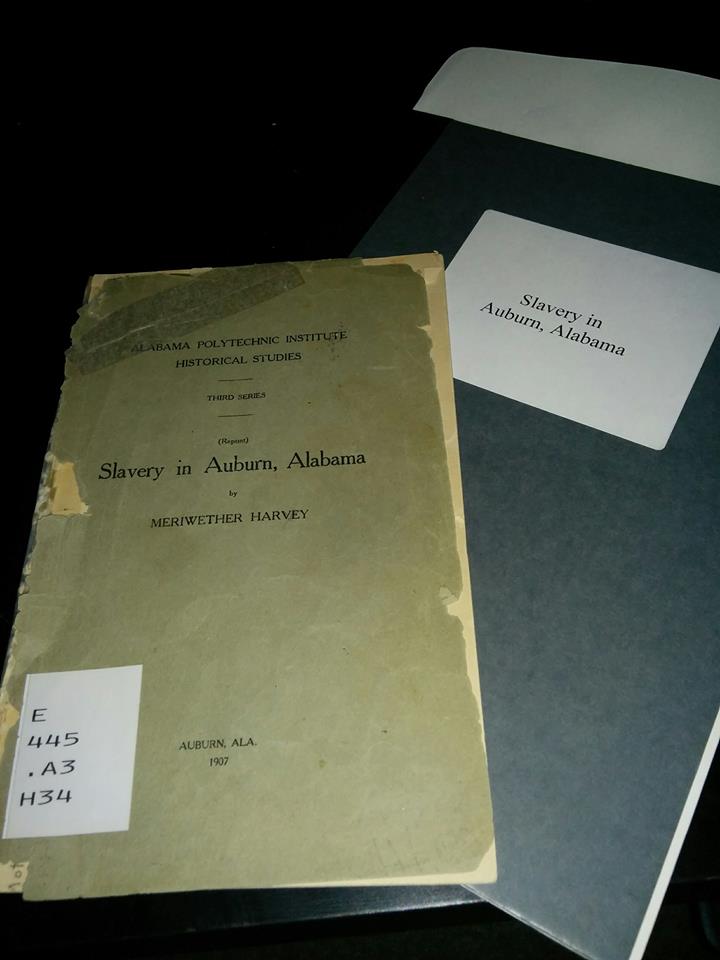
A few weeks ago I mentioned that we had added a 1907 short study on "Slavery in Auburn, Alabama" to the Fair Use Repository. The booklet was published as part of the Alabama Polytechnic Institute Historical Studies series. Meriwether Harvey is listed as the author of the booklet; it is evident from the text that Harvey based the study on some fairly extensive first-hand interviews with family or acquaintances in some of the prominent white families that had formerly owned slaves in the area of Auburn, and also at least some interviews with local African-Americans who had been born under slavery. If you wanted to find information about the author, though, what was available was fairly limited. Harvey was not a member of the Alabama Polytechnic faculty in 1907, and the booklet gives no further detail about its author.

John David Smith, the author of An Old Creed for the New South (2008), describes the the booklet and its author on pp. 173-4, 179:

Fortunately, a talented amateur historian and a number of graduate students went beyond such romanticized views of slavery on the state and local level. [...] Meriwether Harvey and James K. Turner conducted even more minute grass roots research on slavery in Auburn, Alabama and Edgecombe County, North Carolina, respectively. [...] The essays by Meriwether Harvey and James K. Turner remain important because they represent the type of micro research on slavery that still cries out to be written. Harvey, a student at Alabama Polytechnic Institute at Auburn, made the most detailed examination of the period of slavery in any one locale. He focused on slavery in Auburn, in 1860 a small cotton-producing community of one thousand whites and seven hundred blacks....

Smith helpfully, and correctly, identifies Meriwether Harvey as a student at Alabama Polytechnic (now known as Auburn University) -- but misidentifies Harvey as "he." After a bit of research with old copies of the Glomerata at the Auburn University Library Special Collections section, I can now introduce you to Miss Meriwether Harvey, a 19 year old Senior co-ed student at Alabama Polytechnic Institute, who graduated with honors as part of the Class of 1907. Alabama Polytechnic (formerly the Agricultural and Mechanical College of Alabama) had in fact admitted a small number of female students since 1892, -- including Miss Meriwether Harvey.

Miss Meriweather [sic] Harvey

Blockton, Ala.

"Merie." General.

A very congenial piece of curiosity.

Despises frivolity. "Isn't the Captain of Company K handsome!" Believes in maintaining her rights and doing the right. A natural-born mythologist. Always eager to talk about the Conway Cabal (?). Never sends post cards to the professors. Hardest boner of Co-eds. Pretends that she is going to "IV" but makes I's. "I'm shocked to think that Napoleon wrote L-O-V-E letters."

Honorary member of Websterian Literary Society; Distinction '05.

This is from p. 41 in the Senior Class section of the Glomerata, API's official yearbook, Vol. X for the school year ending in 1907.

Ms. Harvey was one of only eight women enrolled at Alabama Polytechnic in 1907. She graduated with honor as part of the Class of 1907; here is her listing in the 1907-1908 Alabama Polytechnic Institute catalogue:

Page 24. [...] GRADUATES WITH HONOR: John Bayard Clarke, Marion; John Cameron Dow, Barbour; Edwin Alexander Harriss, Georgia; Mary Meriwether Harvey, Bibb; [...]
Alabama Polytechnic Institute Catalogue, 1908, p. 24

Many thanks to the Auburn University Archives and Special Collections Department for their help in locating and identifying the author of this remarkable local study. More information about Meriwether Harvey is now available through Meriwether Harvey at ''Notes from the Margins''.

From John V. Denson, “Slavery Laws in Alabama” (1908), Part I: Emancipation

IMG_20160830_135830

This text is transcribed from John V. Denson's 1908 pamphlet, Slavery Laws in Alabama. The booklet was originally published as part of the Alabama Polytechnic Institute Historical Studies series (which had also previously published Meriwether Harvey's Slavery in Auburn, Alabama). John V. Denson was a member of the Board of Instruction for Alabama Polytechnic for History and Latin. Like most of the historical studies from Alabama Polytechnic (now Auburn University) from the 1900s, the viewpoint of the pamphlet is frankly white supremacist, and romanticizes and apologizes for Southern slavery. It is however an extensive and detailed study of the slave code in Alabama in particular. Here is the first section, on the law of manumission. More to follow.

Slavery Laws in Alabama

By

John V. Denson.

In this study of the laws of Alabama that related to slavery, it is not my intention to discuss at all the administration of the laws nor the conditions resulting from any maladministration of them, but merely the laws themselves in the abstract. To get the legal facts about their administration would be a matter of great difficulty, for the courts in which the great majority of slave cases were tried, that is, courts of a justice of the peace, were not courts of record, and the only facts accessible concerning them would be the personal statements of old citizens, and however interesting these might be, they would not be authoritative. The study, then, is a discussion of the statutes that have existed from time to time in Alabama relating to the slave and the free negro from 1819 to 1865. Where it was possible I have compared Alabama laws with the laws of other States. *EMANCIPATION:* Leaving aside any moral questions that may be incident to the emancipation of slaves, I shall discuss it solely from the legal standpoint. Slaves in Alabama were considered and dealt with as property, as chattels personal, and since the right of the owner of any property is absolute, it would seem, at first glance, that the owner of slaves should be allowed to deal with them without interference, and certainly to give them freedom if he saw fit. But slaves were a peculiar kind of property, and for the welfare of the public it was necessary that some restraints be placed upon the powers and rights of the master. A man may own a large quantity of gun-powder, and his property rights are absolute, but for the good of the public he is restrained in a degree, and is forbidden to store it in certain places. [2] And so the Legislature restrained the power of the slave master for various reasons. According to the law slaves were property, and creditors had a legal right to look upon them as security for their debts due from slave owners. The right of the creditor was valid and the master was bound to recognize it, the law providing that an emancipated slave was liable to be taken to satisfy a debt contracted before such emancipation. Again, it was necessary to prevent a freed slave from becoming a charge upon the public, and the master must give bond guaranteeing this. There was among slave-holders a very general impression that the influence of a free negro upon slaves was demoralizing, nor was this unreasonable. The slave might become restless under the taunts of his free brother, or encouraged to hope for freedom himself, and so might run away or incite an insurrection. Hence after 1834 the slave when freed was required to leave the State. also there was current in the South an idea that unrestrained emancipation would result in one of two conditions: either the emancipated negro must remain in the condition of the free negro in competition with the white man for his daily bread, or he must become lord of the soil, as he had in Hayti and Jamaica. Southerners, at least many of them, believed that the negro was incapable of providing sustenance for himself in competition with the whites, and they thought that a large percentage of negroes would be without work, almost starving, and the consequence would be plunder and pillage. The alternative of becoming owners of the soil was even more to be avoided, certainly if reports from Jamaica and Hayti were to be believed.[8] Unrestrained emancipation might turn loose upon Southern white men a horde of ignorant creatures, unchecked by wise leaders, and incapable of being controlled. All these things the South feared, and the laws checking emancipation were intended to prevent them. The Constitution of Alabama, formed in 1819, contained [3] the following statements about emancipation: The General Assembly shall have no power to pass laws for the emancipation of slaves, without the consent of their owners, or without paying their owners, previous to such emancipation, a full equivalent in money for the slaves so emancipated. They shall have the power to pass laws to permit the owners of slaves to emancipate them, saving the rights of creditors, and preventing them from becoming a public charge.[9] The early statute law in Alabama was the act of the Mississippi Territorial Legislature, passed in 1805, when Alabama was included in the Territory, and it remained the law until 1834. That statute provided: That from and after the passage of this act it shall not be lawful for any person or persons holding or owning slaves, to liberate them or any of them, unless they first prove to the satisfaction of the General Assembly, that such slave or slaves have done some meritorious act, either for the benefit of the said owner or for the benefit of this Territory; and in the said case the owner or owners of the said slave or slaves shall give bond or security to the Governor, for the time being, that the said slave or slaves shall not become chargeable to the public. Provided, nevertheless, that all slaves so emancipated shall be liable to be taken by execution to satisfy any debt contracted by the person emancipating them before such emancipation is made. Section 2 of this act provides: That any slave claiming freedom shall proceed by petition to the county or circuit court of his master's county; the master must enter into a bond approved by the governor, in a sum to be adjudged by the court, that such [4] slave will be subject to the order of the court and abide by the judgment of the court, the slave to remain in the service of the master till the determination of the suit.[10] It will be noticed that this statute contains no provision that the freed slave shall leave the state, and there was no such provision until 1834. Another noticeable feature is that there is nothing contained in the statute that would prevent a person's directing in his will that slaves be taken out of the state by his executors, to free territory, and there set free, and a provision of this kind did not occur until 1860. So far as I can find no will containing a bequest of this nature was ever declared null and void. In South Carolina the act of 1820[11] was the same as that quoted above, but in 1841 an act was passed which declared void all bequests, deeds, etc., which intended after the death of the owner to remove slaves from the state and liberate them.[11] Goodell, in his American Slave Code, published in 1853, makes the unqualified statement that, In South Carolina, Georgia, Mississippi, and Alabama, the legislature, only by express enactments, has authority to emancipate slaves, and cites as his authority Stroud, P. 147. Stroud's work was published in 1827.[12] Mrs. Stowe, in Uncle Tom's Cabin, published in 1851, makes the same statement, but cites no authority.[13] If these two persons had taken the trouble, they might have found that in 1834 the Legislature of Alabama enacted a law which provided that judges of the county court might, upon petition of the owner, emancipate slaves, in consideration of long, faithful, and meritorious services performed, and for other good causes, provided such slaves should leave the State within twelve months, never to return, and if such slaves should return, they were to be apprehended by the sheriff [5] and were liable to be sold for life as slaves. As in all provisions for emancipation, it was definitely set forth that nothing in the act should be so construed as to prejudice the rights of the creditors of the owner of the emancipated slaves.[14] This act remained in force until the act of 1860, which revoked and annulled all emancipation laws. The method of procedure under this act was simple. The master desiring to emancipate a slave made publication in his county newspaper for at least sixty days previous to making application, giving the name and description of the slave; at the appointed time the petition was filed and the cause tried. If there was proof that the slave had served his master with fidelity, or other good cause was shown, and no sufficient objection was offered, the judge of probate, acting upon authority conferred by the Legislature, declared the slave free.[14] [6] This act remained in force till 1860. At that time a stringent act prohibiting emancipation was passed, and it is natural to find it. Intensified by the sectional conflict in Kansas, and by the raid of John Brown, the antipathy between the South and the North was growing apace. In Alabama, one of the results of this was the sweeping act of 1860, which was as follows:

Sec. 1. Be it enacted by the Senate and House of Representatives of the State of Alabama, in General Assembly convened, That from and after the passage of this act, all clauses, items, words, or directions contained in any last will and testament, or other instrument, made for the purpose of emancipating any negro slave or slaves, either directly or indirectly, is hereby declared to be void and of no effect.

Sec. 2. Be it further enacted, That any and all clauses of any last will and testament or other instrument by which any executor, administrator, trustee, incorporation or society of persons, may be authorized or directed to remove any slave or slaves from the state of Alabama, for the purpose of emancipating such slave or slaves, is hereby declared to be void and of no effect.

Sec. 3. Be it further enacted, That all gifts and bequests by last will and testament, or other instrument, of any slave or slaves to any person or persons, or to any trustee, incorporation or society of persons, upon the trust or condition that such slave or slaves shall be removed beyond the limits of the state of Alabama, and to some state or territory, where African slavery does not exist, shall be utterly null and void.

Sec. 4. Be it further enacted, That all laws and parts of laws authorizing the emancipation of any slave or slaves, by any proceedings before any court in the state of Alabama, are hereby repealed.

Sec. 5. Be it further enacted, That the provisions of this act shall not apply to wills and testaments or other instruments which may have become effectual before its passage.[15]

  1. [8]Stearn's Notes on Uncle Tom's Cabin, Note 9.↩
  2. [9]Three clauses seem to have been taken almost verbatim from the constitution of Mississippi (1817), except that the latter forbade the emancipation of slaves without the consent of their owners unless where a slave shall have rendered to the State some distinguished service, in which case the owner shall be paid a full equivalent for the slaves so emancipated. See Poore's Charters and Constitutions.↩
  3. [10]Toulmin's Dig. of 1807, p. 259. Hitchcock's Ala. Justice, p. 421.↩
  4. [11]O'Neal's article on S. c. laws in DeBow's Industrial Resources of the South, vol. 2, p. 274.↩
  5. [12]Goodell's American Slave Code, p. 341.↩
  6. [13]Uncle Tom's Cabin and Key, vol. 2, p. 354.↩
  7. [14]

    Acts of the Legislature, '33-34, p. 29.

    Sec. 1. Be it enacted by the Senate and the House of Representatives of the State of Alabama, in General Assembly convened, That whenever the owner or owners of any slave or slaves, shall be desirous of emancipating such slave or slaves, such owner or owners shall make publication in some newspaper printed within the county where such slaves reside, (or if there be no paper printed in said county, then in the nearest paper thereto,) for at least sixty days previously to the making application in which shall be set forth the time and place that such application will be made, together with the names and description of the slave or slaves, sought to be emancipated; and at the time appointed the judge of the county court may upon petition filed, proceed to hear and determine upon the application so made, and if, in his opinion, the said slave should be emancipated, in consideration of long, faithful, and meritorious services performed, or for other good and sufficient cause shown, the said judge may proceed to emancipate and set free such slave or slaves; and the clerk of the court shall make record of the same in a book to be kept by him for that purpose: Provided, that such slave or slaves shall remove without the limits of this state, within twelve months after such emancipation, never more to return, and that such emancipation shall not take effect until after such removal.

    Sec. 2. And be it further enacted, That if the said slave or slaves shall return within the limits of this state after such removal and emancipation, he, she, or they, shall be subject to be apprehended by the sheriff of the county within which the same may be found and imprisoned, and after having advertised the same for at least thirty days, may be sold to the best bidder for cash as slaves for life; and the proceeds of such sale, after paying all expenses, shall be paid into the county treasury for the use of said county.

    Sec. 3. And be it further enacted, That it shall be the duty of all sheriffs, constables and patrols, to apprehend slaves who shall return after having been so emancipated and removed, and bring them before some justice of the peace who shall commit them; and the same compensation shall be allowed in such cases as is allowed for apprehending runaway slaves.

    Sec. 4. And be it further enacted, That nothing in this act contained shall be so construed as to prejudice the rights of the creditors of the owner of slaves so emancipated.

    App'd, Jan. 17, 1834.

    See also Clay's Ala Dig. of 1843, p. 545, secs. 37, 38, and 40. Also Ala. Code of 1852, secs. 2044-2048.

    ↩
  8. [15]Acts of 1859-60, p. 28. App'd Jan. 25, 1860.↩

Now available: full text of “Slavery in Auburn, Alabama” (1907)

Now available on the Fair Use Repository website: I have just made available the full, transcribed text of Slavery in Auburn, Alabama, a small 18pp booklet from the Alabama Polytechnic Institute Historical Studies (published by Auburn University, then known as Alabama Polytechnic Institute) written by Meriwether Harvey.

I found the booklet on the shelves at the Auburn University RBD Library, an aging, decaying reprint booklet carefully tucked into a protective grey cover, and decided that this document of local history deserved preserving. So I have spent the past couple days reading and transcribing the text into digital form.

The booklet was written in 1907, and its viewpoint very emphatically reflects the views common among wealthy white families and former slaveholders (like the Harveys) in and around Auburn, Alabama, a small college town in what was then rural East Alabama. It is romanticized, although concerned enough with points of detail and description that that only causes a problem in some parts of the booklet. At times, the text is oblivious, or frankly racist. It makes some blanket claims about the local slave trade that are almost certainly self-serving lies told by the author's sources. However, the booklet seems to have been based primarily on first-hand interviews with slaveholding white families and a few interviews with African-American residents who had been born under slavery, and whether intentionally or unintentionally provides fascinating points of detail, and anecdotes reflecting the reminiscences, the self-justifying fantasies, and also the anxieties of white slaveholders in East Alabama, as well as some of the range of experiences of slavery in east Alabama, and the operation of the slaves' economy, despite its frustrating limitations. Some excerpts:

Slavery in Auburn, Alabama (1907)

By Meriwether Harvey

[...] Corn shucking was another great occasion in the negro's life. The owner would have all his corn hauled up and thrown on the ground at the crib door in a big pile; then he would invite his neighbors' negroes to come to his house on a certain night to a corn shucking. Only the men were invited; as they came they could be heard in the distance singing corn songs. I have tried to record some of these songs, but I find they were a jargon; they had no real words, only a tune. Some disinterested man would lay a long pole in the middle of the pile; then two negro men would choose sides, as is done today in spelling matches, and the two sides would enter into a contest to see which could first finish their side of the pile. The leader, dressed in a stove pipe hat and feather, walked up and down on the pile and gave out the corn song. The whole crowd answered him in the chorus. As they shucked, they would throw the corn into the barn in front of them and the shucks behind. When they had finished about half of the pile, corn whiskey was passed; thus they worked till eleven o'clock, when [13] they had a big plain supper. After eating the put the shucks in pens made for the purpose. By twelve they had finished, and then the frolic began. They danced about the great bonfire that had been burning all the time behind them, so that they might have sufficient light to shuck the corn, the lights and shadows making a strange and ghostly scene. After the supper the owner of the plantation, the giver of the corn shucking, or sometimes the overseer, was seized and carried about on the shoulders of some of the negroes. The other negroes followed, all singing at the top of their voices. About two or three o'clock in the morning they all went home.

[...] The treatment of slaves was generally good because the negro was property and was cared for as such. [sic] I have interviewed only one man who ever saw a slave unmercifully beaten. [sic] A great many negroes would run away; some of them were chronic runaways, and were so seemingly without any cause whatever. A few of these chronic runaways were chained at night. Certain people all through the country kept fox hounds for tracking runaway negroes, who would go off into the swamps and woods. It was often impossible to catch them in any way except with dogs. They were seldom bitten by the dogs when over taken; they would climb a tree if one was near at hand, but if they were caught on the ground, the dogs were so trained that they circled around the negroes, without going close to them. Negroes always aided a runaway by slipping to him something to eat. Mr. H. never had a negro to lie out more than three days, and never offered more than ten dollars as a reward for his return. Mr. B., with the aid of another man, caught a negro who had been in the woods seven years. He advertised the negro, and in due time returned him to his master. The slave turned out to be the most faithful of a large number of slaves. Mrs. D. says of her whole [15] number of slaves, which was between one hundred and fifty and two hundred, there was never a runaway; Mr. B. knows several such cases. Uncle West would run from the plantation up to Mr. F. R.'s residence whenever the overseer told him to do what he did not wish to do, or threatened to whip him. None of the negroes ever did any other kind of running away.

The overseers were men selected for their practical farming ability, and their business was to oversee the negroes and look after the farm and the planting. Sometimes an overseer was discharged, or brought to trial, when he mistreated a negro. One of Mr. W. H.'s overseers whipped two of his negroes, who hid in the swamp. Some of the other negroes came from the plantation to Auburn to tell their master. He decided the whipping unjust and paid the overseer up and let him go.

When an overseer was hired it was understood that he was to ride the country as a patrol; also the young white slave-owners of the neighborhood patrolled on certain nights. A negro was not allowed to leave his master's plantation without a pass stating where he was going and when he was to return. This had to be signed, either by the overseer or the master. If the negro was caught away from home without a pass, he was whipped with a leather strap by these patrols. The usual punishment for being away from home without a pass was ten to twenty lashes, but in exceptional cases thirty-nine lashes might be given. These patrols went usually Saturday nights and Sunday afternoons and nights, but they also went out any night when they thought they might catch negroes roving about. They patrolled the roads, visited the plantations, and searched the cabins; if a negro was caught in a cabin away from home, he was taken off a good way from the negro quarters and whipped. Of course the whipping depended upon the offense, the mood of the patrol, and the negro whipped. Sometimes people who did not own negroes would catch a [16] negro without a pass and beat him badly, but the regular patrol did not do this.

The negroes were punished as a rule, by whipping; the whip was a leather strap so that it would not cut the skin. The foreman was the boss and did the whipping, but the owner, or overseer, was there to witness it. On some plantations the overseer did the whipping, but the master was usually present. Negroes were not whipped for small offenses; a foreman would sometimes dislike a certain negro and would beat that one unmercifully. As a rule, the overseer was more kind and merciful than the foreman. If there was a large number of hands, the foreman spent his whole time bossing; if the number was small, he would work awhile and then boss awhile. He lorded it over the other negroes. The worst whipping was often done by the negro parents.

[...] Slavery was not without its dark side. There were near Auburn several instances of cruel treatment to slaves. In one case they were not properly fed, in another, they were not sufficiently clothed. How far this was due to the lack of means of the masters is now hard to determine. In some cases they seem to have been overworked. In one or two they were treated roughly and punished severely. In one case a slave stabbed his master, but did not kill him. The slave was tried and hanged. Public opinion disapproved of cruelty on the part of masters. One man was indicted three times for ill treatment of his slaves, especially for failing to supply them with sufficient food and clothing. He was fined each time.

[18]There were some old negroes who did as they pleased and went where they pleased. These negroes were too old and infirm to be of any value. Mr. H. had four or five such, two of whom were blind women. They made money by making baskets and selling chickens and eggs. These negroes were not what were called free negroes. Uncle Burl Dillard was in reality a free negro, but he nominally belonged to the Dillards. He made ginger bread and persimmon beer, which he sold. He also had a wagon and mule, and went through the country buying old rags which he took to Columbus and there sold. His wife, Aunt Kitty Dillard, was a slave.

The negroes had the greatest contempt for poor white folks, that is people who owned no negroes. Every one speaks of their faithfulness. They would divide anything they had with their masters and would steal from their neighbor rather than their master. Only cribs and smoke houses were locked. They thought their folks the greatest in the world, and what belonged to the master was always spoken of as theirs. They were respectful to every one except poor white folks. Mr. R.'s negroes came from South Carolina and would not associate with other negroes because they thought South Carolina negroes far superior to any of the negroes in Auburn. In 1847 Aus Harvey went to Mexico with his master. When they left, the mother of Mr. Harvey made Aus promise to bring her son back if he should die. Mr. Harvey died with yellow fever, and true to his promise, Aus brought the body home. He paid his own fare and that of the corpse by cooking and doing various things. He told parties that the corpse was a piece of furniture he was bringing to Alabama. Finally, he got the body as far as Montgomery; then the family sent for it. There were many examples of faithfulness, too numerous to be told.

--Meriwether Harvey, Slavery in Auburn, Alabama (1907)

Over My Shoulder #25: Lee’s views on Reconstruction and civil rights, from Michael Fellman (2000), The Making of Robert E. Lee

Here’s the rules:

  1. Pick a quote of one or more paragraphs from something you’ve read, in print, over the course of the past week. (It should be something you’ve actually read, and not something that you’ve read a page of just in order to be able to post your favorite quote.)

  2. Avoid commentary above and beyond a couple sentences, more as context-setting or a sort of caption for the text than as a discussion.

  3. Quoting a passage doesn’t entail endorsement of what’s said in it. You may agree or you may not. Whether you do isn’t really the point of the exercise anyway.

Here’s the quote. This is from Chapter 13, Southern Nationalist, of Michael Fellman’s The Making of Robert E. Lee. The war has ended and Lee is now facing the rapidly changing landscape of the South under Reconstruction. Notice how in retrospect the old statist warrior Lee could turn even secession into a statist doctrine. Also keep in mind that this is the white marble man whose memory is officially celebrated together with that of Martin Luther King Jr. (and the civil rights movement by extension) on Lee-King Day, in the states of Arkansas, Mississippi, and my old home state of Alabama.

On February 17, 1866, Robert E. Lee was called before the Joint Committee on Reconstruction in Washington to discuss issues of race and politics. A reluctant witness, Lee nevertheless was quite forthright in his defense both of the 1861 secession of the South and of the current efforts of Southern white elites to wrest back control of their domain from the threats posed by empowerment of blacks.

On the surface, it continued to be important for Lee to claim that he was above partisanship and discord. He asserted at the onset of the testimony that he was not well acquainted with current political issues. I have been living very retired, and have had but little communication with politicians, he testified, rather disingenuously, since he had been in constant communication with such men. The maintenance of an Olympian persona for public consumption was a major component of Lee’s postwar Southern nationalism: he would be the true conservative statesman above the fray, a position that both increased his value to other Southern white leaders and heightened the esteem he had gained in the South during the war, which was of great importance to him. The naive prewar engineer who could not think politically without getting headaches had been politicized by the secession crisis and the war, and afterward Lee was quite aware that his suprapolitical status was especially helpful when synchronized with those of his comrades who sought to roll back Reconstruction.

By the time Lee testified to Congress, Andrew Johnson had begun to come into conflict with congressional Republicans over how far to push change in the defeated South. While the Republicans wanted to punish the leaders of the Confederacy and pass laws and constitutional amendments to guarantee civil rights for blacks, protect their rights as free workers, and offer them suffrage, Johnson opposed all such uses of federal authority, supporting Southern white men and Northern Democrats who were organizing to abort all such political and social changes tand to return the former Confederacy to the Union with whites firmly in control of blacks.

Lee was well positioned to take up Johnson’s proffered handshake. He testified to the congressional committee that the former secessionists are for cooperating with President Johnson in his policy…. Persons with whom I have conversed, Lee stated (almost immediately refuting his position that he had been living very retired), express great confidence in the wisdom of his policy of restoration, and they seem to look forward to it as a hope of restoration.

As nearly as possible, Lee argued, restoration should be a return to the status quo ante, the reinstitution of slavery [which had been abolished under the Thirteenth Amendment —RG] excepted. As part of his position, Lee stoutly defended the legality of secession. Citizens of Southern states such as Virginia had not committed treason in 1861; they considered the act of the State[s] as legitimate, under the Tenth Amendment, merely using the reserved right which they had a right to do…. The act of Virginia, in withdrawing herself from the United States, carried me along as a citizen of Virginia… her laws and her acts were binding upon me.

Besides, Lee said, secession had been brought about by a blundering generation of national politicians. The position of the two sections which they held to each other was brought about by the politicians of the country; that the great masses of the people, if they understood the real question, would have avoided. In that sense, demagogic politicians backed by gullible lower-class white voters had wheedled the nation, Lee stated. He was seeking to narrow the meanings of secession (and even the war) in the name of an essential constitutional continuity, the better to sharply limit new forms of federal intervention during Reconstruction. Along these lines, he was even in favor of Southern states repaying Confederate debts contracted during the war against the Union rather than repudiating them, as the Republicans were insisting—debts held by ex-Confederates such as himself.

Much of Lee’s testimony concerned his opinions toward blacks. On the most general level, Lee said that every one with whom I associate expresses kind feelings towards the freedmen. They wish to see them get on in the world, and particularly to take up some occupation for a living, and to turn their hands to some work. Lee also expressed his willingness that blacks should be educated, and… that it would be better for the blacks and for the whites. Although he did not believe that blacks had the same intellectual capacities as whites, he was acquainted with those who have learned the common rudiments of education.

Guarded and rather condescending by implication during the rest of his testimony, Lee never questioned his belief in the inferiority of blacks as a race, often pairing an attribute he found endearing with results he found irritating. Wherever I have been they have been quiet and orderly, he told the congressmen, not disposed to work, or rather not disposed to any continuous engagement to work, but just very short jobs, to provide them with the immediate means of subsistence. Asked whether the black race had as great a drive to accumulate money and property as whites, Lee answered, I do not think it has. The blacks with whom I am acquainted look more to the present time than the future…. They are an amiable, social race. They like their ease and comfort, and, I think, look more to their present than their future.

There he was in Lee’s mind’s eye: the stereotypical slave, now free but still lazy, irresponsible, and undisciplined, if charming and amusing. What white people such as Lee could not understand was that after their emancipation, many blacks strove mightily to remove themselves from white surveillance and to work on their own toward subsistence and as much economic security as they could garner from short-term employment. Such efforts to gain independence and increase their distance from their former masters appeared to men such as Lee to be a lack of effort that proved black racial inferiority.

Lee was certain that the well-bred Southern whites he knew were kind to these childlike folks. But responding to the possibility of the political elevation of blacks, of the sort that many radicals in Congress were then proposing, Lee’s feelings immediately were shown to be less benign. As for white Northerners who came south to aid the freedmen, Lee conceded that proper gentlemen would avoid them… not select them as associates… not admit them into their social circles. If Congress were to pass an amendment giving suffrage to blacks, men of his class would object. … I think it would excite unfriendly feelings between the two races. I cannot pretend to say to what extent it would go, but that would be the result. Lee threatened nothing in the way of violence, but he feared that general white opinion would turn that way. Indeed, even given the incentive of increased Southern representation in the House of Representatives should blacks be given the franchise, Lee concluded that white Virginia would accept the smaller representation. For the forseeable future, black suffrage would open the door to political and social catastrophe. My own opinion is that, at this time, they cannot vote intelligently, and that giving them the [vote] would lead to a great deal of damagogism, and lead to embarassments in various ways. Just as he had believed before the war that God would end slavery some distant day, Lee could admit the possibility of black suffrage only after some infinitely long process of labor and educational improvement (unlikely for blacks, under his definition of their instrinsically limited intellectual potential). What the future may prove, how intelligent they may become, with what eyes they may look upon the interests of the State in which they may reside, I cannot say more than you.

Bland and calm until then, at the end of his testimony, Lee was drawn out by a series of direct questions into expressing his underlying antipathy for the notion of renegotiating race relations in order to promote a biracial social and political modus vivendi. Asked Do you not think that Virginia would be better off if the colored population were to go to Alabama, Louisiana, and other Deep South states, Lee replied, I think it would be better for Virginia if she could get rid of them. … I think that everyone there would be willing to aid it. Yes, he thought Virginia was absolutely injured and its future would be impaired by the presence of blacks; yes, with its great natural resources, once rid of blacks, Virginia would attract white immigration. And Lee argued that is no new opinion with me. I have always thought so, and have always been in favor of emancipation—gradual emancipation. Lee harkened back to the colonizationist stance of his wife and mother-in-law, a position he had never actually adopted but that might serve him rather well before Congress. The best possible result for race relations in Virginia, he maintained, would be the gradual disappearance of blacks, a curious reworking of the meaning of gradual emancipation and colonization. Failing that, Lee could accept blacks only in the most marginal fashion.

Such were Lee’s opinions when he was at his most reserved, in the sort of public forum he usually sought to avoid. Writing privately, Lee was even more candid about his postwar racial views. In common with most Southerners of the master class, Lee had had relatively little to say about blacks during slavery days, when he had been a confident paternalist who believed that he could manage the servants. Indeed, near the end of the war, he had expressed less concern about black soldiers under direct white control than about guerrilla soldiers drawn from the poor white population. But when, with emancipation, the racial order in fact had been undermined, Lee could maintain paternalist equilibrium only when he saw blacks as clearly subordinate—any move toward political or social equality was deeply upsetting to him.

Rarely one to use hot language, Lee nevertheless expressed considerable distaste for blacks. Particularly was this true for blacks immediately around him, which meant those servants he and Mary Lee sought to employ after the war. As contracted labor, these free blacks presented a new phenomenon: blacks bargaining over wages and conditions of employment. After Lee began to set up housekeeping in Lexington in the fall of 1865, he addressed the servant problem in several letters to Mary, who was to follow him to the college. You had better bring up Miss Skipworth’s woman. I fear we shall not be able to procure white servants. … Servants of some kind (black) I have no doubt can be obtained. But Lee clearly expressed his belief that blacks ought to be the employees of last resort. Freed blacks proved hard to obtain, whatever Lee’s distaste, and they did not seem willing to settle down under the control of former masters. On October 29, Lee wrote Mary, as regards servants, I cannot speak positively till the time comes for employing them. They are leaving their homes here as elsewhere, but there seems to be enough & some have offered their services. If any good ones offer, I advise their engagement. Indifferent ones I think can be had here. We shall want but one man. Lee then ran through the names of their ex-slaves, finding one named Jimmy to be the least incompetent. The next day, he commented about hirnig a man whom one might think Lee would have put in the indifferent category: I have engaged a man for the balance of the year who professes to knoweverything. He can at least make up the fires & go on errands & attend to the yard & table. Uncharacteristic sarcasm revealed Lee’s reaction to a man who had been altogether too uppity for a black servant when Lee had interviewed him. Lee chafed at such new relationships between the races, where blacks did not instantaneously display the appropriate deference but asserted themselves above their station. Racial unrest characterized everyday exchanges as well as politics of a more public and dramatic sort.

As late as 1869, Lee wrote his son Rob about his ex-slave Jimmy, resident on Rob’s plantation, with whom Lee had shared bonds he considered proper before the war. Even with the prospect of hiring Jimmy, however, Lee was now tentative. I forgot to speak for Jimmy, Lee wrote Rob. If he wishes to come to me & is sufficiently acquainted with gardening to undertake the garden, & will attend to the stable & all outdoor matters—send him up. I will give him $10 per month, as long as he suits me & I suit him. The new order was certainly not the best of all possible worlds.

Immediately after the war, Lee began expressing a contempt for blacks that he had never uttered before, including that desire to get freedmen out of his sight by literally pushing them out of Virginia. Early in June 1865, he urged Colonel Thomas H. Carter to discharge his ex-slaves and replace them with whites. Carter replied that such a desire would be utopian in his neighborhood, as he could get only black labor to do the drudge work. I have always observed, Lee then insisted, that wherever you find the Negro, everything is going down around him, and wherever you find the white man, you see everything around him improving.

Lee understood Colonel Carter’s point—there were simply no whites willing to compete with blacks at the bottoms of the labor barrel—but still he wished that black removal could be effected. That October, Lee wrote to Fitzhugh about improving Fitzhugh’s land, I fear that you will be able to do but little with black labour, & until you can put up some buildings, you will not be able to attract white. And a year later, Lee wrote to Rob, his other plantation-owning son, The mill dam I know is a troublesome work, but I hope you will accomplish it, & I fear you will have to execute it with negro labour. I presume at present there is none other to be had. You might get aid from the Virginia Emmigration Co.; which now has an agent in Europe endeavoring to procure emigrants.

Lee had become an active supporter of the Virginia Immigration Society, as part of his notion of how the state ought to both modernize and whiten. In 1869, he wrote to Colonel Joseph H. Ellis, director of the society, that he believed that the agriculturist as much as the industrialist had need for regular & consistent work that can only be served by the introduction of a respectable class of labourers from Europe to replace blacks. Other sources of nonwhite labor would not work well, such as those that had been introduced in California, the Caribbean, and Latin America, for although temporary benefit might be derived from the importation of Chinese or Japanese, it would result I think in eventual injury to the country, & her institutions. We not only want reliable labourers but good citizens whose interests & feelings would be in unison with ours. Whole families of white Europeans, such as the folks flooding the North, were what was wanted. I have been & still am an advocate for European immigration. Lee’s view of a labor force appropriate for modernization resembled the one he saw developing in the North, but white immigrants voted with their feet not to compete with black labor in the war-scarred, impoverished South. In 1868, for example, of 213,000 overwhelmingly northern and western European immigrants, only 713 settledi n Virginia.

Lee’s interest in European immigration to replace black labor—a desire quite widespread in the upper South—contained considerable bitterness about the incapacity and perfidy of blacks. In 1868, Lee wroteRob that he had recently had a visit from a Dr. Oliver of Scotland, who was examining lands for immigrants from his country. From his account, I do not think the Scots and English would suit your part of the country, which would be too hot and hilly to please them. I think you will have to look to the Germans; perhaps the Hollanders, as a class, would be more useful. Lee was also active among those pushing for a railroad into the Shenandoah Valley of Virginia from the eastern seaboard, for then I think there will be no difficulty in getting whites among you. In the meantime, white Southerners would have to bend their backs to the plow, unaccustomed though they were to hard physical labor. People have got to work now. It is creditable to them to do work; their bodies and their minds are benefited by it, and those who can and will work will be advanced by it. Lee was fully aware that for white Southerners manual labor was degraded by its association with blacks. Nevertheless, he insisted that, however irreplaceable it was likely to be, black labor was now fundamentally antagonistic to white interests: You will never prosper with the blacks, and it is abhorrent to a reflecting mind to be supporting and cherishing those who are plotting and working for your injury, and all of whose sympathies and associations are antagonistic to yours. Catching his pen in an unaccustomedly overt expression of that racist anger resident in the dark side of paternalism, Lee quickly corrected himself. I wish them no evil in the world—on the contrary, will do them every good in my power, and know that they are misled by those to whom they have given their confidence. Yet right after paternalistically sympathizing with Virginia’s black innocents who had been misled by Northern carpetbagging politicians, Lee went back to the racial divide: Our material, social, and political interests are naturally with the whites.

In Lee’s mind, as in those of most of his countrymen, North and South, the racial hierarchy was clear. English and Scots were above Germans and Hollanders, who were much better than Chinese and Japanese, all of whom were superior to blacks. To the English journalist W. H. Nettleton, who was about to return home, Lee wrote in 1866, Your visit to America must have impressed upon you the fact that, though climate, government, and circumstances have produced changes in the character of the people, yet in all essential qualities they resemble the races from which they are sprung; and that to no race are we more indebted for the virtues which constitute a great people than to the Anglo-Saxon. You will carry back with you to England my best wishes. When, in 1870, Mrs. Emily Hay forwarded a pamphlet written by the Anglo-Canadian immigration propagandist Professor Goldwin Smith, Lee responded that he was gratified by Smith’s interest in Virginia & wish that the tide of emigration from England could be turned toward the State. Englishmen need not fear the exhibition of hostility against them in Virginia. They would be cordially welcomed… agriculturists especially. To his son Rob, Lee had expressed his doubts that significant numbers of Englishmen would settle in Virginia, but if they did, as fellow Anglo-Saxons, they would be the most welcome of the newcomers: in Lee’s essentialist racial categorization, they were bone of his bone, blood of his blood. Many attitudes were quite in line with the cutting edge of contemporary racialist thought.

Mary Custis Lee was more vituperative on the issue of race than her husband, although he did not really disagree with the underlying sentiments she expressed. To take but one of many examples, on May 20, 1866, she wrote from Lexington to her old friend Emily Mason, We are all here dreadfully plundered by the lazy idle negroes who are lounging about the streets doing nothing but looking what they may plunder during the night. We have been raided on twice already…. But all thro’ the country the people are robbed nearly as much as they were during the war. … When we get rid of the Freedman’s bureau & can take the law in our hands we may perhaps do better. If they would only take all their pets north it would be happy riddance to all.

It must be added that in other moods, when he was not feeling threatened and betrayed, Lee continued to express a kinder paternalism toward this less fortunate race. In this vein, he wrote to a Northern Presbyterian clergyman who was seeking to find suitable genteel Southern white men to distribute Northern educational funds earmarked for the freedmen, I entirely agree with you… that the education and advancement of the colored people at the South can be better attended to by those who are acquainted with their characters and wants than by those who are ignorant of both. Lee recommended Drs. Hoge and Brown in Richmond as useful contacts, while begging off from becoming the distribution agent for Lexington—I coul not attend to it on account of other duties … nor do I know any colored preacher competent—but he then assured this preacher, rather disingenuously, because privately he fumed against black behavior, that the colored people in this vicinity are doing very well, are progressing favorably, and, as far as I know, are not in want. There is an abundance of work for them, and the whites with whom they are associated retain for them the kindest feelings. This calmer part of Lee lived in considerable disjuncture with the Anglo-Saxonist who was so angry at the local blacks, which is not to suggest that both sides may not have coexisted.

—Michael Fellman (2000), The Making of Robert E. Lee (ISBN 0801874114), pp. 264–275