Fair Use Blog

“Will the Union be Preserved?” (Newburyport Daily Herald, May 24, 1861)

363. Will the Union be Preserved?

(Newburyport (Mass.) Daily Herald [Lincoln], May 24, 1861)

Will the Union be Preserved? We have adopted a certain course of proceedure [sic] to suppress rebellion, and whether that course was agreeable to individual parties at the outset or not, it being entered upon, there is but one thing left, to wit: to fight it to the end. Upon this all are agreed. What will be the result, it is impossible for any man to say with certainty. We can only now appreciate and applaud the patriotism thta is ever ready at our country's call, to sustain a government which has never oppressed but always blessed all that sought its protection. It is a terrible necessity that can demand war between brothers and countrymen; and we can only justify war upon the grounds of that very necessity--that all other expedients have failed, that nothing else will answer, and that this will restore the country to union and peace, to [840] justice and order. Whether it will so result, depends upon facts not yet determined. Is this rebellion, or is it revolution? that is, is it the work of a few who have misled or over-awed the many, or is it the wish and fixed determination of a large majority at the South, that the Union shall be dissolved? is it the result of a temporary and transitory excitement, or is it a conscientious conviction, for which they will suffer and endure?

In our revolution of 1776, Great Britain mistook the nature and character of the contest. They deemed it a rebellion that could be crushed, and thus loyalty restored. It was not simple rebellion, but the firm determination of the people to be separate, free and independent; and when afterwards all else could have been satisfactorily arranged, the colonies would not assent to a re-union to the British crown. They came here and blockaded our ports, defeated our armies, and subdued the country step by step from Bunker Hill to Savannah; but they did not accomplish anything in subduing the people--the unconquerable will still remained, and eventually triumphed. It remains for us to prove whether our conflict arises from a conspiracy on the part of political leaders, in rebellion against the federal government, or is such a struggle on the part of the people that we should denominate it a revolution. If it is the first, defeat in the field will quell it, and the states may return to their allegiance, as stars driven from their orbits for a day, by the laws of gravi[ta]tion on which our solar system rests, come back to repeat their endless rounds about the great center; if it is the latter, battles may be lost or won and it will not restore a government founded upon the voluntary action of the people, in which the states hold their places not as conquered provinces, but as co-equal partners. It is not to be presumed that great states, many of them equal in extent to powerful kingdoms--indeed much beyond any kingdom or empire of Europe, save Russia, and inhabited by millions of freemen, brave, high spirited, energetic and jealous of their rights, can be held together except by voluntary cohesion; and if they could be held together by any other means, it would not be the restoration of the union that had its birth from the revolution of 1776.

There never could be a doubt with any sane man of the ability of the North to march over the South. It cannot be done in a day, as some in their impatience would have it, for it is not so light a task that we may intrust it to raw recruits with a supply of one day's rations; but it can be done, and if the war continues will be done, giving us possession of every important post in the country. If it were necessary, we could clear off the thousand millions [sic] of square miles so that not a city or [841] cultivated field would remain; we could exterminate the nine millions of white people and re-settle--re-people the lands. There is no want of ability; and if such a work was demanded, there would be no want of a will. Never were twenty millions of people so strong and so well able to bear the losses of war as the twenty millions of the loyal states; never was a nation that could so speedily call into existence armies and fleets. Less than forty days have elapsed since President Lincoln called for troops, and already three hundred thousand have said--we are ready; ships have been offered of all classes and in any numbers; more than a million dollars a day have been actually contributed for the nation's defence, and any amount tendered on call, while at the same time the national funds have advanced on the markets; arms have been flowing into the country and munitions of war have been accumulated more rapidly than was ever known in the history of any people; and we may therefore say without fear of contradiction, that we are a nation of unparelleled [sic] strength and resources.

There is no doubt at all, then, that we shall defeat the South. But that does not decide the question of the restoration of the union of co-equal States. That Union was not based upon compulsion, and it cannot rest upon force. England can conquer Ireland and hold it, without violence to her constitution; Austria can garrison and retain Venetia, without a change of laws; Russia can incorporate a subjected people, like the Poles, in accordance with her policy; but we cannot have States in such a condition. If the Union is ever restored, South Carolina must be the equal of Massachusetts, and Virginia of New York; and they must remain together of their own will.

Let us understand the nature and aim of this war. It is not one of conquest and subjection; for after peace we should not know what to do with a conquered and subjected people. It is not a war based upon prejudice, passion or revenge; if so, it were unworthy of us and would deserve no support. We have suffered enough and suffered long, but God forbid that we should seek redress in blood. It is not a war for changing any institutions of the seceded States; for that would be a revolution on our part and not theirs. They have the right of local self government and must retain it; and the peculiar institution of slavery could not be overthrown by arms without bringing ruin to the land. It is not a war that looks at disunion as a result. We have been surprised to hear people say--"we'll whip them and then let them go," "we will fight, but that fight must end end the Union, for we shall never be on terms to live together again." If disunion is an inevitable result, no man can justify himself in the waste of blood or treasure in war; nor would the [842] different sections at the close of the war be in so good a condition to arrange terms of separation, as they would to-day.

The only grounds upon which we can justify civil war--so unnatural a war between twin States, between families of the same lineage and blood, who have a common country, a common history, and the same language and religion--is on the ground of its necessity to sustain a government for the good of the whole, that is now threatened by the rebellion of a part. The object is not to overthrow, but to build up; not to destroy, but to restore; not to conquer the people of any State, but to relieve them from the domination of rebel chiefs. If the people deliberately and intelligently determined upon their action in the dozen States that are in rebellion, as did our fathers in the revolution, or if without that deliberation and intelligence, disunion had become a "fixed fact," from which war could not rescue us, then we might hesitate; but so it is not. Fanatical and ambitious leaders counted upon the weakness of the central government, and upon the aversion of the North to sacrifice in war; and usurping power they precipitated secession. The people were not consulted; they were threatened, and terrified, and bowing themselves for the time submitted. It is to free the people from military despotism and the prevailing terror that our troops are facing southward, that they may bring States back untrammelled to anchor in the Union and fasten to the Constitution. We see how this is being done; Baltimore has been relieved of mobs, and Maryland swings back to her old place in the line; St. Louis was rescued from the grasp of a traitor governor, and Missouri resumes her upright position; Col. Anderson goes to Kentucky, and before he reaches the State the legislature requires the troops to swear allegiance to the national constitution; Western Virginia hails the stars and stripes and is sanguine that she can bring back that State; Tennessee is in the secession net, but Johnson and Etheridge and Nelson feel sure of the people. All through the Border States the tide has turned; and our troops instead of being surrounded by enemies as they advance, will be hailed as friends and deliverers. North Carolina that went out unanimously, will find an uprising of her own people; and so it will be in every State till the home of Sam Houston is reached, and his bugle notes call the people to duty along the valley of the Rio Grande.

We feel that our government is in the right and must succeed, though not with a light struggle or a speedy victory; and this is the only ground--that they go as deliverers of the people of the South, and the defenders not only of the National Constitution and of all their local interests on which we could be right. [sic] If we admit that it is to restore them to any [843] thing less than that full and perfect condition in which they have heretofore been, as co-equal states and self-governing communities, then we should have no more justification for hte shedding of one drop of human blood than has Jefferson Davis or Beauregard.

Northern Editorials on Secession Volume II, 839-843.

Two more years of THE LIBERATOR now available! (Scanning Project, Week 1 update)

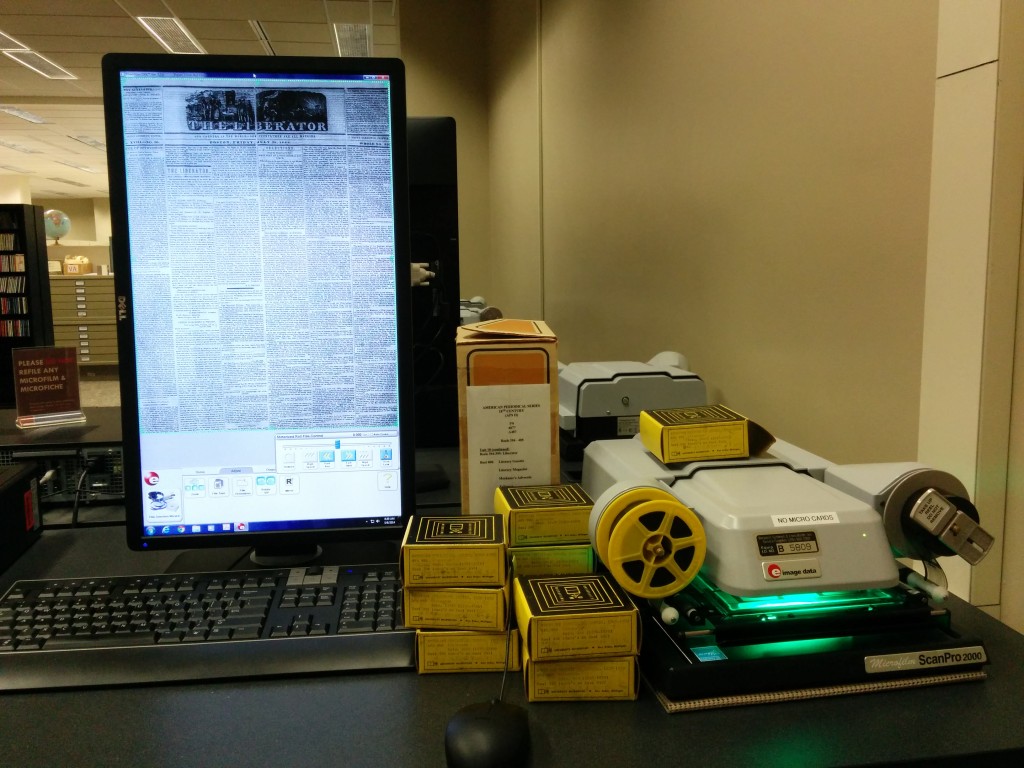
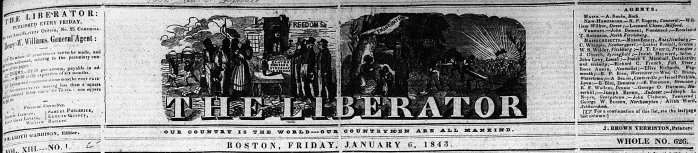
I'm happy to announce, as an update to the ongoing Liberator online archive project that two more volumes of The Liberator -- Vol. XII and Vol. XIII -- are now available, in full page-scan PDF facsimiles -- at the Liberator online archive:

<

p>The early 1840s were eventful and contentious years in the American Abolitionist movement, with much of the controversy centered on Garrison, Abby Kelly and their radical allies -- especially the ultras' strident opposition to electioneering and political parties, and their principled defense of women's freedom to participate equally in the Abolitionist movement. In May 1840, the American Anti-slavery Society underwent a schism in the conflict over both propositions; more conservative, politically-oriented and anti-feminist abolitionists attempted to purge Garrison from the AAS, and when they failed to run him out, they left to form a new, conervative American and Foreign Anti-Slavery Society. The pages of The Liberator in 1841-1842 were full not only of news about national events, slavery, war, but also internal debate within the movement over the AAS/AFAS split and the electoral campaigns of the recently-formed Liberty Party, as well as new reports and arguments over the Come-Outer religious movement, endorsed by Garrison, Abby Kelly, and others, which called on Christians to come out of mainline denominations that did not reflect their conscientious beliefs on spiritual practice or which refused to take a moral stand against slavery, alongside established features such as the Refuge of Oppression columns (in which Garrison quoted, verbatim, the words of defenders of slavery and racism, in order to demonstrate the inhumanity of their views), international updates on the Caribbean and on the speaking tours of British Abolitionists, reflections on religious and moral topics, and pages of bad moral reform poetry. To see it as it happened, you can now check out 104 more issues of The Liberator available online, in full, for free, from January 1841 to the end of December 1842.

If you enjoy this project or find the materials useful, you can help support the work and speed up the on-going progress with a contribution to the project, in any amount, through the Molinari Institute -- the not-for-profit sponsor of the Fair Use Repository. You can read more about the fundraiser and the archive project in the introductory post here at Fair Use Blog.

Read, cite, and enjoy!

The Liberator in Full Online for Free: Scanning Project, Week 1

From time to time I have mentioned my ongoing project of making full issues of William Lloyd Garrison's The Liberator available here at fair-use.org. The Liberator is big (52-53 issues every year, for 35 years!) and the project has progressed at a slow pace. But I'm happy to announce that, thanks to a break from other obligations, a sponsorship from the Molinari Institute, and generous contributions from supporters all over the Internet, the project will be able to proceed much more quickly and steadily from here on out -- hopefully with every issue of The Liberator available in full, online, for free, by the beginning of August 2014. But we need your support to make it happen!

Here's the deal. When the fundraiser project started, thanks to occasional scanning when I had the time to volunteer, fair-use.org had ten years' worth of The Liberator online: Volumes I.-IX. (1830-1839) and Volume XXI. (Jan.-Dec. 1851). In order to finish the remaining 25 years' worth of issues this summer -- instead of sometime around 2019 -- we're raising funds through our fiscal sponsor, the Molinari Institute -- in order to get the scans online and begin to prepare an extensive, open, free and researcher-friendly archive and index for anyone who wants to learn more about radical abolitionism and the history of American social movements. The fundraiser will cover the labor costs for the scanning and the increased web hosting costs for what's likely to become a very widely used web resource.

We started the fundraiser with a soft, quietly circulated launch last week. And I'm happy to announce to-day that, thanks to generous donations from 8 donors, we've already raised over 10% of our goal -- $246 out of the projected $2,000 budget. And also that thanks to the donations, we've already been able to add two new volumes -- Volume X. and Volume XI. of The Liberator (1840-1841) are now available online. We're on track to add the next two volumes (XII. and XIII.) by the end of this week.

About the project:

Our goal is to make every issue of The Liberator, from 1831-1865, available in full, online, for free, and to add free tools to aid students and researchers in searching through the archives of the paper.

  • Phase I. is to scan every issue from every year of The Liberator from microfilm sources and to make facsimile PDFs available online for free at fair-use.org/the-liberator. If the fundraiser is fully funded, we should be able to add about two new volumes' worth of facsimile PDFs each week, and complete Phase I by August 2014.
  • Phase II. is to prepare a free, online hypertext index of The Liberator, similar to the Individuals and Titles and Periodicals sections of Wendy McElroy's indispensable Comprehensive Index to LIBERTY. The index will provide an easily searchable, easily browseable and interlinked complete table of contents for every issue of The Liberator and an index of names, book titles and periodical titles appearing in its pages. If we reach our stretch goals for the fundraiser, then the fundraiser will cover most of the labor cost for Phase II as well as for the scanning project. After Phase I is complete, I should be able to work out a plausible timeline for completing Phase II, but my guess at this point is that it could possibly be completed by the end of the year.
  • Phase III. would be to begin to transcribe individual articles and columns from the PDF facsimiles into lightweight, standards-based, linkable searchable HTML. This will be an immense amount of work and systematic effort to complete it will be a bit down the road. We'll do another round of fundraising to support the Phase III transcriptions once Phase I. is complete and Phase II. is in progress.

About The Liberator

Garrison's Liberator, running from 1831–1865, was the most prominent periodical of radical Abolition in the united states. Proclaiming, in the first issue, that:

. . . I am aware, that many object to the severity of my language; but is there not cause for severity? I will be as harsh as truth, and as uncompromising as justice. On this subject, I do not wish to think, or speak, or write, with moderation. No! no! Tell a man whose house is on fire, to give a moderate alarm; tell him to moderately rescue his wife from the hand of the ravisher; tell the mother to gradually extricate her babe from the fire into which it has fallen; -- but urge me not to use moderation in a cause like the present. I am in earnest -- I will not equivocate -- I will not excuse -- I will not retreat a single inch -- AND I WILL BE HEARD.

Together with the circle of black and white radicals that his paper attracted, Garrison's Liberator helped to organize, and offered a forum for, the Abolitionist movement that spent the next 35 years working for the immediate emancipation of all slaves, condemning racial prejudice and "American Colorphobia," and insisting that emancipation could only truly come about by inspiring a radical moral and social transformation. It urged a politics of radicalizing conscience, and denied that electoral gamesmanship, partisan politics, or political compromise would ever bring about liberation on their own. In the age of the Fugitive Slave Acts, the Garrisonians denounced the united states Constitution as a weapon of the slavers, "A Compromise with Death and an Agreement with Hell." Rejecting the use of either political or military power as a means of overcoming the slave system, they argued for Disunion ("No Union with Slaveholders, religiously or politically"), holding that the Northern free states should secede from the Union, thus peacefully withdrawing the Federal economic, political and military support that the Slave Power depended on, and (they argued) driving the slave system to collapse, by kicking out the Constitutional compromises that propped it up. Garrison and his circle, in the face of condemnation from more conservative anti-slavery activists, also constantly drew parallels and connections between the struggle against slavery and other struggles for social liberation, taking early and courageous stances in defense of women's rights and international peace.

What You Can Do To Help

If you enjoy this project or find the materials useful, you can help support the work and speed up the on-going progress with a contribution to the project, in any amount, through the Molinari Institute -- the not-for-profit sponsor of the Fair Use Repository. We can accept credit card donations through GoFundMe.com and we can also accept Bitcoin donations to bitcoin:18Bojnp2UG3iDpXT9CxjutjsXQjWgbmSCW. (If you send us a BTC contribution, please contact us to let us know who you are, what you donated and where we can reach you, so that we can send you a thank-you and, if you want, keep you up to date with the progress of the project!) Contributors have the option of having their names appear, with our thanks, on the archive page at fair-use.org/the-liberator/, or remaining anonymous if they'd prefer. You can also get periodic updates (no more than one e-mail a week) about both the progress of the fundraiser and the progress of the scanning project.

Please share this notice far and wide! We can finish this project on a small budget, but we need your help in getting the word out. A link here will work fine; or you can link directly to the GoFundMe.com fundraiser page at www.gofundme.com/8tb288

If you have access to microfilm and scanning equipment, you could also help the project immensely by contacting us at fair-use.org about hosting any alternative page-scans of some issues -- as with any 19th century periodical, many of the issues that we are scanning already had blemishes, tears or folds on the pages when they were preserved in microfilm, and if any parts of the text are illegible in our edition (the American Periodical Series microfilm collection, University Microfilms International, Ann Arbor, Mich., as found in the Auburn University Libraries in Auburn, Ala.) we'd love to have alternative page-scans of those issues from other sources.

Thanks for anything you can do. And as always, read, cite, and enjoy!

Six more volumes of The Liberator (Jan. 1835 – Dec. 1839, Jan. 1851 – Dec. 1851) now available in PDF

To-day I am happy to announce that facsimile PDFs of six new volumes of The Liberator, William Lloyd Garrison's radical Abolitionist newspaper, are now available online in the Fair Use Repository. 52 full issues per year, 4pp each, in PDF facsimiles of the microfilmed original papers. A few articles have been transcribed into HTML, with more to come in coming months. The new issues are from volumes V., VI., VII., VIII., IX., and XXI. (1835–1839, 1851):

See Vols. V.-IX., and Vol. XXI (1835–1839, 1851) of The Liberator online at the Fair Use Repository.

Garrison's Liberator, running from 1831–1865, was the most prominent periodical of radical Abolition in the united states. Proclaiming, in the first issue, that:

. . . I am aware, that many object to the severity of my language; but is there not cause for severity? I will be as harsh as truth, and as uncompromising as justice. On this subject, I do not wish to think, or speak, or write, with moderation. No! no! Tell a man whose house is on fire, to give a moderate alarm; tell him to moderately rescue his wife from the hand of the ravisher; tell the mother to gradually extricate her babe from the fire into which it has fallen; -- but urge me not to use moderation in a cause like the present. I am in earnest -- I will not equivocate -- I will not excuse -- I will not retreat a single inch -- AND I WILL BE HEARD.

. . . Garrison, together with the circle of black and white radicals that his paper attracted, helped organize, and offered a forum for, spent the next 35 years arguing for the immediate abolition of slavery, the end of racial prejudice and "American Colorphobia," and insisting that emancipation could only truly come about by inspiring a radical moral and social transformation -- urging a politics of radicalizing conscience, and denying that electoral gamesmanship, partisan politics, or political compromise would ever bring about liberation on their own. In the age of the Fugitive Slave Acts, the Garrisonians denounced the united states Constitution as a weapon of the slavers, "A Compromise with Death and an Agreement with Hell." Rejecting the use of either political gamesmanship or military force as a means of overcoming the slave system, they argued for Disunion ("No Union with Slaveholders, religiously or politically"), holding that the Northern free states should secede from the Union, thus peacefully withdrawing the Federal economic, political and military support that the Slave Power depended on, and (they argued) driving the slave system to collapse, by kicking out the Constitutional compromises that propped it up. Garrison and his circle, against the condemnation of more conservative anti-slavery activists, also constantly drew parallels and connections between the struggle against slavery and other struggles for social liberation, taking early and courageous stances in defense of women's rights and international peace.

As I mentioned when I began this project last year, these newly-available volumes are part of a work in progress -- the ultimate aim is to make all 35 years of The Liberator available in full on the web. The full-issue PDFs are scanned from the reproductions available on microfilm (American Periodical Series, University Microfilms International, Ann Arbor, Mich.) through the Auburn University Libraries in Auburn, Alabama. The reproductions of the issues in the microfilm that I used as my source were of varying quality. I hope to be able to run through soon and mark the issues whose reproductions have significant defects. Scans from other sources are welcome, if available, in order to supplement the collection when reproductions from the Auburn microform are illegible or defective -- if you have access to these, please feel free to contact me; I'd be glad to put them up as alternate versions. All the issues made available so far in Vols. I through IX and in Vol. XXI. were scanned by Charles W. Johnson from January 2013–February 2014.

If you enjoy this project or find the materials useful, you can help support the work and speed up the on-going progress with a contribution to the project, in any amount, through the Molinari Institute -- the not-for-profit sponsor of the Fair Use Repository.

Read, cite, and enjoy!

Volumes 3 and 4 (Jan. 1833 – Dec. 1834) of The Liberator now available in facsimile PDFs

To-day I am happy to announce that facsimile PDFs of the entire third and fourth volumes (1833–1834) of The Liberator, William Lloyd Garrison's radical Abolitionist newspaper, are now available in the Fair Use Repository. 52 full issues per year, 4pp each, in PDF facsimiles of the original papers. A few articles have been transcribed into HTML, with more to come over time.

See Vol. III and Vol. IV (1833–1834) of The Liberator online at the Fair Use Repository.

As I mentioned in January, these newly-available volumes are part of a project in progress -- the ultimate aim is to make all 35 years of The Liberator available in full on the web. The full-issue PDFs are scanned from the reproductions available on microfilm (American Periodical Series, University Microfilms International, Ann Arbor, Mich.) through the Auburn University Libraries in Auburn, Alabama. The reproductions of the issues in the microfilm that I used as my source were of varying quality. I hope to be able to run through soon and mark the issues whose reproductions have significant defects. Scans from other sources are welcome, if available, in order to supplement the collection when reproductions from the Auburn microform are illegible or defective -- if you have access to these, please feel free to contact me; I'd be glad to put them up as alternate versions. All the issues made available so far in Vols. III and IV were scanned by Charles W. Johnson from January–February 2013.

If you enjoy this project or find the materials useful, you can help support the work and speed up the on-going progress with a contribution to the project, in any amount, through the Molinari Institute -- the not-for-profit sponsor of the Fair Use Repository.

Read, cite, and enjoy!

Volumes I and II of The Liberator now available in facsimile PDFs

To-day I am happy to announce that facsimile PDFs of the entire first and second volumes (1831-1832) of William Lloyd Garrison's radical Abolitionist newspaper, The Liberator are now available in the Fair Use Repository. 52 full issues per year, 4pp each, in PDF facsimiles of the original papers; a few articles have been transcribed into HTML, with more to come.

See Vol. I and Vol. II of The Liberator online at the Fair Use Repository.

Garrison's Liberator, running from 1831–1865, was the most prominent periodical of radical Abolition in the united states. Proclaiming, in the first issue, that:

... I am aware, that many object to the severity of my language; but is there not cause for severity? I will be as harsh as truth, and as uncompromising as justice. On this subject, I do not wish to think, or speak, or write, with moderation. No! no! Tell a man whose house is on fire, to give a moderate alarm; tell him to moderately rescue his wife from the hand of the ravisher; tell the mother to gradually extricate her babe from the fire into which it has fallen; -- but urge me not to use moderation in a cause like the present. I am in earnest -- I will not equivocate -- I will not excuse -- I will not retreat a single inch -- AND I WILL BE HEARD.

... Garrison, together with the circle of black and white radicals that his paper attracted, helped organize, and offered a forum for, spent the next 35 years arguing for the immediate abolition of slavery, the end of racial prejudice and "American Colorphobia," and insisting that emancipation could only truly come about by inspiring a radical moral and social transformation -- urging a politics of radicalizing conscience, and denying that electoral gamesmanship, partisan politics, or political compromise would ever bring about liberation on their own. In the age of the Fugitive Slave Acts, the Garrisonians denounced the united states Constitution as a weapon of the slavers, "A Compromise with Death and an Agreement with Hell." Rejecting the use of either political gamesmanship or military force as a means of overcoming the slave system, they argued for Disunion ("No Union with Slaveholders, religiously or politically"), holding that the Northern free states should secede from the Union, thus peacefully withdrawing the Federal economic, political and military support that the Slave Power depended on, and (they argued) driving the slave system to collapse, by kicking out the Constitutional compromises that propped it up. Garrison and his circle, against the condemnation of more conservative anti-slavery activists, also constantly drew parallels and connections between the struggle against slavery and other struggles for social liberation, taking early and courageous stances in defense of women's rights and international peace.

These first two volumes are part of a project in progress, with the ultimate aim being to make all 35 years of The Liberator available in full on the web. The full-issue PDFs are scanned from the reproductions available on microfilm (American Periodical Series, University Microfilms International, Ann Arbor, Mich.) through the Auburn University Libraries in Auburn, Alabama. Scans from other sources are welcome, if available, in order to supplement the collection when reproductions from the Auburn microform are illegible or defective. All the issues made available so far were scanned by Charles W. Johnson in May–November 2012. A great part of the inspiration for this project came from Shawn P. Wilbur’s magnificent work in producing an online archive for Benjamin Tucker’s Liberty. The reproductions of the issues in the microfilm that I used as my source were of varying quality. I hope to be able to run through soon and mark the issues whose reproductions have significant defects. (And eventually to put up alternate versions from a different microfilm source.) But in the meantime...

Read, cite, and enjoy!

“I have a need to be all on fire, for I have mountains of ice around me to melt.” William Lloyd Garrison on rhetoric and polarization, from Henry Mayer (1998), All on Fire: William Lloyd Garrison and the Abolition of Slavery

William Lloyd Garrison was famous for his uncompromising, strident, and deliberately polarizing moral tone when writing about the sin of slavery and the call for immediate abolition. One of his most famous statements on the matter was a comment to his friend and fellow abolitionist Samuel May -- a comment that has been often quoted but also often difficult to track down sources for, because the conversation was not recorded in the pages of Garrison's paper The Liberator, but only in May's memoirs. This passage is from Henry Mayer's 1998 biography of William Lloyd Garrison, All on Fire: William Lloyd Garrison and the Abolition of Slavery (New York: St. Martin's Press) discusses Garrison's rhetorical choices, and recounts the conversation with May.

Unlike the self-effacing Lundy, Garrison had deliberately chosen to make himself an issue. There shall be no neutrals; men shall either like or dislike me, he announced. The editor--and the newspaper as an extension of himself--would draw energy, like a lightning rod, to galvanize the cause. His statements poured forth with an intensity that seemed more like a spontaneous eruption than a composed literary style, which was precisely the effect Garrison wanted. He could have been as smooth and politic as anyone, the editor once observed, but declared that he much preferred nature to art. It was nonetheless a deliberate decision, not an irresistible impulse, that led him to write as he did. He chose his words, one close friend said, with the care of a pharmacist weighing out a prescription.

Nearly every visitor commented upon the surprising contrast between the private Garrison and the public firebrand. People walked in expecting to find a stout, rugged, dark-visaged desperado, as one guest put it, and found instead a pale, delicate, and apparently over-tasked gentleman scurrying from desk to case to imposing stone, making light of the work with an unending series of hymn tunes and jokes, and stopping occasionally to stroke the pussycat stretched out affectionately on the periphery of the work space. Never too busy to talk, it seemed, Garrison stimulated an unending flow of conversation--copious, strong-minded, and fervent--that often turned the printing office into a seminar or Sunday school. The self-effacing Knapp formeda silent backdrop to conversation, as he struggled with the ledgers, the slips of paper containing fragments of subscription information, and the stack of bills. Knapp worked hard, spoke little, and quietly nursed the petty resentments that would one day rupture the bond with his more exuberant partner.

Each week Garrison took a perverse delight in reprinting the jibes of editors who called him everything from an officious and pestiferous fanatic to a mawkish sentimentalist who wept over imaginary suffering like boarding school misses and antiquated spinsters. The insults, he said, are like oil to the flame of my zeal. When New York's Mordecai Noah, one of the most caustic editors in the country, dismissed Garrison as a printer by trade and a reformer of empires by profession, he accepted the sneer as a compliment. He had less patience, however, with people who professed sympathy for the cause but insisted that he moderate his conduct before committing themselves. Such demands came, significantly, from well-to-do whites; the editor's black constituents seldom found his language too harsh or angry. A pinch of practical help--donations, subscribers, a supply of larger paper--would do more for the cause than all the admonitions to reform the reformers, Garrison said. It was not his language that caused offense, for virtually every editor engaged in the freewheeling style that seemed the essenec of a bumptious and aggressive free press, but rather the subject to which Garrison applied his words.

Yet even Samuel May, who understood more than most the dramaturgy of Garrison's editorship, once entreated him to be more temperate. While out for a walk in early spring, Garrison listened patiently and tenderly, May recalled, as the older man rehearsed the concerns of their more timorous friends. Then, however, Garrison exploded, insisting that he would only soften his language when the poor downtrodden slaves tell me that I am too harsh.

O, my friend, urged May, do try to moderate your indignation, and keep more cool; why, you are all on fire.

Garrison stopped walking and looked straight at his beloved friend. He laid his hand upon May's shoulder with a kind but emphatic pressure and, speaking slowly, with deep emotion, said:

Brother May, I have a need to be all on fire, for I have mountains of ice around me to melt.

The two friends stood there in the street, silent for a moment, and May could feel the pressure on his shoulder long after Garrison had withdrawn his hand. From that hour, May wrote forty years later, I have never said a word to Mr. Garrison in complaint of his style.

--Henry Mayer (1998), All on Fire: William Lloyd Garrison and the Abolition of Slavery. New York: St. Martin's Press. 118-120

In the reference notes, on page 645, Mayer notes that the source for the all on fire conversation is Samuel Joseph May, Some Recollections of Our Anti-Slavery Conflict (Boston, 1869), pp. 36-37.