Fair Use Blog

“Racism and prejudice, it is clear, played a fundamental role in encouraging mob violence against Mexicans … [1920s] ‘I would not think of classifying Mexicans as whites’” (Carrigan and Webb)

1920s: “I would not think of classifying Mexicans as whites.” / BB&W 50 (From Taylor interviews.)

Economic competition, although a significant force, does not sufficiently explain the history of anti-Mexican or anti-black mob violence. If mobs had considered only economics, they would have been just as likely to murder or expel any group standing in their way. But, in fact, mobs specially targeted Mexicans in the southwestern United States. Racism and prejudice, it is clear, played a fundamental role in encouraging mob violence against Mexicans. Mexicans were portrayed as a cruel and treacherous people with a natural proclivity toward criminal behavior. Racist stereotypes abounded in private correspondence, contemporary literature, and the popular media. “The lower class of Mexicans, on the west coast, appear to be a dark, Indian-looking race, with just enough of the Spanish blood, without its appropriate intelligence, to add a look of cunning to their gleaming, treacherous eyes, wrote Theodore T. Johnson in 1849.[54] In April, 1872, the Weekly Arizona Miner exclaimed: “Bad Mexicans never tire of cutting throats, and we are sorry to be compelled to say that good Mexicans are rather scarce.”[55] These assumptions, legitimated by pseudoscientific research, remained prevalent well into the twentieth century. A track foreman interviewed in the late 1920s in Dimmit County, Texas, observed: “They are an inferior race. I would not think of classing Mexicans as whites.”[56]

William D. Carrigan and Clive Webb, "Muerto por Unos Desconocidos (Killed by Persons Unknown): Mob Violence against Blacks and Mexicans," in Beyond Black & White: Race, Ethnicity, and Gender in the U.S. South and Southwest, edited by Stephanie Cole and Alison M. Parker (College Station: Texas A&M University Press, 2004), 50.


  1. [54]Theodore T. Johnson, Sights in the Gold Regions and Scenes by the Way (New York: Baker and Scriber, 1849), p. 240. Another early example of Anglo prejudice against Mexicans can be found in T. J. Farham, Life, Travels, and Adventures in California and Scenes in the Pacific Ocean (New York: William H. Graham, 1846), pp. 356-57.↩
  2. [55]Weekly Arizona Miner, Apr. 26, 1872.↩
  3. [56]Paul S. Taylor, Mexican Labor in the United States: Dimmit County, Winter Garden District, South Texas (Berkeley: University of California Press, 1980), p. 446 (quote). For additional accounts of prejudicial views towards Mexicans, see Robert Lee Maril, Poorest of Americans: The Mexican Americans of the Lower Rio Grande Valley of Texas (Notre Dame, Ind.: University of Notre Dame Press, 1989), pp. 10-11, 30, 33, 41-47, 49, 51-54, 79, 81, 151-55; Américo Paredes, “With His Pistol in His Hand,” in Chicano: The Evolution of a People, ed. by Renato Rosaldo, Robert A. Calvert, and Gustav L. Seligmann, Jr. (Malabar, Fla.: Robert E. Krieger Publishing Company, 1982), p. 101; Richard Griswold del Castillo and Arnoldo De León, North to Aztlán: A History of Mexican Americans in the United States (New York: Twayne Publishers, 1996), p. 30; Frank W. Johnson, A History of Texas and Texans (Chicago: American Historical Society, 1914), vol. 1, p. 516; Mark Reisler, “Always the Laborer, Never the Citizen: Anglo Perceptions of the Mexican Immigrant during the 1920s,” in Between Two Worlds: Mexican Immigrants in the United States, ed. by David G. Gutierrez (Wilmington, Del.: Scholarly Resources Inc., 1996), pp. 25-29.↩
“Frustrated at having been beaten out by the lower prices of their Mexican rivals, white competitors resorted to murdering cartmen, driving off their oxen and burning their carts and freight. Economic rivalry with Mexicans continued to inspire retributive action by whites throughout the late nineteenth and early twentieth centuries.” (Carrigan and Webb)

1857: Cart War in context of Anglo lynchings of Mexicans. / BB&W 49

Although the California gold rush witnessed some of the worst acts of mob violence against Mexicans, whites also resorted to savagery–in order to secure economic supremacy–on other occasions. Actions during the Texas “Cart War” of 1857 exemplify this. During the 1850s, Texas businessmen developed a freight-hauling service between Indianola and San Antonio. Frustrated at having been beaten out by the lower prices of their Mexican [50] rivals, white competitors resorted to murdering cartmen, driving off their oxen and burning their carts and freight. Economic rivalry with Mexicans continued to inspire retributive action by whites throughout the late nineteenth and early twentieth centuries. In 1898, a group of Gonzales, Texas men–probably poor white sharecroppers in competition with Mexican immigrants–posted this warning: “Notice to the Mexicans. You have all got ten days to leave in. Mr. May Renfro and brother get your Mexicans all off your place. If not, you will get the same they do. Signed, Whitecaps.” In the 1920s, alarm at the increasing number of Mexican laborers who settled in the Rio Grande valley contributed to the growth of the local Ku Klux Klan.[53]

William D. Carrigan and Clive Webb, "Muerto por Unos Desconocidos (Killed by Persons Unknown): Mob Violence against Blacks and Mexicans," in Beyond Black & White: Race, Ethnicity, and Gender in the U.S. South and Southwest, edited by Stephanie Cole and Alison M. Parker (College Station: Texas A&M University Press, 2004), 49ff.
  1. [53]Waco Times-Herald, Feb. 17, 1898; David J. Weber, ed., Foreigners in their Native Land: Historical Roots of the Mexicans (Albuquerque: University of New Mexico Press, 1973), p. 153; George P. Garrison, Texas: A Contest of Civilizations (Boston: Houghton Mifflin Co., 1973), p. 274; Frank W. Johnson, A History of Texas and Texans (Chicago: American Historical Society, 1914), vol. 1, pp. 515-16; J. Fred Rippy, The United States and Mexico (New York: F. S. Crofts & Co., 1931), pp. 179-80; Charles C. Alexander, The Ku Klux Klan in the Southwest (Lexington: University of Kentucky Press, 1965), p. 24. For further evidence of economic competition precipitating mob violence, see Mary Romero, “El Paso Salt War: Mob Action or Political Struggle?” Aztlán 16, nos. 1-2 (1985): 119-38.↩

Max Eastman Is ‘Sorry’ For Today’s Rebels (Alden Whitman, New York Times, Jan. 9, 1969)

Here is an article on Max Eastman and his reflections on the New Left in his old age. This article appeared in The New York Times of January 9, 1969 (p. 33).

Max Eastman Is 'Sorry' For Today's Rebels

By ALDEN WHITMAN.

One of the country's reigning radical writers and agitators of a half-century ago looked this week at today's young militants and found more to pity than to praise.

He is Max Eastman, editor of the Socialist periodical, The Masses, and its successor, The Liberator, in the years before and during World War I. Widely influential in left-wing and labor circles, these magazines printed articles by Mr. Eastman and by, among others, John Reed and Floyd Dell. Art Young and Robert Minor were among the cartoonists.

Twice Faced Trial

Because of antiwar articles in The Masses, Mr. Eastman was twice brought to trial amid nationwide publicity, charged with conspiracy to obstruct the draft. The charge was dropped after two Federal juries were unable to agree on a verdict.

I feel kind of sorry for these young rebels of today, he said in an interview last Saturday at his West 13th Street apartment that marked his 86th birthday. He was on his way from Martha's Vineyard, where he and his wife spend their summers, to a winter home in Barbados.

They have an emotion not unlike ours, he continued, running his fingers through a shock of fine, snow-white hair. They want to make a revolution but they have no ultimate purpose.

I have a certain emotional sympathy for them, but they are rather pathetic because they have no plan. They just seek a revolution for its ow sake.

By contrast, said Mr. Eastman, glancing from his padded chair around a room festooned with Christmas and birthday cards, We had a program and a purpose, which was to make over capitalism into Socialism, and it was based on an ideal and on an ideal and on an ideology.

With a vigor that belied his years, the ruddy-faced Mr. Eastman categorized the radicals of the New Left as the bohemian wing of the bourgeoisie, sons and daughters of the well-to-do, who have no real class affiliation and no alliances with the working class.

It is not possible, he said in slow, measured tones, to bring about a revolution--except on a class basis--unless by some sort of fluke.

Asked why today's rebels appeared to lack an ideology, he declared:

Socialism was once a plausible plan, but when Socialism failed completely and produced a totalitarian tyranny [in the Soviet Union under Stalin], it left social ideas without a theoretical basis.

Mr. Eastman stressed, though, that there were some similarities between rebels in 1969 and those of his era.

Mood Called the Same

The mood of militance is the same, he asserted, and so is the general rejection of convention. But many of today's restive youth are caught up in trivialities. Obscenity, for example.

Having broken with the Socialist movement (but I never considered myself a Marxist, not even in The Masses days in 1913) when his friend Leon Trotsky was read out of the Communist party by Stalin in 1926-27, Mr. Eastman made his own transition from radicalism to the Reader's Digest. He has been a roving editor for that publication since 1941.

The author and poet indicated hat his outlook for social change in the United States and the world was gloomy. He doubted, he said, that this country needs a revolution, or that one was possible either from the New Left or the Negro community. Negro militants, he said, are bound to raise hell, but they can't make a revolution.

We have to patch up the world as it is and accept it, although I don't feel very happy about it, Mr. Eastman said.

Like many writers, he has given no thought to retirement. Doubleday is to publish this spring a translation he made many years ago of Trotsky's account of Lenin's youth.

The manuscript, which Mr. Eastman had believed lost, turned up in the Harvard library a few years ago. It chronicles the Bolshevik leader's life up to when he joined the Russian revolutionary movement after becoming a lawyer in St. Petersburg, now Leningrad.

In addition, Mr. Eastman is collecting a number of essays and portraits of his contemporaries for publication soon. These, he remarked with a twinkle in his bluish eyes, are to be entitled Bull in the Afternoon and Other Essays.

The lead essay, a criticism of Ernest Hemingway's Death in the Afternoon, precipitated the famous set-to between the two authors.

Fresh in His Mind

That encounter, which took place in 1937 in the office of Max Perkins, an editor at Scribner's, was still fresh in Mr. Eastman's mind.

Hemingway shoved an open book against my nose, he recalled, and accused me of saying that he lacked virility. I grabbed him by the throat and threw him--or backed him up--over Perkins's desk and onto his back on the floor.

The two men's friendship, never thereafter the epitome of cordiality, is now largely a mellow memory for Mr. Eastman. In addition to the piece on Hemingway, Mr. Eastman plans to include his new book essays on H. L. Mencken, Bernard Berenson and Sherwood Anderson.

At 86, an author is still an author.

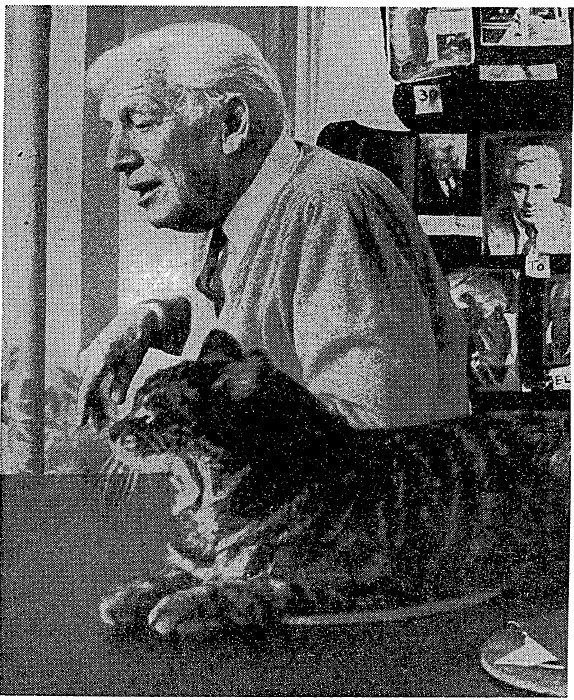
The article closes with a photo from
The New York Times (by Michael Evans)
Max Eastman, with his tabby Twiggy, during the interview at his home on West 13th Street.
>