Here are a pair of stories from the New York Herald in 1874, on "The Communists" and their meetings. The stories are typical examples of mainstream journalism reporting on radical movements in the wake of the United States' first great Red Scare -- the reaction to the Red uprisings in France in 1871 and the proclamation of the Paris Commune. Although the communards had been conquered, massacred and exiled by the Versailles government years before in 1871, the economic depression following the Panic of 1873, and an upsurge in worker protests and labor organizing, left many mainstream papers panicked about the prospects for conspiracy and insurgency in the United States.
Many thanks to Jesse Walker for pointing me to this issue of the Herald.
These stories appeared on Sunday, January 18, 1874. First, on p. 6, the column advertising "To-Day's Contents of the Herald" includes the following item:
THE COMMUNIST SNAKE "SCOTCHED" NOT KILLED: AN ALARMING PRONOUNCEMENT! THEY "WILL HAVE BREAD!" -- Tenth Page.
More on that in a minute. But first, in another column on p. 6:
The Communists of New York--Their Secret Meetings and Movements.
That there exists in the city of New York a disturbing element known as the "Communists" was demonstrated on Tuesday last in Tompkins square, and again last night in Cosmopolitan Hall. Although frustrated in Tuesday's open attempt to defy the lawful authorities which forbade their assembling, or at least their parading the streets in procession, there is no knowing at what hour or by what preconcerted and secret action they may commit some overt act and cause widespread consternation among the community.
These dangerous conspirators against society are not confined to New York nor to Paris; they are spread the world over. They declare, as one of the prisoners arrested on Tuesday last did, that the red flag is their only flag; that they spit upon all other flags; that they demand equal rights in all things, the equalization of property, the apportionment of "good things," and "free love," as it is commonly known, in its broadest sense. They have no religion and no respect for person or station. In New York the body is controlled in a mysterious manner by an unseen so-called "Committee of Safety," only a few of whom have appeared upon the surface. The movements of this committee are as secret and mystical as those of any known secret organization. Their leaders attempt to cover their own peculiar objects and schemes by advocating--nay, "demanding"--the employment of laborers upon the public works. These laborers, it is known, are mostly Irish Catholics, and if by their demands they succeed in securing employment for this class of people they take all the credit therefor, and hope thereby to win the Catholic laboring element to their side and obtain their assistance in their machinations. In these ridiculous demands, however, they have thus far failed. And when the Irish Catholic laborers are made to realize the hideous conduct of these Communists during their reign of carnage and terror in Paris, when the highest prelate in their Church in that unfortunate metropolis--the beloved Archbishop Darboy--together with other venerated and venerable magnates of the Church, was savagely butchered by these frenzied semi-barbarians, and the sacred shrines of their churches ruthlessly robbed of their precious jewels and treasures, they shun, as they would a pestilence, all affiliation with these foes of Christianity and civilization as well as of law and order. Evidence of this may be gleaned from the fact that of the large number of arrests at Tompkins square on Tuesday not a single Irish Catholic was found among the number. And another significant fact may be mentioned here--that of all those arrested, with only two or three exceptions, none were either native born or adopted citizens or foreigners who had declared their intentions of becoming citizens; in short, the great majority were men who recognized only the "red flag" as the flag of their nationality, and who "spat upon all others." The Communists attempt to cajole the German laborers in the same way they have the Irish; but they to almost as great an extent have failed with them as with the Irish. It is even intimated that the Communists have threatened to burn schoolhouses in order to give employment in their reconstruction to both Irish and German laborers.
It may be asked, where does all the money come from to support the extraordinary operations of these men--men who work like machines, or as an engineer moves his locomotive, with people's passions for tramways? They must have money, though professedly poor and starving, for if allowed to appear in procession they are ready to make a gorgeous display of banners and legends, of regalia, gold shields and other paraphenalia that must have cost thousands of dollars. At their meetings, which are seldom held twice in the same place or at the same hour when the places are changed, they have a free lunch at which many a poor fellow, out of work and out of money, is glad to get the wherewith to appease the pangs of hunger. These cost money, and it is the best possible way for them to spend it. The leaders--the engineers of the "Committee of Safety"--do not seem to be very impecunious, one of them (if not of this, of some other similar, if not so radical an organization) exhibiting in his shirt bosom on a certain occasion a thousand dollar breastpin while shrieking for "bread or blood." The money to support all these things, we say, must come from some source, or may it not be here already? May not the booty of the plundered churches of Paris be now furnishing the material aid to carry on these nefarious projects--projects so menacing to the peace and safety of this whole community? It is known, as has been before intimated in this paper, that large amounts of precious stones, without setting, and concealed in balls of wax, together with numerous other treasures, the spoils of the Paris churches we refer to, were secretly conveyed to this country during the temporary but sanguinary régime of the Communists in Paris. Hence is it not reasonable to suppose that the product of these treasures of the sanctuaries is employed in the work of these incendiaries, conspirators and revolutionists?
We do not think that there is any immediate cause for serious alarm in regard to the operations of these desperate people; but it manifestly behooves the authorities to take such steps as will prevent their obtaining the upper hand in any single demonstrative movement they may undertake.
On the first column p. 10, the Herald carries its second story:
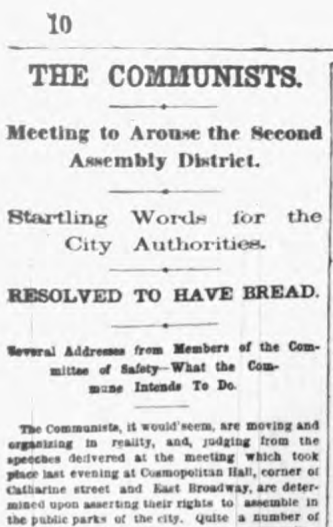
> THE COMMUNISTS.
> Meeting to Arouse the Second Assembly District.
> Startling Words for the City Authorities
> RESOLVED TO HAVE BREAD.
> Several Addresses from Members of the Committee of Safety--What the Commune Intends To Do.
>
>
The Communists, it would seem, are moving and organizing in reality, and, judging from the speeches delivered at the meeting which took place last evening at Cosmopolitan Hall, corner of Catharine street and East Broadway, are determined upon asserting their rights to assemble in the public parks of the city. Quite a number of the organization were present, representing almost every nationality. Applause was freely given whenever any of the speakers alluded to the Police Commissioners or the police as tyrants and despots.
Citizen Banks
>
was on hand at an early hour, and as each newcomer made his appearance he would immediately rise and grasp him by the hand, and at the same time whisper to him in a subdued tone information of a secret character. About eight o'clock there were about sixty or seventy present. Citizen Banks then stepped up to the table at the further end of the room and called the meeting to order. He proposed that Mr. Roger Burke be requested to act as chariman. The motion was seconded and carried, and
Mr. Burke mounted the rostrum.
>
All eyes were now turned upon Citizen Burke, and as he prepared to deliver his address of thanks a faint applause greeted his ears. As soon as order was restored Citizen Burke delivered himself of hte following speech:--
Citizen Burke's Speech
>
Gentlemen--I am thankful to you for having elected me to this position. It is not the first time that I have held similar positions among workingmen. I am sorry to state that last evening one of our meetings was broken up by the police, and several of those present were "pulled." I am happy to be able to announce to you that every district in the city is undergoing a thorough organization. This district, however, is more behind than any other, and we must endeavor to protect our organization here also. The police have endeavored again to infringe upon our rights, for to-day, hearing of our proposed meeting this evening, they were sent around to dissuade the workingmen from putting in an appearance. I understand that at this very moment policement in citizens' clothes are placed around the building to watch us, and that detectives are also in our very midst prepared to note down every word we may give utterance to. The Committee of Safety desire, for the purpose of perfecting our organization, that every one present this evening step forward and transcribe his name upon the roll. At this juncture onf of the audience requested information of the speaker as to whether or not the police of New York city had been empowered to amend the constitution of the United States so as to prevent the right of free speech. This remark was received with applause by the entire assemblage.
Having concluded his remarks, Citizen Burke then introduced
Citizen Elliott.
>
Citizen Elliott announced the fact that the German wards were already thoroughly organized and that the only thing which remained to secure a thorough and effective organization was the enrolment of the English speaking wards. The proper manner of procedure, the speaker stated, for those in sympathy with the movement now on foot to redeem the workingmen was to perfect district and ward organizations throughout the entire city, the same as is done previous to the holding of the political elections. Rumors had gone abroad that the Committee of Safety had determined to resign their trust, but such was not the case. The
Committee of Safety
>
would always remain in active existence. The members of that committee had pledged themselves to remain true to the principles which led to their organization. They would never relax their efforts, but would work night and day to promote the great cause of the workingmen. Not one of them sought any office, and they were all pledged never to accept any. The Committee of Safety have, moreover, determined to carry the cases of the men now in custody who were arrested for participation in the meeting on Tuesday last before the State courts, and no labor nor expense would be spared to free them from bondage. On last Tuesday the country at large had seen a most dastardly outrage perpetrated upon the rights of the workingmen.
Commissioner Duryee
>
had charged his police upon inoffensive workingmen like so many "bulldogs" (Voice in the audience--"Shame! Shame!") When a demonstration is made again let the workingmen go out in large numbers so that the police or military will not dare to resist them. (Loud applause. I request that those who are present here this evening will, before they depart, come forward and sign the roll so that we can form a good nucleus to perfect a solid organization in this ward.
Citizen Banks
>
was then introduced. During the interval between the organization of the meeting and the conclusion of the speech of Citizen Elliot the audience was considerably increased by the entry of quite a number of prominent Communists.
Citizen Banks immediately opened his remarks by alluding to the outrage committed by the police on last Tuesday. He then continued in the following strain:--To-night, again, it appears to me that an attempt is being made to intimidate us from holding our meetings as citizens and workingmen, and a second outrage is being perpetrated upon us. We are denied the right of even meeting in peace and quietness in this hall. Police guard all the entrances, and detectives have been placed in our midst to watch our every movement. This I consider even a greater outrage than the one which was perpetrated on Tuesday last; for they have even busied themselves in warning the workingmen to keep away, telling them that if we met there would be trouble. The committee, however, have met here in defiance of the police. We are not to be terrified. We are not to be coerced into giving up our rights as citizens. Outrages such as these leave men no other remedy than military action and to be prepared militarily, in order that we can meet whenever we desire to exchange opinions and prepare for action. At Tompkins square they prepared an anbuscade for us, and without a word of warning began an indiscriminate clubbing. Those who were endeavoring to run in order to escape laceration were clubbed unmercifully--one workingman being killed outright and another now lies at the point of death. The time has come and we
must now prepare for the worst.
>
We must resist as workingmen, and as such we must endeavor to put down all monopolies. Under the present laws which govern society how much better off are we than the former slaves in the South? (Voice in the audience--"They were well fed.") Yes, they were well fed, and they were cared for and provided with work, which we are denied. We are not even as fortunate as were the negroes. Talk about free America and the Stars and Stripes! Why, the Stars and Stripes are in disgrace. We must prepare to
fight those opposed to us.
>
We are tired of political demagogues. We have had enough of them. They talk about the Communists. The Communists are the only ones who look after the rights of the workingmen. (Loud applause.) Nowadays the workingman who dares to say a word draws down upon his head the anger of the press. The competitive system in existence makes all the trouble. We want the system of universal co-operation, and to this opinion we must all incline. The man who does not labor robs the man who does. He hires you for his good only and robs you of the profit which belongs to your labor. Independent action on the part of the workingmen is the only way we can gain our ends, and if we cannot meet pacifically we must organize militarily. We must have no sympathy for anybody but our families, and if the police will not allow us to meet quietly we must go armed to our meetings.
Other Speakers.
>
Citizen Samuels, of the Committee of Safety, then addressed the meeting, and was followed by Citizen Leander Thompson, chairman of the Committee of Safety, and Citizen McGuire. Subsequent to the speech of Citizen McGuire, Citizen Elliot offered and read the following resolutions, which were unanimously adopted:--
Resolutions.
>
Whereas we are passing through a great financial crisis which has thrown us suddenly out of employment; and whereas there is no destruction of the real wealth of the country, but speculation in gold, stocks and the people's lands, sanctioned by the government, has been the sole cause of the panic; and whereas we are industrious, law-abiding citizens, who wish to avoid all outrage on person or property, and deprecate violence or injustice in any form; and whereas we desire only the means of obtaining the necessities of life, not as objects of charity, but as law-abiding citizens, whose right it is to demand work of the government which we have always protected and supported; therefore, we are
Resolved. That we will not eat the bread of idleness nor starve in the midst of plenty; but that we demand work, and pay for that work, now and without delay.
Resolved. That we demand the rigid enforcement of the eight-hour system on all private as well as public work, and the instant and entire abolition of the whole government contract system.
Resolved. That if the government will not furnish work for the unemployed, we, through our Committee of Safety, will in this our time of need supply ourselves and our families with proper food, shelter and clothing and will send all our bills for the same to the City Treasury to be liquidated, until such times as we shall obtain work and pay.
Resolved. That we demand an immediate and permanent reduction of twenty-five per cent on all house rents until the 1st of May to the unemployed of all classes.
Resolved. That, in the furtherance of the objects set down in the above resolutions, we will enroll our names and organize, not in the interest of any political party, but in the interest of all the people who are suffering from the present condition of affairs.
Resolved. That we will appoint from this mass meeting a committee of twelve workingmen, residents of the ward, to organize the working classes of the ward and co-operate with the German ward organizations.
Resolved. That we will support and sustain the Committee of Safety in its work of securing the above objects.
Adjourned.
>
After a somewhat lengthy address from Mr. McMicken, of the Committee of Safety, the meeting adjourned. Those who had not already signed the roll of membership were then again invited to do so. Some fears had been entertained that when the meeting was over some altercation, if not a serious disturbance, might occur between the police and the men who had attended the meeting, but nothing took place that could in any way be considered reprehensible. The men quietly dispersed to their homes, without even hovering around the building.
A little further down p. 10, in the column on court reports, there is the following report from the Court of Special Sessions:
Court of Special Sessions.
>
The Tompkins Square Rioters.
>
Before Judges Kilbreth, Flammer and Kasmire.
Benjamin Sugden, Peter Ackerman, Charles Green, Lorenzo Solestro, Jacob Eickhoff, Herman Zizachefsky, Thomas McGraw, Terence Donnelly, James Donohue and Joseph Hoefflicher were arraigned at the bar of Special Sessions yesterday, charged with assault and battery on several different officers and with aiding and inciting riot.
They were arrested last Tuesday, in and near Tompkins square, at the time of the workingmen's demonstration, and have been locked up in Essex Market Prison ever since. Counsellor Theodore E. Tomlinson appeared for all of them except Hoefflicher and demanded for his clients a trial by jury. Their cases were, therefore, sent to the Court of General Sessions. Counsellor Price appeared for Hoefflicher and asked that his case might be tried in the Court of Special Sessions. The trial was set down by the presiding magistrate for next Tuesday, when all the witnesses are expected to be present. The prisoners were then removed to the Tombs prison and are at present confined on the fourth tier of that institution. Some of them are accused of felonious assault and battery, while others have no complaint against them except meting and talking wildly in the streets.
Sources